
HSE-223 · Lesson 6 of 12 · 31 min
HAZOP: nodes, guidewords and deviations
The hazard and operability study, or HAZOP, was developed at Imperial Chemical Industries in the United Kingdom in the 1960s and has become the most widely used process hazard analysis method in the world. It is described in IEC 61882:2016, Hazard and operability studies (HAZOP studies): application guide, and in the CCPS Guidelines for Hazard Evaluation Procedures. HSE-103 mentioned HAZOP in passing. This lesson explains how it works in enough detail for you to take part as a team member, read a HAZOP report critically and recognize a poor study. Leading a HAZOP requires facilitator training and experience beyond this course.
The idea behind HAZOP is simple. A process is designed to work within certain intentions: a flow of so much liquid, at such a pressure and temperature, in this direction. Hazards and operating problems arise when the process deviates from those intentions. HAZOP finds deviations systematically by combining guidewords, such as no, more and less, with process parameters, such as flow, pressure and temperature, for each part of the design. The team then asks what could cause each deviation, what the consequences would be and whether the safeguards are adequate.
Nodes and design intent
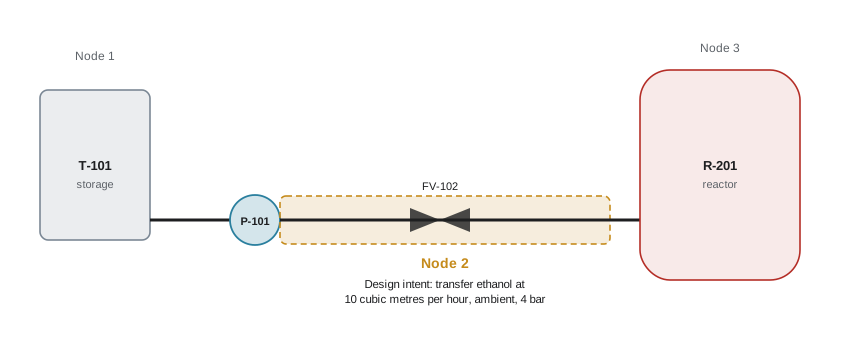
A HAZOP divides the process into nodes: sections of the piping and instrumentation diagrams (P&IDs) with a clear design intent, such as "transfer ethanol from storage tank T-101 to reactor R-201 at 10 cubic meters per hour and ambient temperature" or "maintain reactor R-201 at 80 °C and 3 bar during reaction". Choosing nodes is a skill. Nodes that are too large make the discussion vague; nodes that are too small make the study long and repetitive. Typical nodes are a line between two major items, a vessel with its connections, or a heat exchanger.
The design intent must be written down for each node before deviations are discussed. It should state the function, the parameters and their normal ranges, and the materials. Without a clear intent, the team cannot tell what a deviation is. Operating modes matter too: a node may have different intentions during start-up, normal running, shutdown and cleaning, and a thorough HAZOP considers each mode or holds a separate procedural HAZOP for batch and non-routine operations.
Guidewords and parameters
The standard HAZOP guidewords, from IEC 61882, are: no or not (complete negation of the intent), more (quantitative increase), less (quantitative decrease), as well as (qualitative increase, such as contamination), part of (qualitative decrease, such as a missing component), reverse (logical opposite, such as reverse flow) and other than (complete substitution, such as the wrong material). Additional guidewords for time and sequence include early, late, before and after. Combined with parameters such as flow, pressure, temperature, level, composition, reaction, phase and time, they give the deviations.
| Guideword | Meaning | Example deviation |
|---|---|---|
| No or not | Complete negation of the intent | No flow |
| More | Quantitative increase | More pressure, more temperature |
| Less | Quantitative decrease | Less flow, less level |
| As well as | Qualitative increase | Water as well as ethanol (contamination) |
| Part of | Qualitative decrease | Part of the catalyst missing |
| Reverse | Logical opposite | Reverse flow from reactor to tank |
| Other than | Complete substitution | Methanol delivered instead of ethanol |
| Early, late, before, after | Timing or sequence | Step done before the vessel is purged |
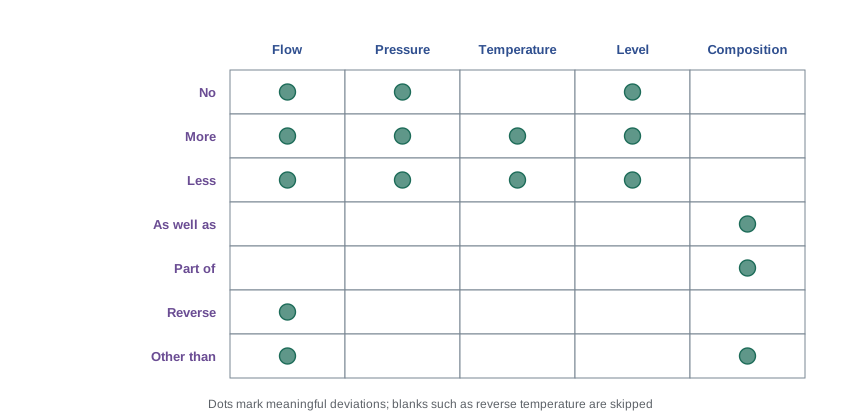
Not every combination makes sense. "Reverse temperature" means nothing, while "reverse flow" is one of the most important deviations in many processes. Experienced facilitators use a pre-agreed list of meaningful deviations for each type of node, such as lines, vessels and heat exchangers, while still allowing the team to add others. A common deviation list for a line might include no flow, more flow, less flow, reverse flow, more pressure, less pressure, more temperature, less temperature, contamination and wrong material.
Working through a deviation
For each deviation, the team records five things on the HAZOP worksheet. Causes: what could produce the deviation within this node, such as a pump trip, a closed valve or a control failure. Consequences: what would happen, followed through to the ultimate outcome, assuming safeguards fail, which may be in another node. Safeguards: the existing measures that prevent the cause or reduce the consequence, such as alarms, trips, relief valves and procedures. Risk ranking, if the company uses a matrix. Recommendations: actions where safeguards are judged inadequate.
| Deviation | Cause | Consequence | Safeguards | Recommendation |
|---|---|---|---|---|
| No flow | Pump P-101 trips | Reactor starved; batch off specification; no safety impact | Low flow alarm FAL-102 | None |
| No flow | Control valve FV-102 fails closed while pump runs | Pump deadheads, overheats; seal failure; ethanol release and fire risk | None identified | Add pump low-flow trip or minimum flow recycle |
| Reverse flow | Pump stops while reactor at 3 bar | Reactor contents flow back to T-101; reaction in storage tank | Check valve CV-103 | Check valve alone may leak; add automatic isolation valve on low flow; test check valve |
| More pressure | Outlet block valve closed in error | Line overpressure above 10 bar design; rupture | Relief valve PSV-104 set at 10 bar | Confirm PSV sizing for pump shut-off head |
Worked problem
Following a consequence across nodes
In node 2, the deviation is "more temperature" caused by steam leaking into the ethanol line through a failed heat exchanger tube upstream. The ethanol enters the reactor hotter than the 25 °C intended. The reactor's reaction is exothermic and normally starts at 60 °C with cooling. Follow the consequence to its ultimate outcome.
Show solution
- Hot ethanol enters the reactor: the reactor starts above its intended initial temperature.
- The exothermic reaction starts earlier and faster than the cooling system is designed for.
- Temperature and pressure rise; ethanol, with a boiling point of about 78 °C, may vaporize.
- Ultimate consequence: possible runaway reaction, reactor overpressure, relief to atmosphere or rupture, release of flammable vapor and fire.
- Safeguards to check: reactor temperature alarm and trip, relief sizing for runaway, and detection of tube leaks.
Answer: Runaway reaction with overpressure and flammable release; check reactor trips, relief sizing and tube leak detection.
The HAZOP team and session
A HAZOP team is typically four to eight people: a trained facilitator independent of the design team, a scribe, a process engineer, an instrument or control engineer, an operations representative who will run the plant, and maintenance or mechanical engineering, with specialists such as chemists brought in as needed. The PSM standard requires at least one team member experienced in the process and one knowledgeable in the method. Sessions are usually limited to about six hours a day because concentration drops, and a medium-sized unit can take several weeks.
Preparation is critical. The team needs up-to-date P&IDs, process flow diagrams, material safety data, operating procedures, design basis documents, relief system data and incident history. A HAZOP on drawings that do not match the plant is wasted. For existing plants, a site walk-through before the sessions helps the team see the real layout and any field modifications.
Worked problem
Estimating HAZOP duration
A unit has 24 nodes. Experience shows each node takes about 1.5 hours on average, with an extra 20 percent for introductions, reviews and breaks. Sessions run 6 hours a day, 4 days a week. How many days and weeks will the study take?
Show solution
- Node time: \( 24 \times 1.5 = 36 \) hours.
- With 20 percent extra: \( 36 \times 1.2 = 43.2 \) hours.
- Days: \( 43.2 \div 6 = 7.2 \), so 8 session days.
- Weeks: \( 8 \div 4 = 2 \) weeks.
Answer: About 8 session days, or 2 weeks at 4 days a week.
Quality of a HAZOP
Signs of a good HAZOP include clear design intents for each node, consequences followed through to the ultimate outcome, safeguards judged critically rather than simply listed, recommendations that are specific and assigned, and attention to non-normal modes such as start-up and maintenance. Signs of a poor one include "no consequence" entered for many deviations without explanation, safeguards listed that are not independent of the cause (a control loop that fails cannot also be its own safeguard), consequences that stop at the node boundary, and recommendations such as "review procedure".
HAZOP has limits. It is time-consuming and depends on good drawings. It considers single deviations, so combinations of failures and common causes may be missed. It is weaker at identifying hazards that do not come from process deviations, such as dropped objects or occupational hazards. And it identifies but does not quantify: for scenarios with severe consequences, the HAZOP often hands over to LOPA to check whether the safeguards are enough. Variants exist for other systems, including computer HAZOP (CHAZOP) for control systems and procedural HAZOP for batch and manual operations.
In the US, HAZOP is one of the PHA methods named in OSHA 1910.119(e) and EPA RMP 40 CFR 68.67, and is by far the most common for refineries and chemical plants. The PHA must be revalidated at least every five years, and many facilities use a revalidation HAZOP that focuses on changes and incidents since the last study.
Worked problem
Spotting a safeguard that is not independent
In a HAZOP, the deviation "more level" in a tank is caused by failure of the level control loop LIC-201, which controls the inlet valve. The team lists the safeguard as "high level alarm LAH-201 on the same transmitter". Is this adequate?
Show solution
- If the transmitter LT-201 fails low, it reads a low level while the tank fills. The controller opens the inlet valve further.
- The alarm uses the same transmitter, so it also reads low and does not sound.
- The safeguard fails from the same cause as the deviation: it is not independent.
- Recommendation: add an independent high level switch or transmitter with its own alarm or trip, as in API 2350 guidance after Buncefield.
Answer: No; the alarm shares the failed transmitter. An independent high level device is needed.
Recording and reporting a HAZOP
A HAZOP report usually contains the terms of reference, the team list and attendance, the drawings and documents reviewed with their revision numbers, the node list with design intents, the full worksheets, the list of recommendations with owners, and a statement of the study's limits. Recording styles vary: full recording records every deviation discussed, including those with no credible cause, while recording by exception records only deviations with credible causes and consequences. Full recording takes longer but provides better evidence that each deviation was considered, which matters at revalidation and in regulatory audits.
Recommendations are typically classed by priority and sent to a responsible engineer for resolution. Each resolution should explain what was done, or why an alternative was chosen, and be checked by someone with HAZOP knowledge. Under process safety rules, the date of resolution and communication to affected workers must be documented.
Worked problem
Recommendation backlog
A HAZOP of 24 nodes produced 96 recommendations: 12 high priority, 36 medium and 48 low. The site's policy is to resolve high priority items within 3 months, medium within 12 months and low before the next revalidation. After 3 months, 10 high, 8 medium and 4 low items are resolved. What share of high priority items is overdue, and what should happen?
Show solution
- High priority overdue: \( 12 - 10 = 2 \), or \( 2 \div 12 \approx 17 \% \).
- The 2 overdue items need escalation to the plant manager with interim risk controls and a firm new date.
- Medium and low items are on schedule; track them monthly.
Answer: About 17 percent of high priority items are overdue and must be escalated with interim controls.
Common mistakes
MistakeStarting deviations without a written design intent.
InsteadWrite the intent, parameters and ranges for each node first.
MistakeStopping the consequence at the node boundary.
InsteadFollow consequences to the ultimate outcome, even in other nodes.
MistakeListing a safeguard that shares the cause of the deviation.
InsteadCredit only safeguards independent of the cause.
MistakeHolding a HAZOP on out-of-date drawings.
InsteadVerify drawings against the field before the sessions.
MistakeWriting recommendations such as "review procedure".
InsteadWrite specific, assigned actions with dates.
Summary and key terms
- HAZOP finds deviations from design intent by combining guidewords with process parameters.
- Nodes are sections of the P&IDs, each with a written design intent and operating modes.
- IEC 61882 guidewords: no, more, less, as well as, part of, reverse, other than, plus timing words.
- For each deviation, record causes, consequences, safeguards, risk and recommendations.
- Teams need a trained independent facilitator, scribe and people from operations and engineering.
- Good HAZOPs follow consequences fully and credit only independent safeguards.
- HAZOP identifies but does not quantify; severe scenarios often go on to LOPA.
- HAZOP
- Hazard and operability study, a systematic method using guidewords to find deviations.
- Node
- A section of a process with a defined design intent.
- Design intent
- What a node is meant to do, with its parameters and ranges.
- Guideword
- A word such as no, more or reverse used to prompt deviations.
- Parameter
- A process property such as flow, pressure or temperature.
- Deviation
- A departure from the design intent, formed by a guideword and a parameter.
- Independent safeguard
- A safeguard that does not share a cause or component with the initiating event.
- IEC 61882
- The international standard for HAZOP studies.
- CHAZOP
- A HAZOP adapted for control and computer systems.
- Procedural HAZOP
- A HAZOP applied to the steps of a procedure or batch operation.
Practice problems
Work each problem on paper first, then reveal the answer to check.
Where and when was HAZOP developed?
Show answer
At ICI in the United Kingdom in the 1960s.
What must be written down for each node before deviations are discussed?
Show answer
The design intent with parameters and ranges.
Combine the guideword "reverse" with a parameter to form a meaningful deviation.
Show answer
Reverse flow.
What does "as well as" mean?
Show answer
A qualitative increase, such as contamination.
List the five columns of a HAZOP worksheet.
Show answer
Deviation (with cause), consequence, safeguards, risk ranking, recommendations.
Why must safeguards be independent of the cause?
Show answer
A safeguard that shares the cause fails at the same time.
A unit has 30 nodes at 1.2 hours each plus 25 percent extra. How many hours?
Show answer
45 hours.
Give two signs of a poor HAZOP.
Show answer
Unexplained "no consequence" entries; non-independent safeguards; vague recommendations.
What is a limitation of HAZOP?
Show answer
It considers single deviations and does not quantify risk.
Which standard describes HAZOP studies?
Show answer
IEC 61882.
Lesson quiz · 5 questions
Score 60% or more to complete this lesson.
Create a free account to save your progress, take quizzes and earn a certificate.