
HSE-223 · Lesson 10 of 12 · 28 min
LOPA and safety integrity levels
Layer of protection analysis (LOPA) sits between the qualitative methods, such as HAZOP and what-if, and full quantitative risk assessment. It takes one scenario at a time, usually from a HAZOP, and asks a precise question: is the frequency of this consequence, after counting the independent protection layers, low enough to meet the company's risk criteria? If not, how much more risk reduction is needed? The method was developed in the 1990s and is described in the CCPS books Layer of Protection Analysis: Simplified Process Risk Assessment (2001) and Guidelines for Initiating Events and Independent Protection Layers (2015). It is also one of the methods in IEC 61511 for determining the safety integrity level (SIL) required of a safety instrumented function.
This lesson is an awareness-level introduction. It will help you take part in a LOPA, check the arithmetic and understand what a SIL means. Designing safety instrumented systems, verifying SIL and signing off LOPA studies require specialist training and competence assessment under IEC 61511, and in some jurisdictions professional engineering licensure.
The LOPA scenario
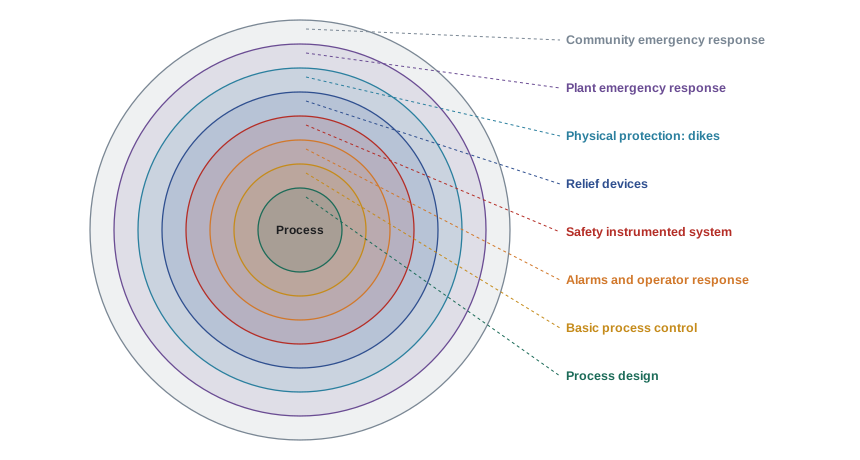
A LOPA scenario is a single cause-consequence pair: one initiating event leading to one consequence, such as "cooling water pump fails, leading to reactor runaway and rupture with potential fatalities". Each scenario is analyzed separately. The steps are: define the consequence and its severity; select the target frequency from the company's criteria; estimate the initiating event frequency; identify the conditional modifiers, such as the probability that a person is present or that a release ignites; identify the independent protection layers (IPLs) and their probability of failure on demand (PFD); and calculate the mitigated event frequency.
LOPA works in orders of magnitude. Initiating frequencies and PFDs are usually rounded to powers of ten, such as 0.1 per year or a PFD of 0.01. This is deliberately conservative and simple; LOPA is meant to be quick and consistent, not precise.
Initiating events
Initiating event frequencies come from company data, industry tables in the CCPS guidelines, or failure databases. Typical values used in many companies are: basic process control system loop failure, 0.1 per year; pump seal failure, 0.1 per year; human error in a routine task done about once a month, 0.1 per year (roughly 12 opportunities a year at about 0.01 errors per opportunity for a well-trained task, rounded); large external fire, 0.01 per year; and full-bore pipe rupture, 0.00001 per meter per year for some pipe sizes. Companies should publish an approved table so that teams use consistent values.
| Initiating event | Typical frequency (per year) | Note |
|---|---|---|
| Basic process control system loop failure | \( 10^{-1} \) | IEC 61511 limits credit for BPCS to no better than this |
| Pump or compressor seal failure | \( 10^{-1} \) | Depends on seal type |
| Operator error, task performed monthly | \( 10^{-1} \) | Assumes about 0.01 error per opportunity, with margin |
| Loss of cooling water | \( 10^{-1} \) | Use site data if available |
| Safety valve opens spuriously | \( 10^{-2} \) | |
| Large external fire | \( 10^{-2} \) | Depends on site |
Independent protection layers
An IPL is a device, system or action that can prevent the scenario from reaching the consequence, regardless of the initiating event or any other protection layer. To be credited, an IPL must be effective (able to prevent the consequence if it works, fast enough and sized correctly), independent (of the initiating event and of every other IPL credited in the scenario) and auditable (its performance can be validated through testing and records). Some guidance adds that it must be specific to the scenario and reliable. Many things that seem protective fail these tests: training and procedures, by themselves, are not IPLs; a control loop cannot be both the initiating event and an IPL; and a pressure alarm on the same transmitter as the failed control is not independent.
| Protection layer | Typical PFD | Conditions for credit |
|---|---|---|
| BPCS control loop (not the initiating loop) | \( 10^{-1} \) | Independent of the initiating event; no better than 0.1 under IEC 61511 |
| Operator response to alarm | \( 10^{-1} \) | Alarm independent; at least 10 to 20 minutes to respond; trained, clear action |
| Relief valve | \( 10^{-2} \) | Sized for the scenario; inspected and tested; discharge to a safe place |
| Safety instrumented function, SIL 1 | \( 10^{-1} \) to \( 10^{-2} \) | Designed and verified to IEC 61511 |
| Safety instrumented function, SIL 2 | \( 10^{-2} \) to \( 10^{-3} \) | Designed and verified to IEC 61511 |
| Dike or bund | \( 10^{-2} \) | For consequences limited by containment |
Worked problem
A complete LOPA calculation
Scenario: the level control loop on a hexane storage tank fails (initiating frequency 0.1 per year), the tank overfills, and hexane spills into the dike. The consequence of concern is a fire with a potential fatality. Conditional modifiers: probability of ignition 0.1, probability a person is present 0.5. Protection: independent high level alarm with operator response (PFD 0.1); dike (credited as reducing the consequence to a pool fire within the dike, so not credited against the fatal outcome here). The company's target for a single fatality is \( 10^{-5} \) per year. Is the risk tolerable, and how much more reduction is needed?
Show solution
- Initiating: \( 0.1 \) per year.
- Conditional modifiers: \( 0.1 \times 0.5 = 0.05 \).
- IPLs: operator response, \( 0.1 \).
- Mitigated frequency: \( 0.1 \times 0.05 \times 0.1 = 5 \times 10^{-4} \) per year.
- Gap: \( 5 \times 10^{-4} \div 10^{-5} = 50 \). Another protection layer with a PFD of 0.02 or better is needed, which points to a safety instrumented function of SIL 1 (a risk reduction factor of 50 falls in the SIL 1 range of 10 to 100).
Answer: Mitigated frequency \( 5 \times 10^{-4} \) per year; a risk reduction factor of about 50 is needed, such as a SIL 1 high level trip.
Safety integrity levels
A safety instrumented function (SIF) is a function carried out by a safety instrumented system, made of sensors, a logic solver and final elements such as valves, that takes the process to a safe state when a dangerous condition is detected. IEC 61508 (for manufacturers and general systems) and IEC 61511 (for the process industry) define four safety integrity levels for functions operating in low-demand mode, based on the average probability of failure on demand (PFDavg). Each level is a factor of ten better than the last. The risk reduction factor (RRF) is the reciprocal of the PFD.
| SIL | PFDavg (low demand) | Risk reduction factor |
|---|---|---|
| SIL 1 | \( 10^{-2} \) to less than \( 10^{-1} \) | More than 10 to 100 |
| SIL 2 | \( 10^{-3} \) to less than \( 10^{-2} \) | More than 100 to 1,000 |
| SIL 3 | \( 10^{-4} \) to less than \( 10^{-3} \) | More than 1,000 to 10,000 |
| SIL 4 | \( 10^{-5} \) to less than \( 10^{-4} \) | More than 10,000 to 100,000 |
A SIL is a property of a function, not of a device. Saying "this transmitter is SIL 2" really means the transmitter is suitable for use in a SIL 2 function under certain conditions. Achieving a SIL requires the whole function to meet the PFD target through its architecture, component reliability, proof test interval and coverage, plus requirements for hardware fault tolerance, systematic capability and a full lifecycle of specification, design, verification, validation, operation, maintenance and management of change. If an analysis says a SIL 3 or higher function is needed, most companies treat that as a signal to redesign the process to reduce the hazard rather than rely on one very reliable function.
Worked problem
Effect of the proof test interval
For a simple single-channel SIF, an approximate formula is \( \text{PFD}_{\text{avg}} \approx \lambda_{DU} \times T / 2 \), where \( \lambda_{DU} \) is the dangerous undetected failure rate and \( T \) is the proof test interval. A function has \( \lambda_{DU} = 2 \times 10^{-6} \) per hour. Calculate the PFDavg and SIL range for proof test intervals of 1 year (8,760 h) and 4 years.
Show solution
- 1 year: \( 2 \times 10^{-6} \times 8{,}760 \div 2 \approx 8.8 \times 10^{-3} \). This is between \( 10^{-3} \) and \( 10^{-2} \): SIL 2 range.
- 4 years: \( 2 \times 10^{-6} \times 35{,}040 \div 2 \approx 3.5 \times 10^{-2} \). This is between \( 10^{-2} \) and \( 10^{-1} \): SIL 1 range.
- Testing less often reduces the integrity by a whole level. Proof testing is part of the SIL, not an optional extra.
Answer: Yearly testing: about \( 8.8 \times 10^{-3} \), SIL 2 range. Four-yearly: about \( 3.5 \times 10^{-2} \), SIL 1 range.
LOPA pitfalls
LOPA is easy to misuse. Teams sometimes credit IPLs that are not independent, such as an operator response to an alarm generated by the same failed control system. They use initiating frequencies that are too optimistic, or round PFDs downward. They forget conditional modifiers in one scenario and stack them unrealistically in another, such as multiplying occupancy, ignition, fatality and weather probabilities until a high-risk scenario looks negligible. Many companies limit the total credit for conditional modifiers and require approval for any scenario that relies on them for more than one order of magnitude. Finally, LOPA assumes IPLs are maintained and tested; credited layers that are bypassed or overdue for testing provide no protection.
Worked problem
Over-crediting conditional modifiers
A team calculates a mitigated frequency as: initiating 0.1 per year, ignition 0.1, occupancy 0.1, probability of fatality 0.5, wind direction toward people 0.25, operator response 0.1. What is the mitigated frequency, and what concern should a reviewer raise?
Show solution
- Conditional modifiers together: \( 0.1 \times 0.1 \times 0.5 \times 0.25 = 1.25 \times 10^{-3} \).
- Mitigated: \( 0.1 \times 1.25 \times 10^{-3} \times 0.1 = 1.25 \times 10^{-5} \) per year.
- Almost three orders of magnitude of credit come from conditional modifiers, not from protection layers. Each is uncertain and some may be correlated (people may be present precisely when an operator is working on the equipment that fails).
- The reviewer should challenge each value, ask for justification, and check whether the company limits modifier credit.
Answer: About \( 1.3 \times 10^{-5} \) per year, but heavily dependent on stacked conditional modifiers that need justification.
In the US, IEC 61511 is adopted as ANSI/ISA 61511, and OSHA has recognized it as a recognized and generally accepted good engineering practice (RAGAGEP) under PSM. LOPA is widely used in PSM and RMP programs to decide whether safeguards identified in a PHA are sufficient.
Recording a LOPA
A LOPA worksheet records, for each scenario, the consequence and its severity category, the target frequency, the initiating event and its frequency with the source of the value, each conditional modifier with its justification, each IPL with its PFD and the reason it qualifies, the mitigated frequency, the gap and the recommendation. Clear records allow a reviewer to check every number and are essential at revalidation, when someone will ask why a particular layer was credited.
Common mistakes
MistakeCrediting an alarm on the same transmitter as the failed control loop.
InsteadCredit only IPLs independent of the initiating event and of each other.
MistakeListing training or procedures as IPLs.
InsteadTreat them as supporting measures unless they form a complete, independent, auditable response.
MistakeStacking conditional modifiers until the scenario disappears.
InsteadJustify each modifier and respect company limits on modifier credit.
MistakeCalling a device SIL 2 by itself.
InsteadRemember a SIL belongs to the whole function, including testing.
MistakeExtending proof test intervals without recalculating.
InsteadRecalculate PFDavg when test intervals change.
Summary and key terms
- LOPA analyzes one cause-consequence scenario at a time using orders of magnitude.
- Mitigated frequency equals initiating frequency times conditional modifiers times IPL PFDs.
- An IPL must be effective, independent and auditable.
- The gap between mitigated frequency and target sets the extra risk reduction needed.
- SIL 1 to SIL 4 correspond to PFDavg bands, each ten times better than the last.
- A SIL belongs to a whole function and depends on design, testing and lifecycle management.
- Watch for non-independent IPLs, optimistic data and stacked conditional modifiers.
- LOPA
- Layer of protection analysis, a semi-quantitative method for single scenarios.
- Independent protection layer
- A safeguard that is effective, independent and auditable.
- Initiating event
- The cause that starts a LOPA scenario.
- Conditional modifier
- A probability such as ignition or occupancy applied to a scenario.
- PFD
- Probability of failure on demand.
- Mitigated event frequency
- The frequency of the consequence after protection layers.
- Safety instrumented function
- A function that brings a process to a safe state on detecting danger.
- Safety integrity level
- A band of PFDavg for a safety instrumented function, from SIL 1 to SIL 4.
- Risk reduction factor
- The reciprocal of the PFD.
- Proof test
- A test to reveal dangerous undetected failures in a safety function.
Practice problems
Work each problem on paper first, then reveal the answer to check.
How many scenarios does a LOPA analyze at once?
Show answer
One cause-consequence pair.
What are the three core requirements for an IPL?
Show answer
Effective, independent and auditable.
Initiating 0.1 per year, one IPL at 0.01. What is the mitigated frequency?
Show answer
0.001 per year.
What is the RRF for a PFD of 0.005?
Show answer
200.
Which SIL range has an RRF of 200?
Show answer
SIL 2.
Why can the BPCS loop that failed not be credited as an IPL?
Show answer
It is the initiating event, so it is not independent.
What is the gap if the mitigated frequency is 1e-3 and the target is 1e-5?
Show answer
A factor of 100.
What happens to PFDavg if the proof test interval doubles?
Show answer
It roughly doubles.
What do many companies do if a SIL 3 function is needed?
Show answer
Look for ways to redesign the process to reduce the hazard.
Name the US adoption of IEC 61511.
Show answer
ANSI/ISA 61511.
Lesson quiz · 5 questions
Score 60% or more to complete this lesson.
Create a free account to save your progress, take quizzes and earn a certificate.