
HSE-223 · Lesson 2 of 12 · 29 min
Choosing a method: legal duties, standards and the technique toolbox
There are dozens of risk assessment techniques. IEC 31010:2019, the international companion to ISO 31000, describes more than forty, from brainstorming and checklists to Monte Carlo simulation and Bayesian networks. No organization uses them all, and choosing the wrong one wastes time or, worse, gives false confidence. A full quantitative risk assessment of an office photocopier is a waste of money; a quick checklist for a new chlorine unloading station is negligent. This lesson explains what the law and the main standards require, how to sort techniques into families, and how to match the method to the question being asked.
What the law requires
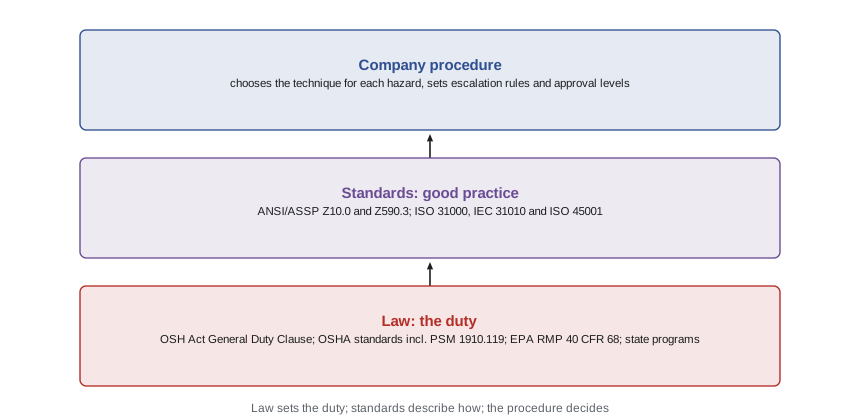
In the United States, OSHA does not have a general risk assessment standard. The General Duty Clause, section 5(a)(1) of the OSH Act, requires employers to protect workers from recognized serious hazards, and many standards require specific hazard assessments: 1910.132(d) for personal protective equipment, 1910.146 for confined spaces and 1910.147 for energy control procedures. Some states go further: California's Injury and Illness Prevention Program rule, Title 8 section 3203, requires employers to identify and evaluate workplace hazards, and Washington requires an Accident Prevention Program. Apart from process safety, the law does not name a technique; the employer chooses a method that suits the hazard.
Process safety: where methods are named
For facilities with highly hazardous chemicals above threshold quantities, OSHA's Process Safety Management standard, 1910.119, is explicit. Paragraph (e) requires a process hazard analysis (PHA) using one or more of these methods, as appropriate: what-if, checklist, what-if/checklist, hazard and operability study (HAZOP), failure mode and effects analysis (FMEA), fault tree analysis, or an appropriate equivalent. The PHA must be done by a team that includes someone experienced in the process and someone knowledgeable in the method, must be updated and revalidated at least every five years, and its recommendations must be resolved and documented. The EPA Risk Management Program rule, 40 CFR Part 68, requires similar hazard analysis for Program 3 processes. EPA's 2024 Safer Communities by Chemical Accident Prevention rule added requirements such as safer technology analysis and third-party audits; in February 2026 EPA proposed rolling back several of them, so check the current status.
The main standards
ANSI/ASSP Z10.0, the US OHS management system standard, requires a process to identify hazards and assess and prioritize risks. ANSI/ASSP Z590.3, Prevention through Design, focuses on assessing and reducing risk early, when facilities, equipment and processes are designed, and lists techniques such as preliminary hazard analysis, what-if, checklists, FMEA and fault trees. Internationally, ISO 45001 clause 6.1.2 requires organizations to identify hazards and assess OHS risks with a methodology that is proactive rather than reactive.
Two international standards apply everywhere. ISO 31000:2018 gives the overall risk management principles and process. IEC 31010:2019 is the technique catalog: for each method it describes the inputs, outputs, strengths and limitations, and it includes a table showing which techniques suit identification, analysis of consequences or likelihood, evaluation and recording. For process safety and instrumented systems, IEC 61511 (with IEC 61508 for manufacturers) adds LOPA and safety integrity levels, covered in Lesson 10.
Families of techniques
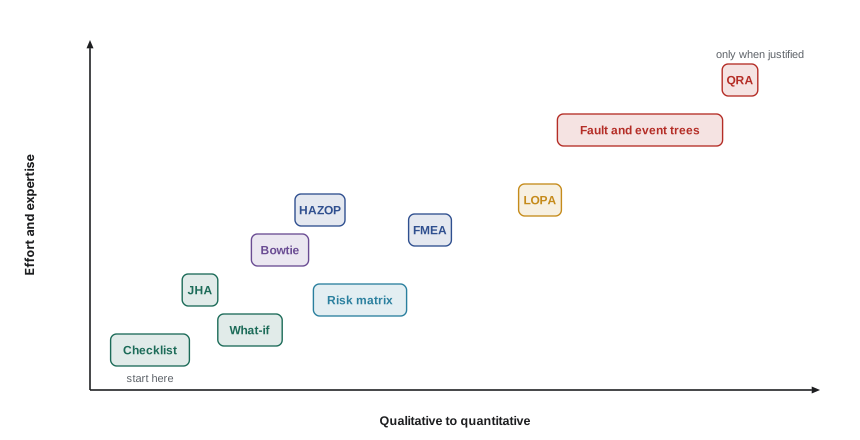
It helps to group methods into a few families. Qualitative methods describe risk in words or categories, such as high, medium and low. Semi-quantitative methods use numbers as scores or orders of magnitude, such as a 5 by 5 matrix or a LOPA that works in powers of ten. Quantitative methods estimate actual frequencies and consequences, such as individual risk of death per year or the number of people exposed to a toxic cloud. The more quantitative the method, the more data and expertise it needs, and the more its results can be misused if the inputs are weak.
| Method | Type | Best for | Main limitation |
|---|---|---|---|
| Checklist | Qualitative | Known hazards, routine designs, audits | Misses anything not on the list |
| What-if | Qualitative | Early design, small changes, procedures | Depends on the team's imagination |
| Job hazard analysis | Qualitative | Tasks and procedures | Weak on equipment failures |
| Risk matrix | Semi-quantitative | Ranking and screening many risks | Coarse; range compression and ties |
| HAZOP | Qualitative | Continuous and batch processes with P&IDs | Time-consuming; needs drawings |
| FMEA | Qualitative or semi-quantitative | Equipment, products, components | Single failures; misses combinations |
| Bowtie | Qualitative | Showing and managing barriers | Not a calculation on its own |
| Fault and event trees | Quantitative | Combinations of failures, outcomes | Needs failure data and skill |
| LOPA | Semi-quantitative | Sizing safeguards for scenarios | One scenario at a time |
| Quantitative risk assessment | Quantitative | Major hazard sites, land use | Expensive; uncertain inputs |
How to choose
IEC 31010 suggests several questions. What is the purpose: finding hazards, ranking them, sizing a safeguard or proving a risk meets a numerical target? What stage is the project at: concept, detailed design, operation or decommissioning? What information exists: a sketch, piping and instrumentation diagrams (P&IDs), procedures, failure data? How severe could the worst outcome be? What resources, time and expertise are available? And what does the regulator or the company standard require? The answers usually point clearly to one or two methods.
A practical rule is to start simple and escalate. A team screens the activity with a checklist or what-if review and a risk matrix. Most risks fall clearly into the acceptable or clearly-needs-action categories and can be handled there. A few high-consequence scenarios, especially those involving multiple failures or relying on instrumented safeguards, are passed to a more detailed method such as LOPA or a fault tree. Only the highest-consequence, most complex cases need a full quantitative risk assessment. This approach spends effort where it matters.
Worked problem
Matching the method to the job
A safety coordinator has four requests this month: (a) a new office layout with standing desks; (b) a change from manual to automated palletizing on a packaging line, with a robot cell and light curtains; (c) a new ammonia refrigeration system holding 4,500 kg of ammonia; (d) checking whether a high-pressure trip on an existing reactor is enough on its own. Suggest a method for each.
Show solution
- (a) Office layout: low hazard, well understood. A checklist with an ergonomics and housekeeping focus, plus a simple matrix if anything stands out.
- (b) Robot cell: machinery hazards and failure of safety devices. A what-if review and task-based JHA for operators and maintenance, with an FMEA or ISO 12100 risk assessment for the cell's safety functions.
- (c) Ammonia system: 4,500 kg is about 9,900 lb, just under the 10,000 lb threshold quantity for anhydrous ammonia under OSHA PSM and EPA RMP, so those rules may not apply by quantity alone. It is still a major hazard, and a small expansion would cross the threshold. A HAZOP on the P&IDs, with LOPA for the high-consequence scenarios, is good practice in both countries, and CSA B52 and the E2 Regulations also apply in Canada.
- (d) Single trip adequacy: a specific scenario with a numerical question. LOPA is designed for exactly this.
Answer: Checklist; what-if, JHA and machinery assessment; HAZOP with LOPA; LOPA.
Worked problem
Is the effort justified?
A HAZOP of a medium-sized process unit is estimated at 8 days for a team of 6 people at an average loaded cost of $900 per person-day, plus $6,000 for the facilitator and scribe. A what-if review would take 2 days with 5 people plus $2,000 for facilitation. The unit handles a flammable liquid and has a history of two loss-of-containment incidents. Compare the costs and recommend a method.
Show solution
- HAZOP: \( 8 \times 6 \times 900 = \$43{,}200 \), plus $6,000 = $49,200.
- What-if: \( 2 \times 5 \times 900 = \$9{,}000 \), plus $2,000 = $11,000.
- The HAZOP costs about 4.5 times more. But the unit is a flammable liquid process with real incident history, and HAZOP's systematic node-by-node approach is far more likely to find the deviations that caused those incidents.
- One serious fire could cost far more than $49,200 in damage, downtime and harm. The HAZOP is justified; the what-if could be used later for small changes.
Answer: HAZOP about $49,200 versus what-if about $11,000; the HAZOP is justified for this unit.
Combining methods
Most mature organizations use a set of methods that feed one another. A HAZOP identifies a deviation, such as high pressure in a vessel, with a severe consequence. The matrix ranks it as high. LOPA checks whether the existing safeguards reduce its frequency enough and, if not, sets the required integrity of a new safety instrumented function. A bowtie then shows the barriers on one page for operators and managers, and the critical barriers become the subject of inspections and audits. Lesson 12 returns to how these pieces fit into a management system.
It is equally important to know what each method does not do. A HAZOP does not rank risk unless a matrix is attached. An FMEA looks at one failure at a time. A bowtie does not calculate anything. A risk matrix does not identify hazards; it only ranks the ones you have already found. Good practice is to state in the report which methods were used, why, and what their limits are, so that readers do not take more assurance from the study than it can give.
Worked problem
Escalation in a screening study
A screening what-if review of a tank farm produces 40 scenarios. Using the company matrix, 26 are rated low, 10 medium and 4 high. The company procedure says low risks need no further action, medium risks need an action plan within the existing controls, and high risks with a consequence of fatality or major release must go to LOPA. Three of the four high risks have a potential fatality. How many scenarios go to LOPA, and what share of the total is that?
Show solution
- Only the high risks with a fatal or major release consequence are escalated: 3 scenarios.
- Share: \( 3 \div 40 = 7.5 \% \).
- The fourth high risk, without a fatal consequence, gets an action plan and is reviewed again after controls are improved.
Answer: 3 scenarios, 7.5 percent of the total, go to LOPA.
Proportionality in practice
Regulators in both countries expect the depth of an assessment to match the size of the risk. An inspector reviewing a small shop does not expect a fault tree, but will expect to see that hazards were identified with the workers, that the obvious controls are in place and that the assessment was reviewed after changes. An inspector or auditor at a major hazard facility will expect systematic methods, competent teams, documented recommendations and evidence that the critical safeguards are tested. A useful test is to ask whether a reasonable, informed person, reading the assessment after a serious incident, would agree that the effort matched the hazard.
Proportionality also applies within a single facility. A refinery may use HAZOP and LOPA for its process units, JHAs for maintenance tasks, checklists for office areas and a bowtie for each major accident hazard. Writing these choices into the company procedure, with the reasons, makes the approach consistent and defensible.
Common mistakes
MistakeUsing the same heavy method for every hazard.
InsteadMatch the method to the hazard, stage and decision; start simple and escalate.
MistakeAssuming the law names the method you must use.
InsteadMost OHS law sets a duty to assess; only process safety rules such as PSM list methods.
MistakeExpecting a risk matrix to find hazards.
InsteadUse identification methods such as checklists, what-if or HAZOP first, then rank.
MistakeReporting results without stating the method's limits.
InsteadState which methods were used, why, and what they cannot show.
MistakeRunning a detailed quantitative study on weak data.
InsteadUse quantitative methods only when data and expertise support them.
Summary and key terms
- Laws in both countries set a duty to identify and assess hazards; few name a technique.
- The General Duty Clause, specific OSHA standards, PSM 1910.119(e) and EPA RMP shape assessment in the US; Z10.0 and Z590.3 are the main standards.
- IEC 31010:2019 catalogs more than forty techniques with their strengths and limits.
- Methods range from qualitative to semi-quantitative to quantitative, with rising data and expertise needs.
- Choose by purpose, project stage, information, severity, resources and requirements.
- Screen simply, then escalate high-consequence scenarios to detailed methods.
- Methods work best in combination, and every report should state their limits.
- Process hazard analysis
- A systematic review of a process to identify and evaluate its hazards, required by PSM.
- IEC 31010
- The international standard describing risk assessment techniques.
- Qualitative method
- A method that describes risk in words or categories.
- Semi-quantitative method
- A method that uses scores or orders of magnitude.
- Quantitative method
- A method that estimates actual frequencies and consequences.
- P&ID
- Piping and instrumentation diagram showing process equipment, lines and controls.
- Screening
- A quick first assessment to sort risks before detailed study.
- Escalation
- Passing a scenario to a more detailed method because of its risk or complexity.
- Revalidation
- Formal review and update of a hazard analysis after a set period.
- Prevention through design
- Reducing risk by addressing hazards during design.
Practice problems
Work each problem on paper first, then reveal the answer to check.
Name the international standard that catalogs risk assessment techniques.
Show answer
IEC 31010:2019.
Which OSHA standard lists methods for process hazard analysis?
Show answer
1910.119(e), the Process Safety Management standard.
List the methods named for PHA under OSHA PSM.
Show answer
What-if, checklist, what-if/checklist, HAZOP, FMEA, fault tree, or an appropriate equivalent.
What is the difference between qualitative and semi-quantitative methods?
Show answer
Qualitative uses words or categories; semi-quantitative uses scores or orders of magnitude.
Give two questions to ask when choosing a method.
Show answer
What is the purpose? What stage is the project? What information exists? How severe is the worst outcome?
Why start simple and escalate?
Show answer
It spends effort on the few scenarios that need detailed study.
What does a risk matrix not do?
Show answer
It does not identify hazards; it only ranks those already found.
A screening finds 60 scenarios, 5 of which need LOPA. What share is that?
Show answer
About 8.3 percent.
Which method suits sizing a safeguard for one scenario?
Show answer
Layer of protection analysis (LOPA).
Why should reports state method limits?
Show answer
So readers do not take more assurance than the study can give.
Lesson quiz · 5 questions
Score 60% or more to complete this lesson.
Create a free account to save your progress, take quizzes and earn a certificate.