
HSE-111 · Lesson 9 of 12 · 24 min
Choking in adults, children and infants
Choking happens when food or an object blocks the airway. A complete blockage stops air reaching the lungs, and without help the person will become unresponsive within minutes and their heart will stop. Choking is a leading cause of accidental death in young children and in older adults, and it happens in workplaces wherever people eat: cafeterias, restaurants, care homes, break rooms and client sites. HSE-110 introduced choking as a breathing emergency. This lesson looks at it from the CPR perspective: the 2025 change to the adult sequence, how the response differs by age and body type, and how choking turns into cardiac arrest.
Mild and severe airway obstruction
The first decision is whether the blockage is mild or severe. In a mild obstruction, the person can still move air: they can cough forcefully, speak and breathe, though they may be wheezing or distressed. Coughing is the most effective way to clear the airway, so encourage them to keep coughing, stay with them and do not slap their back or give thrusts. Call 9-1-1 if the obstruction does not clear or they get worse.
In a severe obstruction, the person cannot breathe, speak or cough effectively. They may clutch their throat, which is often called the universal choking sign, look panicked, make high-pitched noises or no sound, and their lips and face may turn gray or blue. Ask, "Are you choking? Can you speak?" If they nod and cannot speak, act immediately and have someone call 9-1-1.
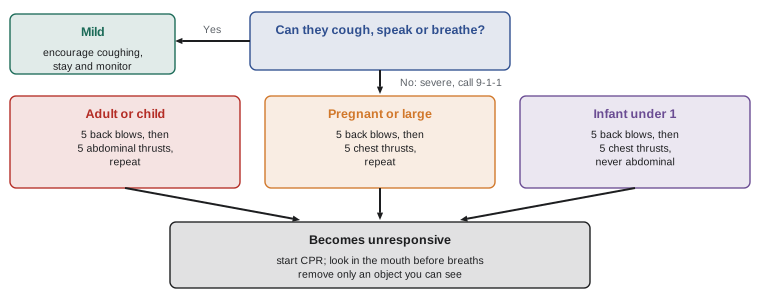
Adults and children: back blows and abdominal thrusts
For a conscious adult or child over 1 year with a severe obstruction, the 2025 American Heart Association guidelines for the first time give a specific sequence: alternate 5 back blows with 5 abdominal thrusts until the object comes out or the person becomes unresponsive. Previous US guidance emphasized abdominal thrusts alone. Canadian training organizations had already taught back blows combined with abdominal thrusts for many years, and the 2025 Heart and Stroke Foundation guidelines are aligned with this approach. Follow the current method taught in your certified course.
Back blows: stand slightly behind and to the side of the person. Support their chest with one hand and lean them forward so that the object, if dislodged, comes out of the mouth rather than going further down. Give up to 5 firm blows between the shoulder blades with the heel of your other hand, checking after each one whether the obstruction has cleared.
Abdominal thrusts: stand behind the person and wrap your arms around their waist. Make a fist with one hand and place the thumb side just above the navel, well below the breastbone. Grasp your fist with your other hand and give up to 5 quick, inward and upward thrusts. Each thrust is a separate attempt to force air out of the lungs and push the object out. For a small child, you may need to kneel behind them.
When abdominal thrusts are not suitable
For a person who is in the later stages of pregnancy, or one whose waist is too large for you to reach around, the 2025 guidelines advise chest thrusts instead of abdominal thrusts. Stand behind the person, place your arms under their armpits and put your fist on the center of the breastbone, then give quick backward thrusts. Back blows are still used. A person in a wheelchair can be given chest thrusts from behind the chair, or abdominal thrusts if the person can be reached; certified courses teach the details.
Infants: back blows and chest thrusts
For an infant under 1 year with a severe obstruction, abdominal thrusts are not used because they risk injuring the liver and other organs. Instead, alternate 5 back blows and 5 chest thrusts. Hold the infant face down along your forearm, supporting the head and jaw with your hand, with the head lower than the body, and rest your arm on your thigh. Give up to 5 firm back blows between the shoulder blades with the heel of your hand. Then turn the infant face up, supporting the head, and give up to 5 chest thrusts in the center of the chest on the lower half of the breastbone. The 2025 guidelines describe using the heel of one hand for infant chest thrusts. Continue until the object comes out, the infant starts to cry or breathe, or the infant becomes unresponsive.
| Adult or child (over 1 year) | Pregnant or too large to encircle | Infant (under 1 year) | |
|---|---|---|---|
| Mild obstruction | Encourage coughing; monitor | Encourage coughing; monitor | Let the infant cough or cry; monitor |
| Severe obstruction | 5 back blows, then 5 abdominal thrusts, repeated | 5 back blows, then 5 chest thrusts, repeated | 5 back blows, then 5 chest thrusts, repeated |
| Becomes unresponsive | Call 9-1-1, start CPR, check mouth before breaths | Call 9-1-1, start CPR, check mouth before breaths | Call 9-1-1, start CPR, check mouth before breaths |
When the choking person becomes unresponsive
If the obstruction does not clear, the person will eventually lose consciousness. When this happens, lower them carefully to the floor, protecting the head. Make sure 9-1-1 has been called and send for an AED. Start CPR, beginning with compressions. Chest compressions raise the pressure in the chest and can help push the object out. Each time you open the airway to give breaths, look in the mouth. If you can see the object, remove it with your fingers. Do not do blind finger sweeps, because they can push the object further in. Continue CPR until the object is cleared and the person breathes, or paramedics take over.
If you are alone with an adult who becomes unresponsive from choking, call 9-1-1 on speaker and start CPR. For a child or infant when you are alone without a phone, give about 2 minutes of CPR before leaving to call, as Lesson 8 explained.
If you are choking and alone
If you choke and no one is nearby, call 9-1-1 if you can, even if you cannot speak; dispatchers can trace many calls and will send help. Then try to give yourself abdominal thrusts using your own fist, or by pressing your upper abdomen quickly and firmly against the back of a chair, a counter edge or another firm object. In shared workplaces, move toward other people rather than away from them, for example out of a private office into a corridor.
After choking
Anyone who received abdominal or chest thrusts, or who had a severe obstruction, should be checked by a health care provider even if they seem fine, because thrusts can cause internal injuries and part of the object may remain in the airway or have been inhaled into the lungs. Signs that need urgent attention include a persistent cough, difficulty swallowing, chest pain or wheezing after the event.
Anti-choking suction devices
Several handheld suction devices are sold for clearing choking obstructions, using a mask and plunger or bellows to create suction. They are marketed to homes, care facilities and schools. The resuscitation guidelines have not recommended them as a replacement for back blows, thrusts and CPR, noting limited and low-quality evidence. If your workplace has such a device, it should not delay the standard response, and staff should follow the training provider's guidance and the manufacturer's instructions.
Worked problem
Response timing in a cafeteria
In a staff cafeteria, a worker begins choking at 12:15:00. A co-worker recognizes severe choking at 12:15:20 and gives cycles of 5 back blows and 5 abdominal thrusts, each cycle taking about 20 seconds. Another worker calls 9-1-1 at 12:15:30. After 4 cycles the object has not cleared and the worker becomes unresponsive. (a) At what time does the worker become unresponsive? (b) What should the rescuers do then, and what should the second worker have done in addition to calling?
Show solution
- (a) 4 cycles × 20 seconds = 80 seconds after 12:15:20, so about 12:16:40.
- (b) Lower the worker to the floor, protect the head, start CPR with compressions, and look in the mouth each time before breaths, removing any visible object.
- The second worker should have sent someone for the AED, or fetched it after calling, so it is ready if cardiac arrest develops.
Answer: Unresponsive at about 12:16:40. The rescuers start CPR immediately, checking the mouth before each set of breaths, and the AED should already be on its way.
Preventing choking at work
Workplaces where people eat or where food is served, and especially care settings, child care and food service, can reduce choking risk. Measures include training staff in recognition and response, posting choking response posters in eating areas, following care plans for residents or clients with swallowing difficulties, supervising young children while they eat, cutting food appropriately for children, and keeping small objects out of reach of infants and toddlers. Alcohol use is a common factor in adult choking at events and should be considered in event planning.
Recognizing choking in people who cannot communicate
Some people cannot easily signal that they are choking: young children, people with dementia or developmental disabilities, people who have had a stroke and people who do not share a language with those around them. Watch for sudden silence during a meal, a startled or panicked expression, inability to cough, drooling, high-pitched breathing sounds, a change of color or sudden collapse. Care staff should know each resident's or client's eating plan and texture requirements, and should be ready to act quickly if they see these signs.
Choking drills and equipment
Choking responses are practiced in certified courses on training vests and manikins that let learners feel the correct hand position for thrusts without harming a partner. Never practice real thrusts on another person. Workplaces with food service or care settings can include a choking scenario in their emergency drills and check that posters showing the current sequence for adults, children and infants are displayed in eating areas, replacing older posters that show abdominal thrusts alone.
Common mistakes
MistakeSlapping the back of someone who is coughing forcefully.
InsteadEncourage them to keep coughing; act only if the obstruction becomes severe.
MistakeGiving abdominal thrusts to an infant.
InsteadFor infants, alternate 5 back blows and 5 chest thrusts.
MistakeUsing abdominal thrusts on a person in late pregnancy.
InsteadUse back blows and chest thrusts.
MistakeDoing blind finger sweeps.
InsteadRemove an object only if you can see it.
MistakeLetting the person go home without a check after thrusts.
InsteadAnyone who received thrusts should be checked by a health care provider.
Summary and key terms
- A mild obstruction allows coughing, speaking and breathing; encourage coughing.
- A severe obstruction stops effective coughing, speaking and breathing; act immediately and call 9-1-1.
- For adults and children over 1, the 2025 guidelines alternate 5 back blows with 5 abdominal thrusts.
- Use chest thrusts instead of abdominal thrusts for late pregnancy or when you cannot encircle the waist.
- For infants, alternate 5 back blows with 5 chest thrusts; never abdominal thrusts.
- If the person becomes unresponsive, start CPR and look in the mouth before each set of breaths.
- Anyone who has had a severe obstruction or received thrusts needs a medical check.
- Airway obstruction
- A blockage of the airway by food, an object or swelling.
- Mild obstruction
- A partial blockage in which the person can still cough, speak and breathe.
- Severe obstruction
- A blockage that prevents effective coughing, speaking or breathing.
- Universal choking sign
- Clutching the throat with one or both hands.
- Back blows
- Firm blows between the shoulder blades with the heel of the hand.
- Abdominal thrusts
- Quick inward and upward thrusts just above the navel to force air out.
- Chest thrusts
- Thrusts on the breastbone used for infants, pregnant people and large adults.
- Blind finger sweep
- Sweeping a finger in the mouth without seeing an object; not recommended.
- Anti-choking suction device
- A handheld device using suction to remove obstructions; not a replacement for standard care.
- Aspiration
- Inhaling food, fluid or an object into the lungs.
Practice problems
Work each problem on paper first, then reveal the answer to check.
How do you tell a mild from a severe obstruction?
Show answer
In a mild obstruction the person can cough forcefully, speak and breathe; in a severe one they cannot.
What do you do for a mild obstruction?
Show answer
Encourage coughing, stay with the person and call 9-1-1 if it does not clear.
What sequence does the 2025 AHA guideline give for adults?
Show answer
Alternate 5 back blows and 5 abdominal thrusts.
Where do you place your fist for abdominal thrusts?
Show answer
Just above the navel, well below the breastbone.
When are chest thrusts used instead of abdominal thrusts?
Show answer
For late pregnancy, a person too large to encircle, and infants.
Why are abdominal thrusts not used on infants?
Show answer
They risk injuring the liver and other organs.
The choking person becomes unresponsive. What do you do?
Show answer
Lower them to the floor, call 9-1-1, start CPR and look in the mouth before breaths.
Why not do blind finger sweeps?
Show answer
They can push the object further into the airway.
How can you help yourself if you choke alone?
Show answer
Call 9-1-1 and give yourself abdominal thrusts with your fist or against a chair back.
Why get a medical check after thrusts?
Show answer
Thrusts can cause internal injury and part of the object may remain.
Lesson quiz · 5 questions
Score 60% or more to complete this lesson.
Create a free account to save your progress, take quizzes and earn a certificate.