
HSE-111 · Lesson 6 of 12 · 25 min
How AEDs work
An automated external defibrillator is one of the most remarkable safety devices ever put in public hands. It can recognize a deadly heart rhythm and deliver a precisely measured electric shock to correct it, guided by spoken instructions that anyone can follow. Understanding how an AED works, what it can and cannot do and why it is safe makes people far more willing to use one. This lesson explains the heart's electrical system, the rhythms an AED looks for and how the device decides whether to shock.
The heart's electrical system
The heart is a muscular pump, but its pumping is controlled by electricity. A small cluster of cells in the upper right chamber, the sinoatrial node, acts as a natural pacemaker, sending out an electrical impulse 60 to 100 times a minute at rest. The impulse spreads across the upper chambers, which contract and push blood into the lower chambers. It then passes through a junction called the atrioventricular node and along specialized conducting fibers through the lower chambers, the ventricles, which contract together and pump blood to the lungs and the body. On an electrocardiogram (ECG), this coordinated activity produces the familiar repeating pattern of waves.
Shockable rhythms
In most sudden cardiac arrests in adults, the first problem is that this coordination breaks down. The two rhythms an AED is designed to treat are:
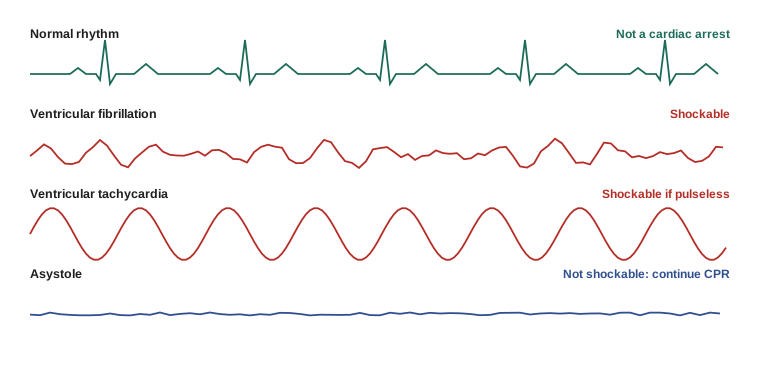
- Ventricular fibrillation (VF): the ventricles quiver chaotically, with hundreds of uncoordinated electrical signals firing at once. The heart muscle twitches but does not pump. On an ECG, VF looks like an irregular, wavy line with no repeating pattern.
- Pulseless ventricular tachycardia (pulseless VT): the ventricles beat so fast and abnormally that they cannot fill or pump effectively. On an ECG it looks like a rapid series of wide, regular waves.
These are called shockable rhythms. A defibrillation shock passes a strong current through the heart, briefly stopping all electrical activity at once. This gives the heart's natural pacemaker a chance to restart a normal, coordinated rhythm. Defibrillation does not jump-start a stopped heart, as films often suggest; it resets a heart that is electrically chaotic.
Non-shockable rhythms
Other cardiac arrest rhythms cannot be corrected by a shock:
- Asystole: no electrical activity at all, often called flatline. It is common when cardiac arrest has gone on for a long time without CPR, or when the cause was a lack of oxygen.
- Pulseless electrical activity (PEA): the heart shows organized electrical activity on an ECG, but the muscle is not pumping enough blood to produce a pulse, often because of severe blood loss, a lack of oxygen or another underlying cause.
For these rhythms, CPR is what keeps blood moving while paramedics and hospital teams try to treat the cause. An AED that says no shock is advised is not broken and does not mean the person is fine. It means: continue CPR. VF also tends to deteriorate into asystole over several minutes, which is one reason early defibrillation is so important, and CPR helps keep the heart in a shockable state for longer.
How an AED decides
When the pads are attached to bare skin, the AED records the heart's electrical signal through them and analyzes it using an algorithm that looks at features such as rate, regularity and the shape of the waves. Modern AEDs are highly accurate: they are designed and tested to recommend a shock for VF and fast pulseless VT and not for other rhythms, with very high specificity, meaning they almost never advise a shock when one is not needed. Analysis takes a few seconds, and movement or touching the person can disturb it, which is why the AED tells everyone not to touch the person during analysis.
If a shock is advised, the AED charges its capacitor, which takes a few seconds, and then either delivers the shock automatically (a fully automatic AED) or tells the rescuer to press a flashing shock button (a semi-automatic AED). Both types are common, and both tell you clearly what to do. After the shock, or after a no-shock decision, the AED prompts you to resume CPR immediately, and it reanalyzes about every 2 minutes.
The shock
Modern AEDs use biphasic waveforms, in which the current flows in one direction and then reverses. Biphasic shocks are effective at lower energies than the older monophasic waveforms, typically 120 to 200 joules for adults in many devices, with some devices increasing the energy for later shocks. The AED measures the electrical resistance of the person's chest, called impedance, and adjusts the shock accordingly. Users do not choose the energy; the device does it all. With pediatric pads or a child mode, the AED reduces the energy for children, as Lesson 7 explains.
| Rhythm | What the heart is doing | AED action | Rescuer action |
|---|---|---|---|
| Ventricular fibrillation | Chaotic quivering, no pumping | Shock advised | Stand clear, shock, resume CPR immediately |
| Pulseless ventricular tachycardia | Very fast, ineffective beats | Shock advised | Stand clear, shock, resume CPR immediately |
| Asystole | No electrical activity | No shock advised | Resume CPR immediately |
| Pulseless electrical activity | Electrical activity without effective pumping | No shock advised | Resume CPR immediately |
| Normal or other rhythm with a pulse | Heart is pumping | No shock advised | Check breathing and responsiveness; follow prompts |
Why AEDs are safe
Many people worry that they might shock someone who does not need it or hurt themselves or bystanders. These fears are understandable but largely unfounded. The AED will not deliver a shock unless it detects a shockable rhythm, so you cannot shock a person whose heart is beating normally just by pressing the button. The main safety rule is simple: make sure no one is touching the person when the shock is delivered. The AED will tell you to stand clear, and you should say it out loud and look to check. Reports of bystanders being injured by AED shocks are extremely rare.
AEDs are designed to be used by untrained people. Studies have shown that even schoolchildren and people who have never seen an AED can use one correctly by following the voice prompts, although they are a little slower than trained users. Training makes people faster and more confident, which is why it is still recommended.
Regulation of AEDs
In the US, AEDs are regulated by the Food and Drug Administration as Class III medical devices. Since a 2015 FDA final order, AEDs and their necessary accessories such as batteries and pads must have premarket approval, the FDA's most rigorous review, because of past problems with device reliability and recalls. Buyers should check that a model is FDA-approved, buy from a reputable supplier and register the device with the manufacturer so they receive safety notices and recalls. State laws, discussed in Lesson 11, govern where AEDs must be installed, maintained and registered.
Worked problem
How many minutes can an early shock save?
At a community arena, a spectator collapses from VF. Scenario 1: bystanders start CPR within 1 minute and use the arena AED at minute 4. Scenario 2: no AED is available; paramedics arrive and shock at minute 11. Using the rough teaching estimate that, with CPR, survival falls by about 4 percentage points a minute from 90 percent, estimate the chance of survival at the time of the first shock in each scenario. What does the comparison suggest about public AEDs?
Show solution
- Scenario 1: \(90 - 4 \times 4 = 74\) percent at the first shock (minute 4).
- Scenario 2: \(90 - 4 \times 11 = 46\) percent at the first shock (minute 11).
- The difference is \(74 - 46 = 28\) percentage points, from the AED shock coming 7 minutes earlier.
- These are illustrative numbers from a simple model; real survival depends on many factors. The direction of the effect is well established in studies of public access defibrillation.
Answer: About 74 percent with the arena AED against about 46 percent waiting for paramedics, in this simplified model. Placing AEDs where they can be reached in a few minutes is one of the most effective ways to improve survival.
What AEDs cannot do
An AED cannot restart a heart that has no electrical activity, cannot fix a blocked artery or blood loss and cannot breathe for the person. It works only as part of the chain of survival, combined with good CPR before and after each shock and with advanced care by paramedics. An AED also only works if it is there, charged, with in-date pads, and someone is willing to use it, which is why Lesson 11 focuses on AED programs.
Inside the AED
An AED contains a battery, a capacitor that stores the energy for a shock, circuitry that records and analyzes the heart rhythm through the pads, a microprocessor that runs the analysis algorithm and the voice prompts, and memory that records the event. Many models also include a sensor in the pads or a separate puck that measures compression depth and rate and gives spoken feedback such as "push harder" or "good compressions". Some newer devices can analyze the rhythm while compressions continue, reducing pauses, and some connect wirelessly to send status reports to the program manager so that a failed self-test is noticed quickly.
Public access and home AEDs
AEDs were first designed for paramedics and hospital staff. Over the past few decades, simpler, cheaper and more reliable designs have made public access defibrillation possible, with AEDs placed in airports, casinos, sports facilities, offices and many other places. Some people at high risk, or their families, buy AEDs for the home. Studies of public access programs have consistently found that survival is highest where AEDs are applied before paramedics arrive, which is why the chain of survival places rapid defibrillation in the bystander links.
AED myths
Several myths discourage people from using AEDs. One is that you need to be certified to use one; in fact anyone may use an AED in an emergency. Another is that an AED can be used to shock a person who is awake; it cannot, because it analyzes the rhythm first. A third is that a shock always restarts the heart immediately; often several rounds of CPR and shocks are needed. Knowing the facts makes people more willing to act.
Common mistakes
MistakeBelieving an AED restarts a heart that has stopped completely.
InsteadAn AED resets a chaotic rhythm such as VF; for asystole, CPR continues.
MistakeThinking "no shock advised" means the person is fine.
InsteadResume CPR immediately unless the person is clearly breathing normally and responding.
MistakeFearing the AED will shock someone who does not need it.
InsteadThe AED only shocks when it detects a shockable rhythm.
MistakeTouching the person during analysis or the shock.
InsteadSay "Stand clear", look to check, and keep everyone off the person.
MistakeBuying an unlicensed or unapproved AED from an unknown seller.
InsteadCheck the device is licensed or approved, and register it with the manufacturer.
Summary and key terms
- The heart's pumping is coordinated by electrical impulses from its natural pacemaker.
- Ventricular fibrillation and pulseless ventricular tachycardia are shockable rhythms.
- A shock stops chaotic electrical activity so a normal rhythm can restart; it does not restart a flatline heart.
- Asystole and pulseless electrical activity are not shockable; CPR continues.
- AEDs analyze the rhythm automatically and are designed to almost never advise a shock that is not needed.
- The key safety rule is that no one touches the person during analysis and shock.
- AEDs are regulated medical devices: Health Canada license in Canada, FDA premarket approval in the US.
- Sinoatrial node
- The heart's natural pacemaker.
- Ventricles
- The lower chambers of the heart, which pump blood to the lungs and body.
- Ventricular fibrillation
- Chaotic quivering of the ventricles with no effective pumping; shockable.
- Pulseless ventricular tachycardia
- A very fast ventricular rhythm without effective pumping; shockable.
- Asystole
- No electrical activity in the heart; not shockable.
- Pulseless electrical activity
- Electrical activity without effective pumping; not shockable.
- Biphasic waveform
- A shock in which current flows one way and then reverses.
- Impedance
- The electrical resistance of the chest, which the AED measures to adjust the shock.
- Semi-automatic AED
- An AED that tells the rescuer to press a button to deliver the shock.
- Fully automatic AED
- An AED that delivers the shock itself after warning everyone to stand clear.
Practice problems
Work each problem on paper first, then reveal the answer to check.
Name the two shockable rhythms.
Show answer
Ventricular fibrillation and pulseless ventricular tachycardia.
What does a defibrillation shock do?
Show answer
Stops all electrical activity briefly so a normal rhythm can restart.
Is asystole shockable?
Show answer
No; continue CPR.
The AED says no shock advised. What do you do?
Show answer
Resume CPR immediately unless the person shows signs of life.
Why must no one touch the person during analysis?
Show answer
Movement can disturb the analysis, and touching during a shock could expose a bystander.
What is the difference between semi-automatic and fully automatic AEDs?
Show answer
A semi-automatic AED asks you to press a shock button; a fully automatic one shocks on its own after a warning.
What is impedance?
Show answer
The electrical resistance of the chest, used to adjust the shock.
Why does early defibrillation matter?
Show answer
VF deteriorates into non-shockable asystole within minutes.
How often does the AED reanalyze?
Show answer
About every 2 minutes.
Who regulates AEDs in your country?
Show answer
Health Canada in Canada; the FDA in the US.
Lesson quiz · 5 questions
Score 60% or more to complete this lesson.
Create a free account to save your progress, take quizzes and earn a certificate.