
HSE-111 · Lesson 12 of 12 · 24 min
Putting it together: team response, aftercare and capstone
The previous lessons covered each part of the response to cardiac arrest separately. In a real emergency they happen together, in a few chaotic minutes, often with frightened bystanders, noise and uncertainty. This final lesson brings the pieces together: how a team of rescuers works, what happens when paramedics arrive, what happens to a survivor afterward, and a capstone scenario that applies the whole course to a realistic workplace. Remember once more that this is an awareness course: the next step for anyone who wants to be ready is a certified hands-on CPR and AED course.
Working as a team
When several trained people respond, the best results come from clear roles and communication. One person should take the lead: often the first trained person on scene or the most experienced. The leader does not need to do compressions; their job is to see the whole picture, assign roles and keep track of time. Typical roles are:
- Compressor: gives compressions and switches with the next compressor about every 2 minutes, at AED analysis.
- AED operator: attaches the AED, follows its prompts and calls "Stand clear" for analysis and shocks.
- Airway and breaths: if trained and a barrier device is available, gives breaths at 30:2.
- Caller: stays on the line with 9-1-1, relays dispatcher instructions and updates.
- Runner and guide: fetches extra equipment such as the first aid kit and naloxone, sends someone to meet the paramedics at the entrance, holds elevators and clears the route.
- Recorder: notes the time of collapse, the start of CPR, each shock and any medication given, for handover.
Closed-loop communication helps: the leader gives a specific instruction to a named person, that person repeats it back and confirms when it is done. For example: "Sam, switch at the next analysis." "Switching at the next analysis." Short, calm statements keep everyone coordinated and reduce pauses in compressions.
When paramedics arrive
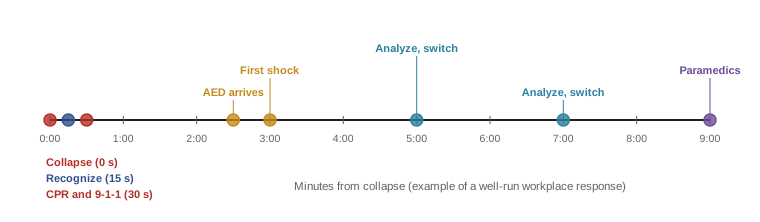
When paramedics arrive, keep doing CPR until they tell you to stop. They will usually take over in a planned way so compressions continue with minimal interruption. Leave the AED pads in place unless they ask otherwise; many paramedic monitors can connect to or replace them. Give a brief, clear handover. A useful structure is: what happened and when ("He collapsed at 10:42, we started CPR at 10:43"), what you did ("Two shocks, at 10:46 and 10:48"), what you know about the person (name, age, any known medical conditions or medications) and anything else important, such as a suspected overdose or a fall. The recorder's notes are invaluable here. Then follow the paramedics' instructions: they may ask you to keep doing compressions, to help carry equipment or to clear space.
Return of spontaneous circulation
Sometimes CPR and defibrillation succeed and the heart starts beating effectively again. This is called return of spontaneous circulation. The person may start to move, cough, open their eyes, breathe normally or make purposeful movements. Stop compressions if this happens, but leave the AED pads on and the AED switched on. If the person is breathing normally but not fully awake, place them in the recovery position and monitor breathing continuously. Cardiac arrest can recur, so be ready to start CPR again immediately if breathing becomes abnormal.
Care after cardiac arrest
For people who survive to reach hospital, the fourth and fifth links of the chain of survival take over: treatment of the cause, such as opening a blocked artery, careful temperature and blood pressure management, and support of the brain and other organs. Survivors often face a long recovery. Many have problems with memory, concentration, fatigue, anxiety or depression in the months afterward, and some receive an implanted defibrillator. The 2025 guidelines emphasize recovery and rehabilitation as part of survival, including physical, cognitive and emotional support for survivors and their families. For workplaces, this means supporting a survivor's return to work through accommodation and a graduated return, as HSE-109 discussed.
When resuscitation does not succeed
Many people in cardiac arrest do not survive despite excellent CPR and early defibrillation, particularly when the arrest was not witnessed, the cause was not a shockable rhythm or the person had serious underlying illness. Rescuers who did their best should know that they gave the person their only chance. Feelings of sadness, guilt, anger or numbness are common. The supportive debrief and follow-up described in Lesson 11 matter just as much when the outcome is death, and family members and co-workers who witnessed the event may need support too.
Capstone scenario
Work through this scenario using everything in the course. It combines recognition, calling, CPR, AED use, a special circumstance and the workplace program.
Worked problem
Cardiac arrest in a maintenance shop
At 14:20 in a vehicle maintenance shop with 30 workers, a 58-year-old mechanic collapses beside a hoist. A co-worker, Priya, sees him fall and finds him unresponsive with occasional snoring gasps. The shop's AED is in the main office, a 75-second walk away. Two other workers, Luis and Dana, are nearby. Priya is CPR-trained; the others are not. The mechanic was lying in a shallow puddle of washing water. (a) Describe the first minute. (b) When should the AED be ready if Dana runs for it at 14:20:30? (c) What adjustments does the scene require? (d) If CPR is given at 110 a minute from 14:21 to the first analysis at 14:23:45, about how many compressions were given? (e) What should happen after paramedics leave?
Show solution
- (a) Priya checks the scene: the hoist is lowered and no electrical hazard is present. She recognizes agonal gasping as cardiac arrest, points at Luis to call 9-1-1 on speaker and at Dana to fetch the AED, then starts compressions by about 14:20:45.
- (b) Round trip 2 × 75 s = 150 s, so the AED arrives at about 14:23:00. Allowing about 45 seconds to dry the chest and apply the pads while Priya continues compressions, it is ready at about 14:23:45.
- (c) Move him off the wet area if it can be done quickly and wipe his chest dry before attaching the pads; make sure no one is kneeling in the water during the shock. Luis relays the dispatcher's instructions and sends someone to meet the ambulance at the shop door.
- (d) From 14:21:00 to 14:23:45 is 2.75 minutes: \(110 \times 2.75 \approx 303\) compressions. Luis, coached by the dispatcher, takes over compressions after the first analysis so Priya does not tire.
- (e) Replace the AED pads and check the battery, restock the rescue kit, record the event, report as required, download AED data if requested, and hold a supportive debrief with Priya, Luis, Dana and other witnesses, offering ongoing support.
Answer: CPR starts within about 45 seconds, the AED is ready at about 14:23:45 with the chest dried and compressions continuing during pad placement, and about 300 compressions are given before the first analysis. Afterward the AED is returned to service and the responders are supported.
Lessons from the scenario
The scenario shows several points that make the difference in real events. Recognizing agonal gasping immediately saved minutes. Giving specific tasks to named people meant 9-1-1 was called and the AED fetched while CPR started. The 150-second round trip to the office was near the edge of the 3-minute target; a review might move the AED closer to the shop floor or add a second unit. The untrained co-worker was able to help through dispatcher coaching. And the after-event steps ensured both the AED and the people who used it were ready for the future.
| Phase | Key actions |
|---|---|
| Recognize | Scene safe; unresponsive and not breathing normally, including gasping |
| Call and get an AED | Specific tasks to named people; 9-1-1 on speaker; AED fetched |
| CPR | 100 to 120 a minute, at least 5 cm (2 in) in adults, full recoil, short pauses; breaths if trained |
| Defibrillate | Pads on bare, dry skin; stand clear; shock if advised; resume compressions immediately |
| Continue | Switch compressors every 2 minutes; follow AED prompts; keep going until paramedics take over or signs of life |
| Hand over | Times, shocks, what you did and what you know about the person |
| After | Restore the AED to service; record and report; debrief and support responders |
Your next steps
If you have not already done so, take a certified CPR and AED course with the American Heart Association, the American Red Cross, the National Safety Council or another recognized provider, ideally one that includes a manikin with feedback on depth and rate. Find out where the AEDs are in your workplace, your home community and the places you visit often. Check whether your workplace has an AED program and an emergency plan, and offer to help improve them. Encourage family members, including children from about age 12, to learn CPR; the 2025 guidelines support teaching it in schools.
Most cardiac arrests happen at home, so the person you save is most likely to be someone you love. The skills in this course take only a few hours to learn and a few minutes to use, and they can turn a death into a survival story.
Practicing the whole response
The best preparation for a real cardiac arrest is a realistic drill that runs from collapse to handover. Choose a location and time without warning most participants, use a manikin and a trainer AED, and have an observer time each step: recognition, the 9-1-1 call, the start of CPR, the AED arriving and the first simulated shock, and meeting the ambulance. Debrief afterward and fix what slowed the response. Repeating drills on different shifts and in different areas shows whether the plan works everywhere, not just in the main office.
A final word on confidence
People who have used CPR and an AED in a real emergency often say afterward that their training took over and that the AED's voice prompts kept them calm. Others say they doubted themselves and wished they had practiced more. Confidence comes from repetition: a certified course, short refreshers, drills at work and knowing exactly where the nearest AED is. The goal of this course has been to give you the understanding behind those skills, so that when the moment comes, you recognize it, call for help, push hard and fast and use the AED without hesitation.
Common mistakes
MistakeEveryone doing compressions at once and no one calling or fetching the AED.
InsteadAssign clear roles: leader, compressor, AED operator, caller, runner and recorder.
MistakeStopping CPR as soon as paramedics walk in.
InsteadKeep going until they tell you to stop and take over.
MistakeRemoving the AED pads when the person starts breathing.
InsteadLeave pads on and the AED on; arrest can recur.
MistakeGiving a long, disorganized handover.
InsteadGive times, shocks, actions and what you know about the person, briefly.
MistakeTreating this course as the end of your training.
InsteadTake a certified hands-on course and refresh it regularly.
Summary and key terms
- A team response works best with a leader, clear roles and closed-loop communication.
- Keep CPR going until paramedics take over, and give a brief, structured handover.
- If circulation returns, stop compressions but leave the AED on and monitor closely.
- Survivors often need long recovery and support with returning to work.
- Rescuers need support whatever the outcome.
- Recognize, call, compress, defibrillate, continue, hand over and restore the program afterward.
- The next step is a certified hands-on CPR and AED course.
- Team leader
- The person who coordinates the response, assigns roles and tracks time.
- Closed-loop communication
- Giving an instruction to a named person who repeats and confirms it.
- Recorder
- The team member who notes times and actions for handover.
- Handover
- The brief transfer of information and care to paramedics.
- Return of spontaneous circulation
- The heart beginning to pump effectively again after cardiac arrest.
- Post-cardiac arrest care
- Hospital treatment after circulation returns, including treating the cause.
- Rehabilitation
- Physical, cognitive and emotional recovery support for survivors.
- Graduated return to work
- A step-by-step increase in work hours and duties after illness or injury.
- Feedback manikin
- A training manikin that measures compression depth and rate.
- Emergency plan
- A written plan for how a workplace responds to emergencies, including cardiac arrest.
Practice problems
Work each problem on paper first, then reveal the answer to check.
Name four roles in a team response.
Show answer
Leader, compressor, AED operator, caller, runner and guide, recorder, airway.
What is closed-loop communication?
Show answer
A specific instruction to a named person, who repeats and confirms it.
When do you stop CPR when paramedics arrive?
Show answer
When they tell you to and take over.
What should a handover include?
Show answer
Time of collapse and CPR, shocks, actions taken and known information about the person.
What are signs of return of spontaneous circulation?
Show answer
Moving, coughing, opening eyes, breathing normally.
What do you do with the AED if the person starts breathing?
Show answer
Leave the pads on and the AED switched on and monitor.
Why do survivors often need workplace support?
Show answer
They may have memory, fatigue or emotional effects and need a graduated return.
In the capstone, why was the AED placement worth reviewing?
Show answer
The 150-second round trip was near the edge of the 3-minute target.
How many compressions are given in 2.5 minutes at 110 a minute?
Show answer
About 275.
From what age does the 2025 guidance support teaching CPR to children?
Show answer
About 12 years old.
Lesson quiz · 5 questions
Score 60% or more to complete this lesson.
Create a free account to save your progress, take quizzes and earn a certificate.