
HSE-111 · Lesson 2 of 12 · 25 min
Recognizing cardiac arrest and agonal breathing
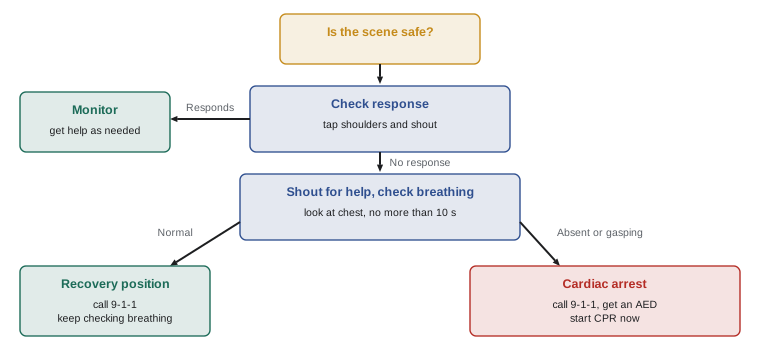
CPR can only help if someone recognizes that it is needed. The first link in the chain of survival is recognition, and it is the link that most often fails. Bystanders may think the person has fainted, is having a seizure, is drunk or is asleep. They may see the person breathing in an unusual, gasping way and believe that the person is breathing and therefore does not need CPR. Every one of these mistakes costs minutes. This lesson explains how to recognize cardiac arrest quickly and confidently, using only two questions: is the person responsive, and are they breathing normally?
The simple test: unresponsive and not breathing normally
Current guidelines for lay rescuers deliberately keep recognition simple. If a person is unresponsive and is not breathing normally, assume they are in cardiac arrest, call 9-1-1, send for an AED and start CPR. You do not need to check for a pulse. Studies have shown that both lay people and trained health care providers are slow and unreliable at feeling for a pulse in an emergency: they often feel their own pulse, or take too long deciding. Pulse checks were removed from lay rescuer CPR training many years ago for this reason, and the 2025 guidelines keep that approach.
The check should take no more than about 10 seconds. Spending longer delays compressions, and as Lesson 1 explained, every minute without circulation reduces the chance of survival.
Step 1: check that the scene is safe
Before approaching anyone who has collapsed, take a moment to look for dangers to yourself and others: traffic, electricity, machinery, fire, smoke, chemicals, an unsafe structure, deep water, an aggressive person or a hazardous atmosphere such as a confined space. HSE-110 covered scene safety in detail. In cardiac arrest the pressure to act fast is intense, but a rescuer who becomes a second casualty helps no one. If the danger can be removed quickly and safely, for example by switching off a machine at its isolation point, do so. If it cannot, call for help and wait for those trained and equipped to deal with it.
Step 2: check for a response
Approach the person and tap them firmly on the shoulders while shouting something like "Are you okay? Can you hear me?" Use their name if you know it. A person who opens their eyes, speaks, moans or moves purposefully is responsive and is not in cardiac arrest, though they may still need urgent help. A person who does not react at all is unresponsive. If the person might have fallen from a height or been struck in a crash, try not to move their head and neck more than needed, but never let concern about a spinal injury stop you from checking breathing or starting CPR.
If you are alone, shout for help as soon as you find the person unresponsive. Someone nearby may hear and be able to call 9-1-1 and fetch an AED while you continue.
Step 3: check breathing
Look at the chest and face for no more than 10 seconds. Normal breathing is regular, quiet and effortless, with the chest rising and falling about 12 to 20 times a minute in an adult. If the person is lying face down, you may need to roll them onto their back to assess them properly and to give CPR. You do not need to put your ear to the person's mouth; looking at the chest and listening while you look is enough. If you are not sure whether breathing is normal, treat it as not normal.
Agonal breathing: the gasp that fools people
In the first minutes after the heart stops, many people in cardiac arrest make occasional gasping breaths. These are called agonal breaths or agonal gasps. They are a reflex from the brainstem as it is starved of oxygen, not real breathing. They may sound like snoring, snorting, gurgling or a deep sigh, and they may come only a few times a minute. The person may appear to be trying to breathe. Agonal breathing occurs in a large share of cardiac arrests, especially in the first few minutes after collapse, and it is one of the main reasons bystanders and even callers to 9-1-1 fail to recognize cardiac arrest.
Agonal breathing is a sign of cardiac arrest, not a reason to delay CPR. In fact, its presence often means the arrest happened recently and the person has a better chance of surviving if CPR and defibrillation start immediately. Dispatchers are trained to ask callers to describe breathing precisely and to treat gasping as absent breathing. If you hear yourself describing breathing as "strange", "barely", "gasping" or "snoring" in an unresponsive person, start CPR.
| What you see or hear | What it means | What to do |
|---|---|---|
| Regular, quiet, effortless breathing | Breathing normally | Recovery position if unresponsive; call 9-1-1; monitor |
| Occasional gasps, snorts or gurgles | Agonal breathing: cardiac arrest | Call 9-1-1, get an AED, start CPR |
| No chest movement at all | Not breathing: cardiac arrest | Call 9-1-1, get an AED, start CPR |
| Noisy, strained breathing with chest movement in a responsive person | Breathing difficulty | Call 9-1-1, help them sit up, monitor closely |
| Unsure | Treat as not breathing normally | Call 9-1-1, get an AED, start CPR |
Seizure-like movements at the start of cardiac arrest
When the brain suddenly loses its blood supply, some people have a brief period of jerking or stiffening that looks like a seizure. This can last several seconds. Bystanders may then wait for the seizure to finish, or wait for the person to wake up. If a person collapses, has a brief seizure-like episode and then is unresponsive and not breathing normally, treat it as cardiac arrest. In HSE-110 you learned that after a true seizure most people begin breathing normally within a minute or two. If normal breathing does not return, start CPR.
Fainting and other look-alikes
Simple fainting causes a short loss of consciousness because blood pressure drops for a moment, often after standing for a long time, seeing blood, pain or heat. A person who has fainted usually starts breathing normally almost immediately and wakes up within a minute or so once they are lying flat. A person in cardiac arrest does not. People who are drunk, high or in a diabetic emergency may be very drowsy but still breathe normally and may respond to a firm tap and shout. If there is any doubt, the two-question test decides: unresponsive and not breathing normally means CPR.
Worked problem
Did the bystanders miss a cardiac arrest?
In a warehouse, a picker collapses at 10:02. A co-worker reaches her at 10:02:30, finds her unresponsive and hears loud snoring sounds about every 10 seconds. He rolls her onto her side and calls a supervisor, who arrives at 10:05 and calls 9-1-1. The dispatcher asks about breathing, recognizes agonal breathing and coaches CPR from 10:06. An AED from the shipping office is attached at 10:09. How long was the delay before CPR, how could it have been shortened, and what was the gasp rate?
Show solution
- Collapse to CPR: from 10:02 to 10:06 is 4 minutes.
- A gasp about every 10 seconds is \(60 \div 10 = 6\) gasps a minute, far below the 12 to 20 breaths a minute of normal adult breathing.
- The co-worker found her unresponsive with gasping breathing at 10:02:30. Had he recognized agonal breathing, shouted for help, called 9-1-1 and started CPR immediately, compressions could have begun about 3.5 minutes earlier.
- Sending a second person for the AED at 10:02:30 might also have brought it about 4 minutes sooner.
Answer: CPR started about 4 minutes after collapse. Snoring sounds about 6 times a minute in an unresponsive person are agonal breathing, so CPR and the AED should have started at about 10:02:30. Training on agonal breathing is the fix.
When the person is breathing normally
If the person is unresponsive but breathing normally, they are not in cardiac arrest. Call 9-1-1, and if there is no suspected spinal injury that prevents it, place them in the recovery position described in HSE-110 to keep the airway clear. Stay with them and keep checking that they are breathing normally. People can go into cardiac arrest after collapsing, so if breathing becomes abnormal or stops, roll them onto their back and start CPR immediately.
Special considerations when recognizing cardiac arrest
Some situations make recognition harder. In poor lighting, noise or cold weather with bulky clothing, it can be hard to see the chest moving; open or move clothing if necessary. In a person who has had an overdose, slow, shallow breathing may progress to no breathing; Lesson 10 covers opioid emergencies. In children and infants, cardiac arrest is often the end result of a breathing problem rather than a heart rhythm problem, and they may stop breathing before the heart stops; Lesson 8 covers this. In drowning, the person may have water in the airway and may not breathe normally even after rescue.
Overcoming hesitation
Even when people recognize cardiac arrest, they may hesitate. Perhaps they do not want to be wrong, or they worry about what others will think. Remember that CPR on a person who turns out not to be in cardiac arrest is unlikely to cause serious harm; the person will usually react, move or push you away, and you can stop. Not giving CPR to someone who is in cardiac arrest almost always means they will die. The guidelines are deliberately designed so that when in doubt, you act.
Practicing recognition
Recognition improves with practice, just like compressions. Good CPR courses now include video or audio examples of agonal breathing so that learners can hear what it sounds like before they meet it for real. Workplace drills can include an actor or a recording that gasps, to test whether responders start CPR rather than waiting. Talking through the two questions out loud, "Not responding, not breathing normally, starting CPR", also helps teams act together.
If you are trained and still unsure, it can help to say what you see out loud to the dispatcher. Describing the breathing in plain words lets the dispatcher make the call with you.
Common mistakes
MistakeTreating gasping, snoring or gurgling as normal breathing.
InsteadAgonal breathing is a sign of cardiac arrest; start CPR.
MistakeSpending a long time feeling for a pulse.
InsteadLay rescuers do not check a pulse; check response and breathing for no more than 10 seconds.
MistakeWaiting for seizure-like movements to stop and for the person to wake up.
InsteadIf the person is then unresponsive and not breathing normally, start CPR.
MistakeLeaving an unresponsive person face down because moving them seems risky.
InsteadRoll them onto their back to check breathing and give CPR; life comes first.
MistakeNot starting CPR because you are not completely sure it is cardiac arrest.
InsteadWhen in doubt, call 9-1-1 and start CPR.
Summary and key terms
- Recognition is the first link in the chain of survival and the one that most often fails.
- Unresponsive and not breathing normally means cardiac arrest: call 9-1-1, get an AED and start CPR.
- Lay rescuers do not check for a pulse.
- Checking response and breathing should take no more than about 10 seconds.
- Agonal breathing, occasional gasps, snorts or snoring sounds, is a sign of cardiac arrest, not normal breathing.
- A brief seizure-like episode can happen at the start of cardiac arrest.
- An unresponsive person who is breathing normally goes in the recovery position and is monitored closely.
- Responsive
- Reacts to voice or touch by opening the eyes, speaking, moaning or moving purposefully.
- Unresponsive
- Shows no reaction to a firm tap and shout.
- Normal breathing
- Regular, quiet, effortless breathing, about 12 to 20 breaths a minute in an adult.
- Agonal breathing
- Occasional reflex gasps in cardiac arrest that are not effective breathing.
- Pulse check
- Feeling for a heartbeat at an artery; no longer done by lay rescuers.
- Recovery position
- A side-lying position that keeps the airway of an unresponsive breathing person clear.
- Fainting
- A brief loss of consciousness from a temporary drop in blood flow to the brain.
- Seizure-like activity
- Jerking or stiffening that may occur briefly when the brain loses its blood supply.
- Scene safety
- Checking for and controlling dangers before approaching a casualty.
- Dispatcher
- The emergency call-taker who sends help and can coach callers through CPR.
Practice problems
Work each problem on paper first, then reveal the answer to check.
What two questions decide whether to start CPR?
Show answer
Is the person responsive? Are they breathing normally?
How long should the breathing check take?
Show answer
No more than about 10 seconds.
Why do lay rescuers not check a pulse?
Show answer
Pulse checks are slow and unreliable in emergencies and delay CPR.
Describe agonal breathing.
Show answer
Occasional gasps, snorts, snoring or gurgling sounds in an unresponsive person.
What does agonal breathing mean?
Show answer
The person is in cardiac arrest; start CPR.
A person collapses, jerks for a few seconds and is then unresponsive and gasping. What do you do?
Show answer
Call 9-1-1, get an AED and start CPR.
What is a normal adult breathing rate?
Show answer
About 12 to 20 breaths a minute.
An unresponsive person is breathing normally. What do you do?
Show answer
Call 9-1-1, place them in the recovery position if possible and monitor breathing.
Why check scene safety first?
Show answer
So you do not become a second casualty.
What should you do if you are unsure whether breathing is normal?
Show answer
Treat it as not normal and start CPR.
Lesson quiz · 5 questions
Score 60% or more to complete this lesson.
Create a free account to save your progress, take quizzes and earn a certificate.