
HSE-111 · Lesson 5 of 12 · 24 min
Rescue breaths, barrier devices and hands-only CPR
Conventional CPR combines chest compressions with rescue breaths. Hands-only CPR uses compressions alone. Both have a place, and knowing when each is appropriate removes one of the biggest barriers to bystander action: the worry about giving breaths to a stranger. This lesson explains why breaths matter in some situations more than others, how rescue breaths are given in principle, how barrier devices work, and how the 30:2 cycle fits together.
Why breaths matter, and when
When a heart rhythm problem causes sudden collapse in an adult, the blood still contains oxygen for the first few minutes. Compressions alone can circulate that oxygen to the brain and heart, and research has shown that for adults who suddenly collapse, hands-only CPR by bystanders produces survival similar to conventional CPR in the early minutes. Hands-only CPR is also easier to learn, easier for dispatchers to coach and avoids pauses for breaths.
In other situations the problem started with a lack of oxygen, so the blood is already low in oxygen when the heart stops. These include cardiac arrest in children and infants, drowning, choking, drug overdose, and other breathing emergencies. In these cases, rescue breaths are much more important, and both the American Heart Association and the Heart and Stroke Foundation in their 2025 guidelines put renewed emphasis on rescue breaths for children and infants. Breaths also become more important the longer CPR continues, because oxygen in the blood is used up.
| Situation | Recommended approach for bystanders |
|---|---|
| Adult who suddenly collapses; untrained or unwilling to give breaths | Hands-only CPR: push hard and fast in the center of the chest |
| Adult who suddenly collapses; trained and willing | Compressions and breaths at 30:2, or hands-only CPR |
| Child or infant | Compressions and rescue breaths if trained; compressions only if unable or unwilling to give breaths |
| Drowning, choking, overdose or other breathing cause | Compressions and rescue breaths if trained |
| Long resuscitation before paramedics arrive | Breaths become more important if trained and able |
Opening the airway
In an unresponsive person, the muscles relax and the tongue can fall back and block the throat. Before giving breaths, the airway is opened using the head tilt-chin lift: one hand on the forehead tilts the head back gently, and the fingertips of the other hand lift the bony part of the chin. This lifts the tongue away from the back of the throat. If a spinal injury is suspected, trained rescuers may use a jaw thrust instead, but if that does not open the airway, the 2025 guidelines say to use head tilt-chin lift, because an open airway takes priority. Look in the mouth only if you can see an obvious object; do not do blind finger sweeps.
Giving rescue breaths in principle
With the airway open, a trained rescuer seals their mouth over the person's mouth, or uses a barrier device, pinches the nose closed and blows steadily for about one second, watching for the chest to rise. The 2025 guidelines emphasize giving enough air to make the chest visibly rise, avoiding both too little and too much. Too much air or blowing too forcefully can push air into the stomach, causing vomiting and reducing the effectiveness of compressions. After the first breath, let the chest fall, then give the second breath. If the chest does not rise with the first breath, re-tilt the head and try once more before going back to compressions.
The two breaths should take no more than about 10 seconds in total, so compressions resume quickly. If breaths are not going in after two attempts, return to compressions; repeated attempts cost compression time. Breathing technique is a practical skill that needs to be learned on a manikin with an instructor, who can show you how much air produces visible chest rise.
The 30:2 cycle
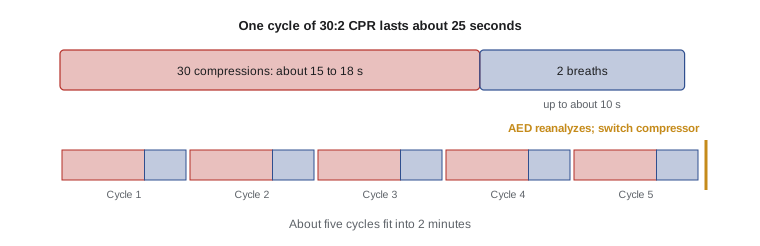
For lay rescuers giving conventional CPR to a person of any age, and for trained rescuers working alone, the standard ratio is 30 compressions followed by 2 breaths. The 2025 guidelines keep this ratio for lay rescuers and for health care providers until an advanced airway is placed. At 100 to 120 compressions a minute, 30 compressions take roughly 15 to 18 seconds, and two breaths should take no more than about 10 seconds, so each cycle lasts about 25 seconds and about five cycles fit into two minutes. When two trained rescuers care for a child or infant, a ratio of 15:2 is taught in health care provider courses.
Worked problem
Timing a 30:2 cycle
A trained rescuer gives 30 compressions at 110 per minute, then two breaths taking 8 seconds in total. (a) How long do the 30 compressions take? (b) How long is one cycle? (c) How many complete cycles fit in 2 minutes, and how many compressions is that? (d) Compare with 2 minutes of hands-only CPR at the same rate.
Show solution
- (a) 110 compressions per minute is \(110 \div 60 \approx 1.83\) per second, so 30 compressions take \(30 \div 1.83 \approx 16.4\) seconds.
- (b) One cycle: \(16.4 + 8 = 24.4\) seconds.
- (c) \(120 \div 24.4 \approx 4.9\), so 4 complete cycles plus most of a fifth. Four cycles give 120 compressions, and the remaining 22 seconds allow about 30 more: roughly 150 compressions in 2 minutes.
- (d) Hands-only CPR at 110 a minute gives \(110 \times 2 = 220\) compressions in 2 minutes.
Answer: About 16 seconds of compressions per cycle, about 24 seconds per cycle and about 150 compressions in 2 minutes with breaths, against 220 with hands-only CPR. The breaths cost compressions, which is why they must be quick, but they add oxygen that matters in children, drowning and long resuscitations.
Barrier devices
A barrier device sits between the rescuer and the person's mouth. The simplest is a face shield: a flexible plastic sheet with a one-way valve or filter that fits over the person's mouth and nose. A pocket mask is a rigid mask that fits over both the mouth and nose, with a one-way valve and filter; it gives a better seal and keeps the rescuer's face farther away, and it is the device usually taught in workplace first aid and CPR courses. Bag-valve-mask devices, which use a squeezable bag to push air, are used by trained responders and health care providers because they are difficult for one person to use effectively.
Barrier devices reduce the rescuer's exposure to saliva, vomit and blood. The actual risk of catching an infection from giving mouth-to-mouth breaths is very low, but the devices make rescuers more willing to give breaths. Many workplaces keep a pocket mask with the first aid kit and in the AED case, and some workers carry a face shield on a key ring. If no barrier device is available and you are not willing to give breaths, give hands-only CPR.
Mouth-to-nose and other variations
If the person's mouth cannot be opened or sealed, for example because of an injury, a trained rescuer can give breaths through the nose with the mouth held closed. For a person with a stoma, an opening in the front of the neck from previous surgery, breaths are given through the stoma. For infants, the rescuer's mouth may cover both the infant's mouth and nose. These variations are taught in certified courses.
Vomiting during CPR
People in cardiac arrest often vomit, especially if air has entered the stomach. If this happens, quickly turn the person onto their side to let the vomit drain, wipe the mouth if you can, roll them back and continue CPR. Protective gloves and a barrier device make this less unpleasant. Do not stop CPR for longer than necessary.
Rescue breathing without compressions
Sometimes a person has a pulse but is not breathing adequately, for example in an opioid overdose before the heart stops. Health care providers check for a pulse and may give rescue breathing alone, at one breath about every 6 seconds for an adult. Lay rescuers are not expected to check a pulse, so the simple rule remains: if the person is unresponsive and not breathing normally, start CPR with compressions.
Overcoming reluctance
Surveys find that many people would be willing to give compressions to a stranger but not mouth-to-mouth breaths. The message from the guidelines is clear: any CPR is better than no CPR. If you are untrained, unsure or unwilling, give hands-only CPR. If you are trained and willing, and especially if the person is a child or infant or the arrest was caused by drowning, choking or overdose, give compressions and breaths.
Breaths and infection risk in context
Concern about infection is one of the most common reasons people give for not giving breaths. Documented cases of infection passed on through mouth-to-mouth resuscitation are extremely rare. During outbreaks of respiratory infections, resuscitation organizations have issued temporary guidance, for example recommending hands-only CPR for adults and the use of barrier devices, to protect rescuers. Workplaces can make breaths more acceptable by keeping pocket masks with every AED and first aid kit and by including them in training, so that responders are familiar with them before an emergency.
Breaths when two rescuers are present
When two trained rescuers are present, one can give compressions while the other manages the airway and gives breaths, switching roles about every 2 minutes. The rescuer giving breaths should be ready with the airway open and the mask sealed as the 30th compression is completed, so the pause is as short as possible. The compressor counts out loud so the other rescuer knows when to prepare. Practicing this hand-off during training makes it smooth in a real event and helps keep the compression fraction high.
Remember that rescue breaths are a skill that needs regular practice. People who trained years ago often give breaths that are too large or too slow, which lengthens pauses. A refresher course with a feedback manikin, which shows when the chest rises and whether too much air is given, corrects these habits quickly.
Common mistakes
MistakeDoing nothing because you do not want to give mouth-to-mouth.
InsteadGive hands-only CPR; any CPR is better than none.
MistakeBlowing hard and long so the chest balloons.
InsteadGive each breath over about one second, just enough to make the chest visibly rise.
MistakeTaking repeated attempts when breaths do not go in.
InsteadRe-tilt once, then go back to compressions; keep pauses under about 10 seconds.
MistakeDoing blind finger sweeps in the mouth.
InsteadRemove an object only if you can see it.
MistakeSkipping breaths for a drowned child when trained and able to give them.
InsteadBreaths are especially important in children and in breathing-related arrests.
Summary and key terms
- Hands-only CPR works well in the first minutes for adults who suddenly collapse.
- Rescue breaths matter more for children and infants, drowning, choking, overdose and long resuscitations.
- Open the airway with head tilt-chin lift; this takes priority even if a spinal injury is suspected.
- Give each breath over about one second, enough to make the chest visibly rise.
- The standard ratio for lay rescuers is 30 compressions to 2 breaths.
- Pocket masks and face shields reduce exposure; the infection risk from breaths is very low.
- Any CPR is better than no CPR: if unable or unwilling to give breaths, give hands-only CPR.
- Rescue breath
- A breath blown into a person's lungs during CPR.
- Conventional CPR
- CPR with both compressions and rescue breaths.
- Hands-only CPR
- CPR with compressions only, recommended for untrained bystanders helping adults.
- Head tilt-chin lift
- Tilting the head back and lifting the chin to open the airway.
- Jaw thrust
- Lifting the jaw forward without tilting the head, used by trained rescuers when spinal injury is suspected.
- Face shield
- A thin plastic barrier with a valve or filter placed over the mouth for rescue breaths.
- Pocket mask
- A rigid mask with a one-way valve that seals over the mouth and nose.
- Bag-valve-mask
- A mask with a squeezable bag used by trained responders to give breaths.
- 30:2
- The ratio of 30 compressions to 2 breaths used by lay rescuers.
- Stoma
- A surgical opening in the front of the neck through which a person breathes.
Practice problems
Work each problem on paper first, then reveal the answer to check.
When is hands-only CPR especially suitable?
Show answer
For an adult who suddenly collapses, when the rescuer is untrained or unwilling to give breaths.
Name three situations where rescue breaths are especially important.
Show answer
Children and infants, drowning, choking, overdose, long resuscitations.
How long should each breath take?
Show answer
About one second.
How do you know a breath is effective?
Show answer
The chest visibly rises.
What is the lay rescuer compression-to-breath ratio?
Show answer
30:2.
How long should the pause for two breaths be?
Show answer
No more than about 10 seconds.
The first breath does not go in. What next?
Show answer
Re-tilt the head, try once more, then return to compressions.
What is the advantage of a pocket mask over a face shield?
Show answer
A better seal and more distance from the person's face.
The person vomits during CPR. What do you do?
Show answer
Turn them on their side, clear the mouth, roll back and continue CPR.
Why can too much air be harmful?
Show answer
It can enter the stomach and cause vomiting, and reduces compression effectiveness.
Lesson quiz · 5 questions
Score 60% or more to complete this lesson.
Create a free account to save your progress, take quizzes and earn a certificate.