
HSE-110 · Lesson 12 of 12 · 27 min
Workplace first aid programs, records and capstone
Individual first aid skills only work if the workplace has organized the people, supplies, communication and procedures to use them. A first aider who cannot find the kit, whose phone has no signal in the basement, or who does not know the site address will lose minutes that matter. This final lesson pulls the course together. It explains how employers assess first aid needs, choose kits and equipment, decide how many trained first aiders they need, plan emergency communication and access, keep records, classify injuries for reporting, practice with drills and support first aiders after serious incidents. It ends with a capstone exercise applying the whole course to a real-world workplace.
Step 1: the first aid assessment
Every first aid program starts with an assessment of the workplace. Some jurisdictions require a written assessment; all expect the employer to consider the factors that drive first aid needs:
- the number of workers on each shift, including contractors, and how they are spread across the site;
- the hazards and the injuries they could cause, using injury records, the hazard assessment and industry experience;
- the time it takes for emergency services to reach the site and for a casualty to reach a hospital, considering traffic, weather, distance and access;
- the layout of the site: multiple buildings, floors, remote areas, confined spaces, work at height, roadside work and mobile or lone workers;
- the people at the workplace who may need special consideration, such as visitors, members of the public, young workers, workers with medical conditions and people who do not speak the main working language.
The assessment produces decisions: how many first aiders, at what level of training, on which shifts; how many kits, of what type and where; whether an AED, bleeding control kits, eyewash and emergency showers, stretchers or a first aid room are needed; how to call for help and guide responders to the casualty; and how to transport injured workers.
Step 2: first aiders and training levels
OSHA's general rule is performance-based: where an infirmary, clinic or hospital is not in near proximity, a trained first aid provider must be available. OSHA has long interpreted near proximity to mean that emergency care is available within about 3 to 4 minutes where serious injuries such as falls, electrocution or amputation are possible, and has accepted up to about 15 minutes in low-hazard workplaces such as offices. Where response times are longer, the employer needs trained first aid providers on site. Logging (1910.266) and electric power work (1910.269) require trained first aid and CPR responders on crews regardless of response time, and construction (1926.50) has similar near-proximity rules.
| Situation | What OSHA expects | Reference |
|---|---|---|
| Serious hazards, EMS can arrive within about 3 to 4 minutes | Outside responders may be relied on, with supplies available | 1910.151(b) and interpretations |
| Low-hazard office, EMS within about 15 minutes | Outside responders may be acceptable | 1910.151(b) and interpretations |
| Longer response times | Trained first aid providers on site and adequate supplies | 1910.151(b) |
| Logging operations | Each employee trained in first aid and CPR | 1910.266 |
| Electric power generation, transmission and distribution | Trained first aid and CPR responders on crews | 1910.269(b) |
| Construction | Medical personnel available; trained person where care is not in near proximity | 1926.50 |
| Corrosive materials | Quick drenching and eye flushing facilities | 1910.151(c) |
Step 3: kits and equipment
First aid kits should match the assessment. ANSI/ISEA Z308.1-2021 defines Class A kits, with supplies for the most common workplace injuries, and Class B kits, with a broader range and larger quantity of supplies, including a tourniquet and splint, for more complex or high-risk environments. It also defines kit containers by environment, from Type I for stationary indoor use to Type IV for mobile outdoor use in harsh conditions. Kits must be easy to find, clearly marked, accessible on every shift and inspected regularly, with used items replaced promptly.
Beyond the kit, many workplaces should consider an AED placed so that one can be reached and brought back within about 3 minutes, bleeding control kits with tourniquets near high-hazard machinery, eyewash stations and emergency showers where corrosives are used, blankets and stretchers, a cooling tub or ice for heat stroke where heat stress is a risk, naloxone where the assessment identifies an overdose risk, and personal protective equipment for first aiders, including gloves, eye protection and CPR barrier devices.
Step 4: communication, access and transport
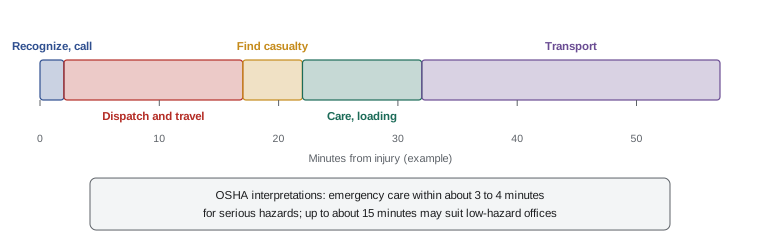
Plan how workers will call for help from every part of the site, including basements, tunnels, remote yards and vehicles where mobile coverage may be poor. Post the emergency number, the site address and directions to the site at phones and first aid stations. Agree meeting points for ambulances, keep access routes clear and unlocked, and mark buildings and doors so responders can find the casualty quickly. For remote and mobile work, plan check-in systems for lone workers, satellite communicators where needed and, where emergency services cannot reach the site in a reasonable time, a means of transporting injured workers safely, as some provinces require.
Worked problem
Sizing a first aid response
A new distribution center will have 160 workers on the day shift and 40 on the night shift, with forklifts, conveyors and a cardboard baler. The local ambulance response time is typically 9 to 12 minutes. Do OSHA interpretations suggest that trained first aid providers are needed on site, and how many would you plan for if you aim for at least one per 50 workers so that one is always reachable within a few minutes?
Show solution
- Response time: 9 to 12 minutes is longer than the 3 to 4 minute benchmark for workplaces with serious hazards such as forklifts and balers, so trained first aid providers are needed on site.
- Day shift: \(160 \div 50 = 3.2\), so plan for 4 trained providers spread across the building.
- Night shift: \(40 \div 50 = 0.8\), so at least 1, and plan for 2 to cover breaks and absences.
- Also: ANSI Class B kits, an AED reachable within about 3 minutes, bleeding control supplies near the baler and conveyors, eyewash at battery charging, bloodborne pathogen training and an exposure control plan for designated providers, and an annual drill.
Answer: Yes, trained providers are needed. Plan about four on the day shift and two on the night shift, with Class B kits, an AED, bleeding control supplies, bloodborne pathogen precautions and drills.
Step 5: records and reporting
Record every first aid treatment: the date and time, the person's name, what happened, the injury, the care given and by whom, and whether the person returned to work or was referred for medical care. Keep records confidential and use them, in summary form without names, to look for patterns that point to hazards. Records also protect workers if a minor injury later becomes serious.
OSHA's recordkeeping rule, 29 CFR 1904, requires covered employers to record work-related injuries that result in death, days away from work, restricted work or job transfer, medical treatment beyond first aid, loss of consciousness or a significant diagnosed injury. Section 1904.7(b)(5)(ii) gives a complete list of 14 treatments that count as first aid, such as using non-prescription medication at non-prescription strength, cleaning and covering wounds with bandages or butterfly closures, hot or cold therapy, non-rigid supports such as elastic bandages, temporary splints used only for transport, removing splinters or eye particles by simple means, and drinking fluids for heat stress. Treatments not on the list, such as sutures, skin glue, rigid splints for immobilization or prescription medication, are medical treatment and make the case recordable. Serious injuries must also be reported to OSHA: a death within 8 hours, and an in-patient hospitalization, amputation or loss of an eye within 24 hours.
Worked problem
Classifying cases and calculating a rate
A plant with 85 workers recorded 22 cases treated only with first aid, 6 cases with medical treatment beyond first aid (stitches, prescription medication) and 2 cases with days away from work, with 170,000 hours worked. Calculate the OSHA total recordable incident rate and the share of all cases that were first aid only.
Show solution
- Cases beyond first aid: \(6 + 2 = 8\).
- Rate per 200,000 hours: \(8 \times 200{,}000 \div 170{,}000 \approx 9.4\).
- All cases: \(22 + 8 = 30\); first aid only: \(22 \div 30 \approx 73\%\).
- The first aid cases are not counted in the rate, but their pattern still shows where hazards are.
Answer: A total recordable incident rate of about 9.4, and about 73 percent of all cases were first aid only and not recordable.
Step 6: drills, review and support
Practice. A short drill, such as a simulated collapse in a remote part of the building, tests whether people know how to call for help, whether the AED and kits can be found and reached quickly, whether directions to the site work and whether first aiders can reach every area. British Columbia, for example, now requires annual first aid drills. Review the program after every serious incident and at least yearly: are certificates current, are kits stocked, has the workforce or the hazard profile changed?
Giving first aid at a serious incident can be distressing, especially if the casualty is a friend or does not survive. Reactions such as replaying the event, poor sleep, irritability and guilt are common. Good programs check in with first aiders and witnesses after serious incidents, offer time off and access to the employee assistance program or other support, and treat the reactions as normal. HSE-109 covers psychological health and safety in more depth.
Capstone exercise
Apply the course to a scenario. A worker at a 60-person metal fabrication shop is cut deeply on the thigh by a falling sheet of steel. Blood is pooling on the floor. The nearest hospital is 25 minutes away. Work through the response: check the scene and stop the overhead crane; check the response; send a named co-worker to call 9-1-1, bring the bleeding control kit and AED and meet the ambulance; apply firm direct pressure, then a tourniquet high and tight on the thigh if bleeding continues, recording the time; treat for shock by laying the worker down, keeping them warm and giving nothing by mouth; monitor and record vital signs; hand over to paramedics with the tourniquet time; send the steel sheet incident for investigation; record the first aid and report the injury; and offer support to the first aider and witnesses. Then review the program: were there enough trained first aiders, was the tourniquet where it was needed, did the call and the ambulance meeting point work?
Common mistakes
MistakeBuying a standard kit without assessing the workplace.
InsteadBase kits, first aiders and equipment on the workforce, hazards and response time.
MistakeHaving first aiders only on the day shift.
InsteadMake sure trained first aiders and supplies are available on every shift.
MistakePosting no site address or directions by phones.
InsteadPost the emergency number, address and directions, and set ambulance meeting points.
MistakeNot recording minor first aid cases.
InsteadRecord every treatment and review patterns to prevent injuries.
MistakeExpecting first aiders to carry on as normal after a fatality.
InsteadCheck in, offer time and support, and treat stress reactions as normal.
Summary and key terms
- A first aid assessment considers workforce size, hazards, response time, site layout and special needs.
- OSHA requires trained first aid providers where emergency care is not available within about 3 to 4 minutes for serious hazards.
- ANSI/ISEA Z308.1-2021 sets Class A and Class B kits; kits must be accessible on every shift and inspected regularly.
- Plan communication from every area, posted addresses, ambulance meeting points and transport for remote sites.
- Record all first aid; OSHA's 1904.7 first aid list separates first aid from recordable medical treatment.
- Run drills, review the program and support first aiders and witnesses after serious incidents.
- The whole response, from scene safety to handover, records and review, makes first aid effective.
- First aid assessment
- An evaluation of the workplace to decide first aid people, supplies and procedures.
- Hazard rating
- A classification of the workplace's injury risk, such as low, medium or high.
- Travel time
- The time for a casualty to reach medical care or for responders to reach the site.
- First aid station
- A marked location with a kit, posted information and a responsible first aider.
- First aid room
- A dedicated room with equipment and staff for larger workplaces.
- Kit type or class
- A standardized category of first aid kit contents.
- First aid record
- A confidential log of first aid treatments given.
- Recordable case
- An injury that must be entered in official injury records, such as one needing medical treatment beyond first aid.
- Drill
- A practice exercise to test the emergency response.
- Critical incident support
- Help for workers after a distressing event, such as check-ins and counseling.
Practice problems
Work each problem on paper first, then reveal the answer to check.
Name four factors in a first aid assessment.
Show answer
Number of workers, hazards, response or travel time and site layout (also special needs).
What response time does OSHA use as a benchmark for workplaces with serious hazards?
Show answer
About 3 to 4 minutes.
Which industries require trained first aid responders regardless of EMS response time?
Show answer
Logging and electric power work, among others.
What is the difference between ANSI Class A and Class B kits?
Show answer
Class B has a broader range and quantity of supplies for complex or high-risk workplaces.
Within about how long should an AED be reachable and brought back?
Show answer
About 3 minutes.
What should a first aid record include?
Show answer
Date and time, name, what happened, the injury, care given, by whom and the outcome.
Is a butterfly bandage first aid or medical treatment under 1904.7?
Show answer
First aid.
A site has 4 recordable cases and 100,000 hours worked. What is the rate per 200,000 hours?
Show answer
8.0.
Why run first aid drills?
Show answer
To test calling for help, finding kits and AEDs, giving directions and reaching every area.
What support should first aiders receive after a serious incident?
Show answer
Check-ins, time off if needed and access to counseling or the employee assistance program.
Lesson quiz · 5 questions
Score 60% or more to complete this lesson.
Create a free account to save your progress, take quizzes and earn a certificate.