
HSE-110 · Lesson 5 of 12 · 25 min
Wounds, infection control and bloodborne pathogens
Most first aid at work involves minor wounds: cuts from box cutters and sheet metal, scrapes from rough surfaces, punctures from nails and splinters, and small skin tears. Treated well, they heal quickly. Treated badly, or not at all, they can become infected, and some need medical care that a first aider should recognize. This lesson covers the types of wounds, cleaning and dressing minor wounds, signs of infection and when to seek medical care. It also covers protecting yourself from bloodborne pathogens, the viruses that can be carried in blood and some other body fluids.
Types of wounds
- Abrasions (scrapes and grazes): the top layers of skin are rubbed away. They bleed little but can be very painful and often contain dirt and grit.
- Lacerations (cuts): the skin is cut or torn. Clean cuts from sharp edges have straight edges; tears from blunt force have ragged edges and may bruise.
- Punctures: a narrow, deep wound from a nail, splinter, needle or tool. They may bleed little but carry a high risk of infection, including tetanus, because dirt is pushed deep into the tissue.
- Avulsions: a flap of skin or tissue is partly or completely torn away.
- Amputations: a body part is cut or torn off (Lesson 4).
- Crush injuries: tissue is squashed between objects. The skin may look intact while deeper tissue is badly damaged.
- Bites: animal and human bites carry a high risk of infection and always need medical assessment.
Caring for minor wounds
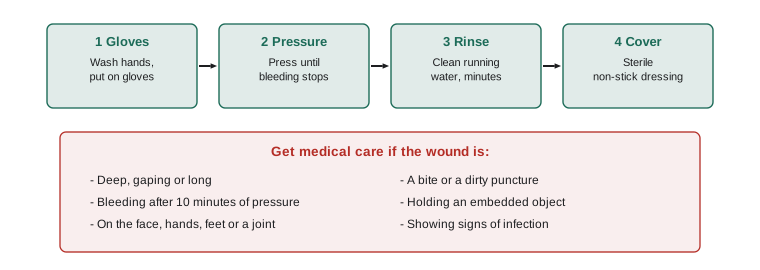
For a minor wound that is not bleeding heavily, the aims are to stop the bleeding, clean the wound and protect it from infection. Wash your hands and put on gloves. Apply pressure with a clean dressing until bleeding stops. Then rinse the wound under clean running water, such as drinking-quality tap water, for several minutes to wash out dirt and germs. Saline or sterile water is fine but not necessary; clean tap water works well. Gently remove loose dirt with clean gauze or tweezers cleaned with alcohol, but leave anything embedded deeply for a health care provider. Pat the surrounding skin dry and cover the wound with a sterile, non-stick dressing or an adhesive bandage. An antibiotic ointment may be applied if the person has no allergy and workplace practice allows it.
Do not use cotton wool directly on a wound because fibers stick to it, and avoid hydrogen peroxide or strong antiseptics in the wound itself, which can damage tissue and slow healing. Advise the person to keep the wound clean and dry, change the dressing daily or when it becomes wet or dirty, and watch for signs of infection.
When a wound needs medical care
Refer the person to a health care provider, or call 9-1-1 if the situation is serious, when a wound:
- bleeds heavily or does not stop after 10 minutes of firm pressure;
- is deep, gaping or long, or shows fat, muscle or bone, since it may need stitches or other closure, ideally within hours;
- is on the face, hands, feet or genitals, or crosses a joint;
- contains an embedded object or dirt that cannot be rinsed out;
- is a puncture, especially from a rusty or dirty object, or is a bite;
- was caused by a high-pressure injection of grease, paint or hydraulic fluid, which can look like a pinprick but is a surgical emergency;
- is accompanied by numbness, weakness or loss of movement beyond the wound;
- shows signs of infection.
Ask about tetanus immunization for any wound contaminated with soil, rust, manure or saliva, and for punctures. Adults need a tetanus booster every 10 years, or sooner after a dirty wound if more than five years have passed since the last dose. A first aider does not give vaccines but should advise the person to check with a health care provider.
Signs of infection
Signs of a wound infection usually appear one to three days after the injury. They include increasing pain, redness spreading from the wound, swelling, warmth, pus or cloudy fluid, a bad smell and red streaks spreading up the limb. Fever, chills and feeling unwell suggest the infection is spreading and needs urgent medical care. Encourage workers to report any wound that is getting worse rather than better, and to keep minor wounds covered at work, especially in food handling, health care and dirty environments.
Bloodborne pathogens
Bloodborne pathogens are micro-organisms in blood that can cause disease in people exposed to that blood. The three of greatest concern are hepatitis B virus (HBV), hepatitis C virus (HCV) and human immunodeficiency virus (HIV). They spread when infected blood, or certain other body fluids, enters the body of another person through a needlestick or cut, through broken skin such as cuts, chapped skin or dermatitis, or through mucous membranes in the eyes, nose or mouth. They are not spread through intact skin, casual contact, sneezing or sharing tools.
The risk from a single exposure is low but not zero. Studies of health care workers have estimated the average risk of infection after a needlestick from an infected source at roughly 6 to 30 percent for hepatitis B in an unvaccinated person, about 1.8 percent for hepatitis C and about 0.3 percent for HIV. Splashes onto mucous membranes carry lower risks. Hepatitis B vaccination is highly effective, and effective treatments now exist for hepatitis C and for preventing HIV infection after an exposure if started quickly, ideally within hours.
Worked problem
Comparing exposure risks
Using the average needlestick risks above, estimate how many infections would be expected per 1,000 needlestick exposures to infected blood for each virus, and explain why prompt reporting matters.
Show solution
- HIV: \(0.003 \times 1{,}000 = 3\) infections per 1,000 exposures.
- Hepatitis C: \(0.018 \times 1{,}000 = 18\) infections per 1,000 exposures.
- Hepatitis B in unvaccinated people: \(0.06 \times 1{,}000 = 60\) to \(0.30 \times 1{,}000 = 300\) per 1,000; in vaccinated people the risk is close to zero.
- Prompt reporting matters because post-exposure treatment for HIV works best when started within hours, hepatitis B protection can be given after exposure, and hepatitis C can be detected and treated early.
Answer: About 3 per 1,000 for HIV, 18 per 1,000 for hepatitis C and 60 to 300 per 1,000 for hepatitis B in unvaccinated people. Vaccination and prompt reporting greatly reduce the risk.
Universal precautions
Because you cannot tell by looking who carries a bloodborne infection, first aiders follow universal (or standard) precautions: treat all blood and potentially infectious body fluids as if they were infected. In practice this means:
- wear disposable gloves for any contact with blood or body fluids, and change them between casualties;
- wear eye protection and a mask if splashing is possible, and use a CPR barrier device for rescue breaths;
- cover your own cuts and broken skin with waterproof dressings before giving first aid;
- remove gloves carefully so that the outside does not touch your skin, and wash your hands with soap and water immediately afterwards, or use alcohol-based hand rub if water is not available;
- handle sharps, such as broken glass or needles, with tools rather than fingers and place them in a puncture-resistant container;
- clean up blood spills using gloves, absorbent material and a suitable disinfectant, such as a fresh dilute bleach solution or an approved product, following the workplace procedure;
- dispose of contaminated materials in a sealed bag or a biohazard container according to local rules.
If you are exposed
If blood gets into a cut, onto broken skin, into your eyes, nose or mouth, or if you are stuck by a used needle: wash the skin with soap and water, flush eyes or mouth with plenty of clean water, do not squeeze the wound, and report the exposure to your supervisor immediately. Seek medical assessment the same day, preferably within two hours, so that a health care provider can assess the risk and offer testing, hepatitis B protection and, if indicated, medication to prevent HIV.
In the US, OSHA's Bloodborne Pathogens Standard, 29 CFR 1910.1030, applies to employees with reasonably anticipated occupational exposure, including employees designated to give first aid as part of their duties. Employers must have a written exposure control plan, provide training and protective equipment, offer hepatitis B vaccination within 10 working days of assignment, and provide confidential post-exposure evaluation and follow-up. OSHA allows an exception for employees who give first aid only as a collateral duty: vaccination may instead be offered within 24 hours after a first aid incident involving blood, provided the employer meets the conditions OSHA has set out, including reporting such incidents.
Splinters, fishhooks and skin tears
Small splinters near the surface can be removed with clean tweezers after washing the area; pull in the same direction the splinter went in, then wash and cover. Deep splinters, splinters under a nail, glass, and anything in the eye should be left for a health care provider. Fishhooks and barbed objects embedded past the barb should usually be left in place, stabilized and assessed by a health care provider, because pulling them out tears tissue.
Skin tears, common in older workers and people taking blood thinners, are thin flaps of skin torn away by minor bumps. Rinse gently, ease the flap back into place if it is still attached, cover with a non-stick dressing and avoid adhesive tape on fragile skin. Friction blisters from new boots or gloves are best left intact and protected with a padded dressing; if a blister has already broken, wash it and cover it.
| Wound | First aid | Refer for medical care if |
|---|---|---|
| Abrasion | Rinse thoroughly, remove loose grit, cover with non-stick dressing | Large area, deeply embedded dirt, signs of infection |
| Laceration | Pressure, rinse, cover | Deep, gaping, longer than about 2 cm on face or hands, bleeding will not stop |
| Puncture | Let it bleed a little, rinse, cover | Dirty or rusty object, deep, on hand or foot, high-pressure injection |
| Avulsion | Pressure, replace flap if attached, cover | Always, unless very small |
| Bite | Rinse with soap and water for several minutes, cover | Always |
Remember that the first aid kit is only as good as its last inspection. Gloves perish, dressings expire and adhesive bandages run out quickly in busy workplaces. Restock after every use, check expiry dates and make sure gloves come in sizes that fit everyone, including people with latex allergies.
Common mistakes
MistakeUsing hydrogen peroxide or strong antiseptic inside a wound.
InsteadRinse with clean running water and cover with a sterile dressing.
MistakeTreating a high-pressure injection injury as a minor puncture.
InsteadSend the person for emergency care immediately; it is a surgical emergency.
MistakeReusing the same gloves for two casualties.
InsteadChange gloves and clean your hands between casualties.
MistakeWaiting until the end of the shift to report a blood exposure.
InsteadWash, report immediately and seek medical assessment the same day, preferably within two hours.
MistakePicking up broken glass with your fingers.
InsteadUse tongs or a dustpan and place sharps in a puncture-resistant container.
Summary and key terms
- Wounds include abrasions, lacerations, punctures, avulsions, amputations, crush injuries and bites.
- For minor wounds: stop bleeding, rinse under clean running water, cover with a sterile non-stick dressing.
- Refer deep, gaping, contaminated, bite, puncture and high-pressure injection wounds and those on the face, hands or joints.
- Advise a tetanus check for dirty wounds; adults need boosters every 10 years.
- Infection signs include spreading redness, swelling, warmth, pus and fever.
- Hepatitis B, hepatitis C and HIV can spread through blood entering broken skin, mucous membranes or punctures.
- Follow universal precautions; OSHA 1910.1030 covers designated first aiders, including hepatitis B vaccination and post-exposure follow-up.
- Abrasion
- A scrape or graze in which the top layers of skin are rubbed away.
- Laceration
- A cut or tear in the skin.
- Puncture
- A narrow, deep wound caused by a pointed object.
- Avulsion
- A flap of skin or tissue partly or completely torn away.
- High-pressure injection injury
- Injection of grease, paint or fluid under pressure into the skin; a surgical emergency.
- Tetanus
- A serious bacterial infection that can enter through dirty wounds; prevented by vaccination.
- Bloodborne pathogen
- A micro-organism in blood that can cause disease, such as hepatitis B, hepatitis C or HIV.
- Universal precautions
- Treating all blood and body fluids as potentially infectious.
- Exposure control plan
- A written plan for preventing and responding to exposure to blood and body fluids.
- Post-exposure follow-up
- Medical assessment, testing and treatment after an exposure to blood.
Practice problems
Work each problem on paper first, then reveal the answer to check.
What is the best way to clean a minor wound?
Show answer
Rinse it under clean running water for several minutes.
Why are puncture wounds a concern?
Show answer
Dirt is pushed deep into the tissue, increasing the risk of infection, including tetanus.
A worker has a pinprick on the finger from a grease gun. What should you do?
Show answer
Treat it as a high-pressure injection injury and send them for emergency care.
How often do adults need a tetanus booster?
Show answer
Every 10 years, or sooner after a dirty wound if more than five years have passed.
List three signs of wound infection.
Show answer
Spreading redness, swelling, warmth (also pus, bad smell, red streaks, fever).
Name the three main bloodborne pathogens of concern.
Show answer
Hepatitis B, hepatitis C and HIV.
Can bloodborne pathogens enter through intact skin?
Show answer
No; they need broken skin, mucous membranes or a puncture.
What should you do immediately after a needlestick?
Show answer
Wash with soap and water, report it and seek medical assessment the same day.
What are universal precautions?
Show answer
Treating all blood and body fluids as if infected and using barriers and hygiene accordingly.
Within how many working days must hepatitis B vaccine be offered under 1910.1030?
Show answer
Within 10 working days of assignment.
Lesson quiz · 5 questions
Score 60% or more to complete this lesson.
Create a free account to save your progress, take quizzes and earn a certificate.