
GCP-194 · Lesson 8 of 12 · 18 min
Commonly confused services and features
▶ Video coming soon A video version of this lesson is on the way.
Many questions on the exam offer four answers that are all real Google Cloud products, and two of them do similar jobs. A candidate who knows each product in isolation can still lose the mark, because the question turns on the one difference between the pair. Mateo's diagnostic showed the pattern clearly: of his six knowledge errors, four were confusions between two neighboring services, not gaps where he had never heard of the answer.
Aisha's approach is to learn the look-alikes as pairs. For each pair, Mateo writes down one sentence that says what decides between them, and one clue word that, when it appears in a question, points to one side. This lesson collects the pairs that matter most for the Associate Data Practitioner exam, grouped by the section of the guide where they usually appear.
Processing and transformation
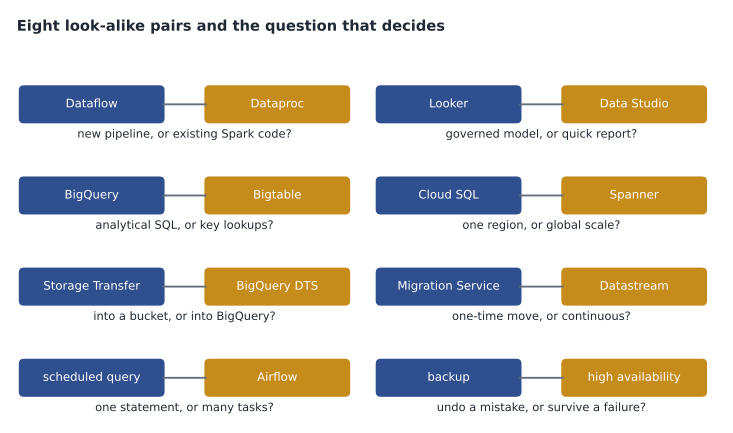
The pair that cost Mateo a question in the diagnostic was Dataflow against Dataproc. Both process large amounts of data in parallel. Dataflow runs Apache Beam pipelines, serverless, for batch or streaming, with autoscaling and no cluster to manage. Dataproc runs Apache Spark, Hadoop and related open-source tools on clusters, or serverless for Spark. The deciding question is whether the team already has Spark or Hadoop code. If it does, and wants to move it with few changes, Dataproc. If the pipeline is new, especially if it streams, Dataflow.
| Pair | Choose the first when | Choose the second when | Clue words |
|---|---|---|---|
| Dataflow / Dataproc | A new batch or streaming pipeline, with no cluster to manage | Existing Spark or Hadoop jobs must move with minimal changes | "Apache Beam", "streaming", "serverless" / "existing Spark", "Hadoop", "lift and shift" |
| Dataform / Cloud Data Fusion | Transformations are SQL in BigQuery, managed as code with tests | A visual, drag-and-drop pipeline with many connectors is wanted | "SQLX", "assertions", "version control" / "visual", "no code", "connectors" |
| BigQuery SQL / Dataflow | Data is already in BigQuery and the transformation is set-based | Data must be transformed in flight, before it lands, or per event | "ELT" / "ETL", "per record", "in flight" |
| Scheduled query / Airflow | One SQL statement runs on a timer | Many tasks with dependencies, retries and branching | "daily", "one query" / "DAG", "dependencies", "orchestrate" |
| Workflows / Airflow | A short chain of service calls triggered by an event | Long-running batch pipelines with many steps on a schedule | "call APIs", "event" / "DAG", "backfill", "Python operators" |
A note on names: in the copy of the guide we read, the Airflow service appears as Cloud Composer. Google announced in April 2026 that it is being renamed Managed Service for Apache Airflow. Either name means the same thing on the exam: managed Apache Airflow, for orchestrating many dependent tasks.
Storage and databases
The storage look-alikes are the largest group, because section 1 asks candidates to choose a storage system for a given use case. The way to keep them apart is to ask three questions in turn: is the data analyzed in bulk or read and written one record at a time; is it relational or not; and how large, and how widely spread, is the workload?
| Pair | Choose the first when | Choose the second when |
|---|---|---|
| BigQuery / Bigtable | Analytical SQL over large data: aggregations, joins, reports | Very fast reads and writes of single rows by key, at huge scale, such as time series or device data |
| Cloud SQL / Spanner | A relational database for one application, in one region, at moderate scale; MySQL, PostgreSQL or SQL Server | A relational database that must scale horizontally and stay strongly consistent across regions |
| Cloud SQL / AlloyDB | Standard managed PostgreSQL, MySQL or SQL Server at moderate scale | PostgreSQL-compatible with higher performance and analytical queries on transactional data |
| Firestore / Bigtable | Documents for web and mobile apps, with offline sync and flexible fields | Wide-column data at very high throughput, read by row key |
| Cloud Storage / BigQuery | Files and objects of any kind: images, logs, exports, a data lake | Tables to query with SQL |
| Nearline / Coldline | Read about once a month; 30-day minimum | Read about once a quarter; 90-day minimum |
Birchline's own systems make useful anchors. Its till system writes to Cloud SQL, because each store's transactions are relational and modest in volume. Its reporting runs in BigQuery. It does not use Bigtable or Spanner, which is exactly why Mateo marked them as gaps in lesson 1: he has only read about them. Aisha suggests he anchor each to a picture. Bigtable is the sensor on every delivery truck sending a reading every few seconds. Spanner is a bank's account table that must be correct on every continent at once.
Moving data in
Section 1 also asks candidates to choose a transfer or extraction tool. Five tools are easy to confuse because all of them move data into Google Cloud.
| Tool | Moves | Typical clue |
|---|---|---|
| Storage Transfer Service | Files from other clouds, on-premises storage or URLs into Cloud Storage, once or on a schedule | "copy files from Amazon S3", "nightly sync to a bucket" |
| BigQuery Data Transfer Service | Data from SaaS applications, other warehouses and Cloud Storage into BigQuery, on a schedule | "Google Ads", "YouTube", "load into BigQuery every day" |
| Transfer Appliance | Very large data sets on a physical device shipped to Google | "hundreds of terabytes", "limited bandwidth" |
| Database Migration Service | A database to Cloud SQL or AlloyDB, with minimal downtime, as a one-time move | "migrate", "cut over" |
| Datastream | Continuous change data capture from a database into BigQuery or Cloud Storage | "replicate changes", "near real time", "CDC" |
The two pairs inside that table that matter most are Storage Transfer Service against BigQuery Data Transfer Service, where the destination decides (a bucket or a table), and Database Migration Service against Datastream, where time decides (a move that ends, or a stream that continues). Lesson 4 worked through the bandwidth arithmetic that decides when Transfer Appliance beats a network transfer.
Worked problem
Reading a transfer question
A question says: "A retailer keeps two years of sales history in a PostgreSQL database on premises. Analysts want the history in BigQuery, and they want new and changed rows to appear in BigQuery within minutes of being written. The database will keep running on premises." Which tool fits best?
Show solution
- The destination is BigQuery, not Cloud SQL, so this is not a database migration.
- "New and changed rows within minutes" is continuous change capture.
- "The database will keep running on premises" rules out a one-time move.
- Datastream fits: it replicates changes continuously from PostgreSQL into BigQuery. Database Migration Service would move the database itself to Cloud SQL or AlloyDB.
Answer: Datastream.
Analysis and presentation
| Pair | Choose the first when | Choose the second when |
|---|---|---|
| Looker / Data Studio | A governed semantic model in LookML, shared definitions of metrics, embedded analytics | A quick self-service report or dashboard, free, from many sources |
| BigQuery ML / Vertex AI AutoML | Data is in BigQuery and analysts want to train with SQL | A custom model on images, text or tabular data with little code, outside SQL |
| Pretrained APIs / training a model | A common task, such as translation, vision labels or sentiment, where a general model is good enough | The task is specific to the business and labeled data exists |
| Colab Enterprise / BigQuery Studio SQL | Python exploration, charts and libraries in a notebook | SQL queries and saved queries, without Python |
| Authorized view / BigQuery sharing | Share a filtered subset within an organization | Publish a dataset to other projects or organizations as a listing |
Names matter here again. The exam guide we read still says Looker Studio for the free reporting tool, which Google renamed Data Studio in April 2026, and Analytics Hub for what is now BigQuery sharing. Looker itself was not renamed. A question that offers both Looker and Looker Studio is the same pair as Looker and Data Studio.
Governance and recovery
| Pair | The difference |
|---|---|
| Backup / high availability | A backup undoes a mistake by restoring an earlier copy; high availability survives a failure by switching to a standby, which copies mistakes too |
| Time travel / fail-safe | Time travel, up to seven days, can be used by the customer to read or restore data; fail-safe, seven more days, can only be recovered through Google support |
| Table snapshot / table clone | A snapshot is a read-only copy kept for recovery; a clone is a writable copy that shares storage until it changes |
| CMEK / CSEK | Customer-managed keys live in Cloud KMS; customer-supplied keys are held by the customer and sent with each request, and only some services support them |
| Partitioning / clustering | Partitioning divides a table by a date, time or integer column so queries can skip whole partitions; clustering sorts data within the table by up to four columns |
| Knowledge Catalog / policy tags | The catalog finds, describes and profiles data; policy tags restrict access to columns in BigQuery |
Two of those rows link to the 2026 renames. The guide we read lists Dataplex for cataloging and governance; Google renamed it Knowledge Catalog in April 2026, and the older Data Catalog service shut down on June 1, 2026. Policy tags survived the change, so a question about restricting a column of salaries or card numbers still points to policy tags.
A drill for look-alikes
Aisha's drill takes five minutes and Mateo plans to run it twice a week until the exam. She reads a one-line need aloud, and he names the product in under ten seconds, then the product it is most often confused with, then the clue that decided. A wrong or slow answer goes into his error log, which lesson 10 turns into a study plan. In the first run, on November 14, he got 15 of 20 within the time, and all five misses were in storage and transfer.
| Need read aloud | Answer | Look-alike | Deciding clue |
|---|---|---|---|
| Millions of truck sensor readings a minute, read by truck and time | Bigtable | BigQuery | Single-row reads by key at high throughput |
| Move a MySQL database to Google Cloud with a short cut-over | Database Migration Service | Datastream | A one-time move |
| Copy a nightly export from another cloud into a bucket | Storage Transfer Service | BigQuery Data Transfer Service | The destination is a bucket |
| Restore a table as it was yesterday | Time travel | Fail-safe | Within seven days, by the customer |
| Run existing Spark jobs with few changes | Dataproc | Dataflow | Existing Spark code |
The drill is deliberately quick because the exam is. On a real question Mateo will have about two minutes, but the decision between a pair usually takes only a few seconds once the clue is spotted. The rest of the time goes on reading the scenario. Training the decision to be fast leaves more time for reading, which was his larger source of errors.
Look-alikes in loading data
One more group catches candidates because all of its members end with data being queryable in BigQuery. The difference is where the data lives and how fresh it is. A load job copies files from Cloud Storage into BigQuery storage, which gives the best query performance and costs nothing to run, but the data is only as fresh as the last load. An external table queries files where they sit, in Cloud Storage or even a Google Sheet, so it is always current but slower, and it lacks some features of native tables. A BigLake table is an external table with finer access control, including row and column security, managed through a connection. And streaming with the Storage Write API writes rows into BigQuery within seconds, for data that must be current, at a cost per amount of data written.
| Need | Fits best |
|---|---|
| A nightly file, queried heavily all day | A load job |
| A small sheet that business users edit, queried occasionally | An external table |
| Files in a lake, queried with row and column security | A BigLake table |
| Events that must be queryable within seconds | Streaming with the Storage Write API |
Common mistakes
MistakeChoosing the product Birchline uses.
InsteadChoose the product the scenario calls for; the company in the question is not Birchline.
MistakePicking Dataflow for any large job.
InsteadExisting Spark or Hadoop code points to Dataproc.
MistakeTreating the two transfer services as one.
InsteadA bucket destination means Storage Transfer Service; a BigQuery destination from SaaS sources means BigQuery Data Transfer Service.
MistakeChoosing Database Migration Service for continuous replication into BigQuery.
InsteadContinuous change capture into BigQuery is Datastream.
MistakeAnswering by the newest product name only.
InsteadRecognize the older names in the guide: Looker Studio, Dataplex, Cloud Composer, Analytics Hub.
Summary and key terms
- Many questions turn on the difference between two similar products.
- Learn look-alikes as pairs, with one deciding question and a clue word for each side.
- Dataflow suits new or streaming pipelines; Dataproc suits existing Spark and Hadoop.
- BigQuery is for analytical SQL; Bigtable for fast key lookups at scale; Cloud SQL for regional relational work; Spanner for global relational scale.
- Storage Transfer Service fills buckets; BigQuery Data Transfer Service fills tables; Database Migration Service moves databases once; Datastream replicates changes continuously.
- Looker gives a governed model; Data Studio gives quick reports.
- Backups undo mistakes; high availability survives failures.
- A short timed drill makes the decision fast.
- Look-alike pair
- Two products that do similar jobs, separated by one deciding difference.
- Clue word
- A word in a question that points to one product of a pair.
- Bigtable
- A wide-column NoSQL database for fast reads and writes by row key at very large scale.
- Spanner
- A relational database that scales horizontally and stays strongly consistent across regions.
- Datastream
- A service for continuous change data capture from databases into BigQuery or Cloud Storage.
- Database Migration Service
- A service for moving a database to Cloud SQL or AlloyDB with minimal downtime.
- Table clone
- A writable copy of a BigQuery table that shares storage with the original until changed.
- Fail-safe
- A further seven days after time travel during which Google can recover deleted BigQuery data.
Practice problems
Work each problem on paper first, then reveal the answer to check.
What decides between Storage Transfer Service and BigQuery Data Transfer Service?
Show answer
The destination: a Cloud Storage bucket or a BigQuery table.
A team must replicate new orders from an on-premises database into BigQuery within minutes. Which tool?
Show answer
Datastream.
Name the older guide names for Data Studio and Knowledge Catalog.
Show answer
Looker Studio and Dataplex.
Lesson quiz · 5 questions
Score 60% or more to complete this lesson.
Create a free account to save your progress, take quizzes and earn a certificate.