
GCP-194 · Lesson 2 of 12 · 19 min
Registering, scheduling and exam delivery
▶ Video coming soon A video version of this lesson is on the way.
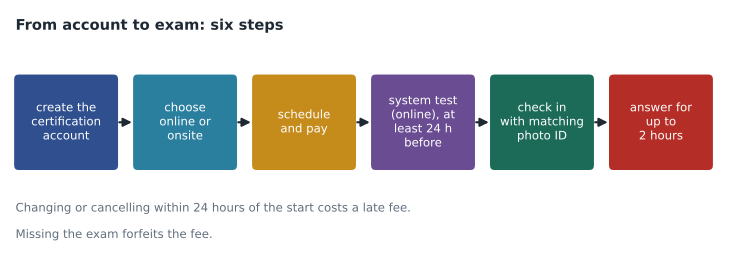
Some exam attempts fail before the first question appears. A booking name that does not match the ID card, a laptop that fails the system test, a work computer whose security software blocks the proctoring program, a candidate who arrives at the wrong building twenty minutes late: each of these can cost a fee and a month of momentum. Aisha has seen two colleagues lose a booking that way. In the second session of the workshop, on Friday afternoon, she walks Mateo through every step from creating an account to sitting down at the exam, so that on the day the only thing he has to think about is data.
The details in this lesson come from Google's certification help pages as we read them in November 2026. Google and its testing partner update these pages from time to time, and the rules that apply to a candidate are the ones published when they book. Treat this lesson as a map of what to check, not a substitute for checking.
Who can take the exam
Google's certification help pages say that anyone aged 18 or older can take a Google Cloud certification exam. There are no prerequisite certifications for the Associate Data Practitioner, and no requirement to have completed a particular course, including this one. The recommended experience from lesson 1, six months or more of hands-on work with data on Google Cloud, is advice, not a rule. By his planned exam date in April 2027, Mateo will have worked with Birchline's data platform for about six and a half months, which is close enough that Ravi is comfortable with the date.
Creating the account and the legal name
Registration starts in Google's certification portal, reached from the Register link on the certification page. Mateo signs in with a personal Google account rather than his Birchline work account. Aisha explains why. A certification belongs to the person, not the employer. If Mateo ever leaves Birchline, a certificate tied to a work account he can no longer sign in to becomes hard to manage, and the renewal reminders three years from now would go to an inbox that no longer exists. The same personal account will receive his results, his digital certificate and his badge.
The most important field in the profile is the legal name. Google's testing requirements say the legal name in the portal must match the government-issued photo ID checked on exam day, and that it must be entered in Romanized characters. A shortened first name, a missing middle name the ID shows, an accent the ID does not use, or a married name not yet on the ID are all common causes of a refused check-in. Mateo's passport says Mateo Andrés Alvarez. He enters exactly that, and then checks how the passport writes the accent, because the portal and the ID must agree.
| Check before booking | Why it matters |
|---|---|
| Legal name in the portal matches the photo ID exactly, in Romanized characters | A mismatch can mean the attempt is refused and the fee lost |
| The ID is valid on the exam date, not just today | An ID that expires in between is not acceptable |
| A personal email address is on the account | Results, certificates and renewal reminders go there |
| The time zone is set correctly | Appointment times are shown in the account's time zone |
| The exam selected is the Associate Data Practitioner, in the right language | English and Japanese versions are separate choices |
Online or onsite?
The exam can be taken in two ways. Online-proctored delivery uses the testing partner's remote proctoring software on the candidate's own computer, with a proctor watching through the webcam and listening through the microphone. Onsite delivery takes place at a testing center run by the partner; the certification page tells candidates to search for Google Cloud on the partner's site to find one. The questions and the time are the same. What differs is the environment, the equipment and what can go wrong.
| Factor | Online-proctored | Onsite at a testing center |
|---|---|---|
| Where | Home or a quiet private room | The partner's testing location |
| Equipment | Your computer, webcam, microphone and connection must pass the system test | Provided by the center |
| Room rules | Quiet, well lit, nobody else present; a room scan; a clear desk; extra monitors disconnected | Personal items stored in a locker before entering |
| Breaks | None; you must stay in the camera's view | Ask the center about its rules before booking |
| Identification | One government-issued photo ID | Two forms of ID, one of them a government-issued photo ID |
| Typical risks | Connection drops, noise, someone walking in, a work laptop that blocks the software | Travel time, parking, finding the room, arriving late |
Google's program policies also say that an online exam can be stopped, or its result canceled, for problems such as lost or poor video, poor audio, too much background noise, another person in the room, or pressing a forbidden key such as Print Screen, and that fees are not refunded in those cases. Mateo shares a flat with a roommate who works irregular shifts, and his only computer at home is his Birchline laptop, whose security software he cannot change. Aisha points out that corporate laptops are one of the most common reasons an online system test fails. He books a testing center.
The nearest testing location to Birchline's head office is a short drive from his apartment. Mateo plans to visit the building once in March to find the entrance, the parking and the waiting area, so that on the morning of the exam there are no surprises.
If you choose online delivery
Many candidates sit online exams without trouble, and for someone with a quiet room and a personal computer it can be the more convenient choice. The rules are strict because the proctor has only the camera to go on. A candidate choosing online delivery should run the system test on the exact computer, network and room they will use, and Google's testing requirements say to do it at least 24 hours before the appointment, so that there is time to fix a problem. A test run in the office on Wednesday says nothing about the home network on Friday.
| Online check | What to do |
|---|---|
| System test | Run it on the same computer and network at least 24 hours before; run it again on the day |
| Webcam and microphone | Use the built-in camera or a single external one; the proctor must see your face and hands |
| Room | Close the door; remove papers, books and second screens; tell others in the home not to enter |
| Desk | Only the computer, a mouse and keyboard if needed; no phone within reach; drinks only if the rules allow |
| Software | Close every other application; turn off notifications; do not use a work laptop with locked security software |
| Network | Prefer a wired connection; ask others not to stream video during the exam |
Scheduling, paying and changing a booking
Once the account is ready, the candidate chooses the exam, the delivery method, a date and a time, and pays the registration fee. Testing centers usually have fixed morning and afternoon times; online appointments are offered across more of the day. Mateo chooses Thursday, April 15, 2027, at 9:00 at the testing center. He works best in the morning, the date leaves twelve days after his second practice set on April 3, and a Thursday lets him take the Wednesday as a light day without missing a sprint planning meeting.
Google's program policies set out what happens if plans change. A booking can be rescheduled or canceled without penalty before a cut-off. Within 24 hours of the start time, changes carry a late fee. A candidate who does not appear at all forfeits the registration fee. The rule is simple to state and easy to forget, so Mateo writes the cut-off into his calendar the day he books: 9:00 on Wednesday, April 14.
Worked problem
Working out the change deadline
Mateo's exam is booked for 9:00 on Thursday, April 15, 2027. After that, at what time can he no longer reschedule without a late fee? If he were sick on the Tuesday and wanted to move the exam a week, would he face a late fee?
Show solution
- The late-fee window is the 24 hours before the start.
- Counting back 24 hours from 9:00 on Thursday gives 9:00 on Wednesday, April 14.
- Tuesday, April 13 is more than 24 hours before the start, so a change made then is outside the window.
Answer: The deadline is 9:00 on Wednesday, April 14. A change made on Tuesday would not carry a late fee, provided he makes it then rather than waiting.
Identification and arrival
For an onsite exam, Google's testing requirements ask for two forms of identification, at least one of them a current government-issued photo ID, and both showing the same name as the booking. Candidates should arrive about 15 minutes early to check in, which may include a photograph, a signature and a check of pockets and sleeves. Personal items, including phones, watches, bags, notes and food, go into a locker. Mateo plans to bring his passport and his driver's license and to leave home 40 minutes earlier than the trip needs, because a missed exam costs the whole fee.
For an online exam, the check-in is done through the proctoring software: photographs of the candidate and the ID, photographs or a live scan of the room, and a short conversation with the proctor. The software usually opens a little before the appointment. Arriving late in either format can mean the session is canceled.
During the exam
The exam is closed book. There are no notes, no internet search, no console and no calculator other than any the exam software provides. Questions appear one at a time, and the software lets the candidate mark questions for review and move back to them before submitting. The two-hour clock runs continuously, and online candidates cannot take breaks. Lesson 9 covers how to use the review list without letting it eat the last twenty minutes.
Conduct rules matter too. Google's policies forbid sharing exam content, and that includes posting questions online or describing them to colleagues afterwards. Mateo will be free to tell people he passed and what he studied. He will not be free to say what was on the exam.
Accommodations
Google's certification pages describe a process for requesting accommodations, such as extra time or other arrangements for a disability or health condition, and the request has to be made and approved before booking. Candidates who need one should start early, because approval can take time and must be in place before scheduling. Mateo does not need one, but Aisha mentions it because a colleague on the data team does, and she wants him to know the option exists when he mentors others.
Results after the exam
When a candidate finishes, the exam software shows a provisional result on screen. Google's certification FAQ says the official result follows after a review period, and that candidates should allow about 7 to 10 days for it. Results are pass or fail. Lesson 12 covers what happens next in either case, including the waiting periods before a retake.
| Date | Step | Status on November 14, 2026 |
|---|---|---|
| November 2026 | Create the certification account with a personal email; legal name matching the passport | Done on Saturday morning |
| Early February 2027 | Book the exam for Thursday, April 15, 9:00, at a testing center | Planned |
| March 2027 | Visit the testing location once | Planned |
| 9:00 Wednesday, April 14 | Last time to change the booking without a late fee | Planned |
| Thursday, April 15 | Arrive at 8:30 with two IDs; sit the exam at 9:00 | Planned |
| April 22 to 25 | Official result expected | Planned |
Common mistakes
MistakeUsing a work email address for the certification account.
InsteadUse a personal account so results and renewals follow you if you change jobs.
MistakeTyping a short or familiar version of your name.
InsteadEnter the legal name exactly as on the photo ID, in Romanized characters.
MistakeRunning the online system test on a different computer or network.
InsteadRun it on the same computer, network and room, at least 24 hours before.
MistakePlanning to reschedule on the morning of the exam.
InsteadChanges within 24 hours of the start carry a late fee, and a missed exam forfeits the fee.
MistakeTalking about specific exam questions afterwards.
InsteadExam content is confidential; share what you studied, not what was asked.
Summary and key terms
- Anyone 18 or older can take the exam, with no prerequisites.
- Create the certification account with a personal email and a legal name that matches the photo ID exactly.
- Choose online delivery only with a quiet private room and a computer that passes the system test at least 24 hours before; otherwise choose a testing center.
- Changes within 24 hours of the start cost a late fee, and a missed exam forfeits the fee.
- Onsite candidates bring two IDs and arrive about 15 minutes early.
- The exam is closed book, with no breaks online.
- A provisional result appears on screen and the official result follows in about 7 to 10 days.
- Online-proctored exam
- An exam taken on your own computer while a remote proctor watches by webcam.
- Onsite exam
- An exam taken at a testing location run by the testing partner.
- Legal name
- Your name exactly as it appears on the government-issued photo ID you will show.
- System test
- A check that your computer, camera, microphone and network can run the proctoring software.
- Late fee
- A charge for changing or canceling a booking within 24 hours of its start.
- Forfeited fee
- The loss of the registration fee when a candidate does not appear.
- Provisional result
- The pass or fail shown on screen at the end, confirmed later.
- Accommodation
- An approved change to exam conditions, such as extra time, arranged before booking.
Practice problems
Work each problem on paper first, then reveal the answer to check.
Why does Mateo use a personal Google account?
Show answer
Certifications belong to the person; results and renewal reminders must reach him even if he leaves Birchline.
Why did Mateo choose a testing center?
Show answer
His only home computer is a work laptop with locked security software, and his flat is not reliably quiet.
An online exam starts at 14:00 on a Monday. When is the latest sensible time to run the system test?
Show answer
By 14:00 on the Sunday, at least 24 hours before, and again on the day.
Lesson quiz · 5 questions
Score 60% or more to complete this lesson.
Create a free account to save your progress, take quizzes and earn a certificate.