
GCP-194 · Lesson 10 of 12 · 18 min
Finding and closing knowledge gaps
▶ Video coming soon A video version of this lesson is on the way.
After the Saturday workshop, Mateo had a long list of things he was unsure about: the guide marked with symbols, the 13 misses from the diagnostic, the five lucky guesses, and a page of notes from the look-alike drill. A long list is not a plan. Studying it from top to bottom would spend as much time on a consideration worth one question as on one worth five. This lesson turns the list into a plan: an error log, a way to rank gaps, study methods matched to the kind of gap, and retests that show whether a gap has really closed.
The error log
The error log is a spreadsheet with one row for every question Mateo gets wrong or guesses, in practice sets, drills or quizzes. Each row records enough to see patterns later. Aisha's version, which she has used for her own certification exams, has seven columns.
| Column | Example | Why it is there |
|---|---|---|
| Date | November 14 | Shows whether old gaps come back |
| Source | Diagnostic, question 23 | Lets him find the question again |
| Section and objective | 4.3 backup and recovery | Ties the gap to the guide's weights |
| Kind of error | Knowledge, reading or lucky guess | Decides the study method |
| What he chose and what was right | Cloud SQL high availability; point-in-time recovery | Records the specific confusion |
| The one-sentence lesson | The standby copies a deletion; backups undo it | The thing to remember, in his own words |
| Retest date and result | November 21: right | Shows whether the gap closed |
The one-sentence lesson is the most important column, and the hardest to write. "Learn Cloud SQL better" is not a lesson. "High availability survives a zone failure but copies a deletion, so recovering from a deletion needs a backup or point-in-time recovery" is one. Writing it forces Mateo to find the exact point he got wrong, and the sentence becomes a flashcard.
Kinds of gap
Not every gap is the same, and the kind decides what to do about it. Lesson 9 sorted practice answers into knowledge errors, reading errors and lucky guesses. Within knowledge errors, Aisha separates three kinds, because they need different study.
| Kind of gap | Sign | Example from Mateo's log |
|---|---|---|
| Never seen | He did not recognize the product or term | Transfer Appliance; Spanner |
| Seen but confused | He knew both products but chose the wrong one of a pair | Database Migration Service against Datastream |
| Known but not applied | He knew the fact but missed that it applied to the scenario | Archive's 365-day minimum, for files deleted after 60 days |
| Reading error | He misread a qualifier, negative or setting | Missed "least operational overhead" |
| Lucky guess | Right, but he could not have explained why | Coldline's minimum duration |
Ranking gaps: weight times gap
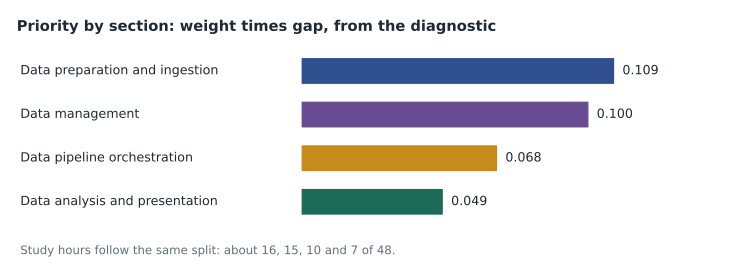
Ravi's rule for ranking is simple: a gap matters in proportion to how many questions it can cost. A section with a large weight and a low score costs the most. One way to put a number on that is to multiply the section's weight by the share of its diagnostic questions Mateo did not answer correctly.
| Section | Weight | Diagnostic | Gap | Weight times gap |
|---|---|---|---|---|
| 1. Data preparation and ingestion | 0.30 | 7 of 11 | 4 of 11, about 0.36 | about 0.109 |
| 2. Data analysis and presentation | 0.27 | 9 of 11 | 2 of 11, about 0.18 | about 0.049 |
| 3. Data pipeline orchestration | 0.18 | 5 of 8 | 3 of 8, about 0.38 | about 0.068 |
| 4. Data management | 0.25 | 6 of 10 | 4 of 10, 0.40 | 0.100 |
The ranking surprised Mateo. His lowest score was in data management, but data preparation and ingestion comes first because its weight is larger and his score there was not much better. Data analysis, his strongest section, comes last, but it is not zero: two misses in a section worth about 16 questions could still cost three marks on the day.
Ravi then splits Mateo's planned study time in proportion to the priorities. Mateo has about 48 hours of study between November 23 and the second practice set on April 3: about two and a half hours a week for 19 weeks, with a lighter week over the holidays.
# Split study hours across sections in proportion to weight times gap.
sections = {
    "Data preparation and ingestion": (0.30, 7, 11),
    "Data analysis and presentation": (0.27, 9, 11),
    "Data pipeline orchestration":    (0.18, 5, 8),
    "Data management":                (0.25, 6, 10),
}
total_hours = 48

priority = {}
for name, (weight, right, asked) in sections.items():
    gap = 1 - right / asked
    priority[name] = weight * gap

total = sum(priority.values())
for name in sorted(priority, key=priority.get, reverse=True):
    hours = total_hours * priority[name] / total
print(f"{name:32s} priority {priority[name]:.3f} hours {hours:4.1f}")Data preparation and ingestion priority 0.109 hours 16.1 Data management priority 0.100 hours 14.7 Data pipeline orchestration priority 0.068 hours 9.9 Data analysis and presentation priority 0.049 hours 7.2
What this code does
For each section the program takes the weight from the exam guide and Mateo's diagnostic result, works out the share of questions he missed, and multiplies the two to get a priority. It then shares out 48 study hours in proportion to those priorities and prints the sections from highest priority to lowest, with the hours each one gets.
The split is about 16 hours for data preparation and ingestion, 15 for data management, 10 for orchestration and 7 for analysis. Ravi treats it as a starting budget, not a rule. After the February 20 practice set the same calculation will run again with the new scores, and the hours for March will move toward whatever is weakest then.
Inside each section, the same idea ranks objectives and considerations. In section 1, Mateo's four misses were two on transfer tools, a consideration in objective 1.1, and one each on storage systems and location types in objective 1.2, so his section 1 hours are split about evenly between the two objectives.
Matching the method to the gap
The kind of gap decides how to study it. Rereading is the most common method and the least effective for most kinds. Aisha's table matches each kind of gap to a method that changes what Mateo can do, not just what he has read.
| Kind of gap | Method | Example |
|---|---|---|
| Never seen | Read the product overview, then do a short lab or follow a tutorial in the sandbox project | Create a dual-region bucket and read its location settings |
| Seen but confused | Write the pair with its deciding question and clue words; add it to the look-alike drill | Datastream against Database Migration Service |
| Known but not applied | Write two scenario questions of his own that turn on the fact | Two questions where the minimum storage duration decides the answer |
| Reading error | Practice the reading habits from lesson 3 on ten timed questions | Underline every qualifier before choosing |
| Lucky guess | Explain the answer aloud to Aisha in two sentences; if he cannot, treat it as never seen | Why Coldline and not Archive for quarterly audits |
Writing his own questions is the method Mateo found most useful in the first week. To write a good wrong option, he has to know exactly why it is wrong, which is the same knowledge the exam tests. He shares his questions with Aisha, who answers them and points out where a wrong option is accidentally right.
Hands-on practice in the sandbox
Some gaps close faster with ten minutes in the console than with an hour of reading. Birchline has a sandbox project, bl-sandbox, with a small monthly budget alert, where analysts may create and delete resources freely. Mateo's list of short labs for the never-seen gaps includes setting a lifecycle rule on a bucket and watching an object change class, creating a BigQuery table snapshot and restoring from it, starting a Storage Transfer Service job between two buckets, and setting a default table expiration on a dataset. Each lab ends with deleting what he created, which is itself a practice of section 4.
Worked problem
Planning one study session
Mateo has a 90-minute session on December 2. His log shows four open gaps in section 4: two confusions (backup against high availability; CMEK against CSEK), one never-seen (Analytics Hub listings) and one lucky guess (Nearline minimum duration). How might he split the session?
Show solution
- Never-seen first, because it needs the most time: 40 minutes to read the BigQuery sharing overview and create a test listing in the sandbox.
- The two confusions: 15 minutes each to write the pair, its deciding question and two questions of his own.
- The lucky guess: 5 minutes to explain the minimum durations aloud and check them against the documentation.
- The last 15 minutes: a timed set of 8 questions on section 4, with misses added to the log.
Answer: 40, 15, 15, 5 and 15 minutes: 90 in all, with a short test at the end.
Retesting after a delay
A gap is closed when Mateo can answer a fresh question on it after some days have passed, not when he has just finished reading about it. Immediately after study, almost everything feels known. So every row in the log gets a retest date about a week later, and the retest uses a different question on the same point. If he gets it right, the row is closed. If not, it stays open and gets a new date, and the one-sentence lesson is rewritten, because the first version did not stick.
| Retest result | Action |
|---|---|
| Right and confident after a week | Close the row; one more check in a month |
| Right but slow or unsure | Keep open; retest in another week |
| Wrong again | Rewrite the lesson; change the method; retest in a week |
Spacing like this is slower in the short run, but it is how facts move into the kind of memory that survives an exam room. It also gives Mateo an honest measure of progress. By the end of November he plans to have retested all 13 diagnostic misses at least once, and he will count how many stayed closed.
Keeping the log honest
An error log only helps if it is complete. The temptation is to log the interesting misses and skip the embarrassing ones, such as a question misread in a hurry or a fact Mateo knew perfectly well a week ago. Those are exactly the rows that show patterns. Aisha checks the log once a week, not to judge it but to ask two questions: is every miss from the week's practice in it, and does every row have a one-sentence lesson that would actually have answered the question?
The log also needs pruning. By March it will have well over a hundred rows, most of them closed. Mateo keeps closed rows, because they show how far he has come and because the final week reviews the fragile ones, but he sorts the sheet so that open rows are always at the top, then rows that took more than one retest to close, then everything else. Once a month he counts rows by section and kind of error and compares the counts with the month before. In his plan, the count of reading errors should fall fastest, because the reading habits from lesson 3 are quicker to learn than new facts; if it does not, he will spend more of his time on timed reading practice and less on content.
Common mistakes
MistakeStudying the whole list from the top.
InsteadRank gaps by weight times gap and start with the highest.
MistakeRereading notes for every kind of gap.
InsteadMatch the method to the gap: labs, pairs, own questions, reading drills.
MistakeWriting vague lessons such as "learn storage".
InsteadWrite one specific sentence that would have answered the question.
MistakeMarking a gap closed right after studying it.
InsteadRetest with a fresh question about a week later.
MistakeIgnoring the strongest section.
InsteadGive it a smaller share of time, not none.
Summary and key terms
- An error log records every miss and lucky guess with its objective, kind of error and a one-sentence lesson.
- Knowledge gaps come in kinds: never seen, seen but confused, known but not applied; reading errors and lucky guesses are logged too.
- Rank gaps by weight times gap so the time goes where marks are most at risk.
- Mateo's ranking puts data preparation and ingestion first, then data management, orchestration and analysis, and splits 48 hours as about 16, 15, 10 and 7.
- Match the method to the gap: short labs for the never seen, pairs for confusions, self-written questions for facts not applied.
- Retest each gap about a week later with a fresh question.
- Error log
- A record of each missed or guessed question, with its cause and lesson.
- Weight times gap
- A section's exam weight multiplied by the share of its questions missed; a way to rank gaps.
- Never-seen gap
- A product or term the candidate did not recognize.
- Confusion
- A gap where the candidate chose the wrong one of two similar products.
- One-sentence lesson
- A specific statement, in the candidate's words, that would have answered the missed question.
- Sandbox project
- A Google Cloud project where resources can be created and deleted freely for practice.
- Delayed retest
- A fresh question on the same point, about a week after study.
- Spaced review
- Returning to material at growing intervals so it is remembered for longer.
Practice problems
Work each problem on paper first, then reveal the answer to check.
Why does data preparation come before data management in Mateo's ranking, though his score there was higher?
Show answer
Its weight is larger: 0.30 times about 0.36 is about 0.109, against 0.25 times 0.40, which is 0.100.
What is the best method for a confusion between two products?
Show answer
Write the pair with its deciding question and clue words, and drill it.
When is a gap closed?
Show answer
When a fresh question on it is answered correctly about a week after study.
Lesson quiz · 5 questions
Score 60% or more to complete this lesson.
Create a free account to save your progress, take quizzes and earn a certificate.