
GCP-194 · Lesson 3 of 12 · 21 min
Reading scenario questions carefully
▶ Video coming soon A video version of this lesson is on the way.
Saturday morning, November 14, began with a test. Before Mateo had finished his coffee, Ravi gave him 40 practice questions he had written from the exam guide over the previous two weeks, eight to eleven from each section, roughly in line with the weights, and 60 minutes to answer them. The questions were in the exam's style: short scenarios with four options, a few asking for two answers. Mateo scored 27 of 40. The interesting part came afterwards, when the three of them went through the 13 he got wrong.
Six of the 13 were questions where Mateo did not know the fact: which transfer tool moves data from another cloud, what the minimum storage duration of Coldline is, which key option keeps the key outside Google. Seven were questions where he knew the material but chose the wrong option anyway. He had read "least operational overhead" as "lowest cost", missed the word "streaming", answered what Birchline does instead of what the scenario said, or chosen a correct statement that did not answer the question asked. "Seven of thirteen," Aisha said. "More than half your misses were reading, not knowledge. That is the cheapest score you will ever gain."
The anatomy of a scenario question
Almost every question on the exam has the same four parts, even when they run together in two or three sentences. Learning to separate them is the first skill of exam reading.
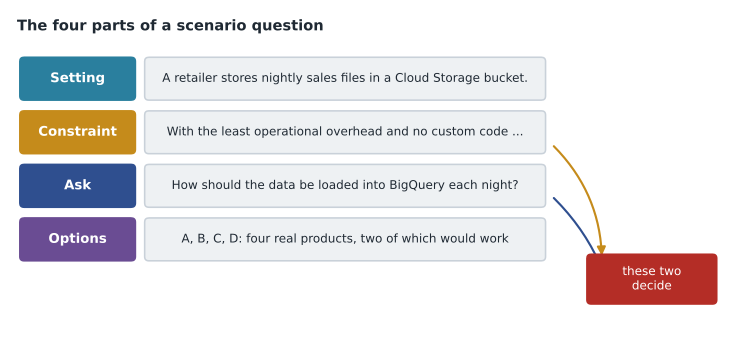
| Part | What it tells you | Example wording |
|---|---|---|
| Setting | The organization, its data and its current situation | "A retailer receives nightly CSV files from 40 stores in a Cloud Storage bucket." |
| Constraint | What the answer must respect: cost, effort, speed, security, location, skills | "with the least operational overhead", "without writing code", "data must stay in Canada" |
| Ask | Exactly what you must choose: a tool, a first step, a setting, a reason | "What should you do first?", "Which service should you use?" |
| Options | Usually one best answer and three that are wrong, weaker or answer a different question | Four choices, sometimes "choose two" |
The setting is usually the longest part and the least important. It contains the facts you need, but also details that do not matter. The constraint is usually short and decides the question. The ask tells you what kind of answer to look for: a tool, an action, an order of steps. Ravi's advice is to read the last sentence first. "Find out what they are asking before you read the story," he says. "Then read the story looking for the facts that matter to that question."
Qualifiers that change the answer
Many questions turn on a single qualifier: a phrase that tells you which of several working options is wanted. In data questions the same few appear again and again, and each one points in a predictable direction.
| Qualifier | What it usually favors | What it usually rules out |
|---|---|---|
| "least operational overhead", "fully managed", "minimal maintenance" | Serverless and managed services: BigQuery, Dataflow templates, scheduled queries, the BigQuery Data Transfer Service | Self-managed clusters, custom scripts on virtual machines |
| "without writing code", "low-code", "for business analysts" | Visual tools: Cloud Data Fusion, BigQuery data preparation, Data Studio | Dataflow pipelines written in code, Spark jobs on Dataproc |
| "lowest cost", "cost-effective" | Cheaper storage classes, partition filters, batch rather than streaming, on-demand for light use | Over-provisioned capacity, streaming where batch would do |
| "in real time", "within seconds", "streaming" | Pub/Sub, Dataflow streaming, BigQuery subscriptions | Nightly batch loads, scheduled queries |
| "existing Spark or Hadoop jobs", "without rewriting" | Dataproc | Rewriting in Dataflow |
| "least privilege", "only the data they need" | Predefined roles at the narrowest level, authorized views, row or column controls | Basic roles such as Editor, project-wide grants |
| "must stay in Canada", "data residency" | A Canadian region or a Canadian dual-region | US or global multi-regions |
| "first", "before anything else" | Investigating, checking or backing up | Making a change straight away |
None of these is a rule that always holds. A question can say "lowest cost" and still require streaming, because the business needs results within seconds. But when two options both work, the qualifier is usually what separates them. Mateo makes a card of the table and reads it each evening for a week.
Four habits of careful reading
Aisha teaches Mateo four habits that, together, fixed most of his reading errors in the diagnostic. They take a few extra seconds per question, which lesson 9 shows the exam can afford.
| Habit | What to do | The error it prevents |
|---|---|---|
| Ask first | Read the final sentence before the scenario | Answering a different question from the one asked |
| Circle the constraint | Find the qualifier and keep it in mind while reading the options | Choosing a working option that ignores the stated priority |
| Use only the scenario | Answer from the facts given, not from how your own organization works | Bringing in assumptions the question did not make |
| Check every clue | Before choosing, confirm the option fits every fact in the setting | Choosing an option that fits most but not all of the clues |
The third habit was the hardest for Mateo. At Birchline, nightly files are loaded by an event-driven Workflows pipeline, so when a question described nightly files he reached for Workflows. But the question said a small team with no engineers wanted a simple daily load with the least overhead. For that setting, a scheduled load through the BigQuery Data Transfer Service from Cloud Storage was the better answer. "Birchline's design is right for Birchline," Aisha says. "The exam is never about Birchline."
Eliminating options
When the right answer is not obvious, it is often easier to find the wrong ones. Most incorrect options fall into a few patterns, and spotting the pattern removes an option quickly.
| Pattern of a wrong option | How to spot it |
|---|---|
| Correct fact, wrong question | The statement is true but does not answer what was asked |
| Works, but breaks a constraint | It would do the job but ignores cost, effort, speed or location |
| Too much | It solves the problem with far more tooling, access or cost than needed, such as Editor for someone who only reads |
| Too early or too late | It is a sensible step, but not the first one, or it skips a required check |
| Wrong product family | It names a real service for a different job, such as Bigtable for an analytics warehouse |
| Made-up feature | It describes something the service does not do |
Worked problem
Eliminating to the answer
A question says: "A marketing analyst needs to join a 2 TB clickstream table in BigQuery with a small spreadsheet of campaign codes maintained by the marketing team in Google Sheets. The analyst wants the campaign codes to stay current without manual exports, and wants the least operational overhead. What should the analyst do?" The options are: (A) Export the sheet to CSV each week and load it into BigQuery; (B) Create a BigQuery external table that reads the Google Sheet; (C) Build a Dataflow pipeline that reads the sheet every hour; (D) Copy the clickstream table into Google Sheets.
Show solution
- Ask first: the analyst needs a way to join the two sources with current campaign codes.
- Constraint: no manual exports, least operational overhead.
- A works but breaks the "no manual exports" constraint.
- C works but is far more effort than needed: too much.
- D is wrong product use: Sheets cannot hold a 2 TB table.
- B reads the sheet in place each time it is queried, so the codes stay current with no pipeline to run.
Answer: B: an external table over the Google Sheet.
Questions with more than one answer
Some questions ask the candidate to choose two or three options. The question says how many. Each chosen option must be correct on its own, and the set must answer the question together. A common trap is an option that is true but belongs to a different step. Aisha's method is to judge each option as true or false against the scenario, one at a time, before looking for the set. If more options seem right than the question asks for, re-read the constraint; one of them usually breaks it. If fewer seem right, re-read the setting; one usually depends on a fact you passed over.
Reading tables, code and query fragments
Some questions show a short SQL query, a bq or gcloud command, a schema or an IAM policy fragment. The exam does not expect perfect recall of syntax, but it does expect the candidate to read what a fragment does. A query without a filter on the partitioning column will scan the whole table. A grant on the project gives access to every dataset in it. A bucket with uniform bucket-level access ignores object-level permissions. Mateo practices by reading the fragments in his own course notes aloud and saying what each one does in a sentence.
SELECT store_id, SUM(net_sales) AS sales
FROM curated.sales
WHERE sale_date BETWEEN '2026-10-01' AND '2026-10-31'
GROUP BY store_id
A question might show this query and ask why it costs less than a similar one that filters on a date computed from sale_ts. The answer is partition pruning: BigQuery can skip partitions only when the filter is on the partitioning column in a form it can use. Mateo had learned this the hard way in GCP-221, when a dashboard tile scanned 1,400 GiB per view.
Wording that signals a trap
A few words deserve a second look whenever they appear. Words such as "always" and "never" in an option are often a sign that it is too absolute to be right, though not always. "All users" or "the whole project" in an access option often signals too much. "Immediately" or "delete" in a first-step question often signals too early. And a negative in the ask, such as "Which option would NOT meet the requirement?", reverses the whole question. Mateo's diagnostic included one negative question, and he answered it as if it were positive.
When two answers still look equally good
Sometimes, after every habit and every elimination, two options remain and both seem to fit. Aisha's tie-breaker has three steps. First, re-read the constraint word by word, because a phrase such as "most cost-effective" and "least operational overhead" can point to different answers between the same two options. Second, ask which option a careful practitioner would choose if they had to explain it to a manager the next morning: the answer that is simpler, uses a managed service and grants less access is usually the one the exam wants. Third, if the tie still holds, choose, mark the question for review and move on, because the minutes spent staring at two options are minutes taken from questions you could answer. In the diagnostic, Mateo spent almost four minutes on one such question and still got it wrong; when he came back to it with fresh eyes on Saturday afternoon, he saw the word "streaming" in the setting in under ten seconds.
Worked problem
Measuring the gain from reading
In the diagnostic, Mateo got 27 of 40 right. Seven of his 13 misses were reading errors. If the four habits fix about two thirds of reading errors and none of the knowledge errors, what would his score have been, and what fraction of the questions would he have answered correctly?
Show solution
- Two thirds of 7 reading errors is about 4.7, so about 5 more questions right.
- 27 + 5 = 32 of 40.
- 32 ÷ 40 = 0.8, or 8 in 10.
Answer: About 32 of 40, or 8 in 10, without learning any new facts.
The calculation is rough, but it made the point to Mateo more than any advice could. Reading well is worth about 5 questions in 40, which on a 60-question exam is about 7 or 8 questions. Lesson 9 adds the timing that makes room for careful reading, and lesson 10 uses the diagnostic's errors to plan what to study.
Common mistakes
MistakeReading the scenario first and the question last.
InsteadRead the ask first, then read the setting looking for the facts that matter.
MistakeTreating every working option as equally good.
InsteadUse the constraint, such as least overhead or lowest cost, to separate options that all work.
MistakeAnswering from your own organization's design.
InsteadAnswer only from the facts in the scenario.
MistakeChoosing a true statement that does not answer the question.
InsteadCheck that the option answers the ask, not just that it is correct.
MistakeMissing a negative such as NOT.
InsteadRe-read the ask on any question whose options all look correct.
Summary and key terms
- A scenario question has a setting, a constraint, an ask and options.
- Read the ask first, circle the constraint, answer only from the scenario, and check that the chosen option fits every clue.
- Qualifiers such as least operational overhead, without code, lowest cost, real time, least privilege and data residency each point in a predictable direction.
- Wrong options usually answer a different question, break a constraint, do too much, come at the wrong step, use the wrong product or describe a feature that does not exist.
- For multiple-answer questions, judge each option on its own.
- Read code and query fragments for what they do.
- In Mateo's diagnostic, more than half the misses were reading errors.
- Setting
- The part of a question that describes the organization and its situation.
- Constraint
- The part of a question that states what the answer must respect, such as cost or effort.
- Ask
- The part of a question that states exactly what to choose.
- Qualifier
- A phrase, such as least operational overhead, that separates options that all work.
- Distractor
- A wrong option written to look plausible.
- Elimination
- Finding the answer by ruling out options that fit a wrong-option pattern.
- Partition pruning
- BigQuery skipping partitions because a query filters on the partitioning column.
- Negative question
- A question that asks which option would not work or is not true.
Practice problems
Work each problem on paper first, then reveal the answer to check.
What were the two kinds of error in Mateo's diagnostic, and how many of each?
Show answer
Six knowledge errors and seven reading errors.
A question asks for "the least operational overhead". Which kind of option does that usually favor?
Show answer
A fully managed or serverless option over a self-managed or custom one.
Why is "Grant the analyst the Editor role on the project" usually wrong in a least-privilege question?
Show answer
It gives far more access than needed: a basic role at the project level.
Lesson quiz · 5 questions
Score 60% or more to complete this lesson.
Create a free account to save your progress, take quizzes and earn a certificate.