
GAS-330 · Lesson 9 of 12 · 21 min
Corrugated stainless steel and polyethylene piping
▶ Video coming soon A video version of this lesson is on the way.
On Wednesday, September 16, Grant and Ayesha went out to Greenway Garden Center on Lockbourne Road, where the owners were adding a heated greenhouse 40 m from the main store and a small office addition on the store's north side. The store already had a 2 psig service for its rooftop units. Bayline had designed two extensions: an underground polyethylene line from the store to the greenhouse, where a line regulator would feed two unit heaters, and a run of corrugated stainless steel tubing through the office addition's ceiling to a new furnace. The owners' landscaping contractor had offered to dig the trench and lay the polyethylene himself, to save money, and Bayline had agreed to inspect the trench and make the connections. "Never sign off a trench you didn't see open," Maureen had told Grant. They arrived as the excavator was finishing.
This lesson covers two piping materials that are common on elevated-pressure systems: corrugated stainless steel tubing, CSST, used inside buildings, and polyethylene, PE, used underground outdoors. It explains where each may be used, how each is joined and protected, how CSST is bonded, and what an inspection of each looks for.
Corrugated stainless steel tubing
CSST is thin-walled, flexible stainless steel tubing, corrugated so that it bends by hand, with a plastic jacket. It comes in long coils and is joined with the maker's own mechanical fittings. Because it bends around obstacles and needs few joints, it is quick to install in ceilings and walls, and it is widely used for both standard and elevated-pressure systems. CSST is certified to ANSI LC 1/CSA 6.26, and every CSST system is a system: the tubing, fittings, manifolds, striker plates and protection devices of one maker, installed to that maker's instructions, which are part of the certification. Mixing brands of tubing and fittings is not allowed.
Installers must be trained. In the United States CSST makers require installers to complete their training and carry the maker's card, and inspectors expect the installer of a CSST system to be able to show it. The training covers cutting and fitting, minimum bend radius, support spacing, protection from physical damage, sizing and bonding, all of which differ between brands.
Sizing and pressure
CSST has a smaller and rougher flow path than steel pipe of the same nominal size, because of its corrugations, so it is sized with the maker's tables or the code's CSST tables, often by an equivalent hydraulic diameter, EHD, number that compares the flow capacity of different makers' products. On elevated-pressure systems a common layout is a dual-pressure system: CSST at 2 psig runs from the meter to a line regulator and manifold near the appliances, and short CSST runs at low pressure feed each appliance from the manifold. The elevated-pressure part is sized from the CSST tables for that pressure and drop, and the low-pressure part from the low-pressure tables, just as lesson 7 described for steel.
Protection from damage
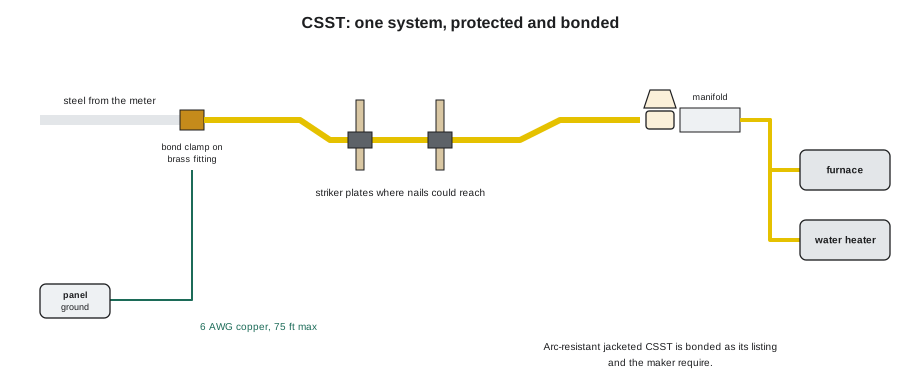
CSST's thin wall resists corrosion but not puncture. Where it passes through studs, joists or plates close to the surface, so that a nail or screw could reach it, the maker's striker plates are fitted over it, and in some locations it is run in conduit or protected by a heavier shield. It must be supported at the maker's spacing, kept to the maker's minimum bend radius, and kept away from sharp edges. Where it enters an appliance or passes through masonry, the maker's fittings and sleeves are used. Outdoors and underground, only CSST and fittings certified for those locations, in the maker's protective sleeves where required, may be used.
Bonding CSST
CSST is bonded because of lightning. A lightning strike on or near a building can energize the gas piping, and the electrical arc between CSST and nearby metal, such as a duct or a wire, can melt a hole in the thin tubing and start a fire. Bonding the gas piping to the building's electrical grounding system reduces the voltage difference that drives such an arc. Makers have also developed arc-resistant jacketed CSST, with a conductive jacket that spreads the energy of an arc and greatly reduces the chance of a hole.
NFPA 54 and the IFGC require CSST that does not have an arc-resistant jacket listed for the purpose to be directly bonded to the building's grounding electrode system with a conductor of at least 6 AWG copper, no more than 75 ft long, clamped to a rigid pipe or fitting at the start of the CSST, not to the tubing. Arc-resistant jacketed CSST is bonded as its listing and the maker's instructions require. Gas piping is never used as an electrical ground. In both countries the electrical side of the bond is part of the electrical system, so the connection to the grounding system is made to the electrical code by an electrician where required.
Polyethylene gas pipe
Polyethylene, PE, is the material of almost every modern utility distribution main and service line, and it is used for customer piping underground outdoors. It does not corrode, it is light and flexible, it comes in long coils, and its joints, made by fusing the plastic, are as strong as the pipe. PE gas pipe is made to ASTM D2513 and is usually yellow or black with yellow stripes, marked with its size, its dimension ratio, SDR, the ratio of outside diameter to wall thickness, and its material designation. A lower SDR means a thicker wall and a higher pressure rating.
PE's limits are as important as its advantages. It is allowed only outdoors and underground. It must not be installed inside buildings, under buildings, or above ground, because it softens with heat, burns, and degrades in sunlight, so it rises out of the ground only inside a certified transition riser. It is not used for liquid propane. It must be protected from sharp rocks and bedded in sand or fine soil. And because it is not metal, it cannot be found with a pipe locator unless something metal is buried with it.
Joining PE
- Butt fusion heats the squared ends of two pipes on a heater plate and presses them together under a set force, forming a bead of fused plastic. It is used on larger sizes.
- Socket fusion heats the outside of the pipe and the inside of a socket fitting together, then pushes them together.
- Electrofusion uses fittings with a heating wire molded into them; a control box powers the wire for a set time and fuses the fitting to the pipe. It is used for couplings, tees and repairs in tight spaces.
- Mechanical fittings certified for PE gas pipe, with internal stiffeners and seals, are used for some connections and transitions.
Fusion joints are made to the pipe maker's qualified procedure, with the right temperatures, times and forces, by someone trained and, where the utility or code requires it, qualified to make them. Many gas contractors buy fittings and risers that avoid field fusion for small customer lines, using certified mechanical connections, because fusion equipment and qualification are a specialty.
Risers, tracer wire and burial
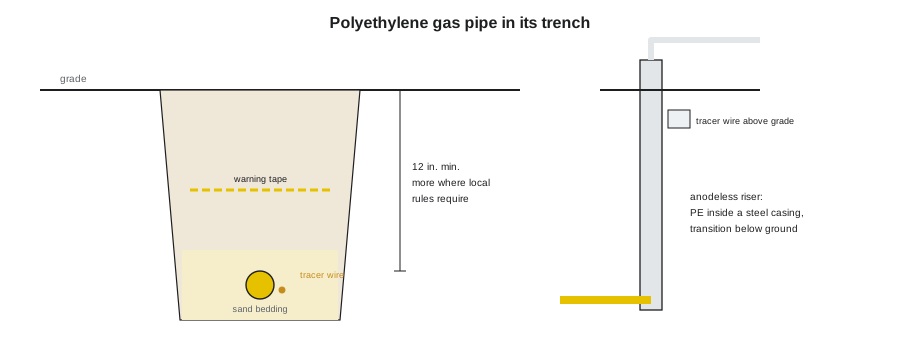
A transition riser brings PE above ground safely. The common type, the anodeless riser, has the PE inside a steel casing, with the transition from PE to steel made below ground inside the casing, so that only steel is exposed above grade. The riser is installed plumb, supported, protected from vehicles and connected to the above-ground steel piping at its threaded or flanged top.
A tracer wire, an insulated copper wire, is laid alongside PE pipe so that it can be located later by a locator connected to the wire. It runs loose beside the pipe, not wrapped around it, and comes up at each riser to an accessible point, so that a locator can be clipped on. NFPA 54 requires it to be at least 18 AWG and to come above grade at the ends. Many contractors also lay a yellow warning tape above the pipe, partway up the backfill, so that anyone digging later hits the tape before the pipe.
The pipe is buried deep enough to protect it. The IFGC requires underground piping to be at least 12 in. below grade, with shallower depths only for individual lines to outdoor lights, grills and similar appliances, and the utility and local rules may require more. Separation from electrical cables in a shared trench follows the code and the local electrical rules. The bottom of the trench is smoothed, rocks are removed, and the pipe is bedded and covered with sand or screened soil before the rest of the backfill goes in.
Static electricity and PE
Gas or air flowing out of a PE pipe can build up static electricity on the plastic, because PE is an insulator, and a static spark can ignite escaping gas. When PE is purged, blown down or cut while it might contain gas, utilities and makers use static-control measures: grounding a wet cloth wrapped on the pipe, keeping the pipe wet, and venting through a grounded metal stack. A gas technician's PE work is usually new pipe that has never held gas, but the principle applies whenever PE is opened.
Worked problem
How much PE and how long a tracer wire?
Greenway's PE line runs 130 ft in the trench from the store's riser to the greenhouse riser. Each riser needs about 4 ft of tracer wire to reach above grade. How much tracer wire is needed, with 10 in 100 extra for slack and splices?
Show solution
- \[130 + 2 \times 4 = 138 \text{ ft}\]
- \[138 \times 1.10 = 152 \text{ ft}\]
Answer: Buy a full spool. Splices in tracer wire are made with connectors rated for direct burial, because a corroded splice breaks the locator signal.
What Grant and Ayesha found at Greenway
The trench was the right depth, about 18 in. along most of its length, and the PE had been laid with gentle bends, not kinks. But there was no tracer wire, the pipe lay directly on broken shale with several sharp stones under it, and at the greenhouse end the landscaper had brought the PE straight up out of the ground and planned to connect it to a steel nipple. Grant asked for the pipe to be lifted, the trench bottom raked clear and bedded with sand, the tracer wire laid, and a certified anodeless riser fitted at the greenhouse end. The landscaper grumbled but agreed, and by mid-afternoon the line was bedded, covered with sand and ready to be tested before backfill, as lesson 10 requires.
In the office addition, the CSST run to the new furnace had been installed by the general contractor's gas sub the week before, and Ayesha checked it with the maker's guide in hand: correct fittings, striker plates wherever the tubing passed closer to the stud faces than that maker allows, the bond clamp on the brass fitting at the start of the run, and the bonding conductor run to the electrical panel by the electrician. She photographed each striker plate before the drywall went up. The furnace would get a line regulator at the CSST manifold, and both extensions would be tested together the next week.
Testing CSST and PE
CSST and PE are pressure tested like any other gas piping, with some additions. CSST makers state the test pressures their systems may see and which components, such as some regulators and appliance connectors, must be isolated during the test; the code also sets minimums for CSST, which are often higher than for a small steel system. PE is tested before backfill, with the joints exposed, and because plastic pipe expands slightly under pressure and its temperature follows the trench and the sun, a PE test is allowed to stabilize before it is timed. The test pressure for PE never exceeds what its dimension ratio and the maker allow. At Greenway, the PE line and the CSST run were tested together the following week, before the trench was backfilled and before the office drywall went up.
Common mistakes
MistakeMixing one maker's CSST with another maker's fittings.
InsteadInstall a single maker's system, to its instructions.
MistakeLeaving CSST unprotected where nails or screws could reach it.
InsteadFit the maker's striker plates or other protection.
MistakeClamping the bonding conductor to the corrugated CSST itself.
InsteadClamp it to a rigid pipe or brass fitting as the code and maker require.
MistakeRunning PE above ground or under a building.
InsteadUse PE only underground outdoors, and rise above grade only in a certified riser.
MistakeBurying PE without tracer wire.
InsteadLay tracer wire beside the pipe and bring it up at each riser.
MistakeBedding PE on rocks or shale.
InsteadRemove rocks and bed and cover the pipe with sand or screened soil.
Summary and key terms
- CSST is flexible, jacketed stainless steel tubing certified to ANSI LC 1/CSA 6.26 and installed as one maker's system by trained installers; it is sized from CSST tables, often by EHD, and is commonly used in dual-pressure systems with a line regulator and manifold.
- It is protected by striker plates where fasteners could reach it, supported and bent to the maker's limits, and bonded against lightning-induced arcing: with at least 6 AWG copper no more than 75 ft long for tubing without a listed arc-resistant jacket, under NFPA 54 and the IFGC.
- PE pipe, made to ASTM D2513 and rated by SDR, is used only underground outdoors, joined by fusion or certified mechanical fittings, brought above ground in certified transition risers, laid with tracer wire, bedded and covered in sand or fine soil, and buried to the code's depth of at least 12 in..
- Static electricity is controlled whenever PE is opened.
- CSST
- Corrugated stainless steel tubing, flexible jacketed tubing for gas installed as one maker's system.
- Equivalent hydraulic diameter
- A number, EHD, used to compare the flow capacity of CSST products.
- Striker plate
- A steel plate that protects CSST from nails and screws where it passes through framing.
- Arc-resistant jacket
- A conductive CSST jacket that reduces the chance of a hole from a lightning-induced arc.
- SDR
- Standard dimension ratio, the outside diameter of plastic pipe divided by its wall thickness.
- Anodeless riser
- A transition riser with PE inside a steel casing and the PE-to-steel transition below ground.
- Tracer wire
- An insulated copper wire laid with PE pipe so that the pipe can be located.
Practice problems
Work each problem on paper first, then reveal the answer to check.
Why must CSST be installed as one maker's system?
Show answer
The tubing, fittings and installation instructions are certified together.
Why is CSST bonded?
Show answer
To reduce the voltage difference that could cause a lightning-induced arc to burn through the tubing.
Where may PE gas pipe be used?
Show answer
Only underground outdoors, rising above grade only in a certified transition riser.
What is a tracer wire for?
Show answer
To let a locator find the non-metallic PE pipe later.
What three faults did Grant find in Greenway's trench?
Show answer
No tracer wire, the pipe bedded on sharp shale, and PE brought above ground without a riser.
Lesson quiz · 5 questions
Score 60% or more to complete this lesson.
Create a free account to save your progress, take quizzes and earn a certificate.