
GAS-330 · Lesson 5 of 12 · 24 min
Overpressure protection
▶ Video coming soon A video version of this lesson is on the way.
On Friday, October 2, the owner of a self-serve car wash on Brice Road called Bayline for the third time in two weeks. Every few mornings, when his attendant opened up, the two water heaters that fed the wash bays were cold and their pilots were out, and the boiler for the heated floor slab had locked out. The attendant had learned to find a small red button on a regulator in the equipment room, press it, and relight everything, and by nine o'clock the hot water was back. The owner wanted to know why his new equipment kept failing. Maureen and Grant went over at seven, before the attendant had touched anything. The button had popped again. "That regulator's not failing," Maureen said. "It's the one thing in here that's working. Something upstream is trying to send 5 psi into water heaters built for half a psi, and this is what's stopping it."
This lesson explains why elevated-pressure systems need overpressure protection, when the codes require it, the kinds of devices that provide it, how they must be installed and vented, and how they are tested. It follows from lessons 2 to 4: a regulator is normally open, so when it fails it usually fails toward the full inlet pressure.
Why regulators fail toward high pressure
Lesson 2 showed that a spring-loaded regulator is held closed only by outlet pressure pushing up on its diaphragm. Anything that stops the valve closing, or stops the diaphragm feeling the outlet pressure, lets the spring push the valve open. Debris on the seat, such as pipe scale, thread sealant, welding slag or a shaving from a cut pipe, holds the valve off its seat at no flow, and the outlet pressure creeps toward inlet pressure overnight. A torn diaphragm can no longer push back against the spring. Ice in the valve or vent can jam it. A blocked sensing line on an externally sensed regulator tells the diaphragm that the outlet pressure is low when it is high. In every case the appliances downstream see a pressure far above what their own regulators and valves were built for.
On a standard 7 in. w.c. system, a failed service regulator is the utility's problem, and its own relief protects the building. On an elevated-pressure system, a failed line regulator can put 2 or 5 psig on appliance controls rated for 14 in. w.c. (0.5 psig) at most. Gas valves can be forced open or their diaphragms ruptured, burners can overfire violently, and gas can escape from appliance regulator vents. That is why the codes require protection.
When overpressure protection is required
Both codes require an overpressure protection device, OPD, where gas is supplied at more than 2 psig to piping that serves appliances designed for 14 in. w.c. or less. The device must limit the pressure reaching those appliances to a safe level if the line regulator fails, which the IFGC sets at 2 psi or less, and it must work independently of the regulator it protects, sensing the downstream pressure on its own. A failure of the line regulator must also be detectable, so that it does not go unnoticed behind a silent backup. At 2 psig or less, line regulators generally need no separate OPD, because appliance controls are built to withstand that pressure without damage, though the line regulator's tag and the appliance instructions must still be followed.
The car wash was a textbook case. Columbia Gas delivered 5 psig, and the water heaters and boiler were standard appliances with combination valves rated for 14 in. w.c. at most. The installer had used a line regulator with an integral OPD, the red-buttoned device the attendant kept resetting.
Kinds of overpressure protection
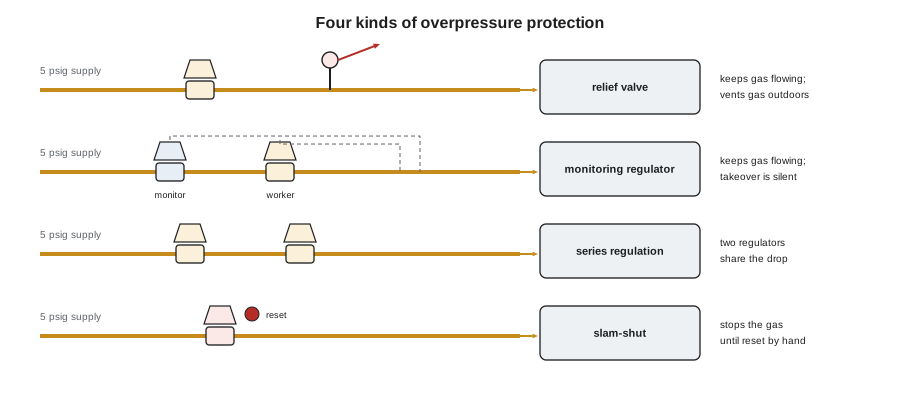
The codes accept several kinds of device. Each has its place, and each has different consequences when it works.
- Relief valve. A spring-loaded valve that opens and vents gas to the outdoors when the downstream pressure rises above its setting. A full-capacity relief can pass all the gas a wide-open regulator could deliver, so the downstream pressure never exceeds the relief's setting plus a small rise. A token relief passes only a small flow and is meant to relieve small creeping leaks through a regulator, not a wide-open failure. Relief valves keep the system running, but they release gas to the atmosphere.
- Monitoring regulator. A second regulator in series with the working regulator, set slightly higher. In normal service it stands wide open, because the outlet pressure is below its setting. If the working regulator fails open, the monitor takes over and controls the pressure at its own, slightly higher, set point. Monitors release no gas, but the failure is silent unless someone checks, so monitored systems need regular pressure checks.
- Series regulation. Two regulators in series, each taking part of the pressure drop, arranged so that if either fails, the other limits the downstream pressure to a safe level.
- Automatic shutoff, or slam-shut. A valve that senses downstream pressure and snaps shut if it rises above its trip setting, and stays shut until someone resets it by hand. A slam-shut releases no gas and makes the failure obvious, because the gas is off. Many line regulators for 5 psig systems combine a regulator and a slam-shut OPD in one listed body.
| Device | Gas released on failure? | Gas supply after failure | Failure noticed by |
|---|---|---|---|
| Full-capacity relief valve | Yes, vented outdoors | Continues | Gas smell or noise at the vent; pressure checks |
| Token relief valve | Small amount | Continues; not for wide-open failure | Pressure checks |
| Monitoring regulator | No | Continues at monitor setting | Periodic pressure checks only |
| Series regulation | No | Continues | Periodic pressure checks |
| Slam-shut (automatic shutoff) | No | Stops until manual reset | Appliances go off |
Worked problem
Can a relief valve handle a wide-open failure?
A line regulator on a 5 psig supply would pass about 4,200 ft³/h if it failed wide open (SAMPLE figure from a maker's wide-open capacity table). The relief valve fitted downstream is rated to pass 70 ft³/h at its set pressure plus allowed rise. Is it a full-capacity relief?
Show solution
- Compare the relief's capacity with the wide-open flow:
- \[\frac{70}{4{,}200} = 0.017\]
- The relief can pass less than 2 in 100 of the flow a failed regulator would deliver.
Answer: This is a token relief, not a full-capacity one. In a wide-open failure, the downstream pressure would rise to nearly the full supply pressure despite the relief. It cannot be the system's only overpressure protection.
Installing overpressure protection
The rules follow from the device's job. The OPD must sense the pressure it is protecting, downstream of the regulator, through its own connection, and it must be independent: a monitor or relief that shares the working regulator's sensing line could be fooled by the same blockage. Relief valves and slam-shuts vent to the outdoors through their own vent lines, sized no smaller than the device's vent outlet and protected from water, insects and blockage, as lesson 4 described. Nothing may be installed that could isolate the OPD from the piping it protects: no valve between a relief valve and the line, unless it is the kind of arrangement the code specifically allows. The OPD's setting must be below the lowest pressure that could damage any protected component, and above the regulator's lockup, so that it does not trip in normal service. Listed combination regulators with integral OPDs are installed exactly as the maker's instructions say, because the regulator and OPD were tested as one assembly.
Strainers matter too. Debris on a regulator seat is the commonest cause of creeping lockup on new elevated-pressure systems, because new welded and threaded piping carries scale, slag and sealant until it has been blown clear. Many regulator makers recommend, and many specifications require, a strainer or filter upstream of each line regulator on new commercial systems.
Testing overpressure protection
An OPD that has never been tested is a guess. At commissioning and at intervals afterward, the technician confirms that each device works at its setting:
- Slam-shut. With the appliances isolated, a test pressure is applied at the device's sensing point through a test port, using a hand pump or a regulated nitrogen source and an accurate gauge, and raised slowly until the device trips. The trip pressure is compared with its setting; the device is then reset and the system restored.
- Relief valve. The pressure at which it starts to discharge is checked in the same way, and the vent line is confirmed clear to its outdoor end.
- Monitor. The working regulator's set point is raised, or the regulator is otherwise made to pass more gas, so that the monitor takes over, and the monitor's control pressure is read.
The results go on the commissioning sheet and on a tag at the device. A technician who finds an OPD that has tripped or is discharging treats it as a symptom of a regulator failure, not as a nuisance.
What Maureen and Grant found at the car wash
Before touching anything, Maureen connected a gauge at the downstream test port of the combination regulator. With the slam-shut tripped and the appliances off, the outlet read 1.25 psig, far above the regulator's 12 in. w.c. set point and trapped between the regulator and the appliance valves. The regulator had been leaking through overnight until the downstream pressure reached the slam-shut's trip setting. She reset the slam-shut, lit one water heater to set some flow, and watched: the regulator held 12 in. w.c. while the heater fired. When the heater shut off, the outlet rose to 13.6 in. w.c. and kept climbing slowly. The valve was not sealing at no flow.
Grant isolated and depressurized the line and opened the regulator. A curl of welding slag and a fleck of thread sealant were pressed into the soft seat. The service and the main into the equipment room had been installed in August, and nobody had fitted a strainer upstream of the line regulator. The seat was cut where the slag had sat, so Bayline replaced the regulator body and seat assembly with the maker's parts, fitted a strainer upstream, and blew down the line from the meter outlet to the new strainer before putting it back in service. They tested the slam-shut by applying nitrogen at its test port: it tripped at 1.0 psig, as its tag said. Then they watched the lockup for twenty minutes. It rose to 13.2 in. w.c. and held.
Worked problem
How long would a slow leak take to trip the OPD?
Suppose the trapped piping between the regulator and the appliance valves holds 0.7 ft³, and the leaking regulator lets through 0.35 ft³ of gas, measured at the piping's pressure, every hour. Estimate how long it would take to raise the pressure from 0.49 psig to the 1.0 psig trip setting, with atmospheric pressure 14.4 psia. Use absolute pressures: the trapped gas is proportional to absolute pressure.
Show solution
- Absolute pressures:
- \[0.49 + 14.4 = 14.89 \text{ psia}, \quad 1.0 + 14.4 = 15.4 \text{ psia}\]
- Extra gas needed, measured at 14.89 psia:
- \[0.7 \times \frac{15.4 - 14.89}{14.89} = 0.024 \text{ ft}^3\]
- Time at 0.35 ft³ per hour:
- \[\frac{0.024}{0.35} = 0.069 \text{ h} \approx 4 \text{ minutes}\]
Answer: Even a tiny leak through a regulator seat raises the pressure in a small, closed section of pipe very quickly. That is why the car wash's OPD tripped every night once the appliances had been off for a while, and why a creeping lockup is never ignored.
Maureen explained it to the owner in plain terms: the red button was a safety device, the reset had been the right thing to do once but not three times, and the cause had been in the regulator all along. She left a note asking the attendant to call Bayline, not reset the device, if it ever tripped again.
Choosing OPD settings
An OPD's setting sits in a window. It must be high enough that the regulator's normal lockup never reaches it, or the device will trip on a quiet night with nothing wrong. It must be low enough that the pressure it allows is below what the protected appliance controls can withstand, and within the IFGC's limit of 2 psi. A listed combination regulator comes with its OPD set at the factory for its outlet spring range, and the setting is on its tag. Where a separate OPD is fitted, its setting is chosen and recorded by the designer, and the commissioning trip test confirms it.
Common mistakes
MistakeResetting a tripped slam-shut again and again without finding the cause.
InsteadTreat a trip as a regulator failure and find out why it happened.
MistakeRelying on a token relief valve as the only protection.
InsteadUse a full-capacity relief, a monitor, series regulation or a slam-shut sized for a wide-open failure.
MistakeLetting an OPD share the working regulator's sensing line.
InsteadGive the OPD its own downstream sensing connection.
MistakeLeaving a relief or OPD vent capped or tied into another vent.
InsteadRun it independently to the outdoors, protected from blockage.
MistakeStarting up a new system with no strainer and no blowdown.
InsteadFit strainers where specified and blow the line clear before regulators go into service.
MistakeAssuming a monitored system is fine because the gas is on.
InsteadCheck monitored systems' pressures on every visit; a monitor's takeover is silent.
Summary and key terms
- Regulators are normally open, so debris on the seat, a torn diaphragm, ice or a blocked sensing line sends the outlet toward inlet pressure.
- Both codes require overpressure protection where more than 2 psig is supplied to piping serving appliances designed for 14 in. w.c. or less; the device must limit the downstream pressure to 2 psi or less, work independently with its own downstream sensing, and make a failure detectable.
- Devices include full-capacity relief valves (token reliefs handle only small leaks), monitoring regulators, series regulation and slam-shut automatic shutoffs that stay closed until reset.
- OPDs vent outdoors on their own lines and are set above lockup and below damaging pressures.
- Strainers and blowdown prevent the debris that causes most failures on new systems.
- Every OPD is tested at commissioning, and a tripped or discharging OPD is a symptom of a regulator failure.
- Overpressure protection device
- A device that limits downstream pressure if a regulator fails; OPD.
- Full-capacity relief valve
- A relief valve able to pass all the gas a wide-open regulator could deliver.
- Token relief valve
- A small relief that handles only slight leakage through a regulator.
- Monitoring regulator
- A standby regulator in series that takes control if the working regulator fails open.
- Slam-shut valve
- An automatic shutoff that closes on high downstream pressure and stays closed until reset by hand.
- Creeping lockup
- Outlet pressure that keeps rising at no flow because a regulator is leaking through.
Practice problems
Work each problem on paper first, then reveal the answer to check.
When do the codes require overpressure protection?
Show answer
Where more than 2 psig is supplied to piping serving appliances designed for 14 in. w.c. or less.
What is the difference between a full-capacity relief and a token relief?
Show answer
A full-capacity relief can pass a wide-open regulator's whole flow; a token relief handles only small leaks.
Why must an OPD have its own sensing connection?
Show answer
So that a blockage that fools the regulator does not also fool the OPD.
What makes a monitoring regulator's takeover hard to notice?
Show answer
Gas keeps flowing at the monitor's setting and nothing is released, so only a pressure check shows it.
What caused the car wash's slam-shut to trip?
Show answer
Welding slag and sealant on the regulator seat made it leak through at no flow.
Lesson quiz · 5 questions
Score 60% or more to complete this lesson.
Create a free account to save your progress, take quizzes and earn a certificate.