
GAS-240 · Lesson 7 of 12 · 24 min
Filling, transfer and overfill protection
▶ Video coming soon A video version of this lesson is on the way.
On Thursday, September 10, his third day at Bayline, Jonah rode with Luis to the Scioto Propane bulk plant in Lockbourne, where the company's refill attendants fill cylinders and its delivery trucks load. Bayline does not fill containers, but Hank wants every apprentice on the propane crew to see it done once, "so you know what a properly filled cylinder looks like, and why the customer's cylinder that someone topped up behind a gas station is a problem." Carla Brandt, the plant's senior attendant, met them at the cylinder dock wearing gloves, a face shield and a long-sleeved shirt. "Rule one," she said, setting a 20 lb cylinder on the scale. "I read the collar before I touch the valve. Rule two: the scale fills it, not my eyes. Rule three: if anything about it looks wrong, it doesn't get filled."
Transfer, moving liquid propane from one container to another, is where most propane releases happen, and it is tightly controlled. This lesson explains who may fill containers, how cylinders are filled by weight and tanks by volume, why the fill limit exists, and what happens when a container is overfilled.
Who may fill, and where
NFPA 58 requires that anyone who transfers propane be trained in proper handling and operating procedures, with the training documented and refreshed at least every three years, and the federal hazardous materials rules add their own training for people who fill and offer cylinders for transport. Filling is done at a cylinder filling station or bulk plant, or from a delivery truck by a trained driver. NFPA 58 controls where dispensers may be placed: distances to buildings, property lines, public ways, ignition sources and the public, protection from vehicles, signs, fire extinguishers and an emergency shutoff. A gas fitter's license does not, by itself, qualify someone to fill cylinders, and Bayline technicians do not do it.
Inspecting a cylinder before filling
Carla's first step is to decide whether the cylinder may be filled at all. She refuses any cylinder that is out of date for requalification, as lesson 2 explained; that lacks an OPD where one is required; that is damaged, with dents, gouges, bulges, fire damage, heavy rust or a bent collar or foot ring; whose valve is damaged, leaking or has a missing or painted-over relief valve; whose markings cannot be read; or that is not refillable, such as a single-use camping cylinder. A new cylinder arrives from the maker full of air, or sometimes of nitrogen, and must be purged before its first fill, because air in a cylinder would mix with the propane, raise the pressure and, with moisture, attack the odorant. A cylinder that a customer says has "never been used" but is past its date is still out of date.
| Check | Refuse to fill if |
|---|---|
| Requalification date | Past its period |
| OPD on small vapor cylinders | Missing where required |
| Body | Dented, gouged, bulged, fire-damaged or badly rusted |
| Collar and foot ring | Bent, cracked or missing |
| Valve and relief valve | Damaged, leaking, painted over or missing parts |
| Markings | Not legible |
| Type | Single-use or not built for propane |
| New cylinder | Not yet purged of air |
Filling cylinders by weight
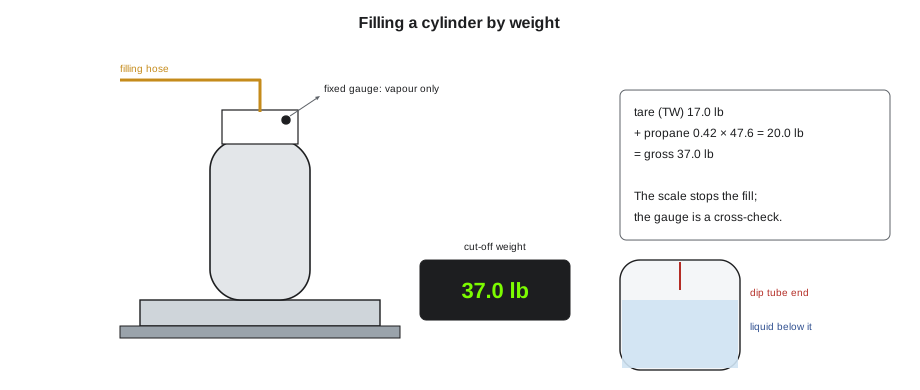
Most cylinders are filled by weight. The amount of propane a cylinder may hold is set by the code as a filling density: the weight of propane as a fraction of the weight of water the cylinder would hold. For propane in an ordinary cylinder the limit works out to about 42 parts in 100 of the water capacity by weight, which leaves a vapor space of about 20 parts in 100 at normal temperatures. The attendant adds the allowed propane to the tare weight stamped on the collar to get the gross weight at which the fill stops, sets the scale, connects the filling adapter, opens the valves and fills until the scale trips. Many scales shut the fill automatically. She then opens the fixed liquid level gauge briefly as a cross-check: vapor only means the level is below the tube, as it should be. Finally she closes the valve, disconnects, leak-tests the valve and its connections with solution, and fits the cap or plug.
Worked problem
Setting the scale
A barbecue cylinder is stamped WC 47.6 lb and TW 17.0 lb. Using a filling density of 42 parts in 100 of the water capacity, how much propane may it hold, and what gross weight should the scale be set to?
Show solution
- Propane allowed:
- \[0.42 \times 47.6 = 19.99 \approx 20.0 \text{ lb}\]
- Gross weight:
- \[17.0 + 20.0 = 37.0 \text{ lb}\]
Answer: The cylinder holds 20 lb of propane, which is where its name comes from, and the scale is set to 37.0 lb.
Filling tanks by volume
Tanks, and some cylinders filled on site, are filled by volume from a delivery truck, often called a bobtail. The driver parks where the hose will reach, sets the brakes and chocks the wheels, shuts off nearby ignition sources and engages the truck's pump. He checks the tank, its fittings and its surroundings for anything wrong, connects the hose to the filling valve, and opens the fixed liquid level gauge. As liquid enters, the gauge discharges a thin stream of vapor. When the liquid reaches the end of the gauge's dip tube, the discharge suddenly turns to a dense white mist of liquid, and the driver stops the pump at once and closes the hose valve. The dip tube is cut to a length that, at the liquid temperature the code assumes for that container, leaves the required vapor space. The truck's meter records how much was delivered, usually corrected to a standard temperature, and the driver closes the gauge, disconnects, checks for leaks and leaves a delivery ticket. Some trucks return vapor from the tank through the vapor return valve during large transfers, so the tank pressure does not rise and slow the fill.
A delivery to a tank that has run out of gas, or to a system that was shut off at the tank, is not just a fill. When a container runs empty, air and moisture can enter, pilots go out, and appliance valves may be left open. The codes and industry practice require the system to be leak checked before it is put back into service, and the appliances relit and checked, as lesson 11 describes. Many drivers will not open the service valve after such a fill unless they or a gas technician do that check.
Cylinder exchange
Many barbecue cylinders are never refilled by their owners at all: they are exchanged. The customer leaves an empty cylinder at a store's exchange cabinet and takes a full one. The exchange company collects the empties, inspects each one at its own plant, requalifies or retires those that are due, replaces worn valves, repaints them, purges new ones, fills them by weight and leak tests them before they go back to the stores. Because every cylinder passes through a plant with trained staff, exchange is one of the safest ways for homeowners to get propane, and the code's shorter distances for exchanged cylinders reflect the fact that they are never filled on site. Exchange cylinders are sometimes filled to a little less than a refill center would put in, so a customer who weighs one should not be surprised to find less than the nominal amount. What a technician sees on a service call is usually an exchange cylinder with a shrink-wrapped valve seal; the seal must be removed before connecting, and a cylinder whose seal is already broken or whose valve leaks goes back to the store.
Why the fill limit matters
Liquid propane expands as it warms, and the vapor space left by the fill limit gives it room. If a container is overfilled, the vapor space may disappear on a warm day; the container becomes liquid-full, and from then on every degree of warming raises the pressure by a large amount, because a liquid cannot be compressed. The relief valve then opens and discharges liquid, which flashes into a large, cold, heavy cloud of vapor, much more dangerous than the small amount of vapor a relief valve normally releases. Overfilling has another effect in service: liquid can reach the vapor outlet, flood the first-stage regulator and send liquid down the service line, where it can freeze regulators, damage appliance controls or cause flames to flare.
Worked problem
What happens to an overfilled cylinder in the sun?
A 100 lb cylinder has a water capacity of 239 lb, or 28.6 gal. Liquid propane weighs about 4.36 lb/gal at 40 °F and about 3.91 lb/gal at 104 °F. Compare a correct fill of 100 lb with an overfill of 110 lb: what fraction of the cylinder's volume does the liquid fill at each temperature?
Show solution
- Correct fill at 40 °F:
- \[\frac{100}{4.36} = 22.9 \text{ gal} \qquad \frac{22.9}{28.6} = 0.80\]
- Correct fill at 104 °F:
- \[\frac{100}{3.91} = 25.6 \text{ gal} \qquad \frac{25.6}{28.6} = 0.90\]
- Overfill at 40 °F:
- \[\frac{110}{4.36} = 25.2 \text{ gal} \qquad \frac{25.2}{28.6} = 0.88\]
- Overfill at 104 °F:
- \[\frac{110}{3.91} = 28.1 \text{ gal} \qquad \frac{28.1}{28.6} = 0.98\]
Answer: Correctly filled, the cylinder still has about 10 parts in 100 of vapor space at 104 °F, the temperature a dark cylinder can reach in summer sun. Overfilled by 10 lb, it is 98 parts in 100 full of liquid: a few more degrees and it is liquid-full, the pressure soars and the relief valve discharges liquid.
Overfill protection
Several layers protect against overfilling, and none replaces the others. The filling procedure, by weight or by the fixed liquid level gauge, is the primary control. The overfilling prevention device in small cylinders, and overfill protection valves in some tank filling valves, are backups that close if the procedure fails. The pressure relief valve is the last line: it limits pressure, but a relief valve discharging liquid is already an emergency. Customers can defeat all of this by filling cylinders themselves from a tank with a homemade adapter, by laying a cylinder on its side to fit more in, or by having a cylinder "topped up" by someone untrained. Bayline technicians who find a cylinder they believe is overfilled, frosting at the top or venting from the relief valve, move people away, keep ignition sources away, do not try to vent it themselves, and call the supplier.
Records and the customer's part
Every fill leaves a record. The refill center's log or the driver's ticket shows the date, the container, the amount delivered and, for a tank, the float gauge reading before and after, and suppliers keep those records with the tank's inspection history. Drivers also record what they see: a regulator vent pointing up, a relief valve without its cap, a new deck built too close to the tank, a dryer vent installed beside the filling connection. A supplier may refuse to fill a tank until such a problem is corrected, which is one reason Bayline technicians tell the supplier when they change anything near a tank. The customer has a part too. Customers should keep the path to the tank clear for the driver, keep snow off the tank and away from the regulator, watch the float gauge or use the supplier's automatic delivery so the tank never runs dry, keep barbecues and other ignition sources away from the filling connection, and call the supplier at once if they smell gas. Bayline leaves a printed propane safety sheet from the supplier with every new propane customer and walks them through it.
Safety during transfer
| Hazard | Control |
|---|---|
| Liquid on skin or in eyes, causing cold burns | Gloves, face shield or goggles and long sleeves; never point a gauge or hose end at anyone |
| Release at the hose connection | Inspect the hose and couplings; connect fully before opening; close valves before disconnecting |
| Ignition of released vapor | No smoking or open flames; engines off unless the pump needs them; no transfer near ignition sources |
| Truck driving away while connected | Wheel chocks; interlocks; driver stays with the truck throughout |
| Static electricity | Bonding and grounding as the equipment requires |
| Overfilling | Fill by weight or fixed liquid level gauge; stop at the first white mist |
Liquid propane boils at −44 °F, and a spray of it on skin freezes the tissue almost instantly, causing burns like frostbite. Carla showed Jonah the safety shower and eye-wash station beside the dock, and explained the first aid: get away from the source, do not rub the area, warm it gently with lukewarm water, and get medical help. Clothing soaked with liquid propane is removed only after it has thawed, because it may be frozen to the skin, and away from any ignition source, because it carries vapor.
Common mistakes
MistakeFilling a cylinder by watching the gauge needle.
InsteadFill by weight or by the fixed liquid level gauge; pressure does not show the amount.
MistakeFilling a new cylinder without purging the air.
InsteadPurge new cylinders before their first fill.
MistakeTopping up a cylinder after the scale trips.
InsteadThe scale setting is the limit; overfilling removes the vapor space.
MistakeOpening the service valve after a run-out fill without a leak check.
InsteadA system that ran out of gas must be leak checked and appliances relit before service resumes.
MistakeVenting a suspected overfilled cylinder yourself.
InsteadMove people back, control ignition sources and call the supplier.
Summary and key terms
- Only trained people fill containers, with training documented under NFPA 58 and the federal hazmat rules, at controlled dispensing sites or from delivery trucks.
- Cylinders are inspected first and refused if out of date, damaged, lacking an OPD, not refillable or not purged.
- Cylinders are filled by weight to a filling density of about 42 parts in 100 of their water capacity: tare plus allowed propane gives the gross weight.
- Tanks are filled by volume until the fixed liquid level gauge shows white mist.
- A run-out fill needs a leak check before service resumes.
- The fill limit leaves vapor space for expansion; an overfilled container can become liquid-full in the sun and discharge liquid through its relief valve.
- The procedure is the primary control, with OPDs, overfill valves and relief valves as backups.
- Transfer needs eye and skin protection, ignition control and attention to the truck and hose.
- Transfer
- Moving liquid propane from one container to another.
- Filling density
- The allowed weight of propane in a container as a fraction of its water capacity.
- Gross weight
- The weight of a cylinder with its propane: tare weight plus the propane allowed.
- Bobtail
- A propane delivery truck that fills tanks on site.
- Liquid-full
- The condition of a container with no vapor space left.
- Purging a cylinder
- Removing air from a new cylinder before its first fill.
- Cold burn
- Freezing injury to skin or eyes from contact with boiling liquid propane.
Practice problems
Work each problem on paper first, then reveal the answer to check.
What is the gross weight of a cylinder with a tare of 18.0 lb and 20 lb of propane allowed?
Show answer
38.0 lb.
What tells a driver to stop filling a tank?
Show answer
A dense white mist from the fixed liquid level gauge.
Why must a new cylinder be purged before its first fill?
Show answer
It contains air, which would raise the pressure and, with moisture, attack the odorant.
What makes an overfilled cylinder dangerous on a hot day?
Show answer
It can become liquid-full and its relief valve can discharge liquid.
What first aid is given for a cold burn from liquid propane?
Show answer
Move away, do not rub, warm gently with lukewarm water and get medical help.
Lesson quiz · 5 questions
Score 60% or more to complete this lesson.
Create a free account to save your progress, take quizzes and earn a certificate.