
GAS-240 · Lesson 6 of 12 · 25 min
First-stage and second-stage regulation
▶ Video coming soon A video version of this lesson is on the way.
On the Saturday of Thanksgiving weekend, October 10, Luis was on call and took Jonah with him to a cottage at Buckeye Lake. The owner said the range burners "roared" when she first lit them in the morning and "went soft" in the evening when the furnace and the water heater were on. At the side of the cottage stood two 100 lb cylinders, and screwed onto their manifold was a single regulator, its vent pointing up and half full of old spider web. There was no second regulator anywhere. "Somebody saved forty dollars," Luis said. "One regulator is trying to take a hundred and fifty psi down to eleven inches of water in one step. It can't do it well, and it can't do it safely." He shut the cylinders off and called the supplier to arrange a proper two-stage system.
This lesson explains how propane regulators work, why building systems use two stages, the pressures each stage delivers, the arrangements in common use, and how a technician checks a regulator by measuring its flowing and lock-up pressures. GAS-330 covers regulators on larger, elevated-pressure natural gas and propane systems.
Why two stages
A propane container's pressure swings with the weather, from under 15 psig on a bitter morning to well over 150 psig on a hot afternoon. An appliance needs a steady pressure of about 11 in. w.c., which is several hundred times lower. A single regulator asked to make that whole reduction has to throttle across a tiny opening, so its outlet pressure drifts with the container pressure and the flow, as the cottage owner noticed. The large pressure drop also chills the gas as it expands, which can freeze any moisture inside the regulator and jam it, either shut, so the appliances starve, or open, so they are overfired. And if a single regulator fails open, the full container pressure goes straight into piping and appliance valves built for a few kilopascals.
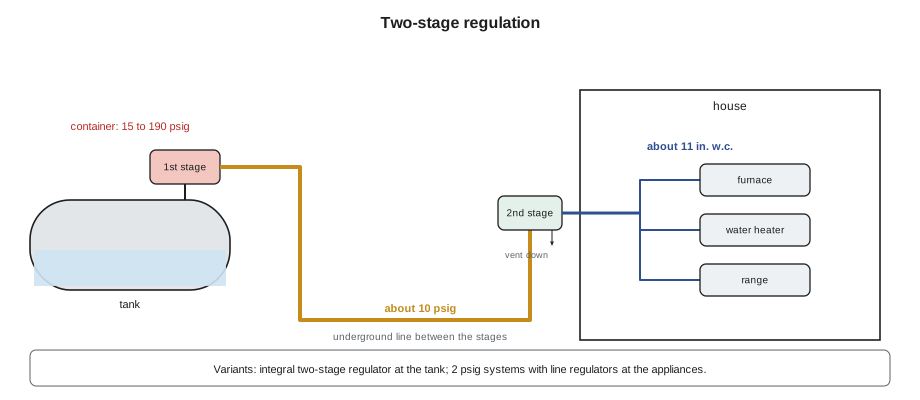
Two-stage regulation solves those problems. A first-stage regulator at the container reduces the variable container pressure to a steady intermediate pressure, typically about 10 psig. A second-stage regulator at the building reduces that to the appliance pressure, typically about 11 in. w.c.. Each regulator makes a smaller reduction, so each holds its setting more closely, each is less likely to freeze, and if the first stage fails, the second stage and its relief protect the building, while if the second stage fails, the first stage limits the pressure to a value the second stage's relief can handle. For these reasons the codes require two-stage regulation, or an approved equivalent, for propane systems serving buildings, and single-stage regulators are limited to a few uses such as small portable appliances with their own regulators.
| Regulator | Where | Typical outlet | Notes |
|---|---|---|---|
| First stage | At the container, under the dome or on the cylinder manifold | about 10 psig | Often painted red; vent points down |
| Second stage | At the building, outside, near where the line enters | about 11 in. w.c. | Often green; adjustable within a narrow range |
| Integral two-stage | At the container | about 11 in. w.c. | Both stages in one body; low-pressure piping runs from the container |
| Automatic changeover | At a two-cylinder manifold | about 10 psig, or 11 in. w.c. if integral | Switches from the service to the reserve side when the service side runs low |
| 2 psig service regulator | At the building | about 2 psig | Feeds a small-diameter system with line regulators at the appliances |
| Line or appliance regulator | Near each appliance on an elevated-pressure system | about 11 in. w.c. | Must be certified for the purpose, with its vent dealt with as the instructions require |
Worked problem
Converting the pressures
Some appliance instructions give propane pressures in kilopascals or psi. Convert 11.0 in. w.c. to psig and to kilopascals, using 1 psi = 27.7 in. w.c. and 1 in. w.c. = 0.2491 kPa, and express the first-stage pressure of 10 psig in inches of water column.
Show solution
- 11.0 in. w.c. in psi:
- \[\frac{11.0}{27.7} = 0.397 \text{ psig}\]
- 11.0 in. w.c. in kilopascals:
- \[11.0 \times 0.2491 = 2.74 \text{ kPa}\]
- 10 psig in inches of water column:
- \[10 \times 27.7 = 277 \text{ in. w.c.}\]
Answer: The usual propane appliance pressure of 11 in. w.c. is about 0.4 psig, and the first stage delivers about 25 times that.
How a regulator works
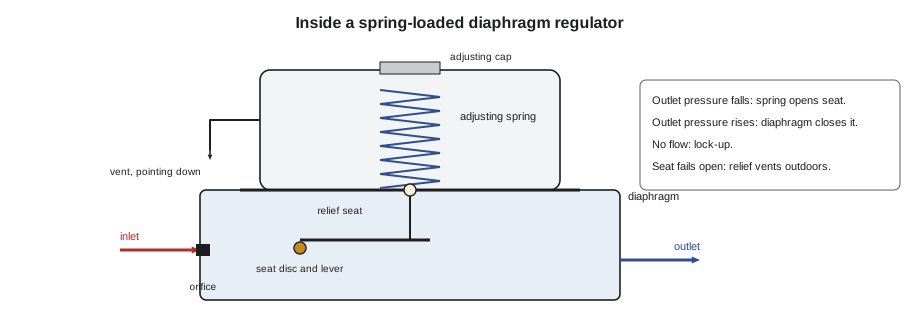
Nearly every regulator in this work is a spring-loaded diaphragm regulator. Gas enters through a small orifice controlled by a seat disc on a lever. The lever is connected to a flexible diaphragm; on one side of the diaphragm is the outlet gas pressure, on the other a spring whose force sets the outlet pressure, with the spring chamber open to the air through the vent. When appliances draw gas, the outlet pressure drops slightly, the spring pushes the diaphragm down, the lever opens the seat and more gas flows. When the appliances stop, the outlet pressure rises, the diaphragm lifts against the spring and the lever closes the seat. The pressure at which it closes completely with no flow is the lock-up pressure, a little above the flowing setting. At high flow the outlet falls somewhat below the setting, called droop; a regulator chosen for the load holds the droop within limits.
Most second-stage and integral regulators also have a built-in relief valve: if the seat fails to close, for example because of dirt or ice, and the outlet pressure climbs well above lock-up, the diaphragm lifts off a relief seat and vents gas through the regulator vent to the outdoors, keeping the pressure in the building piping from rising to dangerous levels. That is why the vent matters so much. It must be open, it must point down or be fitted with the maker's vent assembly so that rain, ice and insects cannot get in, and it must be outdoors and away from openings, air intakes and ignition sources by the distances the code and the regulator instructions require, because in a failure it may discharge a large flow of propane.
Choosing and installing regulators
A regulator is chosen for its inlet pressure range, its outlet setting and its capacity, the flow it can deliver while holding the outlet within its stated droop, taken from the maker's table. A second-stage regulator that is too small droops so far under full load that appliances are underfired; one that is far too large can be unstable at small flows, such as a pilot alone. The supplier usually chooses the first stage, and the contractor the second, from the load list of lesson 5. Regulators are installed outdoors where possible, with the vent down and protected from snow sliding off the roof and from water dripping from eaves, above the expected snow level, and clear of windows and doors. Where a second-stage regulator must be inside, its vent is piped to the outdoors with pipe of the size the instructions require, ending in a protected, downturned termination.
Worked problem
Is the second-stage regulator big enough?
The cottage's appliances are an 80,000 Btu/h furnace, a 40,000 Btu/h water heater and a 55,000 Btu/h range. The second-stage regulator Luis proposes has a capacity of 920,000 Btu/h at the stated droop, from a 10 psig inlet. What is the total load, and what fraction of the regulator's capacity does it use?
Show solution
- Total load:
- \[80{,}000 + 40{,}000 + 55{,}000 = 175{,}000 \text{ Btu/h}\]
- Fraction of capacity:
- \[\frac{175{,}000}{920{,}000} = 0.190 \;\to\; \text{about 19 parts in 100}\]
Answer: The regulator has ample capacity for the cottage, and room for a fireplace or a heater later. Small residential second-stage regulators are commonly far larger than the load, and that is normal; it is undersizing that causes complaints.
Piping between the stages
The line from the first stage to the second carries gas at about 10 psig, so for the same flow it can be much smaller than low-pressure piping. Its size is found from the code's sizing tables for that pressure and an allowed pressure drop, or from the supplier's tables. Underground it is commonly certified polyethylene tubing with a tracer wire, rising above ground at each end through an approved riser, or coated copper or steel, depending on what the code permits between the regulators. Inside the building, the low-pressure piping from the second stage is sized for the much lower pressure and drop, as GAS-120 showed. An elevated-pressure system with a 2 psig service regulator lets small, flexible tubing run long distances in a large house, with a line regulator before each appliance or group of appliances.
| Length of line (ft) | SAMPLE capacity, 1/2 in. PE, 10 psig inlet |
|---|---|
| 30 | 1,650,000 Btu/h |
| 100 | 920,000 Btu/h |
| 200 | 630,000 Btu/h |
| 300 | 510,000 Btu/h |
Regulator freeze-ups
Two different things are called a regulator freeze-up, and they have different fixes. In the first, water inside the gas freezes at the regulator seat, where the expanding gas is coldest. Propane should be dry, but a container that was not properly dried after manufacture or testing, or one that sat open to rain, can carry moisture that comes out at the first stage on a cold night. The regulator sticks, the appliances go out, and by mid-morning, when the sun warms things, everything works again. The supplier deals with it by treating the container with methanol or emptying and drying it; the gas contractor should not try to thaw a regulator with a torch. In the second, water outside the regulator freezes in or over the vent, from freezing rain, drips from an eave or snow sliding off a roof, so the spring chamber cannot breathe and the regulator cannot follow the load. That one is an installation problem, solved by turning the vent down, fitting the maker's vent protection, moving the regulator out from under the eave, or adding a hood. Either way, a technician called to a no-heat complaint on the first cold night of the season looks at the regulators before anything else.
Checking a regulator
Bayline checks every propane system it works on with a manometer or digital gauge at a test port downstream of the second stage, usually at an appliance's inlet pressure tap. With all appliances running at full input, the flowing pressure at the farthest or largest appliance must be within the range on its rating plate, typically not below about 10 in. w.c.. Then, with every appliance off, the pressure rises to the lock-up pressure and must hold steady there; a lock-up pressure that keeps creeping upward means the regulator seat is not closing tightly, and the regulator must be replaced. Lock-up should be within the maker's limit, typically no more than about 2 in. w.c. above the setting. Where there is a test port at the first-stage outlet, its pressure is checked the same way. The readings are written on the job sheet.
Worked problem
Reading the cottage gauges
After the supplier installed a new first stage and Luis a new second stage, he connected his digital gauge at the range. With the furnace, water heater and all four range burners on, it read 10.6 in. w.c. With everything off it rose to 12.0 in. w.c. and held for five minutes. The appliances call for 10 to 13 in. w.c. Is the system acceptable?
Show solution
- Flowing pressure:
- \[10 \le 10.6 \le 13 \text{ in. w.c.} \quad \text{within range}\]
- Lock-up rise above flowing:
- \[12.0 - 10.6 = 1.4 \text{ in. w.c.}\]
- Lock-up held steady, so the seat is tight.
Answer: Both readings are good. The range burners now light with the same flame whether or not the furnace is running, and the old single regulator went into the supplier's scrap bin.
| Symptom | Possible regulator cause |
|---|---|
| Pressure creeps up with appliances off | Seat not closing: dirt, wear or ice; replace the regulator |
| Pressure falls a lot when several appliances run | Regulator undersized, or first-stage pressure low from cold or a fault |
| Gas smell at the regulator vent | Relief discharging because of high pressure, or a leaking diaphragm |
| Erratic pressure in freezing rain | Vent blocked by ice or water in the spring chamber |
| No gas after a storm | Regulator frozen shut, or snow load broke the vent or the line |
Common mistakes
MistakeInstalling a single-stage regulator on a building system.
InsteadBuilding systems need two-stage regulation or an approved equivalent.
MistakeLeaving a regulator vent pointing up or blocked.
InsteadPoint the vent down or fit the maker's protection, and keep it clear.
MistakeChecking pressure with only one appliance running.
InsteadCheck flowing pressure with every appliance at full input, then check lock-up.
MistakeIgnoring a lock-up pressure that creeps upward.
InsteadA creeping lock-up means the seat leaks; replace the regulator.
MistakePiping an indoor regulator's vent with undersized pipe or leaving it inside.
InsteadPipe the vent outdoors with the size and termination the instructions require.
Summary and key terms
- Building systems use two-stage regulation: a first stage at the container reduces the swinging container pressure to about 10 psig, and a second stage at the building reduces it to about 11 in. w.c..
- Two stages hold pressure more closely, resist freeze-ups and protect the building if one fails.
- Integral two-stage regulators, automatic changeover regulators and 2 psig systems with line regulators are common variants.
- A regulator balances outlet pressure on a diaphragm against a spring; it droops slightly at high flow and locks up slightly above the setting with no flow.
- Its vent lets the spring chamber breathe and carries relief flow outdoors, so it must point down, be protected and be clear of openings.
- Regulators are sized for the load, and every system is checked for flowing pressure with all appliances on and a steady lock-up with all off.
- First-stage regulator
- The regulator at the container that reduces container pressure to an intermediate pressure.
- Second-stage regulator
- The regulator at the building that reduces intermediate pressure to appliance pressure.
- Integral two-stage regulator
- A single body containing both stages of regulation.
- Lock-up pressure
- The outlet pressure at which a regulator closes completely with no flow.
- Droop
- The fall in outlet pressure below the setting as flow increases.
- Regulator vent
- The opening that lets the spring chamber breathe and discharges relief flow.
- Line regulator
- A regulator near an appliance on an elevated-pressure system that reduces pressure to appliance pressure.
Practice problems
Work each problem on paper first, then reveal the answer to check.
What are typical outlet pressures of the first and second stage?
Show answer
About 10 psig and about 11 in. w.c..
Give two reasons two-stage regulation is safer than one stage.
Show answer
It holds pressure more steadily and resists freeze-ups, and a failure of one stage is limited by the other.
What does a lock-up pressure that keeps rising tell you?
Show answer
The regulator seat is leaking and the regulator must be replaced.
Why must a regulator vent point down?
Show answer
So that rain, ice and insects cannot enter and block it.
Under what condition is flowing pressure checked?
Show answer
With every appliance running at full input.
Lesson quiz · 5 questions
Score 60% or more to complete this lesson.
Create a free account to save your progress, take quizzes and earn a certificate.