
GAS-240 · Lesson 5 of 12 · 27 min
Vaporization and tank sizing
▶ Video coming soon A video version of this lesson is on the way.
In the second week of January 2026, months before Jonah joined Bayline, a cold snap brought −15 °F mornings to the region, and Luis spent three of them at a market garden near Lockbourne whose owner had heated a new seedling greenhouse with two 100 lb cylinders on a changeover regulator. The heater was rated 100,000 Btu/h. Every morning at dawn, when the heater ran hardest, the flame shrank to a lazy yellow fringe and the heater locked out on flame failure, although both cylinders were more than half full and white with frost. "The cylinders weren't empty," Luis told Jonah, "they were cold. A container can only boil as much propane as the heat coming through its walls allows. On that morning, the air had almost none to give." The supplier set a 500 gallon tank the following week, and the heater never locked out again.
Lesson 1 explained that drawing vapor boils liquid and that boiling takes heat. This lesson turns that into numbers: how much vapor a container can supply, what reduces it, how the load on a propane system is worked out, how the supplier chooses the container, and how long a fill will last.
Where the heat comes from
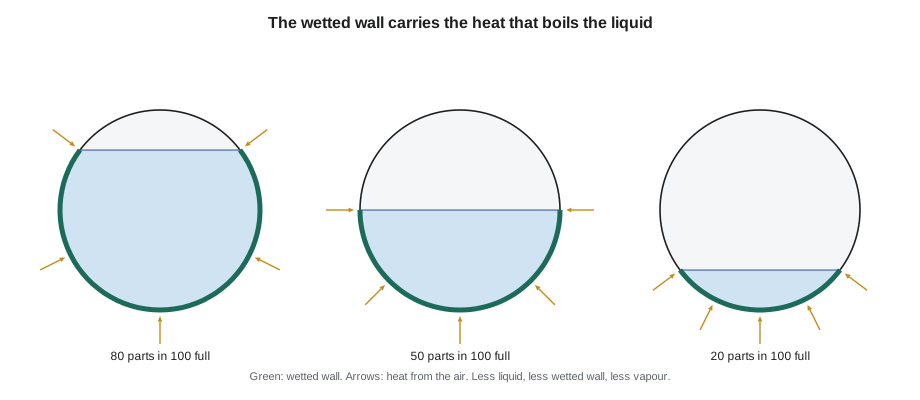
The heat that boils propane in a container comes from the surrounding air, or from the soil around an underground tank, through the part of the wall in contact with the liquid, the wetted surface. Heat flows only if the liquid is colder than its surroundings, so as vapor is drawn the liquid cools until the flow of heat in matches the heat needed to boil the propane being used. Three things set how much vapor a container can supply continuously. The first is the wetted surface: a large container has more of it, and a full container more than a nearly empty one. The second is the temperature difference between the surroundings and the liquid. The liquid cannot usefully cool below the temperature at which its vapor pressure is still high enough to feed the first-stage regulator, so on a cold day there is much less temperature difference to work with. The third is how readily heat passes through the wall, which depends on wind, sun, snow cover and, for an underground tank, the soil and its moisture.
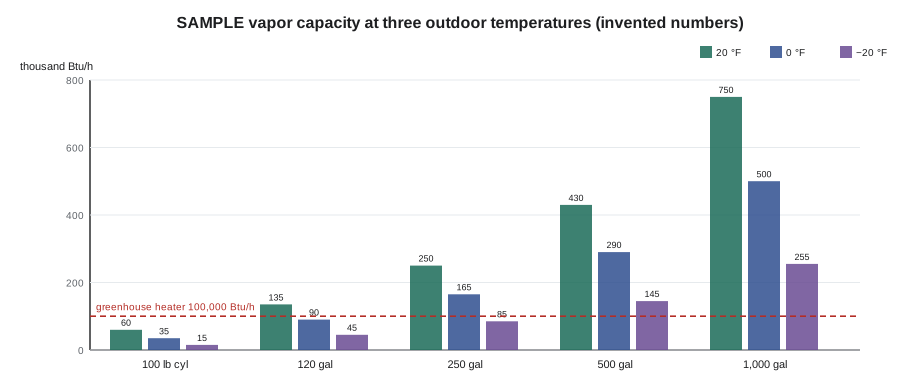
In that simple model, Q is the rate of heat flowing in, U is a heat transfer coefficient for the container and its surroundings, A_w is the wetted area and ΔT is the temperature difference between the surroundings and the liquid. The model explains the behavior, but nobody sizes a tank with it. Suppliers and regulator makers publish vaporization charts based on tests, giving the continuous vapor capacity of each standard container at several outdoor temperatures and liquid levels. The SAMPLE chart below shows the pattern with invented, round numbers.
| Container | SAMPLE capacity at 20 °F | at 0 °F | at −20 °F |
|---|---|---|---|
| One 100 lb cylinder | 60,000 Btu/h | 35,000 Btu/h | 15,000 Btu/h |
| 120 gal tank | 135,000 Btu/h | 90,000 Btu/h | 45,000 Btu/h |
| 250 gal tank | 250,000 Btu/h | 165,000 Btu/h | 85,000 Btu/h |
| 500 gal tank | 430,000 Btu/h | 290,000 Btu/h | 145,000 Btu/h |
| 1,000 gal tank | 750,000 Btu/h | 500,000 Btu/h | 255,000 Btu/h |
Worked problem
Why did the greenhouse heater lock out?
The greenhouse heater is rated 100,000 Btu/h. Two 100 lb cylinders on a changeover regulator draw from one cylinder at a time. Using the SAMPLE chart, what could the cylinder in service supply at 0 °F, and what could a 500 gallon tank supply?
Show solution
- Cylinder in service at 0 °F:
- \[35{,}000 < 100{,}000 \text{ Btu/h} \quad \text{short by } 65{,}000\]
- Even if both cylinders drew together:
- \[2 \times 35{,}000 = 70{,}000 < 100{,}000 \text{ Btu/h}\]
- 500 gallon tank at 0 °F:
- \[290{,}000 \ge 100{,}000 \text{ Btu/h}\]
Answer: A single cylinder could supply about a third of the heater's input on that kind of morning, and even two drawing together would not have been enough. The cylinders cooled, the pressure fell below what the regulators needed, and the flame starved. The tank supplies the load with a wide margin.
What lowers vapor capacity
Several conditions on site cut a container's capacity below the chart value, and an experienced technician looks for them. Low liquid level reduces the wetted surface: a tank at 20 parts in 100 can supply much less than the same tank at 50. Cold, windless, snowy weather is the worst case, especially a tank buried in a snowbank, which insulates it from the air; Bayline asks customers to keep snow cleared from around their tanks. Continuous heavy draw, such as a large heater running all night, gives the liquid no chance to warm up between cycles, while an appliance that cycles lets the container recover. Shade in winter makes a small difference; sun helps a little. For underground tanks the soil temperature, which changes slowly and stays above the coldest air temperatures, matters more than the air, but wet or frozen soil and a small tank can still limit a large load.
The cold limit: pressure as well as volume
Vapor capacity is not only a question of how many molecules boil off; it is also a question of pressure. A first-stage regulator set to deliver about 10 psig needs an inlet pressure comfortably above that, roughly 20 psig or more, to hold its setting under load. Lesson 1's table shows what that means. Propane at 0 °F has a vapor pressure of only about 23 psig, so on a morning when the air is at −15 °F and the liquid has cooled below the air temperature from heavy draw, the pressure in the container can fall below what the regulator needs. The regulator then opens fully and simply passes on whatever pressure there is, and everything downstream falls with it. That is what Luis saw at the greenhouse: there was still plenty of liquid, but the liquid was so cold that its pressure could no longer push enough vapor through the regulators.
Worked problem
How cold can the liquid get before the first stage struggles?
A first-stage regulator needs at least 20 psig at its inlet to hold 10 psig under full flow. Using lesson 1's table, between which two listed temperatures does the liquid reach that pressure, and roughly what is the lowest liquid temperature that keeps the regulator in control?
Show solution
- From the table: −20 °F gives 11 psig and 0 °F gives 23 psig.
- Interpolate for 20 psig:
- \[-20 + 20 imes rac{20 - 11}{23 - 11} = -20 + 20 imes rac{9}{12} = -20 + 15 = -5 ext{ °F}\]
Answer: Once the liquid falls below about −5 °F, the first stage cannot hold its setting at full flow. Because heavy draw cools the liquid several degrees below the air, this can happen on mornings when the air is only a little colder than that, which is why charts show such small capacities at −20 °F.
Underground tanks have an advantage here. A meter or so below the surface, the soil in central Ohio rarely falls much below freezing even in a hard winter, so an underground tank's liquid stays warmer than an aboveground tank's on the coldest mornings, although wet soil can freeze to the tank and slow the flow of heat when the draw is heavy for a long time.
Working out the load
The supplier sizes the container, but it does so from the load the contractor gives it, so the load must be right. Bayline lists every appliance with its rated input from the rating plate or the instructions, adds those that are planned, and then decides which will run at the same time on a design winter day. A furnace, a water heater and a fireplace may all run together on a cold evening; a pool heater will not run in January; a standby generator runs only in a power failure, but a power failure in a winter storm is exactly when the furnace runs hardest. The load the container must carry is the largest combination that can really run together in the coldest weather. Bayline writes the list and its assumptions on the site sheet, so that if a customer later adds a generator or a pool heater, the next technician can see what the system was sized for.
Worked problem
Can the farm tank carry a generator?
The farm near Grove City has a 500 gallon tank serving an 80,000 Btu/h furnace, a 60,000 Btu/h range and a 60,000 Btu/h workshop unit heater. The owners plan a standby generator rated at 290,000 Btu/h of propane input at full load. Using the SAMPLE chart at 0 °F and 30 parts in 100 full, can the tank carry today's loads? During a winter power failure, with the furnace, the unit heater and the generator running, can it carry those?
Show solution
- Today's loads, all running:
- \[80{,}000 + 60{,}000 + 60{,}000 = 200{,}000 \le 290{,}000 \text{ Btu/h}\]
- Power failure:
- \[80{,}000 + 60{,}000 + 290{,}000 = 430{,}000 > 290{,}000 \text{ Btu/h}\]
- With a second 500 gallon tank manifolded:
- \[2 \times 290{,}000 = 580{,}000 \ge 430{,}000 \text{ Btu/h}\]
Answer: The tank carries the farm's present loads comfortably, but not the generator with the heating loads in deep cold. Luis passed the numbers to the supplier, who plans to set a second 500 gallon tank beside the first and manifold them before the generator is installed in the spring of 2027. A single 1,000 gallon tank would also have worked, at 500,000 Btu/h.
Choosing the container
With the load known, the supplier chooses the container with three questions in mind. Can it vaporize the design load at the design outdoor temperature, with the tank at the low level at which deliveries are scheduled, usually 20 to 30 parts in 100? Does it hold enough fuel to give a reasonable delivery interval, so that the truck does not have to come every week in January and the customer does not run out in a storm? And does it fit the site, with the separation distances of lesson 4, which grow with the tank? For most homes the answer is a 500 or 1,000 US gallon tank. Where a single tank cannot vaporize enough, the supplier may manifold two or more tanks, or, for large commercial and industrial loads, install a vaporizer: a heat exchanger that draws liquid from the tank and boils it with heat from electricity, hot water or a small flame. Vaporizers have their own code rules and are designed by the supplier or an engineer.
How long will a fill last?
Delivery planning uses energy, not vapor capacity. The usable fuel is the difference between the fill level and the level at which the supplier reorders. Daily use on a cold day is found from the appliances' inputs and how long each actually runs; a furnace on a design day might run 60 to 80 parts in 100 of the time. Suppliers track each customer's use against degree days, a measure of how cold it has been, and schedule deliveries automatically or from remote tank monitors.
Worked problem
How many cold days does a fill give?
The farm's 500 gallon tank is filled to 80 parts in 100, and the supplier reorders at 20. On a design day the 80,000 Btu/h furnace runs 70 parts in 100 of the time, and cooking and the workshop heater use about 100,000 Btu a day. Propane holds about 91,500 Btu/gal. How many design days does the usable fuel last?
Show solution
- Usable liquid:
- \[(0.80 - 0.20) \times 500 = 300 \text{ gal}\]
- Usable energy:
- \[300 \times 91{,}500 = 27{,}450{,}000 \text{ Btu}\]
- Furnace per day:
- \[80{,}000 \times 0.70 \times 24 = 1{,}344{,}000 \text{ Btu}\]
- Total per day:
- \[1{,}344{,}000 + 100{,}000 = 1{,}444{,}000 \text{ Btu}\]
- Days:
- \[\frac{27{,}450{,}000}{1{,}444{,}000} = 19.0\]
Answer: A fill gives about two and a half weeks of design-day weather, and much longer in an ordinary winter. With a generator running through a long outage, the tank would empty in a few days, which is a second reason for the larger storage the supplier plans.
| Symptom | Likely cause | What to check |
|---|---|---|
| Flame shrinks or appliance locks out on the coldest mornings, then works later in the day | Container cannot vaporize the load when cold | Container size and level against the load; frost on the container; regulator inlet pressure under load |
| Heavy frost on a container during use | Container working hard; possibly undersized | Load against the chart; liquid level |
| Problems only when several appliances run together | Load combination exceeds vapor capacity, or piping undersized | Pressure at the appliances with everything running |
| Pressure low even in mild weather | Regulator fault, freeze-up or piping problem rather than vaporization | Regulator outlet pressure and lock-up, as lesson 6 explains |
Common mistakes
MistakeAssuming a frosted cylinder that is half full is fine for a large heater.
InsteadVapor capacity, not the fuel left, limits supply; check the load against the chart.
MistakeGiving the supplier only the furnace input.
InsteadList every appliance, planned additions and which run together on a design day.
MistakeForgetting the generator runs hardest when the furnace does.
InsteadA winter power failure puts the generator and the heating loads on the tank together.
MistakeLetting snow bury the tank.
InsteadSnow insulates the tank from the air and cuts its vapor capacity; keep it cleared.
MistakeSizing a container at full rather than at its reorder level.
InsteadSize at the low level, usually 20 to 30 parts in 100, where capacity is least.
Summary and key terms
- A container supplies vapor only as fast as heat flows in through its wetted wall from the air or soil, so capacity depends on the wetted surface, the temperature difference and the conditions around it.
- Vapor capacity falls steeply in cold weather and at low liquid levels.
- Suppliers use tested vaporization charts, not formulas; the chart in this lesson is a SAMPLE with invented numbers.
- The contractor lists every appliance, planned additions and which run together on a design day, including a generator during a winter outage.
- The supplier chooses a container that vaporizes the load at the design temperature and reorder level, gives a reasonable delivery interval and fits the site, or manifolds tanks or adds a vaporizer.
- Delivery intervals come from usable energy between the fill and reorder levels and the daily use.
- Vaporization
- The boiling of liquid propane into vapor inside a container.
- Vapor capacity
- The continuous rate at which a container can supply vapor under stated conditions.
- Vaporization chart
- A published table of container vapor capacity at various temperatures and liquid levels.
- Design day
- The cold-weather condition a system is sized to handle.
- Vaporizer
- A heat exchanger that boils liquid propane drawn from a tank, for large loads.
- Reorder level
- The liquid level at which the supplier schedules a delivery.
- Degree day
- A measure of how cold it has been, used to predict fuel use.
Practice problems
Work each problem on paper first, then reveal the answer to check.
Why did the greenhouse heater fail while the cylinders were still half full?
Show answer
The cold cylinders could not vaporize propane fast enough for the heater.
Name three things that reduce a container's vapor capacity.
Show answer
Cold weather, a low liquid level and snow cover, among others.
At what liquid level should a container be sized?
Show answer
At the low level where deliveries are scheduled, usually 20 to 30 parts in 100.
When does a standby generator put its largest load on a tank?
Show answer
During a winter power failure, when the heating loads are also running.
What can a supplier do when one tank cannot vaporize the load?
Show answer
Manifold two or more tanks, use a larger tank or install a vaporizer.
Lesson quiz · 5 questions
Score 60% or more to complete this lesson.
Create a free account to save your progress, take quizzes and earn a certificate.