
GAS-230 · Lesson 5 of 12 · 27 min
Masonry chimneys and liners
▶ Video coming soon A video version of this lesson is on the way.
On Wednesday, October 21, Rosa's crew had replaced the 1994 furnace in a split-level in Upper Arlington with a condensing furnace vented through the side wall, as GAS-210 described. That left the house's atmospheric water heater alone in the brick chimney it had shared with the old furnace for 32 years. When Rosa ran the water heater and tested it, the draft hood spilled for far longer than Bayline accepts, so she shut it off, tagged it and told the owners the house would have no hot water until a liner was in. The liner was moved up the schedule, and on Thursday, October 22, Rosa and Jonah were on the roof by eight in the morning with a coil of flexible liner, a top plate, a cap and a camera on a pole. "Masonry is the hardest vent to judge," Rosa said, "because you can't see most of it, it's usually twice as big as it should be, and it's been eaten by acid for decades without anyone noticing."
This lesson covers masonry chimneys: how they are built, what gas appliances do to them, when the code lets a gas appliance use one, how to examine one, and how to size and install a liner when it does not pass.
How a masonry chimney is built
A masonry chimney in a house is a tower of brick, block or stone with one or more flues running up inside it. In most houses built after about 1940 each flue is lined with clay flue tiles, square or rectangular sections of fired clay about 2 ft long, stacked and mortared one on top of another. The tiles give the flue a smooth, gas-tight surface and protect the brick from heat. At the bottom, a thimble through the side of the chimney receives the vent connector, and below it a clean-out door gives access to the base of the flue where soot and debris collect. At the top, the tiles stand a little above a sloped concrete crown that sheds rain, and a cap keeps rain, animals and debris out of the flue.
Chimneys that run up an outside wall, with three sides exposed to the weather, are exterior chimneys. Chimneys that rise through the middle of the house and only emerge at the roof are interior chimneys. The difference matters for gas: an exterior chimney is cold for most of the heating season, warms slowly and loses heat quickly, so flue gas in it cools fast. Interior chimneys stay warmer because the house heats them.
What gas does to masonry
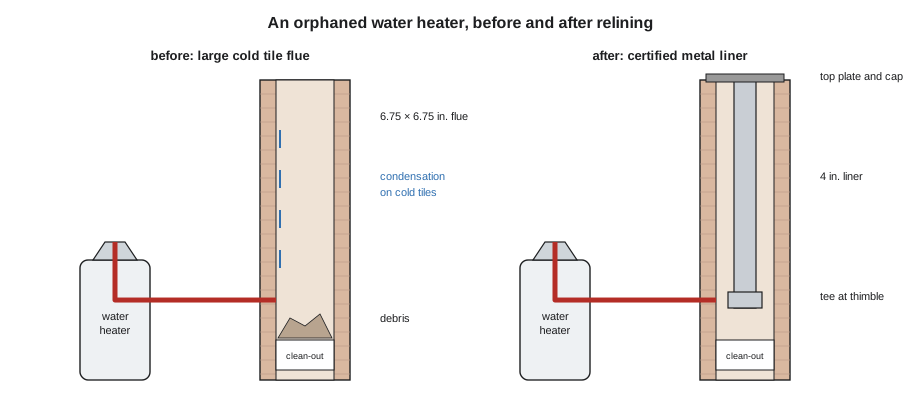
Masonry chimneys were built for coal, wood and oil, whose flue gases are hot and relatively dry. Natural gas flue gas is cooler and much wetter: burning a cubic foot of natural gas produces about two cubic feet of water vapor. As long as the flue gas stays above its dew point, that vapor leaves as gas. But a heavy, cold, oversized masonry flue absorbs heat from a small flow of flue gas faster than the gas can warm it, especially at the start of each cycle, and the water condenses on the tile walls. The condensate is mildly acidic, and over years it dissolves the mortar joints between the tiles, softens the brick behind them, and carries the lime out to the surface, where it leaves white stains on the outside of the chimney. Tiles crack, shift and fall; mortar crumbles into the base of the flue; and in winter, water that has soaked into the brick freezes and breaks off the surface of the brick, a process masons call spalling.
All of this got much worse when furnaces became more efficient. An old furnace sent hot flue gas up the chimney with a lot of dilution air and warmed it thoroughly; a mid-efficiency furnace sends cooler, undiluted gas, and a condensing furnace sends none at all. When a condensing furnace replaces an old one, the water heater is left alone in a flue sized for both, and its small, cool flow of flue gas has to keep a large, cold chimney warm by itself. It cannot, and that is the orphaned water heater problem in its masonry form.
Worked problem
How oversized is the Upper Arlington flue?
The Upper Arlington flue tile measures about 6.75 in. by 6.75 in. inside. The water heater's draft hood outlet is 3 in. in diameter. Compare the flue's cross-sectional area with the draft hood outlet's.
Show solution
- Flue area:
- \[6.75 \times 6.75 = 45.6 \text{ in.}^2\]
- Draft hood outlet area:
- \[\frac{\pi \times 3^2}{4} = 7.07 \text{ in.}^2\]
- Ratio:
- \[\frac{45.6}{7.07} = 6.4\]
Answer: The flue has about six and a half times the area of the water heater's outlet. The same flow of flue gas moves through it at about one-sixth of the speed it would in a vent of the outlet's size, spending far longer in contact with the cold masonry, which is why it spilled for so long at start-up and why its walls were wet.
When a gas appliance may use a masonry chimney
NFPA 54 and the IFGC allow Category I appliances to vent into a masonry chimney only if it is properly built and lined, examined before use, clear of obstructions and soot, and sized for what is connected, using the masonry chimney tables in the code or the liner maker's tables. Unlined masonry chimneys may not be used for gas. The masonry tables are restrictive for exterior chimneys, and in many combinations they do not permit fan-assisted appliances at all, because of condensation. When an appliance is removed from a common masonry chimney, the code requires the remaining system to be resized for what is still connected, which usually means a liner for an orphaned water heater. Ohio follows these rules through the Ohio Mechanical Code and the Residential Code of Ohio.
Whatever the code wording, the practical test is the same on both sides of the border: a masonry chimney is acceptable for a gas appliance only if it is sound, clean, lined, and the right size for the appliances connected to it today. Most chimneys in older houses fail at least one of those once the furnace has gone.
Examining a chimney
Rosa's examination at Upper Arlington followed Bayline's chimney checklist. From the roof, she checked the crown for cracks, the top tile for damage, the cap for rust and fit, and the brick for spalling and missing mortar. She lowered a camera on a pole down the flue and watched the screen with Jonah: two cracked tiles about halfway down, mortar missing from several joints, and a pale crust on the walls near the bottom. At the base, the clean-out door opened on a pile of mortar crumbs, tile fragments and the remains of a bird's nest that reached almost to the bottom of the thimble. Inside the house, she checked the thimble's seal, the connector's slope and condition, and the clearance from the chimney and connector to combustibles. She photographed everything for the file.
| Check | What to look for |
|---|---|
| Cap and crown | Missing or rusted cap, cracked crown, top tile broken or below the crown |
| Outside brick | Spalling, missing mortar, white staining, leaning |
| Flue tiles | Cracks, gaps, missing mortar, offsets, tiles out of line |
| Base and clean-out | Debris, water, a clean-out door that does not close |
| Thimble and connector | Connector pushed too far in, gaps around it, poor slope, corrosion |
| Other connections | Any other appliance, fireplace or abandoned opening into the same flue |
| Size and use | Flue size against what will be connected, interior or exterior |
One check catches more people than any other: whether the flue serves anything else. A gas appliance must never share a flue with a wood-burning fireplace or stove, and a flue that used to serve an oil furnace may carry soot that must be cleaned before a gas appliance uses it. Old, forgotten openings, such as a capped stovepipe hole in an upstairs bedroom, can leak flue gas into the house or let room air in to cool the flue.
Choosing and sizing a liner
A chimney liner for a gas appliance is a factory-made metal pipe, certified for use as a liner, run down the inside of the existing flue from a top plate to the thimble. Liners for Category I gas appliances are usually aluminum or stainless steel, either rigid sections or flexible corrugated pipe that can bend around offsets in the flue. Aluminum liners are lighter and cheaper and are certified for many Category I gas uses; stainless liners are tougher and are needed for higher temperatures or where the instructions call for them. The liner maker's instructions say which appliances and fuels each liner may serve, how to connect it at the top and bottom, and whether the space around it must be insulated or may be left open.
A liner is sized like any other Category I vent: from the code's tables for listed liners or from the liner maker's tables, using the input and type of each appliance, the height, the lateral and the number of elbows. Flexible liners have more friction than smooth pipe because of their corrugations, so their tables usually derate them compared with Type B of the same diameter. A liner that is too large brings back the orphan problem in a smaller form; a liner that is too small spills.
Worked problem
Sizing the Upper Arlington liner
The Upper Arlington chimney gives a liner height of 23 ft from the water heater's draft hood to the cap, with a 3 ft connector. The water heater is natural draft, 40,000 Btu/h, with a 3 in. outlet. A sample practice table for this liner (not for real use) gives, at 23 ft height and 3 ft lateral, a natural-draft maximum of 34,000 Btu/h for 3 in. and 65,000 Btu/h for 4 in. Which size fits, and how much spare capacity does it leave?
Show solution
- 3 in. liner:
- \[40{,}000 > 34{,}000 \text{ Btu/h} \quad \text{too small}\]
- 4 in. liner:
- \[40{,}000 \le 65{,}000 \text{ Btu/h} \quad \text{passes}\]
- Spare capacity:
- \[65{,}000 - 40{,}000 = 25{,}000 \text{ Btu/h}\]
- Fraction of capacity used:
- \[\frac{40{,}000}{65{,}000} = 0.62\]
Answer: On the sample table the 4 in. liner is the right size, carrying the water heater at about 62 in 100 of its capacity. Because the flexible liner's friction is already built into its table, Rosa did not need a separate correction for its corrugations, but she did count its one offset as an elbow.
Installing a liner
Before the liner went in, Jonah cleaned the base of the flue through the clean-out and Rosa ran a brush down from the top to knock loose anything else, because debris left in the flue can block the liner's tee or the clean-out later. On the roof, she measured the flue from the top of the tile to the thimble and cut the liner to that length plus enough to reach the tee and the top plate, following the liner maker's instructions. They fed the liner down slowly from the top, Rosa guiding it and Jonah pulling a rope tied to its bottom end through the clean-out, so it would not snag on the cracked tiles or kink at the offset. At the bottom, the liner connected to a tee, with the water heater's new Type B connector entering the tee's side branch and a sealed cap on the tee's bottom for inspection. At the top, a stainless top plate sealed the flue around the liner and carried a listed rain cap. The thimble was sealed around the connector with the maker's collar, and the clean-out door was closed tight.
Worked problem
Checking the liner length
The flue runs 21 ft from the top of the tile to the center of the thimble. The liner maker's instructions call for 6 in. above the top plate to the cap adapter and 12 in. below the thimble center to the tee's bottom cap. How long a piece of liner does Rosa cut?
Show solution
- Convert the inches to feet:
- \[6 \text{ in.} = 0.5 \text{ ft} \qquad 12 \text{ in.} = 1.0 \text{ ft}\]
- Add the three lengths:
- \[21 + 0.5 + 1.0 = 22.5 \text{ ft}\]
Answer: Rosa cut 22.5 ft of liner, then checked the length against the actual fit before trimming, because flexible liner stretches a little when it is pulled down a flue.
Testing and handing over
With the liner in, Rosa lit the water heater and tested it as she would any Category I system. After five minutes she read the draft through a test hole in the connector: −0.024 in. w.c. at 48 °F outdoors. With a smoke pencil at the draft hood the smoke was drawn in within 20 seconds of the burner lighting. She then ran a worst-case depressurization test, which lesson 8 explains, with the dryer, the range hood and the bath fans running: the water heater still drew within 40 seconds and did not spill. The flue gas carbon monoxide, measured with her analyzer below the draft hood, was low. Only then did she remove her tag and relight the water heater for the owners, and she attached a label at the clean-out giving the liner's make, size and date.
On the paperwork, Rosa recorded the examination, the photographs, the reason for relining, the liner size and maker, the test results and the date. Rosa added the liner to the furnace job's permit paperwork so the inspector would see both. The water heater had been tagged out of service overnight rather than left running in a vent the tables did not allow. "There's no clock in our code like there is in Ontario," Rosa told Jonah, "but there's no permission to leave it unsafe either."
Not every orphaned water heater gets a liner. Sometimes the better choice, especially for an old water heater or a chimney in very poor condition, is to replace the water heater with a power-vented or direct-vent model and stop using the chimney for gas altogether. The chimney is then capped and, if the owner wants, repaired by a mason or taken down below the roofline. That decision is the customer's, but the technician has to give them the facts.
Common mistakes
MistakeAssuming a tile-lined chimney is fine because it worked for the old furnace.
InsteadExamine it and size it for what will be connected now.
MistakeLeaving an orphaned water heater running in an oversized chimney.
InsteadResize, reline or replace before leaving it in service.
MistakeDropping a liner into a flue full of debris.
InsteadClean the base and brush the flue first.
MistakeUsing an aluminum liner where the instructions require stainless.
InsteadUse a liner certified for the appliance and fuel, as its instructions say.
MistakeForgetting a fireplace or old opening into the same flue.
InsteadA gas appliance never shares a flue with a solid-fuel appliance; seal or find every opening.
Summary and key terms
- Masonry chimneys are brick towers with clay-tile flues, a thimble and clean-out at the base and a crown and cap at the top; exterior chimneys run cold.
- Natural gas flue gas is wet and cool, and in an oversized, cold masonry flue it condenses into acidic water that dissolves mortar, cracks tiles and spalls brick, a problem made worse when a furnace is removed and a water heater is orphaned.
- A gas appliance may use a masonry chimney only if it is examined and found sound, clean, lined and correctly sized for what is connected now.
- A certified metal liner, aluminum or stainless, rigid or flexible, sized from its tables, is the usual fix; it is installed from a top plate to a tee at the thimble after the flue is cleaned, and the system is tested for draft, spillage under worst-case conditions and flue gas CO before the appliance is returned to service.
- Replacing the water heater with a power-vented or direct-vent model is the alternative.
- Flue tile
- A section of fired clay pipe lining a masonry chimney flue.
- Thimble
- The opening in a chimney wall that receives the vent connector.
- Clean-out
- A door at the base of a chimney flue for removing debris.
- Crown
- The sloped concrete top of a masonry chimney.
- Spalling
- Breaking off of the surface of brick or concrete, often from water freezing in it.
- Chimney liner
- A certified metal pipe installed inside a chimney flue to vent an appliance.
- Exterior chimney
- A chimney built up an outside wall, exposed to the weather on three sides.
- Top plate
- A plate that seals the top of a flue around a liner and supports its cap.
Practice problems
Work each problem on paper first, then reveal the answer to check.
Why does natural gas damage masonry chimneys that coal and oil did not?
Show answer
Its flue gas is cooler and wetter, so it condenses in a large cold flue.
What is an orphaned water heater?
Show answer
A water heater left alone in a vent or chimney sized for more appliances.
What must a chimney be before a gas appliance uses it?
Show answer
Sound, clean, lined and correctly sized for what is connected.
Why are flexible liners derated compared with smooth pipe?
Show answer
Their corrugations add friction.
What tests follow a liner installation?
Show answer
Draft, spillage under worst-case conditions and flue gas CO.
Lesson quiz · 5 questions
Score 60% or more to complete this lesson.
Create a free account to save your progress, take quizzes and earn a certificate.