
GAS-230 · Lesson 1 of 12 · 27 min
How venting works: draft and buoyancy
▶ Video coming soon A video version of this lesson is on the way.
On Monday, September 21, the first cool morning of the fall, Rosa took Jonah to a 1928 brick two-story in Harrison West, just north of downtown Columbus. The owner, a retired teacher named Glenda Pryce, had called because she smelled "something like a hot stove" in the basement each morning when the hot water came on for her shower. Her water heater was a 2015 atmospheric tank with a draft hood, connected by a short vent connector to a clay-tile-lined chimney built up the outside wall of the house. The furnace had been replaced two years earlier with a condensing model vented through the side wall, so the water heater was now the only appliance using the chimney. "Before we touch anything," Rosa said, "I want you to understand why that flue gas is supposed to go up the chimney at all. Nothing pushes it. Nothing pulls it, unless there's a fan. It goes up because it's hot and light, and that's all."
This course is about getting combustion air into an appliance and flue gas out of it, and about measuring how well the appliance burns. GAS-110 introduced combustion and carbon monoxide, GAS-120 covered what the code says about air supply and venting, and GAS-210 and GAS-220 showed how furnaces, water heaters and their controls work. This first lesson goes back to the physics underneath all venting: buoyancy, draft and the stack effect, and what they mean for the appliances a gas technician installs and services.
Buoyancy: why hot gas rises
Gas expands when it is heated. A cubic foot of air at room temperature weighs a certain amount; heat that same air and it spreads out to fill more space, so any given volume of it now holds less air and weighs less. The hot gas is less dense than the cold air around it. A column of hot gas surrounded by colder, denser air is pushed upward by the heavier air flowing in underneath it, the same way a cork is pushed up through water. This upward push is buoyancy, and it is the only force moving flue gas in a natural-draft vent.
For practical work, the flue gas from a natural gas appliance can be treated as having about the same density as air at the same temperature, because the extra water vapor and carbon dioxide roughly balance the nitrogen and oxygen it replaces. So the density of both can be estimated from temperature alone. US technicians usually skip the density step and use a draft formula built for inches of water column and degrees Rankine, shown later in this lesson, but the idea is the same: air at 300 °F is about a third lighter than air at 32 °F.
Draft: the pressure that buoyancy creates
Picture a chimney full of hot flue gas, standing in cold outdoor air. At the top, the inside and outside pressures are almost equal, because the gas is open to the atmosphere there. At the bottom, the pressure outside is the weight of a tall column of cold, heavy air, while the pressure inside is the weight of an equally tall column of hot, light gas. The outside pressure at the base is therefore greater than the inside pressure. That difference is the draft, or more exactly the theoretical draft: a small negative pressure inside the base of the vent, compared with the room, that draws air and flue gas in at the bottom and sends them up.
Two things set how strong the theoretical draft is. The first is the height of the vent, measured from the appliance's draft hood or flue outlet to the top: a taller column of hot gas means a greater difference in weight. The second is the temperature difference between the gas in the vent and the air outside: the hotter the flue gas and the colder the outdoors, the bigger the difference in density. Doubling the height doubles the theoretical draft; making the flue gas hotter or the outdoors colder increases it too.
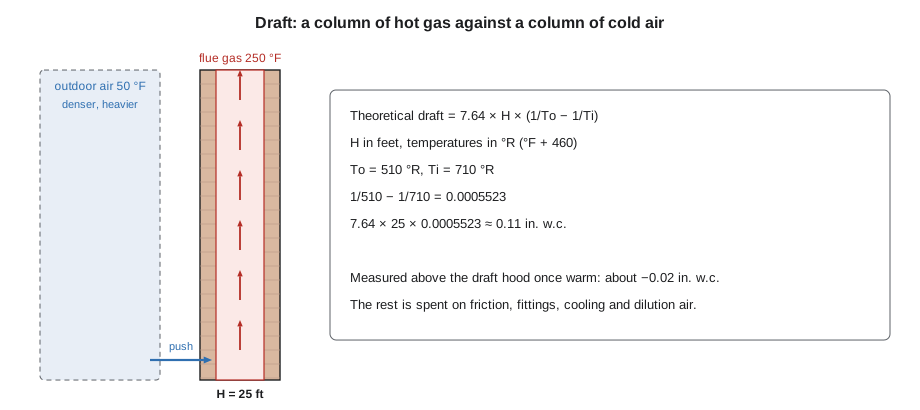
The theoretical draft can be estimated with a short formula used throughout the US heating trade. Draft in inches of water column equals 7.64, times the vent height in feet, times the difference between one divided by the outdoor absolute temperature and one divided by the flue gas absolute temperature, both in degrees Rankine. Degrees Rankine are degrees Fahrenheit plus 460. The constant 7.64 comes from the density of air at standard atmospheric pressure, so the formula needs only a height and two temperatures.
Worked problem
The theoretical draft of Glenda's chimney
Glenda's chimney rises 25 ft above the water heater's draft hood. On the morning of the call it was 50 °F outdoors, and once the water heater had run for a few minutes, the average temperature of the gas in the chimney was about 250 °F. Estimate the theoretical draft.
Show solution
- Convert the temperatures to degrees Rankine:
- \[T_o = 50 + 460 = 510\ {}^\circ\text{R} \qquad T_i = 250 + 460 = 710\ {}^\circ\text{R}\]
- Find the reciprocals and their difference:
- \[\frac{1}{510} - \frac{1}{710} = 0.0019608 - 0.0014085 = 0.0005523\]
- Multiply by the constant and the height:
- \[7.64 \times 25 \times 0.0005523 = 0.105 \text{ in. w.c.}\]
Answer: The theoretical draft is about 0.11 in. w.c. That is a very small pressure, a little over one ten-thousandth of atmospheric pressure, and it has to move every bit of flue gas and dilution air up the chimney.
Where the draft goes
When Rosa put her digital manometer's probe into a small test hole in the vent connector, just above the draft hood, it did not read anything like the theoretical draft. Once the water heater had warmed up, it read about −0.02 in. w.c.. This is normal, and understanding why is the key to understanding natural venting. The theoretical draft is the total push available. As soon as gas starts to flow, most of that push is used up overcoming friction along the inside of the vent, the resistance of every elbow and tee, the cooling of the gas as it rises, and the velocity the gas needs to get moving. What is left over, measured at a point in the system, is the available draft or measured draft at that point.
The draft hood takes a share as well. A draft hood is open to the room, so it lets in dilution air along with the flue gas. That room air cools the flue gas, which reduces buoyancy, but it also isolates the burner from the chimney. Whether the chimney pulls hard on a cold windy day or weakly on a mild still one, the burner sees nearly the same conditions, because the draft hood takes the difference. The draft hood also provides a relief opening: if the chimney is blocked or a downdraft blows in from the top, the flue gas spills out of the hood into the room instead of blowing back into the burner and snuffing it out. That spillage is a safety feature for the burner and a hazard for the occupants, which is why spill switches and spillage tests, covered in lessons 2 and 8, matter so much.
| Where the draft is spent | What it depends on |
|---|---|
| Friction along the vent walls | Vent length, diameter, inside roughness and gas velocity |
| Elbows, tees and fittings | Number of fittings, how sharp each turn is |
| Accelerating the gas | How fast the gas moves through the vent |
| Cooling as the gas rises | Vent material, whether it runs through cold spaces, how long the gas takes |
| Dilution air at the draft hood | Draft hood design and how much room air it draws in |
| Terminations and caps | Cap design, wind and nearby obstructions |
Cold starts and warm-up
A vent does not have its full draft the moment the burner lights. At the start of a cycle the vent is cold, often as cold as the outdoors for an exterior chimney on a winter morning, and a cold vent has almost no buoyancy. The first flue gas that enters it loses heat to the cold walls and may stall or even sink for a short time. Only as the walls warm up does the gas column become light enough to rise steadily. During those first seconds, flue gas can spill out of the draft hood. A short spill at start-up that stops quickly is common in older systems; a spill that lasts, or that happens every time on a cold chimney, is a sign that the vent is oversized, too cold, too short or undermined by the house pulling against it.
That was exactly what Rosa found. With a smoke pencil held at the draft hood relief opening, the smoke was pushed out into the room when the burner lit, wavered at about a minute, and was drawn steadily into the hood by about 70 seconds. The chimney was sized for the old furnace and the water heater together, and it ran up a cold outside wall, so it took a long time to warm with only the water heater's small flow of gas. The smell Glenda noticed each morning was that first minute of spillage. "It clears, so it isn't an emergency today," Rosa said, "but it will get worse in January, and it's the kind of thing that turns into a CO call." She recommended a properly sized liner for the water heater, which lesson 5 explains, confirmed there was a working carbon monoxide alarm on each floor, and wrote it up.
Worked problem
How much stronger is the draft in January?
Using the same chimney and flue gas temperature as before, estimate the theoretical draft on a January morning at 5 °F, and compare it with the 0.105 in. w.c. found at 50 °F.
Show solution
- Outdoor temperature in degrees Rankine:
- \[T_o = 5 + 460 = 465\ {}^\circ\text{R}\]
- Reciprocal difference, with the flue gas still at 710 °R:
- \[\frac{1}{465} - \frac{1}{710} = 0.0021505 - 0.0014085 = 0.0007420\]
- Theoretical draft:
- \[7.64 \times 25 \times 0.0007420 = 0.142 \text{ in. w.c.}\]
- Compared with the fall morning:
- \[\frac{0.142}{0.105} = 1.35\]
Answer: Once the vent is warm, the January draft is about a third stronger. The catch is the word warm: the same cold weather makes the exterior chimney colder at start-up, so the cold-start spill can last longer even though the running draft is stronger.
The house is a chimney too
A house heated in winter behaves like a large, leaky chimney. The warm air inside is lighter than the cold air outside, so it rises and tries to leave through gaps near the top of the house: attic hatches, top-floor ceiling lights, plumbing stacks. Cold air is drawn in to replace it through gaps near the bottom: the rim joist, basement windows, the gap around the gas service and the water line. This is the stack effect of the building. Somewhere in between is the neutral pressure plane, the height at which the inside and outside pressures are equal. Below it, the house is under a slight negative pressure compared with outdoors; above it, a slight positive pressure.
Most fuel-burning appliances sit in the basement, below the neutral pressure plane, where the house is pulling against them. A natural-draft appliance's vent has to overcome not just its own losses but the house's stack effect as well, because the room it draws its air from is at a lower pressure than the outdoors at the top of the chimney. On a cold night, a tall, leaky house with an open stairwell can put a basement at a few pascals negative from stack effect alone. Add a running clothes dryer, a bathroom fan and a kitchen range hood, and the basement can pull hard enough to reverse the flow in a weak chimney. Lesson 8 covers how to measure this and what to do about it.
Worked problem
Stack effect in Glenda's basement
Rosa estimated the neutral pressure plane of Glenda's house at about 10 ft above the basement floor. On a 15 °F night with the house at 70 °F, estimate the pressure in the basement compared with outdoors from stack effect alone.
Show solution
- Absolute temperatures:
- \[T_o = 15 + 460 = 475\ {}^\circ\text{R} \qquad T_i = 70 + 460 = 530\ {}^\circ\text{R}\]
- Reciprocal difference:
- \[\frac{1}{475} - \frac{1}{530} = 0.0021053 - 0.0018868 = 0.0002185\]
- Pressure over the 10 ft height:
- \[7.64 \times 10 \times 0.0002185 = 0.017 \text{ in. w.c.}\]
Answer: The basement sits about 0.017 in. w.c., or about 4 Pa, below outdoor pressure from stack effect alone. That is close to the whole measured draft of a warm water heater vent, which is why a basement can win a tug-of-war with a weak chimney.
Measuring draft
Draft is measured with a manometer, which in this course almost always means a digital manometer with a resolution of at least 0.001 in. w.c.. For a draft-hood appliance, the reading is taken in the vent connector, a short distance above the draft hood, through a small test hole that is sealed afterwards with a high-temperature plug or foil tape rated for the purpose, as the vent maker allows. The manometer compares the pressure inside the connector with the pressure in the room, so a negative reading means the vent is drawing. Readings are taken after the appliance has run long enough to warm the vent, usually five minutes or more, and are compared with the appliance or vent maker's guidance where it gives one. Bayline records the outdoor temperature with every draft reading, because a reading that is fine on a cold day may be poor on a mild one.
Fan-assisted and power-vented appliances are a different case. Their vent pressures are set mainly by the fan, and the maker's instructions say whether and where draft or vent pressure should be read. Lesson 2 compares the main appliance types, and lesson 9 explains how a combustion analyzer measures draft at the same time as it samples the flue gas.
| Factor | Effect on natural draft |
|---|---|
| Taller vent | Stronger draft |
| Hotter flue gas | Stronger draft |
| Colder outdoors | Stronger draft once warm; slower warm-up for exterior chimneys |
| Oversized vent | Gas moves slowly, cools and may condense; weak draft at start-up |
| Long horizontal connector, many elbows | More of the draft is spent on friction |
| Vent through cold spaces | Gas cools, buoyancy falls, condensation forms |
| House depressurized | Opposes the vent; can stall or reverse it |
| Wind and nearby obstructions | Can help or oppose the draft at the termination |
Common mistakes
MistakeThinking the chimney pulls flue gas up.
InsteadBuoyancy pushes hot gas up; the chimney only gives it a path.
MistakeExpecting the measured draft to match the theoretical draft.
InsteadMost of the theoretical draft is spent on friction, fittings and cooling; the measured draft is what is left.
MistakeReading draft the moment the burner lights.
InsteadLet the vent warm up, usually five minutes or more, and record the outdoor temperature.
MistakeIgnoring the house.
InsteadThe stack effect and exhaust fans depressurize the basement and work against the vent.
MistakeDismissing a short start-up spill every time.
InsteadA spill that is long or getting longer is a warning sign; find out why.
Summary and key terms
- Hot flue gas is lighter than cold outdoor air, and buoyancy pushes it up the vent.
- The theoretical draft is the pressure difference this creates at the base of the vent; it grows with vent height and with the temperature difference between the flue gas and the outdoors, and can be estimated from those alone.
- Friction, fittings, cooling and dilution air use up most of it, so the measured draft above a draft hood is only a few pascals.
- A cold vent has little draft, so short spills at start-up are common, but long or repeated spills point to an oversized, cold or overpowered vent.
- A heated house is itself a chimney: below its neutral pressure plane, usually where the appliances are, it is under negative pressure that opposes natural venting.
- Draft is measured with a digital manometer after the vent has warmed, with the outdoor temperature recorded.
- Buoyancy
- The upward push on a light gas surrounded by heavier, colder air.
- Theoretical draft
- The pressure difference created by a column of hot gas in a vent compared with an equal column of outdoor air.
- Measured draft
- The draft actually read at a point in the vent system, after losses.
- Dilution air
- Room air drawn into a draft hood or barometric damper along with the flue gas.
- Stack effect
- The movement of air through a building caused by the difference between indoor and outdoor temperatures.
- Neutral pressure plane
- The height in a building at which indoor and outdoor pressures are equal.
- Cold start
- The first part of a cycle, when the vent walls are cold and draft is weak.
Practice problems
Work each problem on paper first, then reveal the answer to check.
What two things set the strength of the theoretical draft?
Show answer
Vent height and the temperature difference between the flue gas and the outdoors.
Why is the measured draft above a draft hood so much smaller than the theoretical draft?
Show answer
Friction, fittings, cooling and dilution air use up most of it.
Why might a water heater spill only for the first minute of each cycle?
Show answer
The vent is cold at start-up and has little draft until it warms.
Where is a heated house under negative pressure from stack effect?
Show answer
Below the neutral pressure plane, usually the basement.
When should draft be measured?
Show answer
After the appliance has run long enough to warm the vent, with the outdoor temperature noted.
Lesson quiz · 5 questions
Score 60% or more to complete this lesson.
Create a free account to save your progress, take quizzes and earn a certificate.