
GAS-220 · Lesson 4 of 12 · 24 min
Intermittent pilot ignition
▶ Video coming soon A video version of this lesson is on the way.
The boiler at the house on Bexley's Euclaire Avenue was a 2007 atmospheric cast-iron boiler with five heating zones, the same boiler whose zone transformer Luis had upgraded earlier in the autumn. On Tuesday, October 20, the owner called because the house had been cold two mornings in a row, and both times the boiler had started working again after she switched it off and on. Rosa took Jonah. When they arrived the boiler was in lockout: its ignition module had tried to light and given up. Rosa reset it and they watched through the sight glass. A spark snapped at the pilot burner, the pilot lit with a small blue flame, and the spark kept snapping. The main burners never came on. After a minute and a half the pilot went out and the module locked out again. "The pilot lit," Rosa said. "So the module isn't seeing it. That's our question."
The boiler used intermittent pilot ignition, usually shortened to IPI, the system that replaced standing pilots on most appliances built from the 1980s on. Its pilot is lit by a spark at the start of each call for heat and goes out when the call ends, so it burns no gas between calls. This lesson explains how an IPI system works, the parts of an IPI module and pilot assembly, the different shut-off and retry behaviors, why propane appliances need a particular kind of module, and how to troubleshoot an IPI system one step at a time.
How intermittent pilot ignition works
An IPI system has four main parts: an ignition module, a pilot burner assembly with a spark electrode and a flame sensor, a high-voltage ignition cable, and an intermittent pilot gas valve with separate pilot and main valve operators, as lesson 3 described. On some designs one rod both makes the spark and senses the flame; this is called local sensing with an igniter-sensor. On others the spark electrode and the flame sensing rod are separate, which is called remote sensing.
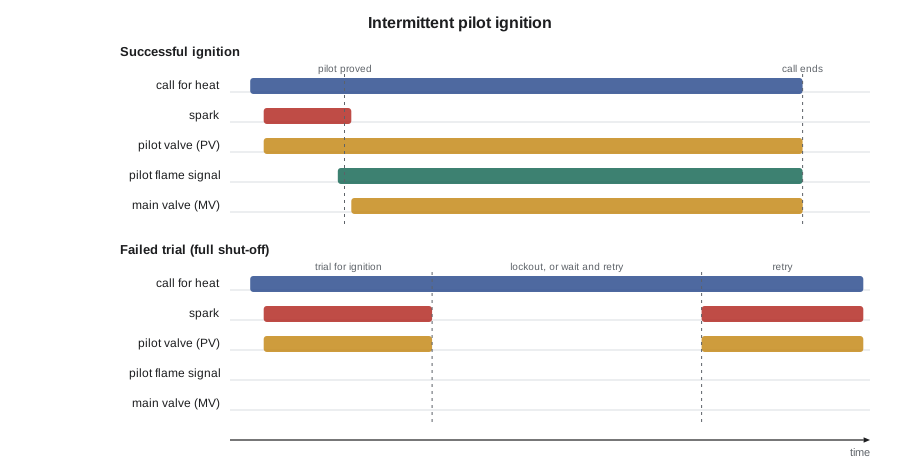
The sequence is short. When the thermostat or zone control calls, 24 volts reaches the module, after passing through any safety switches in the chain, and on a vented appliance any vent damper or pressure switch that must prove first. The module powers the pilot valve through its PV terminal and at the same moment starts the spark. Gas flows to the pilot burner and the spark lights it. The module senses the pilot flame through the flame sensor by flame rectification, the method lesson 6 explains in detail. As soon as the pilot is proved, the module stops the spark and powers the main valve through its MV terminal. Gas flows to the main burner, where the pilot lights it. The module keeps sensing the pilot flame for the whole run; if it loses the flame, it closes the main valve within a fraction of a second to a few seconds, as the module's specification gives. When the call ends, the module removes power from both valves and the pilot goes out.
The ignition module
An IPI module is a small sealed box with low-voltage terminals and a high-voltage output. Typical terminal markings are 24V and 24V GND for its power, PV, MV and MV/PV for the gas valve, a high-voltage spark output where the ignition cable plugs in, a sense terminal for remote sensing, and a terminal marked GND or BURNER GND that must be connected to the burner. Some modules have extra terminals for a vent damper plug or an alarm. The module is a sealed control, and it is replaced, never repaired.
The burner ground connection is more important on an IPI system than almost any other wire. The spark jumps from the electrode to the grounded pilot hood or burner, and the current returns to the module through the ground wire. The flame signal also returns through the burner ground. A loose, corroded or missing ground wire can stop the spark, weaken it so that it jumps somewhere else, or reduce the flame signal so that the module never proves the pilot. Every IPI troubleshooting chart begins with this connection.
The spark itself is several thousand volts, enough to jump a gap of a few millimeters in air. The spark gap between the electrode tip and its ground, often about 1/8 inch, is set by the maker and given in the instructions; too wide and the spark may not jump, too narrow and it may not light the gas reliably. The electrode is held in a ceramic insulator, and a cracked insulator can let the spark leak to the bracket instead of crossing the gap. The ignition cable is a special high-voltage cable whose length the maker limits. It must be routed away from metal surfaces and other wires, must not be spliced, and must not run alongside the flame sensor lead on remote-sensing systems, where it can disturb the flame signal.
Modules carry a hazard of their own. The spark output can give a painful and dangerous shock, and the burner and its surroundings are a poor place to be startled. The module's power is turned off before the ignition cable or electrode is touched, and spark tests are done with the right tool, held by its insulated handle.
Shut-off, lockout and retry
IPI modules differ in what they do when the pilot does not light. The differences are listed in the module's specification, and the appliance's instructions say which type it needs.
A full shut-off module turns off the pilot gas as well as the spark if the pilot is not proved within its trial for ignition, a period that is commonly from about 15 seconds to 90 seconds, depending on the module and the appliance. A full shut-off module with lockout then stays off until it is reset by interrupting its power, for example by turning the thermostat down and up or switching the appliance off and on. A full shut-off module with continuous retry waits a set time, commonly around five or six minutes, and then tries again, and keeps doing so for as long as the call lasts. Retry modules mean that a passing problem, such as a gust of wind, does not leave a house cold until someone notices, while still never letting pilot gas flow for long without a flame.
A partial shut-off module, sometimes called a non-full or continuous-pilot module, keeps the pilot valve open and the spark running for as long as the call lasts if the pilot does not light; only the main valve is held shut. This type is used only with natural gas, where a small, unlit pilot flow disperses upward. It must never be used with propane, which is heavier than air and settles in the bottom of the appliance and the room, where a later spark could ignite it. Appliances for propane, and appliances installed where propane conversion is possible, use full shut-off modules, and many universal replacement modules have a setting that must be selected to match.
| Module type | If the pilot is not proved | Gas allowed | Typical use |
|---|---|---|---|
| Full shut-off, lockout | Spark and pilot gas stop after the trial; module stays off until reset | Natural gas and propane | Appliances whose maker requires a manual reset |
| Full shut-off, continuous retry | Spark and pilot gas stop after the trial; module waits and tries again | Natural gas and propane | Most modern IPI appliances |
| Partial shut-off | Spark and pilot gas continue until the call ends; main valve held shut | Natural gas only | Older natural gas appliances |
Worked problem
Why propane needs full shut-off
A pilot burns about 1,000 Btu/h of natural gas, about 1 cubic foot per hour. A full shut-off module with continuous retry has a 90-second trial and waits 5 minutes between trials. If the pilot never lights during a one-hour call, how much pilot gas is released? How much would a partial shut-off module release in the same hour?
Show solution
- One retry cycle is a 90-second trial and a 5-minute wait, 6.5 minutes in all. Trials in one hour, and gas time:
- \[\frac{60}{6.5} \approx 9.2 \text{ cycles} \qquad 9.2 \times 90 \text{ s} \approx 830 \text{ s}\]
- Gas released with full shut-off, at 1 cubic foot per hour:
- \[1 \text{ ft}^3\text{/h} \times \frac{830}{3600} \text{ h} \approx 0.23 \text{ ft}^3\]
- With partial shut-off, the pilot flows for the full hour:
- \[1 \text{ ft}^3\text{/h} \times 1 \text{ h} = 1 \text{ ft}^3\]
Answer: The full shut-off module releases about a quarter of a cubic foot of unlit gas in the hour, the partial shut-off module more than four times as much. With natural gas, which rises and disperses, the partial module's flow is small enough to be accepted. With propane, which pools at the floor, the same flow can build into a flammable layer, which is why propane appliances must use full shut-off.
What IPI saves
The reason IPI replaced the standing pilot is the gas a pilot burns between calls. A standing pilot burns all year; an intermittent pilot burns only while the appliance runs. In winter part of a standing pilot's heat warms the appliance and its room, but in summer, on a heating appliance, all of it is wasted.
Worked problem
A standing pilot against an intermittent one
A boiler's pilot burns 1,000 Btu/h. A standing pilot burns for all 8,760 hours of a year; on an IPI system the pilot burns only during the boiler's 1,800 hours of operation. How many therms does each use in a year?
Show solution
- Standing pilot:
- \[1000 \times 8760 = 8\,760\,000 \text{ Btu} = 87.6 \text{ therms}\]
- Intermittent pilot:
- \[1000 \times 1800 = 1\,800\,000 \text{ Btu} = 18 \text{ therms}\]
Answer: The standing pilot uses about 88 therms a year, the intermittent pilot 18: a saving of about 70 therms, most of it in the months when the boiler is idle.
Troubleshooting an IPI system
IPI problems divide neatly by how far the sequence gets, and the technician's first job is to watch it and see which step fails. Before anything else, the technician confirms that the module has 24 volts on its power terminals during the call, that its burner ground is tight and clean, and that gas is available at the valve inlet.
No spark. If the module has power but no spark appears, the fault is in the spark path: the module's high-voltage output, the ignition cable, the electrode, its ceramic insulator, the gap or the ground. The technician looks for a cracked insulator, a cable that is damaged, wet or touching metal, a gap out of specification, or a loose ground. If all of these are good and the module has power, the module is faulty.
Spark but no pilot. If the spark is good but the pilot does not light, the technician checks for 24 volts at the valve's PV and MV/PV terminals during the trial. With no voltage, the module is not opening the pilot valve; with voltage, the problem is gas: the pilot valve itself, a blocked pilot orifice or pilot tube, air in the line after the gas has been off, or a spark that is not reaching the pilot gas because the electrode is out of position.
Pilot lights but the main valve does not open. This is the most common IPI fault and the one on Euclaire. The spark keeping on after the pilot is lit is the module's way of saying it has not proved the pilot. The cause is almost always in the flame sensing circuit: a pilot flame too small or misdirected to envelop the sensor, a dirty or oxidized sensor rod, a cracked insulator, a poor burner ground, or on some modules reversed polarity on the 120-volt supply. Lesson 6 shows how to measure the flame signal in microamps.
Main burner lights and then goes out. If the main valve opens and the burner lights, then shuts down after seconds or minutes, the module is losing the flame signal during the run. A marginal signal that is just enough to prove the pilot alone can fail when the main burner's flame and draft disturb the pilot. Lesson 6 also covers this.
On Euclaire, Rosa had Jonah measure the flame signal with the meter in series in the sensor lead. It read 0.3 microamps with the pilot lit, below the 0.5 to 1 microamp minimum the module's literature gave. The pilot flame was short and yellow-tipped and barely touched the rod. Jonah found the pilot orifice partly blocked with fine rust and the ceramic insulator of the igniter-sensor cracked. They replaced the pilot assembly with the maker's kit, set the gap to the instructions, and relit. The pilot now wrapped the rod, the signal read 2.6 microamps, the spark stopped within two seconds and the main burners lit smoothly. Rosa had Jonah cycle the boiler five times from each zone thermostat before she wrote up the call.
Common mistakes
MistakeReplacing the IPI module first because the main valve did not open.
InsteadWatch the sequence; a pilot that lights with the spark continuing points to flame sensing.
MistakeNeglecting the burner ground wire.
InsteadCheck it first: the spark and the flame signal both return through it.
MistakeFitting a partial shut-off module to a propane appliance.
InsteadPropane appliances need full shut-off modules.
MistakeRunning the ignition cable against the cabinet or along the sensor lead.
InsteadRoute it clear of metal and other wires, unspliced, within the maker's length.
MistakeTouching the electrode or cable with the module powered.
InsteadTurn the power off; the spark output can give a dangerous shock.
Summary and key terms
- Intermittent pilot ignition lights the pilot by spark on each call and puts it out when the call ends.
- The module powers the pilot valve and the spark, proves the pilot flame by flame rectification, stops the spark, and only then opens the main valve.
- It watches the pilot through the whole run.
- The burner ground carries both the spark return and the flame signal.
- Full shut-off modules stop pilot gas after a trial and either lock out or retry; partial shut-off modules keep the pilot gas flowing and are for natural gas only, never propane.
- IPI saves the gas a standing pilot burns between calls.
- Troubleshoot by the step that fails: no spark, spark but no pilot, pilot but no main valve, or main burner lost during the run.
- Intermittent pilot ignition (IPI)
- A system that lights a pilot by spark on each call and proves it before opening the main valve.
- Ignition module
- The control that produces the spark, proves the flame and powers the gas valve operators.
- Igniter-sensor
- A single rod that makes the spark and then senses the flame: local sensing.
- Remote sensing
- An IPI design with separate spark electrode and flame sensing rod.
- Spark gap
- The set distance between the spark electrode and its ground.
- Full shut-off
- A module behavior that stops pilot gas as well as the spark if the pilot is not proved.
- Partial shut-off
- A module behavior that keeps pilot gas and spark on until the call ends; natural gas only.
- Lockout
- A module or board state that stops all ignition attempts until it is reset or a timer expires.
Practice problems
Work each problem on paper first, then reveal the answer to check.
What must the module prove before it opens the main valve?
Show answer
That the pilot flame is present.
Why is the burner ground wire so important on an IPI system?
Show answer
The spark and the flame signal both return to the module through it.
Why must propane appliances use full shut-off modules?
Show answer
Unlit propane pools at the floor instead of dispersing.
The pilot lights but the spark keeps going and the main burner never lights. Where is the fault likely to be?
Show answer
In the flame sensing circuit.
What is the difference between lockout and continuous retry?
Show answer
Lockout waits for a reset; continuous retry waits a set time and tries again.
Lesson quiz · 5 questions
Score 60% or more to complete this lesson.
Create a free account to save your progress, take quizzes and earn a certificate.