
GAS-220 · Lesson 1 of 12 · 26 min
Why gas appliances need safety controls
▶ Video coming soon A video version of this lesson is on the way.
On a Thursday evening at the end of September, after Jonah Clarke's third week at Bayline Gas & Heating, Hank Morrow kept him and two other apprentices back at the shop. On the bench was the training board Hank had built years ago: a 24-volt transformer, a thermostat, a row of switches with colored labels, an inducer motor salvaged from a scrapped furnace, a gas valve with its outlet capped, and a control board with a small window over its status light. Hank pointed at it. "A furnace is a fire in a steel box in somebody's basement, usually under a bedroom," he said. "Everything on this board is there for one reason: so the fire only happens when it should, only where it should, and only as long as it is safe. You will spend most of your career working on these parts. If you understand why each one is there, you will never be tempted to take one out of the circuit."
Three weeks later, on Friday, October 16, Jonah saw what happens when someone is tempted. Luis Ferreira took him to a no-heat call at a rented house on Sullivant Avenue. Behind the furnace's burner door they found a short piece of wire with two insulated clips, bridging the terminals of the flame rollout switch. The tenant said the landlord's handyman had "fixed" the furnace that way the winter before, after it kept shutting off. Luis shut the gas off at the appliance valve, pulled the jumper and pulled the burners. The flue collector box was half blocked with rust scale, and the flames had been rolling out of the burner openings every time the furnace fired. "Every one of those shutdowns was the furnace telling him something," Luis said. "He taped its mouth shut." The furnace was tagged and left off until the landlord approved the repair.
This lesson explains what the safety controls on a gas appliance protect against, how they are arranged so that a fault always shuts the burner down, and what the codes and Bayline expect of a technician who finds a control missing, damaged or bypassed. The rest of the course takes the controls one at a time: pilots and thermocouples, gas valves, ignition systems, flame sensing, pressure switches, limits and rollout switches, control boards, wiring diagrams and the sequence of operation that ties them together.
What can go wrong with a gas flame
Burning natural gas or propane is safe only when four things are true. The gas must light as soon as it reaches the burner, the flame must stay where it was designed to be, the products of combustion must leave the building, and the heat must be carried away fast enough that nothing overheats. Each of the main hazards in this trade comes from one of those conditions failing, and each has controls designed to catch it.
The first hazard is unburned gas. If the gas valve opens and the gas does not light, the combustion chamber and the heat exchanger fill with a mixture of gas and air. When it finally lights, from a late spark, a glowing igniter or a pilot, it does not burn quietly: it burns all at once in a delayed ignition, which can be anything from a loud bang that blows the burner door off to an explosion that splits the heat exchanger. Gas leaking into a room from an appliance that has not lit is the same hazard on a larger scale. The controls that guard against it are the ones that prove there is a flame and shut the gas off quickly if there is not: the thermocouple on a standing pilot, the flame sensor on electronic ignition, and the timing built into every ignition control.
The second hazard is combustion products in the living space. If the vent is blocked, disconnected or too weak to carry the flue gas away, or if the flame is starved of air, the flue gas spills into the house, and an air-starved flame produces carbon monoxide. GAS-110 described the October incident on Parsons Avenue where exactly that happened. The controls that guard against it are the ones that prove the vent and the draft: pressure switches on induced-draft and power-vented appliances, blocked vent and spill switches on natural-draft appliances, and the rollout switch, which catches flame and flue gas escaping from the front of the burner.
The third hazard is overheating. A heat exchanger that does not have enough air or water moving across it gets hotter than it was designed for. Metal that is repeatedly overheated cracks, and a cracked heat exchanger lets flue gas into the circulating air. Overheating also starts fires in nearby materials. The controls that guard against it are the high limit, which shuts the burner off when the air or water leaving the appliance gets too hot, and on boilers the low-water cutoff and pressure controls covered in later courses.
The fourth hazard is electrical: a shock, a fire in the wiring or a control that misbehaves because its power is wrong. GAS-130 covered these. They matter here because a modern flame safeguard depends on correct polarity and a good ground to work at all, as lesson 6 explains.
The safety chain
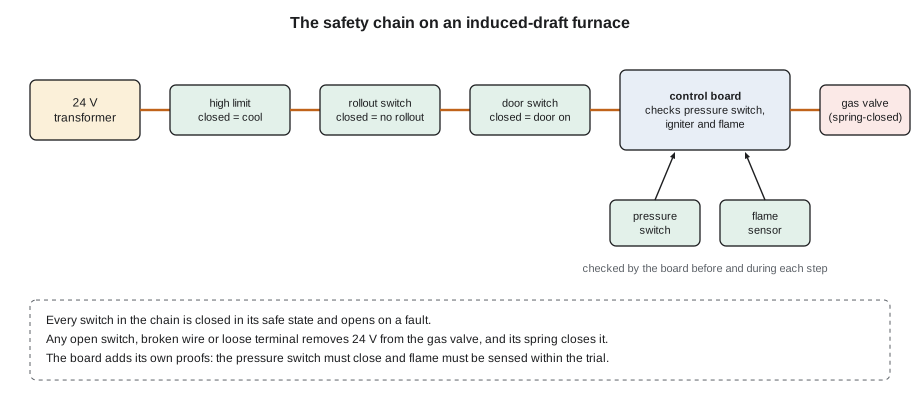
Most of the switches that guard against these hazards are wired in series in the low-voltage control circuit, so that the gas valve can only be powered when every one of them is closed. Technicians call this the safety chain or the limit string. On a typical induced-draft furnace the chain runs from the 24-volt side of the transformer through the high limit and the rollout switch to the control board; the board then adds its own conditions: the pressure switch must close, the igniter must have had its warm-up, and the flame must be proved within a few seconds of the valve opening. If any switch in the chain opens, the circuit is broken, the valve closes and the burner goes out. GAS-130 explained why switches that must all be satisfied go in series; here the point is what they prove.
| Control | What it proves or watches | Hazard it guards against | Lesson |
|---|---|---|---|
| Thermocouple or thermopile | A pilot flame is present | Unburned gas | 2 |
| Gas valve (redundant seats) | Gas stops when power is removed | Unburned gas | 3 |
| Ignition module or board timing | Ignition happens within a set trial time | Unburned gas, delayed ignition | 4, 5, 9 |
| Flame sensor (rectification) | Main or pilot flame is present | Unburned gas | 6 |
| Pressure switch | The inducer is moving flue gas | Flue gas in the house, poor combustion | 7 |
| Blocked vent or spill switch | Flue gas is not spilling from the draft hood | Flue gas in the house | 7, 8 |
| High limit | Air or water leaving the appliance is not too hot | Overheating, cracked heat exchanger, fire | 8 |
| Flame rollout switch | Flame is not escaping from the burner area | Fire, flue gas in the house | 8 |
Fail-safe design
The controls on a gas appliance are designed so that the most likely ways they can fail leave the burner off. This is called fail-safe design, and it shows up in every part of the system. The gas valve is held closed by a spring and opens only while it is powered, so a broken wire, a blown fuse or a power failure closes it. The safety magnet in a standing-pilot valve is held open only by the small current from a hot thermocouple, so a cold, broken or disconnected thermocouple closes it. The switches in the safety chain are closed in their safe state and open on a fault, so a broken wire or a loose terminal looks to the board the same as a tripped limit. A flame sensor that is dirty, broken or disconnected reads no flame, never a false flame. A pressure switch that has stuck closed is caught by the board, which checks before it starts the inducer that the switch is open, as lesson 7 explains.
Fail-safe design means that most failures produce a shutdown and a no-heat call, not a hazard. That is why the customer's complaint is so often "it keeps shutting off" or "it won't stay lit". It also explains the temptation the handyman on Sullivant Avenue gave in to. A safety control that has shut the appliance off is doing its job. The fault is somewhere else, and the technician's task is to find it, not to stop the control from reporting it.
Proving before, during and after
Modern ignition controls follow a simple idea: prove each condition before the next step, and keep proving it. Before the inducer starts, the board checks that the pressure switch is open, so a switch welded shut cannot fool it. Before the igniter is energized, the board checks that the pressure switch has closed, proving that the inducer is moving air. Before the gas valve is held open, the board checks that a flame has been sensed within the trial for ignition, a window of a few seconds. Throughout the run, it keeps checking the limit, the rollout switch, the pressure switch and the flame, and shuts the valve within seconds if any of them is lost.
Air movement is part of the proof too. The inducer runs for a pre-purge before every ignition, clearing the combustion chamber and heat exchanger of any gas or flue gas left from the last cycle. It runs an inter-purge between failed ignition attempts, so that gas from a failed trial is cleared before the next one, and a post-purge after the burner shuts off. These purges are the reason a modern furnace makes the customer wait half a minute or more after the thermostat calls before anything visible happens.
Worked problem
Why the trial for ignition is short
A furnace burns 80,000 Btu/h of natural gas at 1,000 Btu per cubic foot. If the gas valve were held open for 20 seconds without the gas lighting, how much gas would enter the combustion chamber? How much would enter in a typical 4-second trial for ignition? Natural gas will burn when it makes up about 5 parts in 100 of a gas and air mixture; what volume of mixture could 20 seconds of gas make flammable?
Show solution
- Gas flow in cubic feet per second:
- \[\frac{80\,000 \text{ Btu/h}}{1000 \text{ Btu/ft}^3} = 80 \text{ ft}^3\text{/h} = \frac{80}{3600} = 0.0222 \text{ ft}^3\text{/s}\]
- In 20 seconds and in 4 seconds:
- \[0.0222 \times 20 = 0.44 \text{ ft}^3 \qquad 0.0222 \times 4 = 0.089 \text{ ft}^3\]
- Mixture made flammable by 0.44 cubic feet of gas at 5 parts in 100:
- \[\frac{0.44}{0.05} = 8.9 \text{ ft}^3\]
Answer: Twenty seconds of unlit gas could make about 8.9 cubic feet of flammable mixture, several times the volume of a furnace's combustion chamber and heat exchanger. A 4-second trial lets in less than a tenth of a cubic foot, which the inter-purge clears before the next try. That is why ignition controls allow only a few seconds for the flame to be proved.
Worked problem
How many times a pre-purge clears the box
The combustion chamber, heat exchanger and collector box of a furnace hold about 0.9 cubic feet. The inducer moves about 32 cfm. How many times does a 15-second pre-purge replace the air in them?
Show solution
- Air moved in 15 seconds:
- \[32 \text{ cfm} \times \frac{15}{60} \text{ min} = 8 \text{ ft}^3\]
- Number of changes:
- \[\frac{8}{0.9} \approx 8.9\]
Answer: The pre-purge replaces the air in the box about nine times, so any gas or flue gas left from the last cycle is cleared long before the igniter is energized. A blocked vent or a weak inducer reduces that margin, which is one reason the pressure switch must prove the airflow before ignition.
Redundancy
Where a single failure could be dangerous, the appliance has two independent protections. A combination gas valve has two valve seats in series, so gas is stopped even if one of them leaks or sticks. A furnace has both a high limit and a rollout switch, which watch different symptoms. Many boards check the flame sensor and the gas valve circuit separately, so that a welded relay contact or a valve that stays open when it should be closed is detected and the inducer is kept running to clear the box. Redundancy is also the reason the codes require a manual shut-off valve ahead of every appliance: the technician must be able to stop the gas without relying on the appliance's own valve.
The codes and the technician
In Ohio, gas appliances must be listed and installed to the fuel gas code, the Ohio Mechanical Code with the International Fuel Gas Code for commercial work and the Residential Code of Ohio for houses, with NFPA 54 as the reference standard, and to the manufacturer's installation instructions, which are part of the listing. Removing, bypassing or altering a safety control, or replacing it with a part the maker does not specify, takes the appliance outside its listing. A technician who finds a bypassed or defeated safety control has found an immediate hazard: the appliance is shut off and red-tagged under Bayline's procedure, the customer is told in plain words why, and Bayline's office notifies Columbia Gas of Ohio where its procedure calls for it. The tags and the paperwork that goes with them were covered in GAS-110.
Bayline adds a company rule that every apprentice learns in the first month: no safety control is ever jumpered while the burner can fire. Switches are tested by measuring voltage across them or resistance through them with the power off, as GAS-130 taught. A jumper is used only on the training board, or, where the maker's own troubleshooting guide calls for it, briefly on a low-voltage circuit with the gas valve unable to open and the technician watching. A jumper is never left in place, and a technician who finds one is expected to take a photograph, remove it and record it.
Why the controls are worth understanding
An apprentice can learn to replace parts by following fault codes. A technician understands what each control is proving, so that when a furnace locks out he can ask the right question: did the board fail to prove the draft, the ignition or the flame, and why? On the training board that September evening, Hank had Jonah open each switch in turn and watch what the board did: opening the limit stopped everything and started the blower, opening the pressure switch before ignition made the board wait and flash a code, and pulling the flame sensor wire made the board shut the valve within seconds and try again. "It is always telling you which step failed," Hank said. "Your job is to work out what made that step fail." The rest of this course follows that idea through every control.
Common mistakes
MistakeTreating a safety control that keeps tripping as the fault.
InsteadFind what is making it trip; the control is doing its job.
MistakeJumpering a limit or rollout switch to see if the furnace will run.
InsteadMeasure the voltage across the switch or its resistance with the power off.
MistakeLeaving a customer's appliance running with a known bypassed control.
InsteadShut it off, remove the bypass, tag it and explain why.
MistakeReplacing a safety control with whatever fits the bracket.
InsteadUse the exact part, or an approved equivalent, that the maker specifies.
MistakeAssuming a no-heat call has nothing to do with safety.
InsteadMost no-heat calls are a safety control stopping the burner; find out which one and why.
Summary and key terms
- Gas appliances face four main hazards: unburned gas, combustion products in the house, overheating and electrical faults.
- Safety controls watch for each of them, and most are wired in series in a safety chain so that any open switch removes power from the gas valve.
- The controls are fail-safe: their likely failures leave the burner off.
- Ignition controls prove each condition before the next step and keep proving it, and purge the combustion chamber before ignition, between tries and after the burner stops.
- Short trials for ignition limit how much unlit gas can enter the box.
- Critical functions are redundant.
- In Ohio, the fuel gas codes require listed appliances installed to their instructions, and a bypassed control is an immediate hazard. Bayline never jumpers a safety control while the burner can fire.
- Safety chain
- The safety switches wired in series so that any open switch removes power from the gas valve.
- Fail-safe
- Designed so that its likely failures leave the appliance in a safe, off condition.
- Delayed ignition
- Gas that accumulates before lighting and then burns all at once, often with a bang.
- Trial for ignition
- The few seconds a control allows for a flame to be proved after the gas valve opens.
- Pre-purge
- Running the inducer before ignition to clear the combustion chamber and heat exchanger.
- Inter-purge
- Running the inducer between failed ignition attempts to clear unburned gas.
- Post-purge
- Running the inducer after the burner shuts off to clear the remaining flue gas.
- Redundancy
- Two independent protections for a function where a single failure could be dangerous.
Practice problems
Work each problem on paper first, then reveal the answer to check.
Name the four main hazards safety controls guard against.
Show answer
Unburned gas, combustion products in the house, overheating and electrical faults.
Why is a gas valve held closed by a spring?
Show answer
So that any loss of power, from a broken wire, a blown fuse or a power cut, closes it.
What does a board check before it starts the inducer, and why?
Show answer
That the pressure switch is open, so a switch stuck closed cannot fake a proven draft.
Why does the trial for ignition last only a few seconds?
Show answer
To limit the unlit gas that can collect if ignition fails.
What does Bayline do when it finds a jumpered safety control?
Show answer
Photographs it, removes it, shuts the appliance off and tags it, and records it.
Lesson quiz · 5 questions
Score 60% or more to complete this lesson.
Create a free account to save your progress, take quizzes and earn a certificate.