
GAS-220 · Lesson 2 of 12 · 26 min
Standing pilots and thermocouples
▶ Video coming soon A video version of this lesson is on the way.
On Tuesday, October 13, Luis Ferreira took Jonah to a small machine shop in Groveport whose owner had called three times in two weeks. The shop was heated by a 1990s gas unit heater hung from the ceiling, with a standing pilot: a small flame that burns all the time, day and night, ready to light the main burner whenever the thermostat calls. Every few days the shop was cold in the morning, the pilot was out, and the owner climbed a ladder with a long lighter to relight it. "A standing pilot that goes out is one of the oldest calls in the trade," Luis said, setting up the ladder. "There are only a handful of reasons, and you can test for every one of them. Don't guess, and don't just throw a new thermocouple at it."
Standing pilots are fading from new equipment. Furnaces gave them up decades ago for electronic ignition, and in Canada gas fireplaces made since 2020 must be able to put their pilot out automatically. They are still found on older furnaces, wall furnaces, boilers, unit heaters and fireplaces, on many storage water heaters, and on equipment like the shop heater that has outlived several owners. A gas technician will work on them for years yet. They also teach the principle that every later ignition system uses: no gas flows to the main burner unless something proves that a flame is ready to light it.
This lesson explains how a standing pilot and its thermocouple or thermopile prove the pilot flame, how to read a good and a bad pilot flame, how to test a thermocouple and a thermopile with a meter, and how to install a replacement properly.
The pilot burner
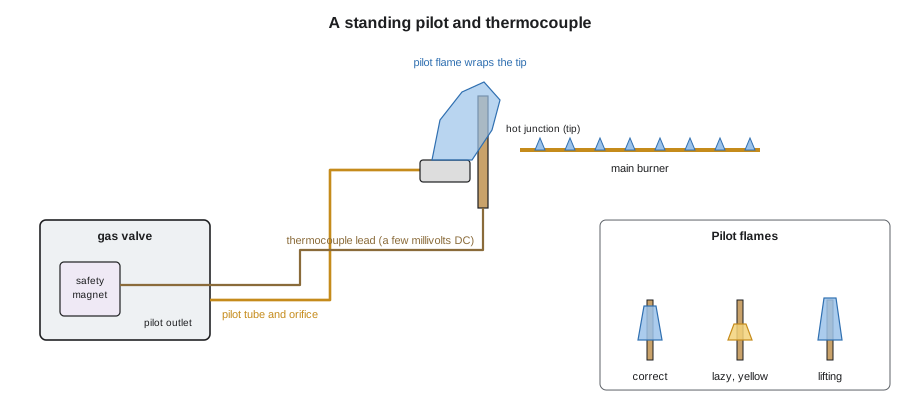
A pilot burner is a small burner, typically burning a few hundred watts of gas, mounted beside the main burner so that its flame reaches the main burner's ports. Gas comes to it through a small pilot tube, usually aluminum or copper tubing of about 1/4 inch outside diameter, from a separate outlet on the gas valve, and passes through a pilot orifice much smaller than any main burner orifice. Many valves have a pilot adjustment screw that sets the pilot gas flow. The pilot burner holds the flame sensing element, here a thermocouple or thermopile, in its flame, and on many designs a hood directs part of the flame toward the main burner and part onto the sensing element.
A good pilot flame is steady, soft and mostly blue, and it wraps around the tip of the thermocouple, typically covering the top 3/8 to 1/2 inch of it, as the maker's diagram shows. Three faults are common. A small or lazy yellow flame that barely touches the element comes from a partly blocked orifice, lint, a spider web or dirt in the pilot burner, low gas pressure, or a pilot screw turned too far in. A lifting or noisy flame that blows away from the burner head comes from too much pilot gas or a wrong orifice. A flame that is bent away from the element by a draft, a misaligned hood or a damaged bracket heats the element poorly. Each of these lets the thermocouple run cool, and a cool thermocouple gives a weak signal.
How a thermocouple works
A thermocouple is two wires of different metals joined at one end, the hot junction. When the hot junction is heated and the other end stays cooler, a small DC voltage appears between the two wires. This is the Seebeck effect, and the voltage depends on the metals and on the difference in temperature between the two ends. A pilot thermocouple produces only a few tens of millivolts, but it can drive a useful current through a very low resistance circuit. The thermocouple's lead is a tube with a center conductor, and its end screws into the gas valve, where the current flows through the coil of a small electromagnet called the safety magnet, power unit or pilot safety.
To light the pilot, the technician turns the valve to its pilot position and holds the reset or pilot button down. That button pushes the safety valve open by hand and lets gas reach the pilot burner while the pilot is lit. Once the thermocouple is hot, usually after holding the button for 30 to 60 seconds, its current is enough for the magnet to hold the safety valve open by itself, and the button can be released. If the pilot goes out, the thermocouple cools, its voltage falls, and within a short time the magnet can no longer hold the valve against its spring. The valve snaps shut, often with an audible click, and stops gas to both the pilot and the main burner. This is called full shut-off, which makers' literature often labels with the figure 100: when the safety drops out, nothing flows.
The time between the pilot going out and the valve closing is called the drop-out time. A thermocouple is not instant: it has to cool before its voltage falls far enough. Product standards set a maximum drop-out time of a few minutes, and on a healthy system it is commonly around one to two minutes. A valve that takes much longer, or that does not close at all, has a faulty magnet and must be replaced.
What a thermocouple should read
Three measurements tell a technician almost everything about a thermocouple circuit, and they are taken with a meter on its DC millivolt range. The exact figures come from the valve and thermocouple makers' literature, but the ranges below are typical for a standard 30-millivolt thermocouple.
The open-circuit reading is taken with the thermocouple unscrewed from the valve and its pilot lit, with one meter lead on the end of the center conductor and the other on the outer tube. A healthy thermocouple in a good pilot flame typically reads about 25 to 35 millivolts; well below about 18 millivolts it is weak. The closed-circuit reading is taken with the thermocouple connected to the valve and working, using a test adapter screwed in between the thermocouple and the valve so the meter can read the voltage across the magnet while it carries its current. A typical closed-circuit reading is roughly half the open-circuit reading, often around 12 to 15 millivolts. The drop-out reading is the closed-circuit voltage at the moment the magnet releases, watched on the meter as the pilot is shut off and the thermocouple cools; a typical magnet drops out at a few millivolts, often 1 to 2 millivolts and well under about 6.
| Reading | How it is taken | Typical healthy value | What a bad reading suggests |
|---|---|---|---|
| Open circuit | Thermocouple off the valve, pilot lit | About 25 to 35 mV | Low: weak pilot flame or worn thermocouple |
| Closed circuit | Test adapter between thermocouple and valve | About half the open-circuit value, often 12 to 15 mV | Very low with good open circuit: high resistance at the connection or a shorted magnet |
| Drop-out | Watch closed-circuit voltage as pilot is shut off | Magnet releases at about 1 to 2 mV | Releases at a high voltage: weak magnet; never releases: faulty valve |
Read together, the three numbers point to the fault. A low open-circuit reading with a good pilot flame means a worn thermocouple; with a poor flame it means the pilot needs attention first. A good open-circuit reading but a very low closed-circuit reading means the current is being lost somewhere, often at a dirty or loose connection at the valve. A good closed-circuit reading with a magnet that drops out at a high voltage means a weak magnet, which is a valve fault.
Worked problem
Reading the shop heater
At the machine shop, Luis cleaned the pilot burner, which was half blocked with fine dust and a spider web, and relit it. With the flame now properly wrapping the tip, Jonah measured 27 mV open circuit. With the test adapter in, the closed-circuit reading was 5.2 mV, and the magnet dropped out at 1.4 mV. Before the cleaning, the open-circuit reading had been 16 mV. What do these numbers say?
Show solution
- Compare the open-circuit readings before and after cleaning:
- \[16 \text{ mV} \to 27 \text{ mV}\]
- The pilot was the first problem: a dusty pilot heated the thermocouple poorly. Now compare the closed-circuit reading with the open-circuit reading:
- \[\frac{5.2}{27} \approx 0.19\]
- A healthy circuit runs at roughly half the open-circuit value, so about 13 to 14 mV would be expected. The magnet itself released at 1.4 mV, which is normal.
Answer: There were two faults. The dusty pilot explained the low open-circuit voltage, and the closed-circuit voltage, at under a fifth of the open-circuit value, showed a high-resistance connection. Luis found the thermocouple's tip contact pitted and the valve's socket dirty. He replaced the thermocouple, cleaned the socket and measured 26 mV open and 13.8 mV closed. The magnet's drop-out was normal, so the valve could stay.
Replacing a thermocouple
Thermocouples are inexpensive, and replacing one is routine, but a careless replacement causes the next callback. The replacement must be the type and length the valve maker or the appliance maker specifies, or a listed universal replacement with the right adapter. The pilot gas is shut off first. The new lead is routed the way the old one was, away from the main burner flame and from sharp edges, with gentle bends and no kinks, and any extra length is coiled loosely, not crushed. The tip is pushed fully into the pilot bracket so the flame wraps it as the diagram shows.
At the valve, the connection is the most common source of trouble. The valve's socket and the thermocouple's end must be clean and dry. Makers typically say to tighten the nut finger-tight and then only a quarter turn more with a wrench. Over-tightening can damage the magnet's contact and cause exactly the high-resistance fault that the new thermocouple was meant to cure. After installation, the technician lights the pilot, takes the open-circuit and closed-circuit readings, and checks the drop-out time with a watch by shutting the pilot off and waiting for the click.
Thermopiles and millivolt systems
A thermopile, sometimes called a powerpile, is a group of thermocouples connected in series inside one housing, so that their voltages add. A typical thermopile produces about 750 millivolts, three-quarters of a volt, open circuit. That is enough not only to hold a safety magnet but to open a millivolt gas valve through a wall switch or a millivolt thermostat, without any house power at all. Millivolt systems are common on older fireplaces, wall furnaces and some boilers, because they keep working during a power failure. On many millivolt valves, a separate thermocouple holds the pilot safety while the thermopile operates the main valve; on others, the thermopile does both.
Testing a thermopile follows the same idea as a thermocouple. The open-circuit reading is taken at the thermopile's terminals with the pilot lit and the wires removed. The closed-circuit or loaded reading is taken at the valve's thermopile terminals with the thermostat or switch closed and the main valve open, so the thermopile is driving its full load. Every connection between the thermopile and the valve, including the switch and the wire to it, uses up some of that small voltage. Makers publish a minimum loaded voltage below which the main valve may not open reliably, and a maximum drop across the switch circuit, measured across the switch terminals with the switch open. On a fireplace with a long run of thin wire to a wall switch, the drop in the wire can be the whole problem.
Worked problem
A thermopile voltage budget
A fireplace thermopile reads 690 mV open circuit. With the wall switch closed and the main burner on, the reading at the valve's thermopile terminals is 260 mV. With the main burner on, Jonah measures 95 mV across the wall switch circuit, between the switch wires at the valve. The maker's minimum loaded reading is 300 mV. What should he check first?
Show solution
- The loaded reading is below the maker's minimum:
- \[260 \text{ mV} < 300 \text{ mV}\]
- Of the voltage available under load, 95 mV is lost in the switch wiring and the switch. If that loss were cut to about 20 mV, the valve would see roughly:
- \[260 + (95 - 20) = 335 \text{ mV}\]
- That would be above the minimum.
Answer: The thermopile itself is producing a reasonable voltage; the switch circuit is losing too much of it. Jonah should check the switch contacts and every connection in the switch wiring, and the length and size of the wire, before replacing the thermopile. A corroded switch or a long run of thin wire is the most common cause.
Pilot outage: the usual causes
When a standing pilot goes out, the cause is almost always one of a short list. The pilot flame may be weak or misdirected because of dirt, lint, a spider web, a bad orifice, low pressure or a bent bracket. The thermocouple may be worn, short, loose in its bracket or poorly connected at the valve. The magnet may be weak. A draft may be blowing the pilot out, from a door, a fan or, on a natural-draft appliance, a strong downdraft in the vent. The gas supply may be interrupted, for example on a propane system with a tank running low or a regulator freezing. And on some appliances a safety switch, such as a spill switch or a thermal cutoff on a water heater's flame arrestor, is wired into the thermocouple circuit and interrupts it on a fault. In that case the pilot outage is the safety control doing its job, and the cause is what tripped it.
Luis summed it up for Jonah at the end of the shop call. "Clean the pilot, measure the three numbers, check what else is in the thermocouple circuit, and look for a draft. Then you'll know whether you're replacing a part or fixing the reason the part looked bad." Before they left, he showed the owner how to read the lighting instructions on the label, including the step that says to wait five minutes after turning the gas off before relighting, so that any gas around the burner has time to clear.
In the United States, there is no federal rule against standing pilots on gas fireplaces, and standing-pilot models are still sold beside intermittent pilot models. Many makers build to Canada's 2020 rules anyway, so the same fireplace can sell on both sides of the border. When a technician services a standing-pilot fireplace, it is good practice to explain the pilot's gas use to the customer and the option of turning it off in summer, as GAS-210 showed.
Common mistakes
MistakeReplacing the thermocouple without looking at the pilot flame.
InsteadClean and adjust the pilot first; a weak flame makes a good thermocouple read low.
MistakeOver-tightening the thermocouple nut at the valve.
InsteadFinger-tight, then a quarter turn more, or as the maker says.
MistakeTesting only the open-circuit voltage.
InsteadTake open-circuit, closed-circuit and drop-out readings to locate the fault.
MistakeIgnoring a spill switch or thermal cutoff wired into the thermocouple circuit.
InsteadCheck every device in the circuit; a tripped safety switch has a cause.
MistakeRelighting a pilot right after shutting the gas off.
InsteadWait the time the lighting instructions give, usually five minutes.
Summary and key terms
- A standing pilot burns continuously and heats a thermocouple or thermopile that proves the flame.
- A good pilot flame is steady and blue and wraps the top of the thermocouple.
- A thermocouple produces a few tens of millivolts that hold the valve's safety magnet open; when the pilot goes out, the magnet releases and shuts off pilot and main gas.
- Typical readings are about 25 to 35 mV open circuit, about half that closed circuit, and a drop-out at 1 to 2 mV, but makers' figures govern.
- A low closed-circuit reading with a good open-circuit reading points to a bad connection.
- A thermopile produces about 750 mV and can run a millivolt valve without house power; losses in the switch circuit are a common fault.
- Pilot outages come from a dirty or misdirected pilot, a worn or loose thermocouple, a weak magnet, drafts, supply problems or a safety switch in the circuit.
- Standing pilot
- A pilot flame that burns continuously, ready to light the main burner.
- Thermocouple
- Two dissimilar metals joined at a hot junction that produce a small DC voltage when heated.
- Safety magnet
- The electromagnet in a gas valve that holds the safety valve open while the thermocouple is hot.
- Drop-out time
- The time between the pilot going out and the safety magnet releasing.
- Open-circuit reading
- The voltage of a thermocouple or thermopile measured with no load connected.
- Closed-circuit reading
- The voltage measured while the thermocouple or thermopile drives its load.
- Thermopile
- Several thermocouples in series, producing about 750 mV, able to run a millivolt valve.
- Millivolt valve
- A gas valve operated by a thermopile's output, needing no house power.
Practice problems
Work each problem on paper first, then reveal the answer to check.
Why does a thermocouple's voltage fall when the pilot goes out?
Show answer
The hot junction cools, and its voltage depends on the temperature difference.
What is a typical open-circuit reading for a pilot thermocouple?
Show answer
About 25 to 35 millivolts.
What tool is needed for a closed-circuit thermocouple reading?
Show answer
A test adapter screwed in between the thermocouple and the valve.
What does a good open-circuit reading with a very low closed-circuit reading suggest?
Show answer
A high-resistance connection at the valve, or a magnet fault.
Why can a long wall-switch run stop a millivolt fireplace from lighting?
Show answer
The wire and switch drop part of the thermopile's small voltage, leaving too little for the valve.
Lesson quiz · 5 questions
Score 60% or more to complete this lesson.
Create a free account to save your progress, take quizzes and earn a certificate.