
FIN-301 · Lesson 2 of 12 · 28 min
How securities are traded: orders, margin, accounts and taxes
Lesson 1 described where securities trade. This lesson follows a trade from the investor's side: the kinds of orders that can be placed, what trading really costs, how investors borrow to buy (buying on margin) or sell shares they do not own (short selling), and which accounts and tax rules shape the return an investor actually keeps. These details look mechanical, but they matter. Costs, leverage and taxes can turn a good investment into a poor one, and the account an asset is held in can be worth as much as the choice of asset itself. The rules described here were checked in October 2026; contribution limits and tax thresholds change every year, so investors should confirm current figures with the tax authority.
Types of orders
A market order asks the broker to buy or sell immediately at the best available price. It guarantees execution but not price: in a fast-moving or thinly traded stock the investor may pay much more than the last quoted price. A limit order sets the worst acceptable price, a maximum for a buy or a minimum for a sell, and waits in the order book until it can be filled at that price or better. It guarantees price but not execution. A stop order, or stop-loss, becomes a market order once the stock trades at or through a trigger price; it is used to limit losses or protect gains, but in a sharp drop the sale may happen far below the stop. A stop-limit order becomes a limit order at the trigger, so it protects price but may not be filled at all. Orders can also specify how long they last, such as for the day or until canceled.
Every stock has a bid, the highest price a buyer is offering, and an ask, the lowest price a seller will accept. The difference is the bid–ask spread. A buyer using a market order pays the ask; a seller receives the bid; an investor who buys and immediately sells loses the spread. For large, heavily traded shares the spread may be a cent; for small companies, exchange-traded funds with little trading, or bonds, it can be much wider. Large orders also move the price against the trader, a cost called market impact. Explicit costs, such as commissions, have fallen to zero at many online brokers, but the spread and market impact remain, and some zero-commission brokers are paid by market makers for routing orders to them, a practice called payment for order flow that regulators continue to scrutinize.
Worked problem
The cost of trading a small company
A stock is quoted at $9.80 bid and $10.00 ask. An investor buys 2,000 shares at the market and sells them a month later when the quote is unchanged. What did the round trip cost, ignoring commissions?
Show solution
- Purchase cost: 2,000 × 10.00 = 20,000.
- Sale proceeds: 2,000 × 9.80 = 19,600.
- Cost of the round trip: 400, or 2 % of the amount invested.
Answer: The midpoint price did not change, yet the investor lost 2 % to the spread. Frequent trading in wide-spread securities is expensive even with zero commissions.
Buying on margin
A margin account lets an investor borrow from the broker to buy securities, using the securities as collateral. The investor's equity is the market value of the securities minus the loan. The initial margin is the minimum fraction of the purchase the investor must pay in cash; the maintenance margin is the minimum equity, as a fraction of market value, that must be kept. If prices fall and equity drops below the maintenance level, the broker issues a margin call: the investor must deposit cash or securities, or the broker sells positions, often at the worst moment. Interest is charged on the loan, usually at a rate well above the risk-free rate.
In the United States, the Federal Reserve's Regulation T sets the initial margin for most listed shares at 50 %, and FINRA requires maintenance equity of at least 25 %. Brokers commonly set higher house requirements, often 30 % or more, and higher still for volatile shares.
Margin magnifies returns in both directions, exactly like the financial leverage in FIN-201 lesson 12. With half the purchase borrowed, a 10 % rise in the stock gives roughly a 20 % return on the investor's equity before interest, and a 10 % fall a 20 % loss. The price at which a margin call occurs can be found from the condition that equity equals the maintenance fraction of market value.
Here \( n \) is the number of shares, \( D \) the loan, \( m \) the maintenance margin and \( P^{*} \) the price that triggers a call.
Worked problem
A margin purchase
An investor buys 1,000 shares at $50 with 50 % initial margin, borrowing $25,000 at 6 % a year. The maintenance margin is 30 %. Find the margin call price and the one-year return if the price rises to $60 or falls to $40, with no dividends.
Show solution
- Margin call price: 25,000 ÷ (1,000 × 0.70) = 35.71.
- At $60: equity = 60,000 − 25,000 − interest 1,500 = 33,500; return = 33,500 ÷ 25,000 − 1 = 34 %.
- At $40: equity = 40,000 − 25,000 − 1,500 = 13,500; return = −46 %.
- Without margin, the returns would have been +20 % and −20 %.
Answer: Borrowing half the purchase more than doubles the swings in the return on equity once interest is included.
Short selling
A short sale profits from a price decline. The investor borrows shares from the broker, sells them, and later buys them back to return to the lender. The profit is the sale price minus the repurchase price, minus any dividends paid to the lender while the shares are borrowed and any borrowing fee. Short sellers must post margin, keeping the sale proceeds plus additional equity in the account. Because a share price can rise without limit, a short seller's potential loss is unlimited, and a sharp rise can force many short sellers to buy at once, a short squeeze such as the one in GameStop shares in January 2021. Short sellers are often unpopular, but they help keep prices honest: some of the best-known accounting frauds were exposed by short sellers who had studied a company's accounts closely.
# Margin purchase and short sale, one-year horizon
def margin_return(n, p0, p1, init_margin, rate, div=0.0):
    equity0 = n * p0 * init_margin
    loan = n * p0 - equity0
    equity1 = n * p1 + n * div - loan * (1 + rate)
    return equity1 / equity0 - 1

def call_price_long(n, loan, maint):
    return loan / (n * (1 - maint))

def short_result(n, p0, p1, deposit, div=0.0):
    profit = n * (p0 - p1) - n * div
    return profit, profit / deposit

def call_price_short(n, p0, deposit, maint):
    # equity = deposit + proceeds - n*P ; call when equity / (n*P) = maint
    return (deposit + n * p0) / (n * (1 + maint))

for p1 in (60, 50, 40):
    print(f"long on margin, price {p1}: return {margin_return(1000, 50, p1, 0.5, 0.06):+.1%}")
print(f"margin call below {call_price_long(1000, 25_000, 0.30):.2f}")

for p1 in (70, 80, 90):
    prof, r = short_result(500, 80, p1, deposit=20_000, div=1.0)
    print(f"short 500 at 80, cover at {p1}: profit {prof:+,.0f}, return on deposit {r:+.1%}")
print(f"short margin call above {call_price_short(500, 80, 20_000, 0.30):.2f}")long on margin, price 60: return +34.0% long on margin, price 50: return -6.0% long on margin, price 40: return -46.0% margin call below 35.71 short 500 at 80, cover at 70: profit +4,500, return on deposit +22.5% short 500 at 80, cover at 80: profit -500, return on deposit -2.5% short 500 at 80, cover at 90: profit -5,500, return on deposit -27.5% short margin call above 92.31
Tax-advantaged accounts
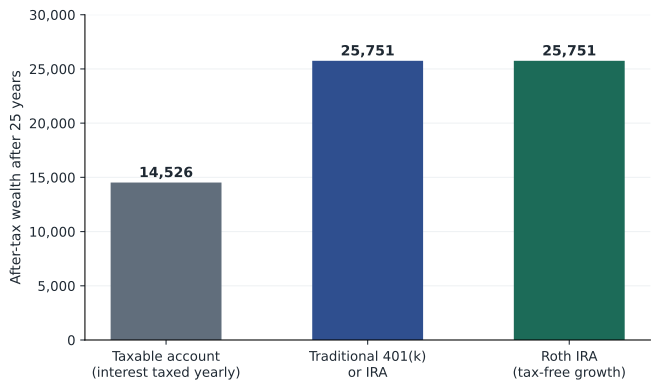
The United States offers several tax-advantaged accounts. In a traditional 401(k), contributions reduce taxable income, growth is tax-deferred, and withdrawals are taxed as income; the 2026 employee deferral limit is $24,500, plus an $8,000 catch-up from age 50 and a higher $11,250 catch-up at ages 60 to 63, and many employers add matching contributions. Roth 401(k) contributions are made after tax, but qualified withdrawals are tax-free. Individual retirement accounts (IRAs) allow $7,500 in 2026, plus $1,100 from age 50; Roth IRA contributions phase out for single filers with modified adjusted gross income between $153,000 and $168,000. Health savings accounts and 529 education plans offer further tax advantages for specific purposes.
The two broad designs, tax deferral (deduct now, tax on withdrawal) and tax-free growth (no deduction, no tax on withdrawal), give the same after-tax result when the tax rate on contribution equals the rate on withdrawal. The deferral account wins when the investor's tax rate in retirement will be lower than today; the tax-free account wins when it will be higher, or when withdrawals might reduce income-tested benefits. Both beat an ordinary taxable account, because they shelter the investment return from tax every year.
Taxes on investment income
In a taxable US account, interest is taxed as ordinary income. Gains on assets held more than a year are long-term capital gains, taxed at 0 %, 15 % or 20 % depending on taxable income; for 2026 the 15 % rate starts above $49,450 for single filers ($98,900 for married couples filing jointly) and the 20 % rate above $545,500 ($613,700). Qualified dividends receive the same rates, while short-term gains and non-qualified dividends are taxed as ordinary income. A 3.8 % net investment income tax applies above $200,000 of modified adjusted gross income for single filers ($250,000 joint). Capital losses offset gains, plus up to $3,000 of ordinary income a year, but the wash sale rule disallows a loss if substantially identical securities are bought within 30 days before or after the sale, including in an IRA.
Taxes change the best place to hold each asset, a decision called asset location. Because interest is taxed most heavily, bonds are often better held inside a sheltered account and shares, whose returns come partly as lightly taxed gains and dividends, in a taxable account. The right answer depends on the investor's tax rates, expected returns and need for access to the money, so the rule of thumb is a starting point rather than a law.
Worked problem
After-tax return in a taxable account
A single US investor in the 24 % federal bracket, with 5 % state tax (illustrative), earns $1,000 of bond interest, $1,000 of qualified dividends and a $1,000 long-term capital gain. How much does each leave after tax?
Show solution
- Interest: tax = 24 % + 5 % = 29 %; keeps 710.
- Qualified dividends: 15 % federal + 5 % state = 20 %; keeps 800.
- Long-term gain: also 20 %; keeps 800.
Answer: The same pre-tax return produces very different after-tax returns; comparing investments without taxes can mislead.
Common mistakes
MistakeA stop-loss order guarantees the sale price.
InsteadIt becomes a market order at the trigger and can fill far below the stop in a sharp fall.
MistakeZero commission means trading is free.
InsteadThe bid–ask spread and market impact are still paid on every trade.
MistakeMargin only magnifies gains.
InsteadIt magnifies losses equally, and interest makes the asymmetry worse.
MistakeA short seller's maximum loss is the amount invested.
InsteadA share price can rise without limit, so the potential loss is unlimited.
MistakeSelling at a loss and rebuying the same shares in my IRA the next day lets me claim the loss.
InsteadThe wash sale rule disallows the loss when an IRA buys substantially identical shares within 30 days.
Summary and key terms
- Market orders guarantee execution; limit orders guarantee price; stop orders trigger market orders.
- The bid–ask spread and market impact are real costs even when commissions are zero.
- Margin borrowing magnifies returns and losses; a margin call occurs when equity falls below the maintenance level.
- Short sellers profit from declines but face unlimited potential losses and must pay dividends to the lender.
- 401(k)s and traditional IRAs defer tax; Roth accounts make qualified withdrawals tax-free.
- Long-term gains and qualified dividends are taxed at 0, 15 or 20 %; interest at ordinary rates.
- Asset location places heavily taxed assets in sheltered accounts where possible.
- Market order
- An order to trade immediately at the best available price.
- Limit order
- An order to trade only at a specified price or better.
- Stop order
- An order that becomes a market order once a trigger price is reached.
- Bid–ask spread
- The difference between the price at which dealers sell and buy.
- Margin account
- A brokerage account in which the investor can borrow to buy securities.
- Maintenance margin
- The minimum equity, as a share of market value, an investor must keep in a margin account.
- Margin call
- A demand to add funds when equity falls below the maintenance margin.
- Short sale
- Selling borrowed shares in the hope of buying them back at a lower price.
- Asset location
- The choice of which account type holds each investment, for tax efficiency.
- Wash sale
- A loss disallowed because substantially identical securities were bought within 30 days before or after the sale.
Practice problems
Work each problem on paper first, then reveal the answer to check.
A stock is quoted $24.95–$25.05. What is the spread as a percentage of the midpoint?
Show answer
0.10 ÷ 25.00 = 0.4 %.
Which order guarantees a price but not execution?
Show answer
A limit order.
You buy 500 shares at $40 with 60 % initial margin. How much do you borrow?
Show answer
500 × 40 × 0.40 = 8,000.
In that case, with 25 % maintenance margin, at what price is there a margin call?
Show answer
8,000 ÷ (500 × 0.75) = 21.33.
You short 200 shares at $30 and cover at $24 after a $0.50 dividend. Profit?
Show answer
200 × (30 − 24) − 200 × 0.50 = 1,100.
Why can short squeezes push prices up sharply?
Show answer
Short sellers forced to cover all buy at once, adding demand.
What is the 2026 IRA contribution limit for someone under 50?
Show answer
$7,500.
When does a tax-deferred account beat a tax-free account?
Show answer
When the tax rate on withdrawal is lower than the rate when contributing.
Why are bonds often held in sheltered accounts?
Show answer
Interest is taxed at full ordinary rates every year.
Portfolio task: find your employer plan's matching formula and calculate the contribution needed to receive the full match.
Show answer
Answers vary; show the calculation.
Lesson quiz · 5 questions
Score 60% or more to complete this lesson.
Create a free account to save your progress, take quizzes and earn a certificate.