
FAT-340 · Lesson 3 of 12 · 20 min
Fire science, codes and system types review
The first review session is on a Tuesday evening in Bramwell's training room. Gerry has put a whiteboard at the front, Sasha has her flashcards, and Nadia Fortier, now in her second year, has asked to sit in. 'The foundations come first,' Gerry says, 'because every other question leans on them. Why a fire alarm exists, what a fire does in a building, which code makes the building have one, and what kind of system it gets.' This lesson reviews the material from FAT-110: fire science, the codes that require fire alarm systems, and the main system types. Each section gives the key ideas, a worked example and the traps candidates fall into.
Fire science in three ideas
Fire needs fuel, heat and oxygen, and the chemical chain reaction between them; remove any one and the fire goes out. That is the fire tetrahedron, covered in FAT-110 lesson 2. For a fire alarm technician, three ideas matter most. First, smoke spreads faster and farther than flame and kills more people than heat, which is why smoke detection and early warning matter. Second, fires grow, often slowly at first and then very fast, which is why the time between ignition and detection is so important. Third, the products of a fire depend on what burns: modern furnishings with plastics and foams produce more smoke, faster, than the materials of fifty years ago.
Fire growth is often described with the t-squared model from FAT-110 lesson 3: the heat release rate grows with the square of time after ignition, Q = α t², where α depends on how fast the fire grows. Engineers use standard values of α for slow, medium, fast and ultra-fast fires. The model is a simplification, but it shows why detection time matters: a fast fire doubles its time from ignition and quadruples its size.
# t-squared fire growth: time to reach 1 MW for the standard growth rates
import math
alphas = {"slow": 0.00293, "medium": 0.01172, "fast": 0.0469, "ultra-fast": 0.1876}   # kW/s^2
target = 1000.0   # kW
for name, a in alphas.items():
    t = math.sqrt(target / a)
print(f"{name:<11s} alpha {a:.4f} kW/s2 reaches 1 MW in {t:5.0f} s ({t / 60:4.1f} min)")slow alpha 0.0029 kW/s2 reaches 1 MW in 584 s ( 9.7 min) medium alpha 0.0117 kW/s2 reaches 1 MW in 292 s ( 4.9 min) fast alpha 0.0469 kW/s2 reaches 1 MW in 146 s ( 2.4 min) ultra-fast alpha 0.1876 kW/s2 reaches 1 MW in 73 s ( 1.2 min)
An exam question on fire science is rarely a calculation. More often it asks which detector suits a smoldering fire, why smoke detection is required in sleeping areas, or what the products of combustion are. The trap is choosing an answer that is true in general but does not fit the situation described, such as a heat detector for a fire that will smolder for an hour before it produces much heat.
Which code requires the system
In the United States, the building code decides whether a building needs a fire alarm system and what kind. Most states and cities adopt the International Building Code, whose section 907 sets requirements by occupancy group and size: for example, Group A at an occupant load of 300, Group E at 50, and Group R-2 at three stories or sixteen units; high-rise buildings over 75 ft need additional measures including emergency voice/alarm communication. The International Fire Code covers existing buildings and maintenance. Both codes refer to NFPA 72 for how the system is installed, tested and maintained. Some jurisdictions use NFPA 101, the Life Safety Code, instead or as well, especially for health care facilities. North Carolina adopts its own state building code based on the International codes. This chain from code to standard is covered in FAT-110 lesson 7 and FAT-220 lesson 2.
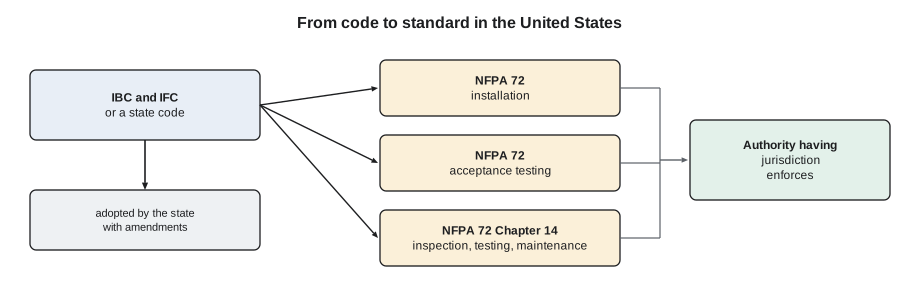
The authority having jurisdiction is the organization or person who enforces the code: usually the local building and fire departments. Many exam questions turn on who decides something: whether an alternative is acceptable, whether a test may be deferred, whether a system may be impaired. The answer is usually the authority, often with the owner's responsibility alongside it.
Worked problem
Does the building need a fire alarm system?
A two-story medical office building is being built in Charlotte. Its occupant load is about 120 on the upper floor. Does it need a fire alarm system, and which documents govern the installation?
Show solution
- Classify the occupancy under the IBC: a medical office without overnight care is Group B.
- Check IBC 907.2.2: for Group B, a manual fire alarm system is required when the occupant load is 500 or more in total, or more than 100 above or below the lowest level of exit discharge.
- The upper floor has about 120 occupants above the level of exit discharge, so a manual system is required.
- Installation, acceptance testing and maintenance: NFPA 72, as referenced by the code.
- The local fire marshal's office is the authority for the permit and acceptance test.
Answer: A manual fire alarm system is required, installed and tested to NFPA 72.
System types
The main system types from FAT-110 lesson 5 are protected premises systems, supervising station systems and emergency communications systems; within protected premises systems, conventional and addressable systems, general evacuation and partial or relocation strategies, and stand-alone and networked systems. Conventional systems report by zone; addressable systems report each device. Most buildings use general evacuation, but hospitals and high-rises often use partial evacuation or relocation, and some buildings use positive alarm sequence, where trained staff have 15 seconds to acknowledge and up to 180 seconds to investigate before the alarm sounds automatically. Voice systems give spoken instructions and are required in high-rise buildings. FAT-210 lesson 7 covers these sequences in detail.
A trap on positive alarm sequence questions is the two times. The 15 seconds is to acknowledge the signal; the 180 seconds is the total investigation time. If either runs out, or a second detector or a manual station activates, the alarm sounds at once. Positive alarm sequence applies only to automatic detectors, never to manual stations or waterflow.
Sprinklers and the fire alarm
Most buildings with fire alarm systems also have sprinklers, and the two must work together. The fire alarm supervises the sprinkler system: a waterflow switch reports an alarm when water flows, and valve supervisory switches report when a control valve is closed. FAT-110 lesson 8 and FAT-120 lesson 8 cover these devices. The two times every candidate should know are that a waterflow alarm must be indicated within 90 seconds of flow equal to one sprinkler, and that a valve supervisory signal must operate within two turns of the handwheel or one-fifth of the travel of the valve. In a sprinklered building, the codes sometimes allow fewer smoke detectors, because the sprinklers act as heat detectors; but smoke detection is still required where people sleep and in specific locations.
Practice set: foundations
Gerry ends the session with six questions written for Sasha and Nadia. Each one is followed by the answer and the reasoning, because the reasoning is what they need to carry into the exam.
Question 1. A fire in an upholstered chair smolders for 40 minutes before flaming. Which detector type would most likely give the earliest warning? Answer: a photoelectric smoke detector. Smoldering fires produce large, visible particles, which photoelectric detectors sense best; a heat detector would not respond until flaming. The trap answer is ionization, which is better for fast flaming fires.
Question 2. A building owner says the fire alarm system is required by NFPA 72. Is that right? Answer: no. The building code requires the system; NFPA 72 sets how it is installed, tested and maintained. The distinction matters because the building code also sets what kind of system, for example manual or automatic, and whether voice is needed.
Question 3. Under positive alarm sequence, staff have acknowledged within 15 seconds and are investigating. A second smoke detector operates. What happens? Answer: the alarm signals operate at once. A second automatic detector, or any manual station or waterflow, overrides the sequence.
Question 4. An eight-story apartment building is 85 ft from the fire department vehicle access to the highest occupied floor. Is it a high-rise? Answer: yes, because the threshold is more than 75 ft, measured from the lowest level of fire department vehicle access to the floor of the highest occupied story. The trap is measuring to the roof.
Question 5. A sprinkler control valve is closed during a renovation. What signal does the panel show, and what should the owner do? Answer: a supervisory signal. The owner treats it as an impairment: notifies the fire department and the monitoring company, arranges measures such as a fire watch if required, and restores the valve as soon as possible. The trap is calling it a trouble signal.
Question 6. A fire grows as a fast t-squared fire. About how long does it take to reach 1 MW? Answer: about 146 seconds, or just under two and a half minutes, using α of about 0.047 kW/s². The point of the question is not the number but the lesson: a fast fire becomes large within the time it might take someone to notice and decide to act.
Where to look
| Topic | Course and lesson | Document |
|---|---|---|
| Fire science and growth | FAT-110 lessons 2 and 3 | Fire protection handbooks |
| Why buildings need systems | FAT-110 lesson 4 | IBC section 907 |
| System types | FAT-110 lesson 5, FAT-210 lesson 7 | NFPA 72 Chapter 23 |
| Codes and the authority | FAT-110 lesson 7, FAT-220 lesson 2 | IBC, IFC, NFPA 72 |
| Sprinkler interfaces | FAT-110 lesson 8, FAT-120 lesson 8 | NFPA 72, NFPA 13 |
Sasha copies the table onto the back of her map of the standards. On the exam, knowing where to look is half the answer.
Fire science in one page
Fire science questions on the exams are usually about why a rule exists rather than the physics for its own sake. A short list of ideas covers most of them. Fire needs fuel, heat and oxygen, and the chemical chain reaction that sustains it. A growing fire produces a plume of hot gases that rises, spreads under the ceiling as a ceiling jet, and fills the room from the top down; this is why detectors go on or near ceilings and why stratification in tall spaces can keep smoke from reaching them. Smoldering fires produce larger smoke particles and little heat, which photoelectric detectors see well; flaming fires produce smaller particles and more heat, which ionization and heat detectors respond to. The t-squared model describes how quickly a fire grows: slow, medium, fast and ultrafast fires take about 600, 300, 150 and 75 seconds to reach about 1 MW.
# t-squared fire growth: time to reach 1,055 kW for each growth rate
growth = {"slow": 600, "medium": 300, "fast": 150, "ultrafast": 75}
for name, tg in growth.items():
    alpha = 1055 / tg ** 2
    q_60 = alpha * 60 ** 2
print(f"{name:>9s}: alpha {alpha:.4f} kW/s2, heat release after 60 s about {q_60:.0f} kW") slow: alpha 0.0029 kW/s2, heat release after 60 s about 11 kW
medium: alpha 0.0117 kW/s2, heat release after 60 s about 42 kW
fast: alpha 0.0469 kW/s2, heat release after 60 s about 169 kW
ultrafast: alpha 0.1876 kW/s2, heat release after 60 s about 675 kWThe output shows why fast fires leave so little time: an ultrafast fire is already near 700 kW after one minute, while a slow fire is barely past 10 kW. Detection that waits for heat at the ceiling can come too late for a fast fire, which is one reason smoke detection is required in sleeping areas and escape routes.
System types in one table
| System type | What it does | Typical building |
|---|---|---|
| General evacuation | Every alarm sounds the alarm signal everywhere | Small offices, shops, schools |
| Positive alarm sequence | A short delay for staff to investigate, with automatic alarm if not acknowledged | Staffed buildings with trained staff |
| Voice evacuation | Live and recorded messages by zone | High buildings, assembly |
| Addressable | Each device reports its own address | Most new commercial buildings |
| Conventional | Devices report by zone | Small and older buildings |
Common mistakes
MistakeChoosing heat detection for a slow, smoldering fire.
InsteadUse smoke detection where early warning of smoldering fires is needed.
MistakeQuoting the installation standard as the reason a building needs a system.
InsteadThe building code requires the system; the standard says how.
MistakeApplying positive alarm sequence to manual stations.
InsteadIt applies only to automatic detectors.
MistakeForgetting who decides on alternatives.
InsteadThe authority having jurisdiction decides.
MistakeMixing up waterflow and supervisory signals.
InsteadWaterflow is an alarm; a closed valve is a supervisory signal.
Summary and key terms
- Smoke spreads faster than flame, and fires grow roughly with the square of time.
- The building code requires the system; NFPA 72 says how it is installed and tested.
- Positive alarm sequence gives 15 s to acknowledge and 180 s to investigate.
- Addressable systems report each device; conventional systems report by zone.
- Waterflow within 90 s; valve supervisory within two turns or one-fifth of travel.
- Fire tetrahedron
- Fuel, heat, oxygen and the chemical chain reaction.
- Heat release rate
- The rate at which a fire releases energy, in kilowatts.
- Authority having jurisdiction
- The organization or person who enforces the code.
- Occupancy
- The use of a building, which sets many code requirements.
- Supervisory signal
- A signal showing a condition that needs attention, such as a closed valve.
Practice problems
Work each problem on paper first, then reveal the answer to check.
Which code decides whether a building needs a fire alarm system?
Show answer
The building code adopted by the state or city, usually based on the IBC.
What are the two times in positive alarm sequence?
Show answer
15 s to acknowledge and 180 s to investigate.
Above what height is a building a high-rise?
Show answer
75 ft.
Within how long must a waterflow alarm be indicated?
Show answer
90 seconds.
Which chapter of NFPA 72 covers inspection, testing and maintenance?
Show answer
Chapter 14.
Lesson quiz · 5 questions
Score 60% or more to complete this lesson.
Create a free account to save your progress, take quizzes and earn a certificate.