
FAT-340 · Lesson 2 of 12 · 20 min
How the exams work and how to study
Gerry has watched a lot of good technicians fail certification exams. 'Not because they didn't know the work,' he says. 'Because they studied the way they'd read a novel. Front to back, once, and then they hoped.' This lesson is about studying the other way: starting from what the exam covers and how much each part counts, planning the weeks before the exam, practicing retrieval rather than rereading, and managing the time on exam day. None of it is specific to fire alarms, but all of it has been tested on fire alarm candidates at Bramwell for years.
Know the format
The NICET Level II exam is computer-based and taken at a testing center, with a time limit and a set number of scored questions. NICET publishes a content outline for each level that gives the domains and their weight; for Level II, installation is about 30 to 40 percent, maintenance about 25 to 35 percent, submittal preparation and system layout about 20 to 30 percent, and management and supervision about 5 to 15 percent. Many questions are applied: they describe a building, a device or a test result and ask what the code requires. NICET lists the references for each exam, with NFPA 72 at the center. Check the current candidate information for the exact number of questions, the time allowed and whether references are provided on screen; NICET revises these from time to time.
Two things follow from the format. First, the exam rewards breadth: every topic area appears, so a big gap in one area costs more marks than perfecting another. Second, most questions are about applying a rule, not reciting it. A candidate who can find the rule and see how it applies will do well even on questions worded in an unfamiliar way.
Turn the blueprint into a plan
Gerry builds Sasha's plan from the NICET Level II content outline, taking the middle of each range: installation 35 percent, maintenance 30 percent, submittal preparation and layout 25 percent, and management and supervision 10 percent. Inside each domain he lists the topics that come up most in Bramwell's work and in past candidates' memories of the exam. The point is not the exact figures but that study time follows the weight.
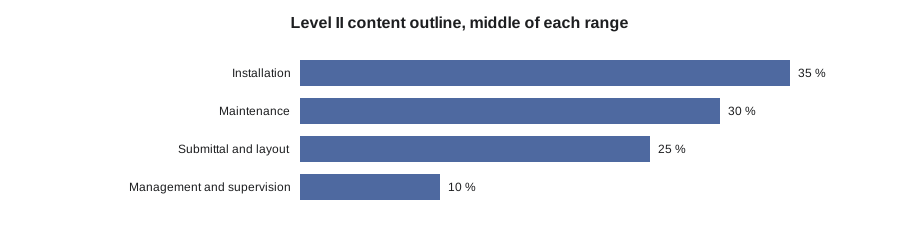
Sasha has twelve weeks before the exam and can give it about six hours a week outside work, plus whatever she learns on the job. That is 72 hours. Gerry's rule is to plan only 80 percent of the time and keep the rest for catching up and for the full practice exams in the last two weeks.
# Study planner: split the available hours by exam weight (keep 20 percent in reserve)
weeks, hours_per_week = 12, 6
weights = {"Installation": 35, "Maintenance": 30, "Submittal preparation and layout": 25, "Management and supervision": 10}
total = weeks * hours_per_week
plan = total * 0.8
print(f"Available {total} h, planned {plan:.0f} h, reserve {total - plan:.0f} h")
for topic, w in weights.items():
    h = plan * w / 100
print(f"{topic:<34s} {w:>3d} % {h:5.1f} h about {h / weeks * 60:4.0f} min a week")Available 72 h, planned 58 h, reserve 14 h Installation 35 % 20.2 h about 101 min a week Maintenance 30 % 17.3 h about 86 min a week Submittal preparation and layout 25 % 14.4 h about 72 min a week Management and supervision 10 % 5.8 h about 29 min a week
The plan is a starting point. After the first practice test, Sasha moves time toward her weakest areas. Gerry's warning is not to abandon a heavy topic just because it feels comfortable: a big domain answered at 85 percent can still lose more marks than a small one answered at 60 percent.
Study by retrieval, not rereading
The most reliable finding in the research on learning is that people remember more by testing themselves than by rereading. Rereading feels productive because the material looks familiar, but recognizing a page is not the same as being able to recall it on an exam. Retrieval practice means closing the book and trying to answer: writing out the battery calculation steps from memory, explaining the difference between verification and inspection to Nadia, or answering practice questions before checking the source.
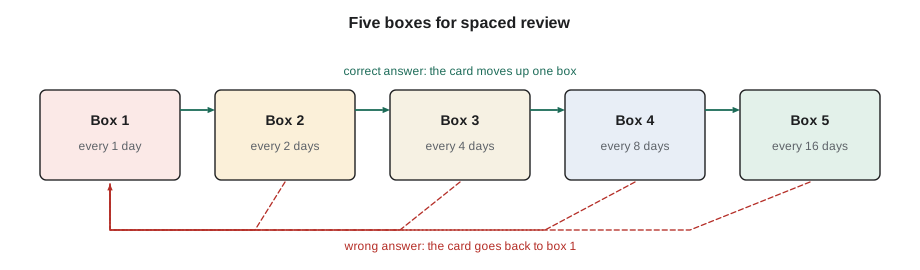
Spacing matters too. Material reviewed once a day for a week is remembered far better than the same total time spent in one sitting. A simple way to space review is a set of flashcard boxes, often called a Leitner system. New cards start in box 1 and are reviewed every day. A card answered correctly moves up a box and is reviewed less often; a card answered wrongly goes back to box 1. Over a few weeks, the cards Sasha knows well are seen rarely and the hard ones keep coming back.
# Leitner flashcard scheduler: when is each card due next?
intervals = {1: 1, 2: 2, 3: 4, 4: 8, 5: 16}   # days between reviews for each box
cards = {"waterflow alarm time": 1, "two-stage acknowledge time": 2, "smoke spacing to walls": 3,
         "battery margin": 1, "NAC minimum voltage": 4}
results = {"waterflow alarm time": True, "two-stage acknowledge time": False, "smoke spacing to walls": True,
           "battery margin": True, "NAC minimum voltage": True}
for card, box in cards.items():
    new_box = min(box + 1, 5) if results[card] else 1
print(f"{card:<28s} box {box} -> {new_box}, review again in {intervals[new_box]:>2d} days")waterflow alarm time box 1 -> 2, review again in 2 days two-stage acknowledge time box 2 -> 1, review again in 1 days smoke spacing to walls box 3 -> 4, review again in 8 days battery margin box 1 -> 2, review again in 2 days NAC minimum voltage box 4 -> 5, review again in 16 days
Sasha writes her cards in her own words, with the source on the back: 'Waterflow: alarm within 90 s of flow (FAT-120 lesson 8, FAT-230 lesson 8).' Writing the source matters, because on the exam a half-remembered rule is often enough to find the right section quickly when references are allowed, and to eliminate wrong answers when they are not.
Learn the standards' structure
Most fire alarm questions can be answered from a small number of documents. A candidate who knows how each document is organized can find the answer quickly, check a half-remembered number and avoid traps. Sasha makes a one-page map of each standard: the main parts and sections, where the tables are, and the five or six topics she looks up most. She uses the maps every time she studies until she can sketch them from memory.
For NFPA 72, the map shows the fundamentals and documentation chapters, the circuits and pathways chapter, the protected premises chapter, the initiating devices chapter, the notification appliances chapter, the emergency communications chapter, the supervising station chapter and the inspection, testing and maintenance chapter, with the big tables: the test methods and frequencies tables in the ITM chapter and the visible appliance tables. FAT-220 lesson 1 and FAT-230 lesson 2 cover these structures in detail.
Exam technique
On exam day, time is the resource. Sasha divides the time by the number of questions to get a per-question budget, then works through in passes. On the first pass she answers every question she can answer quickly and flags the rest. On the second pass she works the flagged questions. In the last few minutes she makes sure nothing is blank, because an unanswered question is always wrong.
# Pacing: time per question and checkpoints
minutes = 180
questions = 100
reserve = 10                      # minutes kept for the final check
per_q = (minutes - reserve) / questions
print(f"Budget {per_q * 60:.0f} s per question")
for frac in (0.25, 0.5, 0.75, 1.0):
    q = round(questions * frac)
    t = q * per_q
print(f"By question {q:>3d}: about {t:5.0f} min used")Budget 102 s per question By question 25: about 42 min used By question 50: about 85 min used By question 75: about 128 min used By question 100: about 170 min used
The question count and time in the code are an example; Sasha uses the figures in her NICET exam confirmation.
For each question, she reads the last line first to see what is asked, then the whole stem, looking for the words that change the answer: new or existing, minimum or maximum, standby or alarm, public mode or private mode, sleeping area or not. She eliminates options she knows are wrong before choosing. If two answers seem right, the question usually turns on a detail in the stem, and she rereads it before guessing.
Worked problem
Working a tricky question
A practice question reads: 'During a periodic inspection of an existing system, a technician finds a ceiling smoke detector 3 in from a wall. What should the technician do?' The options are: replace the detector; move it; record it on the report; or ignore it because inspection does not cover location.
Show solution
- Read the stem: 'annual inspection', 'existing building'. This is an inspection question, not an installation question.
- Recall the rule: inspection and testing record conditions found; the inspector does not redesign the system on the spot.
- Eliminate 'ignore it': a visual inspection looks for conditions that impair performance, including obvious location problems.
- Eliminate 'replace' and 'move': those are corrective actions for the owner to arrange, possibly with design review.
- Choose 'record it on the report' as a deficiency or recommendation.
Answer: The detector's location is recorded on the report for the owner to correct. The trap is answering as an installer instead of as an inspector.
Looking after yourself
Gerry's last piece of advice is the least technical. Sleep the night before, eat before the exam, arrive or log in early, and test the computer and webcam the day before for an online exam. A candidate who sits down tired and rushed loses several percent before the first question, and on an 80 percent pass mark that can be the difference.
A week in the plan
Gerry turns the hours into a weekly routine so that Sasha does not have to decide each evening what to study. Monday is new material from the heaviest topic of the week; Wednesday is practice questions on the same topic; Friday is review of the flashcards that are due, from every topic; Saturday morning is a timed set of mixed questions. Sunday is off. The routine keeps every topic in rotation and makes retrieval, not reading, the main activity.
| Day | Activity | Time |
|---|---|---|
| Monday | New material from the week's main topic | 90 min |
| Wednesday | Practice questions on that topic, then check sources | 90 min |
| Friday | Flashcards due from all topics | 60 min |
| Saturday | Timed mixed question set, then review errors | 120 min |
| Sunday | Rest | none |
Study groups
Studying with others helps when it is done as retrieval: taking turns to explain a topic, quizzing each other, and arguing about why a wrong answer is wrong. It hurts when it turns into rereading together or into a social evening. Gerry's evenings with Sasha and Nadia follow a simple pattern: fifteen minutes of questions on last week's topic, an hour of review on this week's, and fifteen minutes in which each of them explains one rule to the others without notes. Explaining is one of the strongest forms of retrieval, because gaps in understanding show up immediately.
Using practice questions well
Practice questions are only useful if the answers are checked against the source, not just against an answer key. When Sasha gets a question wrong, she finds the rule in the standard, writes it on a card, and notes why she chose the wrong answer. When she gets one right by guessing, she treats it as wrong. And she is careful with practice questions found online: some are out of date, some are for a different country, and some are simply wrong. The safest questions are the ones written from the standard by someone who knows it, which is why Gerry and Ravi write Bramwell's.
Practice questions must never be copied from real exams. Certification bodies protect their questions, and a candidate who has memorized leaked questions has learned the questions, not the work. Bramwell's questions are written fresh from the standards and the job.
Common mistakes
MistakeRereading notes until they feel familiar.
InsteadTest yourself: answer first, then check.
MistakeCramming everything in the last week.
InsteadSpace review over the weeks, using a box system.
MistakeStudying favorite topics and skipping heavy ones.
InsteadSplit time by exam weight, then adjust to weak areas.
MistakeSpending ten minutes on one hard question.
InsteadFlag it, move on, and come back on the second pass.
MistakeLeaving questions blank.
InsteadAnswer everything; a blank is always wrong.
Summary and key terms
- Know the exam format, timing and pass mark before planning.
- Split study time by the weight of each area, with a reserve.
- Retrieval and spaced review beat rereading.
- Learn how each standard is organized so you can find answers quickly.
- Pace the exam in passes and answer every question.
- Blueprint
- The list of exam areas and their weights.
- Retrieval practice
- Studying by trying to recall answers before checking.
- Spaced review
- Reviewing material at increasing intervals.
- Leitner system
- A set of flashcard boxes with longer review intervals for cards answered correctly.
- Stem
- The part of a multiple-choice question that sets out the situation and asks the question.
Practice problems
Work each problem on paper first, then reveal the answer to check.
Why does Gerry plan only 80 percent of the available hours?
Show answer
To keep time for catching up and for full practice exams.
What happens to a Leitner card answered wrongly?
Show answer
It goes back to box 1 and is reviewed every day.
What should you read first in a long question?
Show answer
The last line, to see what is asked.
Why write the source on each flashcard?
Show answer
So you can find or check the rule quickly and learn where it lives.
What is the trap in the existing-detector question?
Show answer
Answering as an installer instead of as an inspector.
Lesson quiz · 5 questions
Score 60% or more to complete this lesson.
Create a free account to save your progress, take quizzes and earn a certificate.