
FAT-340 · Lesson 11 of 12 · 20 min
Practical skills and job-site assessment
NICET Level II has no hands-on exam: the practical side is covered by the performance measures, the tasks a supervisor verifies the candidate can do. Gerry takes that seriously. 'When I sign a performance measure,' he says, 'I'm saying I watched you do it, right, more than once. I don't sign them as a favor.' This lesson covers the practical skills behind the performance measures, the hands-on test that North Carolina's limited license and many employers use, and how Bramwell assesses its own technicians on the job.
Performance measures and practical tests
NICET's performance measures for Levels I and II describe the tasks a technician must be able to do: install and terminate devices, test devices and circuits by the correct method, read drawings, use meters, find and correct faults, complete forms, and work safely. The supervisor verifies each one in the application, and NICET may audit the verification. Many employers, and some licensing bodies, add a hands-on test of their own. Bramwell's is a two-and-a-half-hour assessment on its training panel, modeled on the tasks in NFPA 72 Chapter 14, which every technician passes before leading an inspection crew.
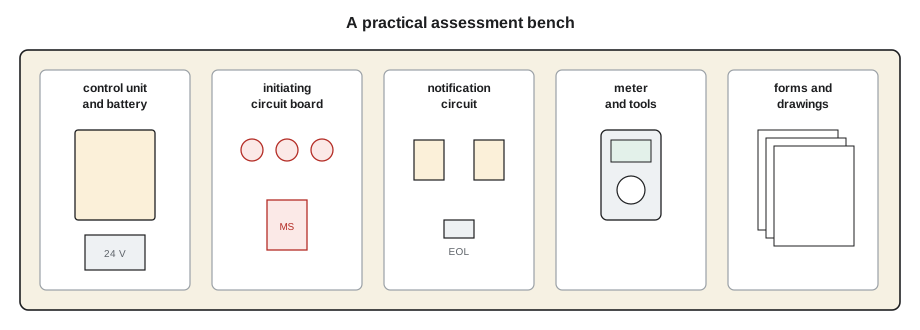
The skills tested are the ones Sasha uses every week, but done in front of someone who is watching for each step. The invigilator or assessor is looking for three things: that the method is correct, that it is done safely, and that the result is recorded accurately. A correct answer reached by a wrong method usually loses marks.
Meters and measurements
Most practical tasks involve a meter (FAT-130 lesson 4). The candidate measures voltage at a power supply and at the end of a notification circuit, measures the resistance of an end-of-line device with the circuit disconnected, checks for ground faults, and measures current where the task calls for it. Each measurement has a correct setup: the right function and range, the meter's leads in the right jacks, the circuit in the right state. Measuring resistance on a live circuit, or current with the meter in parallel, are the mistakes assessors watch for.
# Interpreting readings on a supervised initiating circuit (4.7 kohm end-of-line)
eol = 4700
readings = {"zone 1": 4690, "zone 2": 1e9, "zone 3": 4720, "zone 4": 12, "zone 5": 3900}
for zone, r in readings.items():
    if r > 1e6:
        meaning = "open circuit: trouble"
    elif r < 100:
        meaning = "short: alarm on a conventional zone (or a wiring fault)"
    elif abs(r - eol) / eol <= 0.05:
        meaning = "normal: end-of-line resistor in place"
    else:
        meaning = "out of tolerance: check for a wrong resistor or a high-resistance joint"
    shown = "open" if r > 1e6 else f"{r:.0f} ohm"
print(f"{zone}: {shown:>9s} -> {meaning}")zone 1: 4690 ohm -> normal: end-of-line resistor in place zone 2: open -> open circuit: trouble zone 3: 4720 ohm -> normal: end-of-line resistor in place zone 4: 12 ohm -> short: alarm on a conventional zone (or a wiring fault) zone 5: 3900 ohm -> out of tolerance: check for a wrong resistor or a high-resistance joint
Zone 5's reading of 3,900 Ω is the kind of result a good assessor puts in front of a candidate: not an obvious open or short, but a resistance that is wrong. It could be a resistor of the wrong value, or a second resistor fitted by mistake at a device partway along the circuit. The candidate who measures, compares with the drawings and walks the circuit finds it; the one who sees the panel showing normal and moves on does not.
Testing devices correctly
The device tests on a practical follow lesson 8: smoke detectors with listed aerosol into the chamber, heat detectors with a heat source that will not damage them, manual stations operated as a person would, notification appliances operated and checked for synchronization. Assessors watch the small things: putting the system in test mode and telling the monitoring company before the first device, restoring each device and checking the panel returns to normal, resetting the system and taking it out of test mode at the end. A candidate who tests every device perfectly but forgets to restore the monitoring connection has left the building unprotected.
Worked problem
A complete device test
The assessor asks Sasha to test the photoelectric detector on zone 3 of the training panel. What steps does she take?
Show solution
- Confirm the system's state and tell the assessor she is notifying the monitoring company and placing the system in test, as she would on site.
- Check the detector visually: correct type and location, base secure, no covers, no damage, label matches the drawing.
- Apply listed aerosol into the chamber, following the manufacturer's instructions for distance and duration.
- Confirm the alarm at the control unit and the annunciator with the correct description, and that the notification appliances operate.
- Let the detector clear, reset, confirm normal, record the result, and restore the monitoring connection at the end of testing.
Answer: Five steps, every one observed. The test is not just the alarm; it is the whole cycle from notification to restoration.
Finding faults
Every practical includes faults the candidate must find: an open, a short, a ground fault, a wrong end-of-line value, a reversed polarity on a notification appliance, a detector in the wrong zone. The method matters more than speed. Sasha's method, from Gerry, has four steps. Read the panel: which circuit, which type of fault. Isolate: disconnect the circuit at the panel and measure. Halve: measure at the midpoint and work toward the fault. Confirm: once found and corrected, reconnect, check the panel returns to normal and record what was found.
# Halving a circuit to find an open (devices numbered from the panel)
devices = 24
fault_after = 17          # the open is between this device and the next (hidden from the technician)
lo, hi, steps = 0, devices, 0
while hi - lo > 1:
    mid = (lo + hi) // 2
    steps += 1
    continuity = mid <= fault_after    # measuring from the panel to device 'mid'
    print(f"Step {steps}: measure to device {mid:>2d} -> {'continuity' if continuity else 'open'}")
    lo, hi = (mid, hi) if continuity else (lo, mid)
print(f"Open is between device {lo} and device {hi}, found in {steps} measurements")Step 1: measure to device 12 -> continuity Step 2: measure to device 18 -> open Step 3: measure to device 15 -> continuity Step 4: measure to device 16 -> continuity Step 5: measure to device 17 -> continuity Open is between device 17 and device 18, found in 5 measurements
Forms and records
Bramwell's assessment, like the performance measures, includes completing the inspection and testing form the way Chapter 14 requires: device-by-device results, deficiencies with their location and description, and the technician's name and certification. Assessors check that results are recorded as they happen, not from memory at the end, and that a deficiency describes what was found clearly enough for someone else to fix it.
Bramwell's practical checklist
Donna uses the same checklist for every technician's assessment, scored by an assessor who watches the whole session. Each item is pass or fail, and some are critical: a safety error or a test that leaves the building unprotected fails the assessment regardless of the score. The checklist is a fair preview of what any practical assessment looks for.
# Score a practical assessment: weighted items, with critical items that must pass
items = [
    ("notified monitoring and placed system in test", 5, True, True),
    ("visual inspection of each device", 5, False, True),
    ("smoke detector tested with aerosol", 10, True, True),
    ("heat detector tested without damage", 10, False, True),
    ("supervision of IDC confirmed (open, ground)", 10, False, True),
    ("NAC end voltage measured correctly", 10, False, False),
    ("battery voltage and load test", 10, False, True),
    ("fault found by halving", 15, False, True),
    ("results recorded as tested", 10, False, True),
    ("system restored and monitoring reconnected", 15, True, True),
]
score = sum(w for _, w, _, ok in items if ok)
total = sum(w for _, w, _, _ in items)
critical_fail = [name for name, _, crit, ok in items if crit and not ok]
pct = 100 * score / total
print(f"Score {score}/{total} = {pct:.0f} %")
print("Result:", "FAIL (critical item)" if critical_fail else ("PASS" if pct >= 80 else "FAIL"))Score 90/100 = 90 % Result: PASS
In the example, the candidate measured the notification circuit's end voltage with the meter on the wrong range and got a meaningless reading. It is not a critical item, and the score is 90 percent, a pass. But it is exactly the kind of slip that, repeated, takes a candidate below 80.
Practice set: practical tasks
Donna gives these as spoken tasks, the way an assessor would. Sasha answers out loud, then Donna reads the model answer.
Task 1. Measure the voltage at the end of a notification circuit in alarm. Model answer: confirm the monitoring company is notified and the system is in test; set the meter to DC volts on a range above 30 V; connect across the last appliance's terminals with the correct polarity; put the system into alarm; read and record the voltage; restore the system. A reading in alarm, not standby, is what tells you whether the appliances get enough voltage.
Task 2. Show that the initiating circuit is supervised for an open. Model answer: with the system in test, lift one conductor at the end-of-line device or a device on the circuit; confirm a trouble signal appears at the control unit and annunciator for the correct circuit; reconnect, confirm the trouble clears, and record the result.
Task 3. Show that the circuit is supervised for a ground fault. Model answer: with the system in test, connect one conductor of the circuit to ground through a short jumper at a safe point; confirm the ground fault trouble appears; remove the jumper; confirm it clears; record.
Task 4. Load test the battery. Model answer: check the battery's date, condition and terminals; measure the voltage at rest; disconnect AC power to put the system on battery; apply the load the manufacturer or the standard specifies, or run the system in alarm for the specified time; measure the voltage under load; restore AC power and confirm the charger returns the battery to float. A battery whose voltage drops below the manufacturer's minimum under load fails.
Task 5. Find out why a horn-strobe does not operate. Model answer: check whether the circuit shows trouble; check the appliance's polarity and connections; measure the voltage at the appliance in alarm; check whether the appliance is set to the right candela and sync mode; replace the appliance if voltage and wiring are correct. Record what was found and done.
Task 6. Complete the record for the devices tested. Model answer: record each device's location, type, test method and result as it is tested; list deficiencies with the four Ws from lesson 8; sign the record with name and certification or registration number; note the time the system was returned to normal and monitoring restored.
What assessors notice
| Good practice | Common slip |
|---|---|
| Says what they are about to do before doing it | Works in silence, leaving the assessor guessing |
| Checks the meter on a known source first | Trusts a meter with a flat battery or blown fuse |
| Reads the drawing before touching the circuit | Starts lifting wires at random |
| Restores each device and checks for normal | Leaves a device in alarm and moves on |
| Records as they go | Records at the end from memory |
| Asks a question when the task is unclear | Guesses what the assessor meant |
Gerry adds one more: ask. An assessor would rather hear 'Do you want me to measure this in standby or in alarm?' than watch a candidate measure the wrong thing perfectly. Asking for the drawing, the manufacturer's instructions or the battery's rating is part of doing the job right, and it is never marked down.
Safety on the bench
A practical assessment includes the same safety rules as site work. The panel's AC supply is a mains circuit: it is switched off and locked out before anyone works on it, and a technician does not put fingers or tools inside a live control unit's high-voltage area. Meter leads are checked for damage. Batteries can deliver a large current into a short, so tools are kept clear of the terminals, and terminals are covered when a battery is moved. Safety glasses are worn when working with batteries. An assessor who sees an unsafe act stops the assessment, because a technician who works unsafely on the bench will work unsafely on site.
Common mistakes
MistakeMeasuring resistance on a live circuit.
InsteadDisconnect the circuit first.
MistakeTesting a smoke detector with its test button.
InsteadUse listed aerosol into the chamber.
MistakeForgetting to notify monitoring or to restore it.
InsteadNotify before, restore after, every time.
MistakeGuessing where a fault is.
InsteadIsolate and halve.
MistakeFilling in the form from memory at the end.
InsteadRecord each result as it is tested.
Summary and key terms
- NICET Level II's practical side is the supervisor-verified performance measures; employers add their own tests.
- Assessors watch for correct method, safety and accurate records.
- Meter readings must be taken with the right setup and interpreted against the drawings.
- Faults are found by isolating and halving.
- Notification and restoration are part of every test.
- Invigilator
- The person who supervises and marks a practical exam.
- Performance measure
- A task a supervisor verifies the candidate can do.
- Halving
- Finding a fault by measuring at the midpoint and narrowing down.
- Test mode
- A panel state used during testing, with monitoring notified.
- Critical item
- An assessment item that must pass regardless of the overall score.
Practice problems
Work each problem on paper first, then reveal the answer to check.
What reading shows an open initiating circuit?
Show answer
Very high resistance or no continuity.
What might a 3,900 ohm reading on a 4.7 kohm circuit mean?
Show answer
A wrong resistor value or an extra resistor on the circuit.
How many measurements does halving need to find an open among 24 devices?
Show answer
About five.
What must be done before testing the first device?
Show answer
Notify the monitoring company and place the system in test.
Why are results recorded as they happen?
Show answer
So the record is accurate and complete.
Lesson quiz · 5 questions
Score 60% or more to complete this lesson.
Create a free account to save your progress, take quizzes and earn a certificate.