
FAT-340 · Lesson 12 of 12 · 20 min
Capstone: a full practice exam and a career plan
Two weeks before her Level II exam, Sasha sits a full practice exam in Bramwell's training room under exam conditions: a hundred original questions written by Gerry and Ravi to the Level II content outline, three hours, phone in Donna's office. Nadia sits the first half for practice. Afterwards, Gerry marks it with Sasha, and they spend an evening on what the results say. This capstone follows that evening, the last two weeks of study, the exam itself, and the conversation with Donna about what comes next.
Scoring by topic
Gerry's first rule for a practice exam is not to look only at the total. A total says whether a candidate would pass today; the score by topic says what to do in the next two weeks. He enters Sasha's answers into the scoring script, which gives the percentage for each topic and flags anything below the pass mark.
# Practice exam: score by topic against the pass mark
results = {"Installation": (30, 35), "Maintenance": (26, 30), "Submittal preparation and layout": (18, 25), "Management and supervision": (8, 10)}     # topic: (correct, questions)
pass_mark = 80
total_c = sum(c for c, _ in results.values())
total_q = sum(q for _, q in results.values())
print(f"Total {total_c}/{total_q} = {100 * total_c / total_q:.0f} % (pass {pass_mark} %)")
for topic, (c, q) in sorted(results.items(), key=lambda kv: kv[1][0] / kv[1][1]):
    pct = 100 * c / q
    flag = "  <- below pass mark" if pct < pass_mark else ""
print(f"{topic:<34s} {c:>2d}/{q:<2d} {pct:5.0f} %{flag}")Total 82/100 = 82 % (pass 80 %) Submittal preparation and layout 18/25 72 % <- below pass mark Management and supervision 8/10 80 % Installation 30/35 86 % Maintenance 26/30 87 %
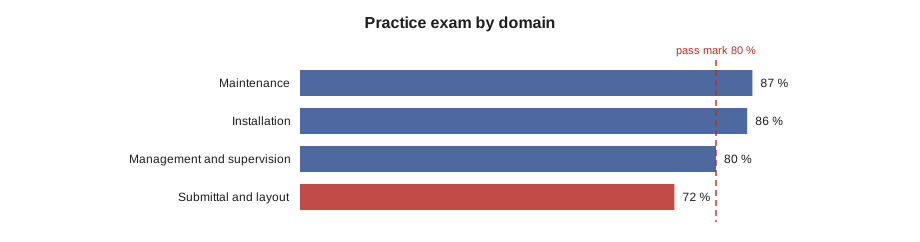
Her total is 82 percent: likely a pass, but with little to spare. One domain stands out. Submittal preparation and layout is at 72 percent, below the line, which matches what Gerry has seen: Sasha is strong on installation and maintenance, which she does every week, and less practiced on layout and calculations, which Ravi's design group usually handles. Management and supervision is right at 80.
The error log
Gerry's second rule is to sort every wrong answer by why it was wrong, not just by topic. There are only a few reasons a prepared candidate misses a question: they did not know the rule, they knew it but misread the question, they knew it but applied the wrong version (an old edition, or the wrong building type), or they made an arithmetic or setup error. Each reason has a different fix.
# Error log: why were the questions missed?
misses = [("Submittal and layout", "setup error"), ("Submittal and layout", "setup error"), ("Submittal and layout", "did not know"), ("Submittal and layout", "did not know"), ("Submittal and layout", "setup error"), ("Submittal and layout", "applied wrong version"), ("Submittal and layout", "setup error"), ("Installation", "applied wrong version"), ("Installation", "applied wrong version"), ("Installation", "misread question"), ("Installation", "did not know"), ("Installation", "did not know"), ("Maintenance", "misread question"), ("Maintenance", "applied wrong version"), ("Maintenance", "did not know"), ("Maintenance", "misread question"), ("Management", "did not know"), ("Management", "misread question")]     # (topic, reason)
from collections import Counter
by_reason = Counter(r for _, r in misses)
by_topic = Counter(t for t, _ in misses)
print("Misses by reason:")
for r, n in by_reason.most_common():
    print(f"  {r:<28s} {n}")
print("Misses by topic:")
for t, n in by_topic.most_common():
print(f" {t:<28s} {n}")Misses by reason: did not know 6 setup error 4 applied wrong version 4 misread question 4 Misses by topic: Submittal and layout 7 Installation 5 Maintenance 4 Management 2
The pattern is clear. Of her eighteen misses, only six were rules she did not know. Four were setup errors in layout calculations, which lesson 5 warned about: she started a voltage-drop question at 24 V and used the wrong alarm period for a voice system. Four were the wrong version: she answered with her jurisdiction's adopted edition instead of the 2022 edition the exam is based on. The rest were misreadings, which her pacing should fix.
The last two weeks
Gerry and Sasha turn the error log into a plan. For setup errors, she works ten calculation problems every evening by hand, writing the setup line first: what voltage, what current, what length, what period, what margin. For version errors, she makes a single page of the values that changed between editions and reads it every morning. For misreadings, she practices reading the last line first and underlining the words that change the answer, as lesson 2 described. For the rules she did not know, she adds cards to her review boxes. She does not reread the whole course. 'You've learned it,' Gerry says. 'Now stop making the mistakes you already make.'
Worked problem
A setup line
A practice battery question describes an 18-story residential high-rise with a voice system, a standby current of 0.85 A and an alarm current of 6.2 A. Sasha's setup line comes first.
Show solution
- Building: high-rise with emergency voice/alarm communication, so the alarm period is 15 minutes.
- Standby: 24 h at 0.85 A = 20.4 Ah. Alarm: 0.25 h at 6.2 A = 1.55 Ah.
- Margin 1.25: (20.4 + 1.55) × 1.25 = 27.4 Ah.
- Next standard size: 33 Ah.
Answer: 33 Ah. Writing the alarm period first is what stops the 5-minute mistake.
Exam day
Sasha takes the Level II exam at a testing center on a Saturday morning in June, arriving early with her identification. She works in two passes, flags fourteen questions, and finishes with eleven minutes to spare. A few weeks later, NICET confirms that she has passed and that her experience and performance measures are accepted. She is certified at Level II. Gerry takes the crew for lunch.
Keeping the credential
NICET certification is renewed every three years with continuing professional development points. Sasha sets up a simple log the day her certificate arrives, with the training she already has planned: a manufacturer course on Bramwell's new panel line, a code update class when the next NFPA 72 edition is adopted, and the local chapter meetings of a fire alarm association.
# Continuing education tracker
need = 90            # points needed for the three-year period (example target)
log = [("Manufacturer training: new panel line", 10), ("Code update class", 8), ("Chapter meetings (four)", 4)]
have = sum(p for _, p in log)
print(f"Logged {have} of {need} points for the three-year period (example target)")
for item, p in log:
    print(f"  {item:<44s} {p}")
print("On track" if have >= need else f"Need {need - have} more")Logged 22 of 90 points for the three-year period (example target) Manufacturer training: new panel line 10 Code update class 8 Chapter meetings (four) 4 Need 68 more
The point target in the code is an example; Sasha checks NICET's current recertification requirements for the real figure and the activities that count.
A career plan
The week after the results, Donna sits down with Sasha to talk about the next five years. Bramwell, like most fire alarm companies, has several paths for a certified technician, and each one asks for different strengths. Donna lays them out on a whiteboard.
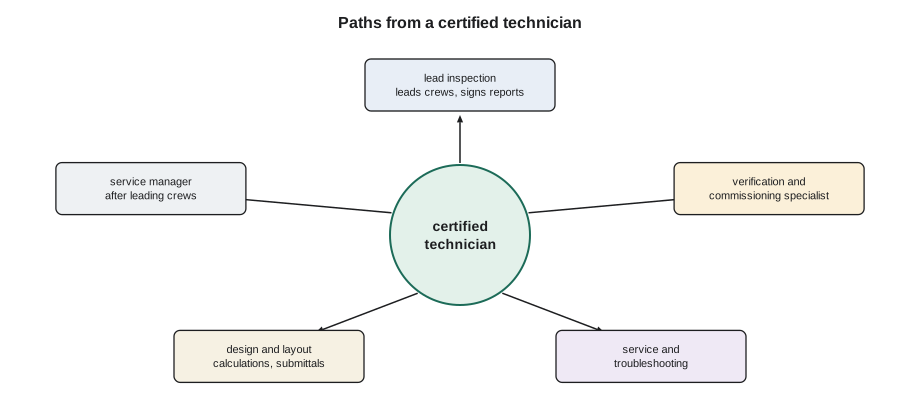
A lead inspection technician runs crews on annual inspections, signs reports and deals with building owners; it suits someone who is thorough and calm with clients, and it is the role Riverlight needs this December. A verification and commissioning specialist works on new buildings, coordinating with contractors and engineers; it suits someone who likes systems coming together. A service technician troubleshoots the faults the others find; it suits someone who enjoys the puzzle. A designer lays out systems and prepares submittals with Ravi; it needs strong calculation and code skills, the area Sasha's practice exam showed she has to build. A service manager like Donna schedules hundreds of buildings and a dozen technicians; it comes later, after leading crews.
# Comparing paths (illustrative scores out of 5 for fit, demand and growth)
paths = {
    "Lead inspection technician":   (5, 5, 3),
    "Verification specialist":      (4, 4, 4),
    "Service and troubleshooting":  (4, 4, 3),
    "Design and layout":            (3, 4, 5),
    "Service manager (later)":      (3, 3, 5),
}
weights = (0.4, 0.3, 0.3)      # Sasha's own weights: fit, demand, growth
for name, scores in sorted(paths.items(), key=lambda kv: -sum(w * s for w, s in zip(weights, kv[1]))):
    total = sum(w * s for w, s in zip(weights, scores))
print(f"{name:<30s} {total:.1f}")Lead inspection technician 4.4 Verification specialist 4.0 Design and layout 3.9 Service and troubleshooting 3.7 Service manager (later) 3.6
The scores are Sasha's own, and the point of the exercise is to make her reasons visible, not to let a script decide. She chooses to lead the Riverlight inspection this year and to start working with Ravi on layouts one day a week, aiming for Level III when she has the experience. Pay follows responsibility in this trade. The US Bureau of Labor Statistics gives a median wage of about 60,070 dollars a year for security and fire alarm systems installers in May 2025, and certified technicians who lead crews or design systems usually earn above it.
Looking back
Over this program, Sasha has gone from pulling cable at Willowbank to leading an inspection at Riverlight. The courses followed the order of the work: fire science and codes, devices, electrical theory, panels, installation, inspection and testing, voice and integration, verification, and now certification. The certification marks what she has learned, but the habits are what will carry her: asking where a rule comes from, testing by the right method, recording what she finds, and leaving every building protected when she walks out of it. Nadia, two years behind her, now has the flashcards.
Sample questions from the practice exam
These six questions come from the practice exam Sasha sat at the start of the lesson, with the reasoning Gerry wrote beside each one when he marked it.
Question 1. A detector on an 11.5 ft ceiling is 20 ft from the nearest wall. Is that within the spacing rule? Answer: for smooth ceilings, a detector may be up to half the listed spacing from a wall. With a 30 ft spacing, the limit is 15 ft, so 20 ft is too far. Another detector is needed, or the layout is shifted.
Question 2. A 24 V system has a standby current of 0.4 A. How many ampere-hours does standby use in 24 hours? Answer: 0.4 × 24 = 9.6 Ah, before the alarm load and margin are added.
Question 3. A panel shows a supervisory signal from a sprinkler valve. What is the first thing the technician checks? Answer: whether the valve has been closed, and if so, why. A closed valve means part of the sprinkler system is out of service, which is a serious impairment.
Question 4. What does an STI of 0.38 in a space mean? Answer: speech there is likely to be poorly understood. The target average is at least 0.50. The space needs a better speaker layout, or the design must identify it as a space where intelligibility is not required, with the authority's acceptance.
Question 5. An acceptance test finds a strobe missing from a restroom shown on the drawings. What happens? Answer: it is a deficiency; the strobe is installed and tested before the record of completion is signed as complete.
Question 6. A technician tests a detector and the panel shows the alarm, but the notification appliances do not sound. What is the likely cause? Answer: the notification outputs are bypassed or disabled, perhaps from an earlier test, or the circuit has a fault. The technician checks the panel's status for disabled points and the circuit for trouble. A bypass left in place after testing is one of the most common and most dangerous findings.
A study timetable for the last month
| Week | Focus | Practice |
|---|---|---|
| 4 weeks out | Weakest two topics from the error log | Two short topic quizzes |
| 3 weeks out | Calculations and the frequency tables | Ten calculation problems, timed |
| 2 weeks out | Full practice exam under exam conditions | Score by topic, update the error log |
| 1 week out | Error log only, and the formula sheet | Short mixed sets, no new material |
| Last 2 days | Light review, logistics, sleep | None beyond a few flashcards |
The pattern is the one lesson 2 described: retrieval, spacing and a full practice exam well before the real one, so that there is still time to fix what it shows. The last week adds nothing new. A candidate who is still learning new topics in the last two days is usually better off rebooking.
After the exam
Sasha's Level II certification arrived in October, and Bramwell updated her rate the same week. Gerry's advice for the next step: keep a log of continuing education and work from the first month, because recertification points are easy to collect and hard to reconstruct from memory three years later. Level III needs five years of experience and recommendations, and the work logged now is the evidence for it.
Common mistakes
MistakeLooking only at the total on a practice exam.
InsteadScore by topic and find the weak areas.
MistakeRereading everything in the last two weeks.
InsteadFix the specific mistakes the error log shows.
MistakeSkipping the setup line on calculations.
InsteadWrite the voltage, current, length, period and margin first.
MistakeLetting continuing education slide after the exam.
InsteadKeep a log from the first day.
MistakeChoosing a career path by pay alone.
InsteadWeigh fit, demand and growth, and your own strengths.
Summary and key terms
- Score practice exams by topic, not just the total.
- Sort errors by reason: unknown rule, misreading, wrong version or setup error.
- Use the last weeks to fix the specific errors, not to reread.
- Keep certification current with professional development points.
- Plan a career path by fit, demand and growth.
- Practice exam
- A full-length exam taken under real conditions to test readiness.
- Error log
- A record of missed questions sorted by the reason they were missed.
- Setup line
- The first line of a calculation stating every input and assumption.
- Continuing education
- Learning required to keep a credential current.
- Career path
- A sequence of roles a technician can grow into.
Practice problems
Work each problem on paper first, then reveal the answer to check.
What total did Sasha score on her practice exam?
Show answer
82 percent.
Which domain was below the pass mark?
Show answer
Submittal preparation and layout.
What alarm period applies to a voice system in a high-rise?
Show answer
15 minutes.
How often is NICET certification renewed?
Show answer
Every three years.
Which path did Sasha choose for the coming year?
Show answer
Lead inspection technician, with one day a week on layout.
Lesson quiz · 5 questions
Score 60% or more to complete this lesson.
Create a free account to save your progress, take quizzes and earn a certificate.