
ENGG-160 · Lesson 10 of 12 · 28 min
Designing for safety, reliability and sustainability
A design that meets its functional requirements can still be a poor design if it hurts people, breaks down too often, cannot be maintained, or imposes a large and avoidable burden on the environment. These qualities cannot be added at the end; they are decided by early choices of concept, materials, layout and configuration. ENGG-100 introduced the language of hazard, risk, the hierarchy of controls and reliability. This lesson turns those ideas into design methods: inherently safer design, safety margins, failure modes and effects analysis used as a design tool, designing for reliability, availability and maintainability, and life-cycle assessment for comparing the environmental impact of design options, with a worked carbon comparison.
Inherently safer design
The most effective way to make a design safe is to remove hazards rather than control them, the top of the hierarchy of controls. The chemical engineer Trevor Kletz, reflecting on disasters such as Flixborough (1974) and Bhopal (1984), summarized inherently safer design in four strategies:
- Minimize: use smaller quantities of hazardous materials or energy. A process that stores one day's supply of a toxic chemical instead of a month's has far less to release. A lower-voltage system has less arc-flash energy.
- Substitute: replace a hazardous material or process with a less hazardous one: water-based instead of solvent-based coatings, a non-flammable refrigerant, a mechanical guard instead of a light curtain that can be bypassed.
- Moderate: use the hazardous material in a less dangerous form or condition: lower temperature or pressure, dilute solutions, a gas stored as a less volatile compound.
- Simplify: design out opportunities for error: fewer connections, controls that cannot be set wrongly, equipment strong enough to withstand the worst credible conditions so that relief systems are not relied on.
These strategies are cheapest at the concept stage, when choosing the process or architecture; later, the only options left are added safeguards, procedures and protective equipment, which can fail and must be maintained. Asking "can we eliminate this hazard?" at every design review is one of the most valuable habits an engineer can develop.
Worked problem
An inherently safer choice
A small water treatment plant needs disinfection. The original design uses chlorine gas delivered in 900 kg metric ton containers, with leak detection, scrubbers and emergency response plans. Apply Kletz's strategies.
Show solution
- Substitute: use sodium hypochlorite solution (liquid bleach) or generate hypochlorite on site from salt and electricity, eliminating the toxic gas inventory.
- Minimize: if gas is retained, use 68 kg cylinders instead of metric ton containers to cut the maximum release by more than ten times.
- Moderate and simplify: keep hypochlorite storage small and cool (it degrades over time), and use simple, fail-safe dosing.
Answer: Many utilities have switched from chlorine gas to hypochlorite or on-site generation for exactly these reasons, removing the possibility of a toxic gas release into the surrounding community. The trade-offs (cost, chemical degradation, handling corrosive liquid) are evaluated, but the inherent safety gain is large.
Safety factors and margins
Even with hazards minimized, every design must resist the loads it will see. Safety factors and design margins cover the uncertainties in loads, material properties, manufacturing and models. Modern codes for structures use limit states design (ENGG-100), with load factors that increase the loads and resistance factors that reduce the calculated strength; mechanical design often uses a single factor of safety, the ratio of strength to working stress, with typical values from about 1.5 for well-understood conditions to 3 or more for uncertain loads or brittle materials, and much higher for lifting equipment and pressure systems where codes specify them. The right margin depends on how well the loads and materials are known, how severe failure would be, and whether failure gives warning: ductile steel yields visibly before breaking, while glass and cast iron do not.
Margins do not cover everything. They do not protect against errors, unanticipated failure modes, fatigue under repeated loading, corrosion and other degradation over time, or loads beyond those considered. That is why reviews, testing (Lesson 9) and failure modes analysis matter as much as the factor itself.
FMEA as a design tool
Failure modes and effects analysis (FMEA), introduced in ENGG-100, systematically asks, for each component or function: how can it fail, what would the effect be, what causes the failure, and how would it be detected? In design FMEA, each failure mode is commonly rated from 1 to 10 for severity (S), occurrence (O) and detection (D), the last rated high when the failure is unlikely to be caught before it causes harm. The risk priority number RPN = S × O × D ranks failure modes for action, although most practitioners now give priority to any mode with high severity, whatever its RPN, because a rare but catastrophic failure must not be averaged away.
| Function / part | Failure mode | Effect | S | O | D | RPN | Action |
|---|---|---|---|---|---|---|---|
| Pump motor | Overheats and trips | No water delivered | 6 | 4 | 3 | 72 | Add thermal monitoring and alarm |
| Storage tank | Freezes in cold snap | No water; tank damaged | 7 | 3 | 6 | 126 | Insulate; size for daily turnover; add low-level drain |
| Inlet screen | Clogs with sediment | Reduced flow | 4 | 6 | 4 | 96 | Add screen access and inspection schedule |
| Treatment dosing | Pump fails, no disinfection | Unsafe water | 10 | 2 | 5 | 100 | Add residual monitoring, alarm and backup pump |
Although the tank-freezing mode has the highest RPN, the dosing failure has the highest severity, a public health risk, and gets attention first regardless of its rating. The FMEA leads to specific design changes, each of which is verified, and the ratings are updated to confirm the risk has fallen. A design FMEA is most useful when it is done early by a cross-functional team, including operators and maintainers, and updated as the design evolves.
Reliability, availability and maintainability
Reliability is the probability that an item performs its function for a stated period under stated conditions. For components that fail randomly at a constant rate λ, reliability over time t is \(R(t) = e^{-\lambda t}\), and the mean time between failures (MTBF) is 1/λ. ENGG-100 showed that reliabilities multiply for components in series and that redundancy in parallel improves reliability if failures are independent.
For repairable systems, what users usually care about is availability, the fraction of time the system is working:
where MTTR is the mean time to repair. Availability can be improved either by making failures rarer (higher MTBF) or by making repairs faster (lower MTTR), and the second is often cheaper: modular designs, spare parts on hand, diagnostic indicators, and components that technicians can reach and replace quickly.
Worked problem
Availability of a pump station
A pump has an MTBF of 8,000 hours. When it fails, a replacement must be ordered and fitted, taking 72 hours on average. (a) Find its availability. (b) What if a spare pump is kept on site, cutting MTTR to 6 hours? (c) What if two pumps are installed in parallel (one standby, each able to meet demand), with the original 72-hour repair time and independent failures?
Show solution
- (a) A = 8000/(8000 + 72) = 0.9911: unavailable about 0.89 % of the time, roughly 78 hours a year.
- (b) A = 8000/8006 = 0.99925: about 6.6 hours a year.
- (c) Each pump is unavailable 0.0089 of the time; both at once about 0.0089² = 0.000079, so A ≈ 0.99992: about 0.7 hours a year.
Answer: Keeping a spare on the shelf improves availability twelvefold, and a second installed pump about a hundredfold, assuming independent failures. The choice depends on cost and on the consequence of downtime: for a fire pump or a hospital water supply, redundancy is required; for a garden fountain, a spare is plenty. Common-cause failures (ENGG-100), such as both pumps losing the same power supply, limit what redundancy can achieve.
Designing for maintainability means thinking about the people who will inspect, service and repair the product over its life: clear access, standard tools, parts that cannot be installed incorrectly, condition monitoring that warns of wear before failure, and documentation that technicians can actually use. Maintenance staff are users too, and their input during design reviews often prevents problems that would otherwise last for decades.
Designing for sustainability
Sustainable design reduces a product's or project's environmental impact over its whole life, from extracting raw materials through manufacture, transport, use, maintenance and end of life. Its strategies include using less material (lightweighting, efficient structural forms), choosing lower-impact and recycled materials, reducing energy and water use in operation, designing for long life, repair and upgrade, and designing for disassembly, reuse and recycling at end of life. Products designed so that parts can be separated easily, with fewer different materials and labeled plastics, are far more likely to be recycled.
Comparing the environmental impact of options requires care, because impacts arise at different stages and trade off against each other: a lighter aluminum part has higher embodied carbon but may save fuel in a vehicle for years; a durable product may cost more carbon to make but less over its life. Life-cycle assessment (LCA), standardized in ISO 14040 and 14044, provides the method.
- Define the goal and scope, including the functional unit: the service being compared, such as "one bench in service for 20 years" or "1 m² of wall with a given insulating value for 60 years". Comparing products without a common functional unit is meaningless.
- Inventory the inputs and outputs (materials, energy, emissions, waste) at each life stage.
- Assess impacts, such as global warming potential (in kg CO₂ equivalent), water use, acidification and toxicity.
- Interpret, including sensitivity to uncertain data and assumptions.
# Simplified cradle-to-grave carbon comparison for park benches
# Functional unit: one bench in service for 20 years. Factors are illustrative, kg CO2e per kg.
years = 20
benches = {   # name: (list of (mass kg, factor), service life years, maintenance kg CO2e per year)
    "Galvanized steel":       ([(45, 2.3)], 25, 0.0),
    "Aluminum (primary)":    ([(18, 12.0)], 30, 0.0),
    "Recycled plastic":       ([(60, 1.2)], 25, 0.0),
    "Timber on steel frame":  ([(35, 0.4), (8, 2.3)], 10, 1.5),
}
print("Bench                   per unit   units   maintenance   total kg CO2e")
for name, (parts, life, maint) in benches.items():
    unit = sum(m * f for m, f in parts)
    units = -(-years // life)                       # round up: replacements needed in 20 years
    total = unit * units + maint * years
    print(f"{name:22s} {unit:9.1f} {units:7d} {maint * years:13.1f} {total:15.1f}")

# Sensitivity: the same aluminum bench made with 75 percent recycled metal
f_mix = 0.25 * 12.0 + 0.75 * 0.6
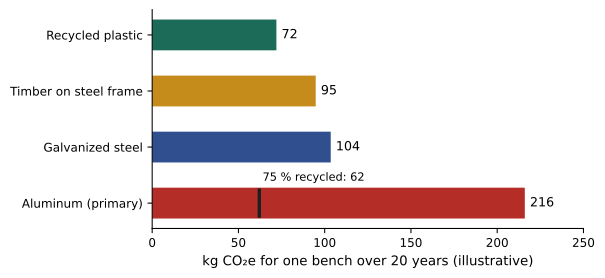
print(f"Aluminum with 75% recycled content: factor {f_mix:.2f}, total {18 * f_mix:.1f} kg CO2e")Bench per unit units maintenance total kg CO2e Galvanized steel 103.5 1 0.0 103.5 Aluminum (primary) 216.0 1 0.0 216.0 Recycled plastic 72.0 1 0.0 72.0 Timber on steel frame 32.4 2 30.0 94.8 Aluminum with 75% recycled content: factor 3.45, total 62.1 kg CO2e
With these illustrative factors, the recycled-plastic bench has the lowest carbon footprint, the timber bench is competitive despite needing replacement after ten years, and the primary aluminum bench is highest, because primary aluminum smelting is very energy-intensive (CHEM-103). But the last line shows how sensitive the result is to one assumption: with 75 % recycled aluminum, the same bench becomes the second-lowest option. Real LCAs use verified data, such as environmental product declarations (EPDs) from manufacturers, and report their assumptions so readers can judge them. Carbon is also only one impact: timber's sustainability depends on forest management, and plastic lumber may shed microplastics. LCA informs decisions; it does not make them.
In buildings and infrastructure, embodied carbon, the emissions from making and building the structure, is a growing share of the total as operating energy falls, and many owners and governments now require embodied carbon to be reported or limited. Engineers reduce it by using less material through efficient design, specifying lower-carbon concrete mixes (CHEM-103) and recycled steel, reusing existing structures rather than demolishing them, and designing for future adaptation.
Putting it together in design reviews
Safety, reliability, maintainability and sustainability are best handled together at each design review (Lesson 5): Has every hazard been eliminated or minimized where possible? Have the FMEA actions been completed? Does the design meet its reliability and availability targets, and can it be maintained by the people who will do it? Have life-cycle impacts been compared for the main options? Recording the answers gives the next reviewer, and the eventual owner, a clear account of how the design meets its obligations to the people who use it and the environment it affects.
Common mistakes
MistakeAdding safeguards before asking whether the hazard can be eliminated.
InsteadApply minimize, substitute, moderate and simplify first.
MistakeTreating a safety factor as protection against every failure.
InsteadFactors cover uncertainty, not errors, fatigue or unanticipated modes.
MistakeRanking FMEA items by RPN alone.
InsteadAct on high-severity failure modes first, whatever their RPN.
MistakeImproving availability only by improving reliability.
InsteadReducing repair time is often cheaper and just as effective.
MistakeComparing environmental impacts without a functional unit.
InsteadCompare options that deliver the same service over the same period.
Summary and key terms
- Inherently safer design minimizes, substitutes, moderates and simplifies hazards at the concept stage.
- Safety factors cover uncertainty; they do not cover errors, degradation or unforeseen failure modes.
- Design FMEA rates severity, occurrence and detection; act first on high-severity modes.
- Reliability R = e^(−λt); availability = MTBF/(MTBF + MTTR); spares and redundancy improve it.
- Design for maintainability involves the people who service the product.
- LCA compares options over their whole lives using a common functional unit.
- Embodied carbon is reduced by using less, choosing lower-carbon and recycled materials, and reusing structures.
- Inherently safer design
- Removing or reducing hazards rather than controlling them.
- Factor of safety
- The ratio of strength to working stress.
- Design FMEA
- An FMEA applied to a design to find and reduce failure risks.
- Risk priority number
- Severity × occurrence × detection in an FMEA.
- MTBF
- Mean time between failures.
- MTTR
- Mean time to repair.
- Availability
- The fraction of time a system is able to perform its function.
- Life-cycle assessment
- A method for assessing environmental impacts over a product's whole life.
- Functional unit
- The common service on which options are compared in an LCA.
- Embodied carbon
- Greenhouse gas emissions from producing and constructing materials and products.
Practice problems
Work each problem on paper first, then reveal the answer to check.
Name Kletz's four strategies for inherently safer design.
Show answer
Minimize, substitute, moderate, simplify.
Give an example of "moderate".
Show answer
For example, operating a process at lower pressure or temperature, or using a dilute solution.
Why does ductility affect the choice of safety factor?
Show answer
Ductile materials give visible warning before failure; brittle ones fail suddenly, so larger margins are needed.
A failure mode has S = 9, O = 2, D = 3. Find its RPN. Should it be ignored because the RPN is low?
Show answer
54; no, its severity is high, so it needs action.
Find R(1000 h) for a component with λ = 1 × 10⁻⁴ per hour.
Show answer
e^(−0.1) = 0.905.
Find the availability for MTBF = 2,000 h and MTTR = 10 h.
Show answer
2000/2010 = 0.995.
Give two design features that reduce MTTR.
Show answer
For example: modular replaceable units, clear access, diagnostics, standard tools.
Why is a functional unit essential in LCA?
Show answer
Options must be compared delivering the same service for the same time.
From the code output, why does the timber bench count twice?
Show answer
Its 10-year life means two benches are needed over 20 years.
Give two ways to reduce embodied carbon in a building structure.
Show answer
For example: efficient design using less material, lower-carbon concrete, recycled steel, reusing existing structures.
Lesson quiz · 5 questions
Score 60% or more to complete this lesson.
Create a free account to save your progress, take quizzes and earn a certificate.