
ELV-210 · Lesson 9 of 12 · 20 min
AC induction and permanent-magnet motors
Most elevator motors today are AC motors. The pump motor in a hydraulic power unit, like the ones being replaced at Holloway Memorial Hospital, is an induction motor started straight from the supply or through a starter. The door operator on many cars is a small induction motor or a permanent-magnet motor. And the hoist machines at Quayside Tower are permanent-magnet synchronous motors, gearless, with the drive sheave mounted directly on the motor shaft and turning at little more than a hundred revolutions per minute. This lesson explains how these motors turn, how their speed is related to the supply frequency, and how a mechanic works out the power a hoist motor needs.
The rotating magnetic field
The three windings of a three-phase motor's stator are placed around its frame, displaced from each other by a third of a pole pitch. When they are fed with three-phase currents, each a third of a cycle apart, the combined magnetic field does something remarkable: it rotates around the stator at a steady speed, without anything moving mechanically. The speed of that rotating field is the synchronous speed, set by the supply frequency and the number of magnetic poles the winding produces.
Here the speed is in revolutions per minute, the frequency in hertz and p is the number of poles, always an even number. A two-pole winding at 60 Hz has a synchronous speed of 3,600 rpm, a four-pole winding 1,800 rpm, a six-pole winding 1,200 rpm. A gearless elevator machine has many poles, perhaps twenty or more, so that it can turn slowly while the drive feeds it at a moderate frequency. Swapping two supply lines reverses the order of the phases and so reverses the direction of the rotating field, which is why phase rotation, discussed in Lesson 6, matters.
Induction motors and slip
In an induction motor, the rotor has no connection to the supply. The common type, the squirrel cage, has a rotor of aluminum or copper bars set in a laminated iron core and joined by end rings. The rotating field sweeps across the bars, induces currents in them, and the currents in the field produce torque that drags the rotor around after the field. The rotor can never quite catch up, because if it turned at synchronous speed the field would not cut its bars, no current would be induced, and there would be no torque. The difference between synchronous speed and rotor speed, as a fraction of synchronous speed, is the slip.
At no load an induction motor runs very close to synchronous speed. At full load the slip is typically two to five percent, so a four-pole motor with a synchronous speed of 1,800 rpm runs at about 1,750 rpm, as its nameplate states. Torque rises with slip over the normal working range. If the load increases beyond the motor's capacity, the slip increases to the point of maximum torque, the breakdown torque, beyond which the motor stalls.
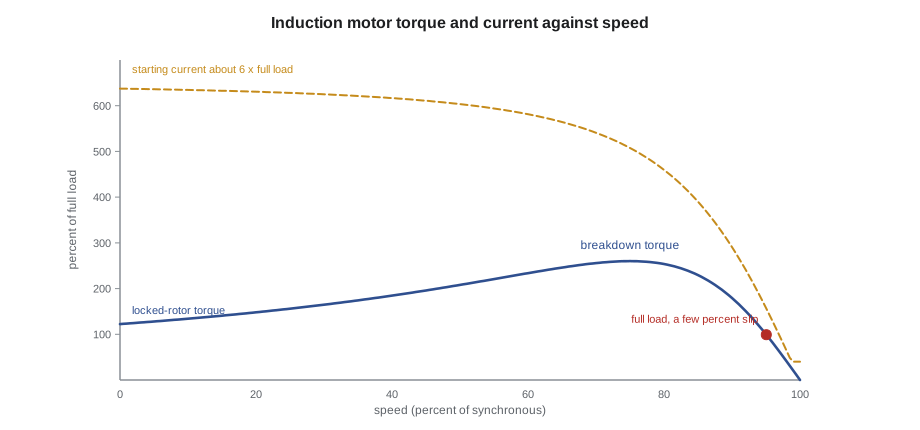
Starting is the difficult moment. At standstill the slip is one, the rotor currents are large, and the motor draws a locked-rotor current of five to seven times its full-load current until it accelerates. On a large hydraulic pump motor started directly on the line, that inrush dips the building supply and stresses the motor. Starting methods reduce it. A wye-delta starter connects the windings in wye for starting, which applies only about 58 percent of the voltage to each winding and cuts the starting current to about a third, then switches them to delta for running. A soft starter uses thyristors to ramp the voltage up over a few seconds. The new power units at Holloway use soft starters, which also make the start quieter in the hospital corridors next to the machine rooms.
# Holloway car 1 pump motor: speed, slip and starting current (illustrative)
f, poles = 60.0, 4
ns = 120 * f / poles
nameplate_rpm = 1765.0
fla = 47.0            # full-load amperes at 480 V
s = (ns - nameplate_rpm) / ns
print(f"synchronous speed {ns:.0f} rpm, full-load slip {100 * s:.1f} %")
locked = 6.5 * fla
print(f"direct on line: locked-rotor current about {locked:.0f} A")
print(f"wye-delta start: about {locked / 3:.0f} A from the supply")
for pct in (40, 55, 70):
    # a soft starter limits the current; motor current is roughly proportional to applied voltage at standstill
print(f"soft start at {pct} % voltage: about {locked * pct / 100:.0f} A, torque about {100 * (pct / 100) ** 2:.0f} % of locked-rotor torque")synchronous speed 1800 rpm, full-load slip 1.9 % direct on line: locked-rotor current about 306 A wye-delta start: about 102 A from the supply soft start at 40 % voltage: about 122 A, torque about 16 % of locked-rotor torque soft start at 55 % voltage: about 168 A, torque about 30 % of locked-rotor torque soft start at 70 % voltage: about 214 A, torque about 49 % of locked-rotor torque
The last lines show the trade-off. Starting torque varies with the square of the voltage, so a soft starter that halves the voltage leaves only a quarter of the starting torque. A pump motor starts unloaded, because the valve bypasses the oil to the tank until the motor is up to speed, so it does not need much starting torque. That is not true of a traction hoist motor, which must start holding the car and counterweight, and is one of the reasons traction elevators use drives rather than starters.
Two-speed AC elevators
Before drives were common, many low-rise traction elevators used two-speed induction motors: a single motor with two separate windings, for example six poles for full speed and twenty-four poles for leveling. The car ran at full speed on the fast winding, then the controller switched to the slow winding near the floor and the car slowed abruptly to a quarter speed before the brake stopped it. The ride was rough by modern standards, and the leveling accuracy varied with load. Ray still services one such car on Route 7, in the Delmont Hotel, and Tamsin can recognize it by the distinct clunk of the speed change on every stop.
Permanent-magnet synchronous motors
A permanent-magnet synchronous motor has a stator like an induction motor, but its rotor carries permanent magnets instead of a squirrel cage. The magnets lock onto the rotating field and the rotor turns at exactly synchronous speed, with no slip. Because the magnets provide the field, the motor needs no magnetizing current, so its power factor and efficiency are high, and it can produce high torque at low speed in a compact frame. These are the properties that made the gearless machine-room-less elevator practical: the Quayside machines are flat, many-pole motors with the sheave on the rotor, small enough to mount in the hoistway.
A permanent-magnet motor cannot be started from a fixed-frequency supply, because the rotor cannot jump to synchronous speed from standstill. It must be run from a drive that starts at zero frequency and ramps up, keeping the field in step with the rotor. To do that, the drive must know exactly where the rotor's magnets are, so the machine has an absolute encoder on its shaft. When a gearless machine or its encoder is replaced, the drive must learn the encoder offset, the angle between the encoder's zero and the magnets, in a procedure set out by the manufacturer. An incorrect offset causes the motor to draw high current, run rough or refuse to move.
Permanent magnets also mean that the motor generates a voltage whenever its rotor turns, whether or not the drive is on. If the brake is lifted manually during a rescue and the car moves, the motor's terminals become live. Many gearless machines use this deliberately: contactors short the motor windings together when the drive is off, so that a moving rotor drives current through its own windings and is braked electrically. This dynamic braking limits the speed of a car moved by manual brake release. A mechanic working on the motor leads of a permanent-magnet machine must know that the car being stationary and the brake set is part of the isolation.
From motor speed to car speed
The car speed follows from the motor speed, the sheave diameter and the roping. On a gearless machine with 1:1 roping, the rope speed equals the sheave rim speed, and the car moves at rope speed. With 2:1 roping, as at Quayside, the ropes pass under sheaves on the car and counterweight, and the car moves at half the rope speed. On a geared machine, the gear ratio divides the motor speed before the sheave.
Here v is the car speed, D the sheave diameter, n the motor speed in rpm, r the roping factor and i the gear ratio, equal to one for a gearless machine. The code below works out the Quayside machine speed and the frequency the drive must supply for rated speed.
# Quayside car 2 gearless machine: motor speed and drive frequency at rated speed
import math
v_car = 500            # rated car speed, ft/min
D = 16 / 12                   # traction sheave diameter, ft
roping = 2                # 2:1
poles = 24
rope_speed = v_car * roping
n = rope_speed * 1 / (math.pi * D)     # rpm
f = n * poles / 120
print(f"rope speed {rope_speed:.1f} ft/min, motor speed {n:.0f} rpm, drive frequency {f:.1f} Hz")
# leveling speed for the last part of the approach
v_lev = 10
print(f"at {v_lev} ft/min leveling speed the drive runs at {f * v_lev / v_car:.2f} Hz")rope speed 1000.0 ft/min, motor speed 239 rpm, drive frequency 47.7 Hz at 10 ft/min leveling speed the drive runs at 0.95 Hz
How much power a hoist motor needs
A traction elevator's counterweight is heavier than the empty car by a fraction of the rated load, typically 40 to 50 percent, called the overbalance. With the car carrying exactly that fraction of its rated load, the car and counterweight balance, and the motor only has to overcome friction and accelerate the masses. With a full car going up, the motor must lift the difference between the full car and the counterweight. With an empty car going up, the counterweight is heavier and the motor must hold the car back. The largest steady power is therefore for the full car going up, and it depends on the unbalanced load, the speed and the efficiency of the machine and roping.
Here Q is the rated load, K the overbalance fraction, g the acceleration of gravity, v the car speed and η the overall efficiency. The formula gives the steady running power; during acceleration the motor also supplies the energy to speed up the car, counterweight, ropes and rotating parts, so the motor and drive are rated above the steady figure.
# Steady hoist power for Quayside car 2, full load up (and the other cases)
Q = 3500             # rated load, lb
K = 0.45            # overbalance
v = 500             # car speed, ft/min
eta = 0.82          # machine and roping efficiency
for name, load in (("full car up", Q), ("balanced load", K * Q), ("empty car up", 0.0)):
    unbalance = load - K * Q            # positive: car side heavier
    p_shaft = unbalance * 1 * v       # mechanical power, ft-lb/min
    p_motor = p_shaft / eta if p_shaft > 0 else p_shaft * eta
    print(f"{name:<15} unbalance {unbalance:7.0f} lb  motor power {p_motor / 33000:6.1f} hp "
+ ("(motoring)" if p_motor > 0 else "(regenerating)" if p_motor < 0 else ""))full car up unbalance 1925 lb motor power 35.6 hp (motoring) balanced load unbalance 0 lb motor power 0.0 hp empty car up unbalance -1575 lb motor power -19.6 hp (regenerating)
The empty car going up needs negative power: the heavier counterweight is driving the machine, and the motor acts as a generator. Lesson 10 shows what the drive does with that energy.
Worked problem
Reading a motor nameplate
The replacement pump motor for Holloway car 2 has a nameplate reading: 3 phase, 60 Hz, 460 V, 40 hp, 49 A, 1,770 rpm, service factor 1.15, insulation class F, design B. What does each item tell Tamsin?
Show solution
- 3 phase, 60 Hz, 460 V, the nameplate voltage for a 480 V system: the supply the motor is wound for. On this supply its synchronous speed is 1,800 rpm, so it is a four-pole motor.
- 40 hp and 49 A: the rated output and the current it draws at that output. A clamp reading well above 49 A on every run would mean overloading or a supply problem.
- 1,770 rpm: full-load speed, so the full-load slip is 30 / 1,800 = 1.7 percent.
- Service factor 1.15: the motor can carry 15 percent overload continuously at rated voltage, though with more heating and shorter life; it is not a design margin to plan on.
- Class F insulation and design B: the insulation's temperature class and the shape of the torque-speed curve, both needed when ordering an equivalent replacement.
Answer: The nameplate gives the supply, the rated output and current, the full-load speed and slip, and the information needed to replace the motor with an equivalent one.
Common mistakes
MistakeExpecting an induction motor to run at synchronous speed.
InsteadIt runs a few percent slower; the slip produces the torque.
MistakeAssuming a soft starter gives full starting torque at reduced current.
InsteadTorque falls with the square of the voltage.
MistakeTreating a permanent-magnet machine's leads as dead because the drive is off.
InsteadA turning rotor generates voltage; keep the car still and the brake set.
MistakeReplacing a gearless encoder without running the offset procedure.
InsteadThe drive must learn the encoder offset before the car is run.
MistakeCalculating hoist power from the full rated load.
InsteadUse the unbalanced load, (1 − K) Q, for the full car up.
Summary and key terms
- Three-phase stator currents produce a rotating field at synchronous speed, 120 f / p.
- An induction motor's rotor runs slightly slower than the field; slip produces the torque.
- Induction motors draw five to seven times full-load current when starting; starters reduce it at the cost of torque.
- Permanent-magnet synchronous motors run without slip, need a drive and an encoder, and generate voltage when turned.
- Car speed follows from motor speed, sheave diameter, roping and gear ratio.
- Hoist power depends on the unbalanced load; with a light car going up, the motor regenerates.
- Synchronous speed
- The speed of the rotating magnetic field, 120 f / p rpm.
- Slip
- The difference between synchronous speed and rotor speed, as a fraction of synchronous speed.
- Squirrel cage rotor
- An induction motor rotor of conducting bars joined by end rings.
- Locked-rotor current
- The current an induction motor draws at standstill, typically five to seven times full-load current.
- Permanent-magnet synchronous motor
- A motor with magnets on its rotor that turns at exactly synchronous speed.
- Encoder offset
- The angle between a gearless machine's encoder zero and its rotor magnets, learned by the drive.
- Overbalance
- The fraction of rated load by which the counterweight exceeds the empty car.
Practice problems
Work each problem on paper first, then reveal the answer to check.
What is the synchronous speed of a six-pole motor at 60 Hz?
Show answer
120 × 60 / 6 = 1,200 rpm.
A four-pole motor runs at 1,740 rpm at full load. What is its slip?
Show answer
(1,800 − 1,740) / 1,800 = 3.3 %.
A 2,500 lb rated car with 45 % overbalance runs at 200 ft/min with 80 % efficiency. What steady power does the full car need going up?
Show answer
0.55 × 2,500 × 200 / 33,000 / 0.80 = 10.4 hp.
Why must the drive know where a permanent-magnet rotor's magnets are?
Show answer
It must keep the stator field in step with the magnets from standstill, using the encoder position.
Lesson quiz · 5 questions
Score 60% or more to complete this lesson.
Create a free account to save your progress, take quizzes and earn a certificate.