
ELV-210 · Lesson 8 of 12 · 20 min
DC motors and generators
Tillicum car 1 is the oldest working traction elevator on Route 7. Its hoist motor is a DC motor, coupled through a worm gear to the drive sheave, and it gets its power not from the building supply directly but from a motor-generator set in the corner of the machine room: an AC induction motor running all the time the car is in service, turning a DC generator on the same shaft. The arrangement is called a Ward-Leonard system, after the engineer who patented it in the 1890s, and for most of the twentieth century it was how good-quality traction elevators were controlled. Many are still running. Tamsin needs to understand them both for their own sake and because the principles they use, back EMF, torque from current, and speed from voltage, are the same principles a modern drive manages electronically.
How a motor makes torque
A conductor carrying current in a magnetic field experiences a force at right angles to both the current and the field. The force is proportional to the field strength, the current and the length of conductor in the field. A motor arranges many conductors on a rotating armature so that the forces on them all push in the same direction around the shaft, producing torque.
In a DC motor, the field is produced by field windings on the stationary frame, or by permanent magnets in small motors, and the armature conductors are fed through a commutator: a ring of copper segments on the shaft, with carbon brushes riding on it. As the armature turns, the commutator switches the current in each conductor so that the conductors under each pole always carry current in the direction that produces torque the same way. The commutator and brushes are the part of a DC motor that wears and needs maintenance, and the part that sparks.
Back EMF and speed
A conductor moving through a magnetic field has a voltage induced in it, which is the principle of the generator. A motor's armature is moving through its field, so it generates a voltage too, opposing the applied voltage. This back EMF is proportional to the field flux and the speed. At standstill there is no back EMF, and the only thing limiting the current is the small resistance of the armature. As the motor speeds up, the back EMF rises and the current falls, until the motor settles at the speed where the applied voltage, less the drop in the armature resistance, equals the back EMF.
These three relationships say almost everything a mechanic needs. The speed of a DC motor with a constant field is close to proportional to the armature voltage, falling a little as load increases because the larger current drops more voltage in the armature resistance. The torque is proportional to the armature current. And if the field is weakened, the motor must turn faster to produce the same back EMF, so it speeds up, which is why a separately excited DC motor that loses its field while connected to its supply can accelerate dangerously. DC elevator controllers have a field loss relay that stops the car if the motor field current falls below a safe value.
# Tillicum car 1 DC hoist motor: speed from armature voltage and load (illustrative)
Ra = 0.12            # armature circuit resistance, ohms
kphi = 2.10          # V per (rev/s) at full field
rated_v = 230.0
for load, ia in (("empty car down (motor generating)", -40.0), ("balanced", 8.0), ("full load up", 95.0)):
    for v in (rated_v, rated_v / 2):
        e = v - ia * Ra
        n = e / kphi * 60          # rpm
        print(f"{load:<34} V {v:5.1f}  Ia {ia:6.1f} A  E {e:5.1f} V  speed {n:6.0f} rpm")
# weakened field at rated voltage, balanced load
for frac in (1.0, 0.8, 0.6):
    n = (rated_v - 8.0 * Ra) / (kphi * frac) * 60
print(f"field at {frac:.0%}: speed {n:6.0f} rpm")empty car down (motor generating) V 230.0 Ia -40.0 A E 234.8 V speed 6709 rpm empty car down (motor generating) V 115.0 Ia -40.0 A E 119.8 V speed 3423 rpm balanced V 230.0 Ia 8.0 A E 229.0 V speed 6544 rpm balanced V 115.0 Ia 8.0 A E 114.0 V speed 3258 rpm full load up V 230.0 Ia 95.0 A E 218.6 V speed 6246 rpm full load up V 115.0 Ia 95.0 A E 103.6 V speed 2960 rpm field at 100%: speed 6544 rpm field at 80%: speed 8180 rpm field at 60%: speed 10907 rpm
The output shows that the speed is set almost entirely by the armature voltage: half the voltage gives very nearly half the speed, whatever the load. That is the property the Ward-Leonard system uses. It also shows the field weakening effect: at sixty percent field the motor would try to run two thirds faster. In the case of the empty car running down, the current is negative: the overhauling counterweight is driving the motor, which is acting as a generator and pushing current back into the supply.
The generator
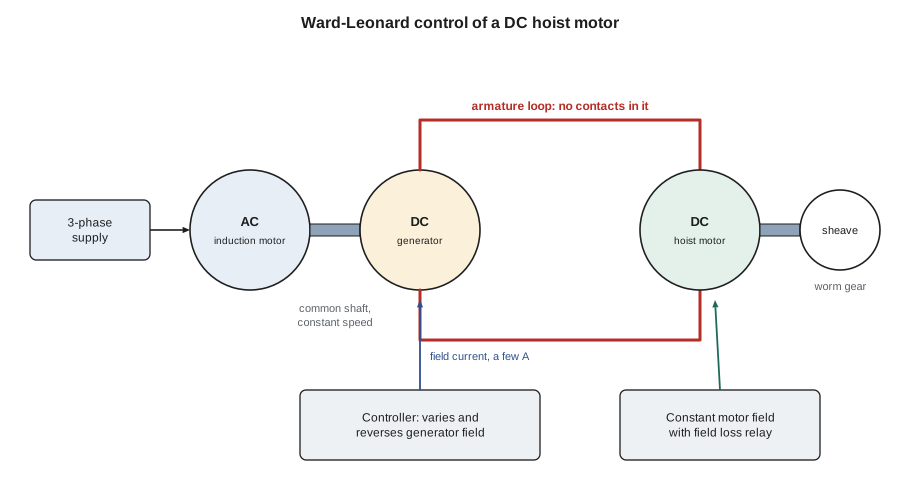
A DC generator is a DC machine driven by something else. Its armature turns through its field and produces a voltage proportional to field flux and speed. If the speed is held constant, the output voltage is controlled entirely by the field current, and the field current is small: a few amperes controls the output of a generator delivering a hundred amperes or more. In a motor-generator set the generator is driven at nearly constant speed by an AC induction motor, so its output voltage follows its field current.
Ward-Leonard control
In a Ward-Leonard system, the generator's armature is connected directly to the hoist motor's armature in a closed loop with no switching contacts in it. The hoist motor's field is fed from a constant DC supply. The controller controls the car by controlling the generator field. To start the car upward, it energizes the generator field in one direction and increases it gradually, the generator voltage rises, and the hoist motor accelerates smoothly in proportion. To slow the car, it reduces the field; to reverse, it reverses the generator field. Because the power loop has no contacts, there is no arcing of heavy currents, and the speed can be controlled smoothly from zero to full speed. On early controllers the generator field was varied by relays switching resistors in steps; on later ones, by an electronic field regulator using feedback from a tachometer generator on the motor shaft.
The system brakes the car electrically too. When the controller reduces the generator field to slow the car, the hoist motor's back EMF is momentarily higher than the generator voltage, so current flows the other way: the hoist motor becomes a generator, the generator becomes a motor, and the AC induction motor is driven slightly above its synchronous speed and feeds power back into the building supply. The mechanical brake on a Ward-Leonard car is only applied once the car has been brought nearly to rest electrically, so the brake linings wear very little.
# Ward-Leonard generator: field current to armature voltage and car speed (illustrative)
gen_k = 92.0           # V per A of field current on the straight part of the curve
sat_v = 250.0          # voltage where the iron saturates
def gen_voltage(i_field):
    v = gen_k * i_field
    return sat_v * v / (sat_v + 0.25 * abs(v))   # gentle saturation
rated_speed = 200     # car speed at 230 V on the hoist motor, ft/min
for i_f in (0.0, 0.5, 1.0, 1.5, 2.0, 2.5, 3.0):
    v = gen_voltage(i_f)
print(f"field {i_f:3.1f} A -> generator {v:5.0f} V -> car about {rated_speed * v / 230:5.2f} ft/min")field 0.0 A -> generator 0 V -> car about 0.00 ft/min field 0.5 A -> generator 44 V -> car about 38.24 ft/min field 1.0 A -> generator 84 V -> car about 73.26 ft/min field 1.5 A -> generator 121 V -> car about 105.45 ft/min field 2.0 A -> generator 155 V -> car about 135.14 ft/min field 2.5 A -> generator 187 V -> car about 162.60 ft/min field 3.0 A -> generator 216 V -> car about 188.09 ft/min
As the field current rises, the generator voltage rises nearly in proportion until the iron begins to saturate, and the car speed follows the voltage. The adjuster sets the field current for each speed, and on Tillicum car 1 the settings are recorded on a card inside the controller door, written by a mechanic decades ago and updated since.
Problems with motor-generator systems
Motor-generator sets have three weaknesses that explain why they have mostly been replaced. They waste energy, because the AC motor runs and the generator spins whenever the car is in service, even with the car parked, and the set is losing energy to friction, windage and magnetizing current the whole time. They are large, noisy and heavy, requiring a machine room big enough for both machines. And they need maintenance: two commutators, two sets of brushes, and bearings on two machines. Ray checks the brushes on Tillicum car 1 at every maintenance visit, looking for brushes worn below their limit, chipped edges, sparking under load and a commutator surface that should have an even chocolate-brown film rather than bright copper, black burns or grooves.
Brush and commutator work is done with the car locked out and the motor-generator set stopped, because the commutator is live and rotating when the set is running. Carbon dust from the brushes is conductive and must be cleaned out with a vacuum, not blown around the machine room. A severe commutator fault can flash over: the arc between adjacent segments spreads around the commutator, and the resulting arc flash is a serious hazard to anyone looking into the machine.
From the 1970s onward, solid-state DC drives replaced many motor-generator sets. A DC drive uses thyristors, controlled rectifiers, to convert the AC supply directly into a variable DC voltage for the hoist motor armature, keeping the existing DC motor but eliminating the generator. The Tillicum building owner has been offered exactly that as a first stage of modernization for car 1, with a full replacement of the machine and controller later.
Shunt, series and compound machines
DC machines are classified by how their field is connected. In a separately excited machine, the arrangement on Tillicum car 1, the field is fed from its own supply and is independent of the armature. A shunt machine has its field connected in parallel with the armature, which gives nearly constant speed. A series machine has its field in series with the armature, so the field strengthens with load; it has very high starting torque but runs away if unloaded, which is why it was used on traction vehicles and cranes but never on elevator hoist motors. Compound machines combine both. Many Ward-Leonard generators had a small series winding to compensate for the drop in voltage under load.
Worked problem
The car runs slow when loaded
Ray is called to Tillicum car 1 because the car runs at normal speed empty but noticeably slower going up with a full load. The generator field current is correct for full speed, and the hoist motor field current is normal. What would explain the symptom?
Show solution
- With the generator field correct, the generator's no-load voltage should be correct. A slow loaded speed means the voltage reaching the motor falls under load, or the motor's internal drop is larger than it should be.
- From V = E + Ia Ra, a larger resistance in the armature loop means more voltage lost at high current, leaving less back EMF and so less speed, while at light load the difference is small.
- The armature loop includes the generator armature, its brushes, the interconnecting cables and the motor armature and brushes.
- With the set stopped and locked out, Ray finds the generator brushes worn short and their springs weak, so the contact resistance at the commutator is high under load.
Answer: The excess resistance in the armature loop dropped voltage at high current; new brushes, seated to the commutator, restored the loaded speed.
Common mistakes
MistakeWorking on a commutator with the motor-generator set running.
InsteadStop and lock out the set; the commutator is live and rotating.
MistakeBlowing carbon dust out of a motor with compressed air.
InsteadVacuum it; carbon dust is conductive.
MistakeTreating field loss as a minor fault.
InsteadA separately excited motor that loses its field can overspeed; the field loss relay must work.
MistakeExpecting a DC motor's speed to depend on its load.
InsteadSpeed follows armature voltage; load changes it only by the armature resistance drop.
MistakePolishing a commutator to bright copper.
InsteadAn even brown film is normal and helps the brushes; remove only burns and grooves.
Summary and key terms
- A motor makes torque from current in a magnetic field; the commutator keeps the torque in one direction.
- Back EMF rises with speed; at steady speed the applied voltage equals back EMF plus the armature resistance drop.
- DC motor speed is set by armature voltage, and torque by armature current; weakening the field raises speed.
- A DC generator's output voltage follows its field current when it is driven at constant speed.
- Ward-Leonard control varies the generator field to control the hoist motor smoothly, and regenerates during slowing.
- Motor-generator sets waste energy and need brush and commutator maintenance, and are being replaced by drives.
- Armature
- The rotating winding of a DC machine that carries the load current.
- Commutator
- The segmented copper ring that switches current in the armature conductors as they turn.
- Back EMF
- The voltage generated in a motor armature, opposing the applied voltage.
- Field winding
- The winding that produces the magnetic field of a DC machine.
- Ward-Leonard system
- Control of a DC motor by varying the field, and so the output voltage, of a generator driven at constant speed.
- Field loss relay
- A relay that stops the car if the hoist motor field current falls too low.
- Motor-generator set
- An AC motor driving a DC generator on the same shaft.
Practice problems
Work each problem on paper first, then reveal the answer to check.
A DC motor has 230 V applied, an armature resistance of 0.2 ohm and draws 50 A. What is its back EMF?
Show answer
E = 230 − 50 × 0.2 = 220 V.
If the armature voltage of a DC motor is halved at the same load, what happens to its speed?
Show answer
It falls to a little under half.
Why does the AC motor of a Ward-Leonard set run above synchronous speed while the car slows?
Show answer
The hoist motor generates, the generator motors, and the set drives the AC machine as a generator feeding the supply.
What should a healthy commutator look like?
Show answer
An even brown film, without burns, grooves or bright raw copper.
Lesson quiz · 5 questions
Score 60% or more to complete this lesson.
Create a free account to save your progress, take quizzes and earn a certificate.