
ELEC-430 · Lesson 9 of 12 · 25 min
Hazardous locations, special occupancies and special systems
The later parts of the code deal with locations and systems where general rules are not enough: atmospheres that can explode, water that increases shock risk, patients connected to equipment, systems that must keep working in a fire, and newer technologies such as solar arrays, batteries and electric vehicle chargers. Exam questions on these topics usually test the classification of a location, the key protective concept, and a handful of distinctive requirements. Because the rules are detailed, the best preparation is to understand why each set of rules exists and to practice finding the right section quickly. This lesson reviews hazardous location classification and protection techniques, pools and other wet locations, health care facilities, emergency and standby systems, fire alarm systems, renewable energy and storage, electric vehicle charging, and temporary installations.
Hazardous locations: classification
A hazardous location is one where flammable gases, vapors, combustible dusts or ignitable fibers may be present in quantities sufficient to produce an explosive or ignitable mixture. Ordinary electrical equipment, which produces sparks at switch contacts and hot surfaces, could ignite such mixtures. Classification describes what is present and how often, so that the protection can match the risk.
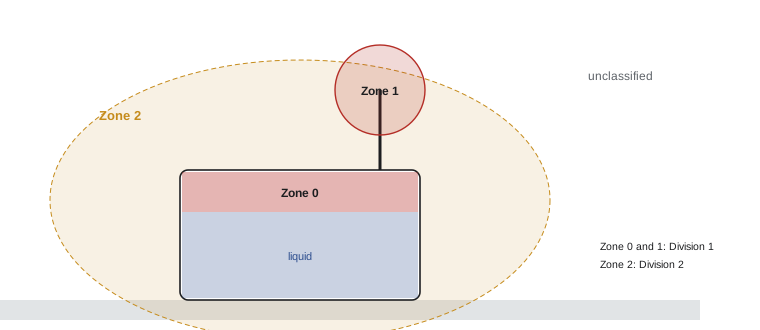
The NEC uses two systems. The Class and Division system of Articles 500 to 503 classifies locations as Class I (flammable gases or vapors), Class II (combustible dusts) and Class III (ignitable fibers and flyings), each divided into Division 1 (hazard present in normal operation) and Division 2 (hazard present only in abnormal conditions). Materials are grouped: Groups A to D for gases (A acetylene, B hydrogen, C ethylene, D propane and gasoline) and E to G for dusts. The zone system of Articles 505 and 506 offers Zones 0, 1 and 2 for gases and Zones 20, 21 and 22 for dusts, consistent with international practice. Equipment carries a temperature code (T1 to T6) showing its maximum surface temperature, which must be below the ignition temperature of the material.
Protection techniques
Equipment for hazardous locations uses one or more protection techniques, each identified by a marking:
- Explosion-proof or flameproof enclosures (Ex d): strong enclosures that contain an internal explosion and cool escaping gases through tight flame paths.
- Increased safety (Ex e): equipment designed so that sparks and hot spots do not occur in normal operation.
- Intrinsic safety (Ex i): circuits limited in energy so that sparks and heating cannot ignite the atmosphere, even under fault conditions; used for instrumentation and requiring barriers and careful segregation.
- Purged and pressurized enclosures (Ex p): enclosures kept at positive pressure with clean air or inert gas.
- Encapsulation (Ex m), oil immersion (Ex o) and powder filling (Ex q): enclosing sources of ignition in compound, oil or sand.
- Non-incendive and type n equipment: suitable for Zone 2 or Division 2 where hazards are rare.
Wiring in hazardous locations uses threaded rigid conduit or cables approved for the location, with seals that prevent flames and gases passing through conduits from one area to another or into enclosures. Seal locations, the depth of sealing compound, and the distance of seals from enclosures are favorite exam topics.
| Situation | Typical classification |
|---|---|
| Inside a closed fuel tank above the liquid | Zone 0 (Class I, Division 1) |
| Near a fuel dispenser or open vent | Zone 1 (Class I, Division 1) |
| Around a well-ventilated area that becomes hazardous only on leaks | Zone 2 (Class I, Division 2) |
| Inside a grain elevator with dust in suspension | Zone 20 or 21 (Class II, Division 1) |
| A sawmill area with ignitable fibers | Class III, or Zone 22 for some combustible fibers |
Pools, hot tubs and fountains
Water lowers body resistance and gives a good path to earth, so pools, hot tubs, spas and fountains have strict rules. The key protective concepts are equipotential bonding, which connects all metal parts of the pool structure, reinforcing steel, ladders, handrails, pumps and the surrounding deck to each other so that no voltage differences exist where people touch; GFCI protection for underwater lighting, pump motors and nearby receptacles; minimum distances between receptacles, switches and luminaires and the water; low-voltage or GFCI-protected underwater luminaires; and clearances for overhead conductors above pools and diving structures.
In the NEC, Article 680 covers pools, spas, hot tubs, fountains and hydromassage tubs. For example, receptacles must be at least 1.83 m (6 ft) from the inside wall of a permanently installed pool and those within 6.0 m (20 ft) must be GFCI protected, and 680.26 requires an equipotential bonding grid including the perimeter deck within 900 mm (3 ft) of the pool, bonded with solid 8 AWG copper.
Health care facilities
Patients in hospitals and clinics may be connected to equipment, sedated or have their skin barrier broken by catheters, making them far more vulnerable to shock than healthy people; currents of microamperes applied directly to the heart can cause fibrillation. Health care electrical systems therefore use redundant equipment bonding, often including both a raceway and an insulated bonding conductor, so that patient care equipment remains bonded even if one path fails; isolated power systems with line isolation monitors in some critical areas such as operating rooms; hospital-grade receptacles; and essential electrical systems, with automatic transfer to generators, divided into branches for life safety, critical care and equipment.
In the United States, Article 517 of the NEC covers health care facilities, and NFPA 99, Health Care Facilities Code, sets risk categories and performance requirements, including essential electrical systems with life safety, critical and equipment branches.
Emergency, standby and fire alarm systems
Some systems must keep working when normal power fails or during a fire. Emergency systems supply exit signs, egress lighting, fire alarms and fire pumps, and must transfer to an emergency source, such as batteries or a generator, within seconds. Their wiring is kept separate from normal wiring and protected against fire, and their sources are tested regularly. Standby systems, legally required or optional, supply loads whose loss would create hazards or inconvenience. Fire alarm systems detect fires, notify occupants and signal the fire department; their circuits are supervised, so that open circuits and ground faults produce trouble signals, and their wiring and installation follow both the electrical code and fire alarm installation standards.
In the United States, NEC Article 700 covers emergency systems, 701 legally required standby systems, 702 optional standby systems and 695 fire pumps, and Article 760 covers fire alarm system wiring. Installation, testing and maintenance of fire alarm systems follow NFPA 72, National Fire Alarm and Signaling Code, and NFPA 110 covers emergency and standby power systems. Building and fire codes determine where systems are required.
Renewable energy and energy storage
Solar photovoltaic systems, wind turbines and battery energy storage systems are now common on homes and commercial buildings, and the code has expanded accordingly. Key concepts include DC circuits with high open-circuit voltages that rise in cold weather, so that maximum voltage must be calculated with a temperature correction; currents sized at 125 % or more of short-circuit current because PV output can exceed its rating in bright conditions; disconnecting means for every source; arc-fault protection for DC circuits; rapid shutdown, which reduces the voltage of rooftop conductors within seconds so that firefighters can work safely; interconnection rules that limit how much generation may be back-fed through a panelboard's busbar; and requirements for battery systems, such as ventilation, spacing and listing.
In the NEC, Article 690 covers solar photovoltaic systems, including rapid shutdown in 690.12, Article 705 covers interconnected power production sources, including the "120 % rule" for back-feeding panelboard busbars, and Article 706 covers energy storage systems. Utilities have their own interconnection requirements.
Electric vehicle charging
Electric vehicle supply equipment (EVSE) is a continuous load and is sized accordingly, so a 48 A charger needs a 60 A circuit. Codes require listed equipment, ground-fault protection for personnel (built into most EVSE), disconnecting means for larger equipment, ventilation where indoor charging could produce hazardous gases (rare with modern batteries), and rules for load management systems that allow several chargers to share limited capacity. Bidirectional charging, where vehicles supply power back to a building or the grid, adds interconnection requirements.
In the NEC, Article 625 covers electric vehicle power transfer systems, and Article 220 (120 in 2026) includes EVSE loads in calculations, with 220.70 and the energy management rules of Article 750 (130 in 2026) allowing managed loads.
Temporary installations and other special topics
Construction sites, events and seasonal displays use temporary wiring, which has its own relaxations and protections, notably GFCI protection or an assured equipment grounding program for receptacles used by workers, time limits for removal, and protection of cords from damage. Other special topics that appear on exams include signs and outline lighting, cranes and hoists, elevators, welders, agricultural buildings with corrosive and wet conditions and livestock sensitive to small voltages, mobile homes and recreational vehicle parks, marinas with their risk of electric shock drowning, and Class 2 and other limited-energy circuits such as low-voltage lighting and communications. For each, know where the rules are and the central hazard they address.
Worked problem
Answering a special-location question
An exam question asks for the type of wiring permitted for a luminaire above a fuel dispenser at a gas station. How should you approach it?
Show solution
- Identify the location: a fuel dispenser area, a hazardous location with flammable vapors.
- Go to Article 514 (motor fuel dispensing facilities), which uses Table 514.3(B)(1) to classify areas and refers to Articles 500 to 505.
- Determine the zone or division at the luminaire's height and distance from the dispenser.
- Find the wiring methods and equipment permitted in that zone or division, including seals.
- Compare with the options; watch for methods permitted only in less hazardous areas.
Answer: Use the specific dispensing section to classify the area, then the hazardous-location rules for that classification; a general wiring method answer is almost certainly wrong.
Agricultural buildings and marinas
Farm buildings combine corrosive atmospheres from animal waste, dust, moisture and livestock that are sensitive to very small voltage differences, which can affect their health and productivity. Codes require corrosion-resistant wiring methods, dust-tight and watertight equipment, and equipotential planes in animal confinement areas, bonded to the electrical grounding system so that animals do not experience stray voltages. Marinas and docks present the hazard of electric shock drowning, in which leakage current in fresh water paralyses swimmers; codes require ground-fault protection on shore power and feeders, careful bonding, and warning signs. These locations are examined because their hazards are distinctive and their rules are easy to find once you know where to look.
Studying special locations efficiently
Because special locations cover many sections, it is tempting to skip them, but together they account for a meaningful share of marks. An efficient approach is to make a one-page summary for each major topic, listing the section, the central hazard, the classification scheme if any, and five or six key requirements. Hazardous locations, pools, health care, emergency systems, fire alarm, solar photovoltaic, energy storage, EV charging and temporary wiring each fit on a page. Review the pages regularly and practice lookups for each until you can find the main rules in under a minute.
Signs, cranes and other equipment
Questions on signs and outline lighting usually concern disconnecting means within sight of the sign, branch-circuit ratings and the protection of neon and LED sign components. Cranes and hoists have rules for conductor sizing based on duty cycle, contact conductors and disconnecting means. Welders have conductor sizing rules based on duty cycle multipliers. Each is a short, self-contained topic that rewards knowing where to look.
Common mistakes
MistakeUsing general wiring rules in a hazardous location.
InsteadClassify the location, then apply the hazardous-location rules.
MistakeConfusing Zone 1 with Zone 2.
InsteadZone 1 is likely in normal operation; Zone 2 is not.
MistakeRelying on GFCIs alone near pools.
InsteadApply equipotential bonding as well.
MistakeMixing emergency wiring with normal wiring.
InsteadKeep emergency circuits separate as required.
MistakeSizing PV circuits at 100 % of short-circuit current.
InsteadApply the required multipliers and temperature corrections.
Summary and key terms
- Hazardous locations are classified by material and likelihood of presence.
- Protection techniques include flameproof, increased safety, intrinsic safety and purging.
- Seals stop flames and gases traveling through conduit.
- Pools rely on equipotential bonding, GFCIs and clearances.
- Health care systems use redundant bonding and essential electrical systems.
- Emergency and fire alarm circuits are separated, protected and supervised.
- PV, storage and EV charging have their own rules for voltage, current and safety.
- Hazardous location
- Area where an explosive atmosphere may occur.
- Zone 1
- Explosive gas likely in normal operation.
- Division 2
- Hazard present only in abnormal conditions.
- Temperature class
- Maximum surface temperature code of equipment.
- Intrinsic safety
- Energy limitation preventing ignition.
- Seal
- Fitting with compound blocking gases in conduit.
- Equipotential bonding
- Bonding to remove voltage differences.
- Essential electrical system
- Health care power with backup sources.
- Rapid shutdown
- Reducing PV conductor voltage for firefighter safety.
- EVSE
- Electric vehicle supply equipment.
Practice problems
Work each problem on paper first, then reveal the answer to check.
What defines a Zone 0 location?
Show answer
Explosive gas present continuously or for long periods.
What does a temperature class indicate?
Show answer
Maximum surface temperature of the equipment.
How does a flameproof enclosure work?
Show answer
It contains an internal explosion and cools escaping gases.
What is intrinsic safety?
Show answer
Limiting circuit energy so it cannot ignite the atmosphere.
Why are seals installed in hazardous-location conduits?
Show answer
To stop flames and gases passing through the conduit.
What is the purpose of pool equipotential bonding?
Show answer
To prevent voltage differences people could touch.
Why do health care areas need redundant bonding?
Show answer
Patients are highly vulnerable to small currents.
Why is fire alarm wiring supervised?
Show answer
To report open circuits and ground faults as troubles.
What is rapid shutdown for?
Show answer
Reducing rooftop PV voltage for firefighter safety.
Minimum circuit rating for a 32 A EV charger?
Show answer
40 A (125 %).
Lesson quiz · 5 questions
Score 60% or more to complete this lesson.
Create a free account to save your progress, take quizzes and earn a certificate.