
ELEC-430 · Lesson 2 of 12 · 25 min
Code navigation under time pressure
The electrical code is a large, dense document, and nobody remembers all of it. What separates fast, accurate exam candidates from slow ones is not memory but navigation: knowing how the code is organized, how its rules are numbered and worded, where the tables live, how exceptions and notes change a rule, and how to go from a question to the right paragraph in under a minute. These are skills that improve rapidly with deliberate practice. This lesson explains the structure of the code, how to read a rule precisely, how to use the index and table of contents efficiently, the most frequently used tables, and drills that build speed.
How the code is organized
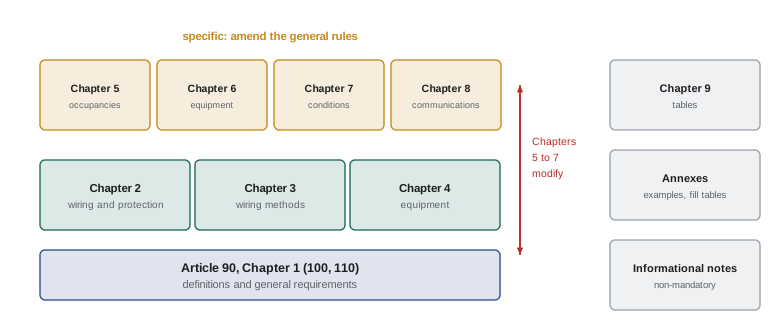
The National Electrical Code (NFPA 70) begins with Article 90, the introduction, which explains its purpose, scope and arrangement. Chapters 1 to 4 apply generally: Chapter 1 contains definitions (Article 100) and general requirements (Article 110); Chapter 2 covers wiring and protection, including branch circuits (210), feeders (215), services (230), overcurrent protection (240) and grounding and bonding (250); Chapter 3 covers wiring methods and materials, including conductors (310), boxes (314) and each raceway and cable type; Chapter 4 covers equipment for general use, including cords, receptacles, luminaires, appliances, heating, motors (430), air conditioning (440), generators, transformers (450) and batteries. Chapters 5, 6 and 7 cover special or specific occupancies, equipment and conditions, such as hazardous locations (500–516), health care (517), pools (680), solar photovoltaic systems (690), emergency systems (700) and limited-energy circuits. Chapter 8 covers communications systems, and Chapter 9 contains tables, including conduit fill and conductor properties. Informative annexes give examples and supporting information. Rules are numbered by article and section, for example 210.8 is a section of Article 210. The 2026 NEC began a larger reorganization: for example, load calculations moved from Article 220 to Article 120.
Article 90 explains that Chapters 1 through 4 apply generally, while Chapters 5, 6 and 7 can supplement or modify them for specific situations. When a rule in Article 680 for pools conflicts with a general rule in Chapter 2 or 3, the Article 680 rule governs for that installation.
Reading a rule precisely
Exam questions often hinge on a single word. Code language is precise, and small differences in wording change requirements:
- "Shall" means mandatory; "shall be permitted" means allowed but not required.
- "Not less than" sets a minimum; "not more than" or "shall not exceed" sets a maximum.
- "Within" a distance means the item is inside that distance, measured as the rule describes, for example horizontally or along the shortest path.
- Lists joined by "and" require all items; lists joined by "or" require any one.
- Defined terms have precise meanings that may differ from everyday use, such as "dwelling unit", "readily accessible", "continuous load" or "bonding".
Always read the whole rule, including all subrules, exceptions and notes. Many wrong answers on exams come from reading only the first sentence of a rule and missing a condition that applies to the question. Exceptions are as much part of the code as the main rule, and questions are often written specifically to test them.
In the NEC, informational notes explain or give references but are not enforceable requirements. Definitions in Article 100 apply throughout, and since the 2023 edition nearly all definitions have been collected there, with the article they mainly relate to noted in brackets.
Using the index and table of contents
Two finding tools come with every code book. The table of contents lists the sections or articles and their main parts, and is fastest when you know the general subject: if a question is about motors, go straight to the motor section. The index lists specific topics alphabetically, with many cross-references, and is fastest for narrow topics: bathrooms, swimming pools, cable trays, receptacles in kitchens. Effective index use requires thinking of the right keyword. If "garage receptacle" gives nothing, try "receptacles", then "garages", then "ground-fault circuit interrupters". With practice, you will learn the index's vocabulary.
A useful routine for code questions is:
- Identify the subject and the key noun in the question, such as the equipment, location or circuit.
- Go to the section or article directly if you know it; otherwise use the index.
- Find the rule and read it completely, including exceptions.
- Check whether a specific section modifies the general rule for this situation.
- Compare with the options, watching for answers that differ only in units or a single word.
The tables you will use most
| Table | Contents | Typical question |
|---|---|---|
| Table 310.16 | Ampacities of insulated conductors, not more than three current-carrying in raceway or cable | Minimum conductor size for a load |
| Table 310.15(B)(1) and 310.15(C)(1) | Ambient temperature correction and adjustment for more than three conductors | Derating in hot locations or full raceways |
| Table 220.12, 220.42, 220.55 | General lighting loads, lighting demand factors, range demand | Dwelling and commercial load calculations (Article 120 in 2026) |
| Table 250.66 and 250.122 | Grounding electrode conductor and equipment grounding conductor sizes | Size of a GEC or EGC |
| Table 314.16(A) and (B) | Box volumes and volume allowance per conductor | Box fill |
| Chapter 9, Tables 1, 4, 5 and Annex C | Conduit fill percentages, raceway areas, conductor areas, fill tables | Conduit size for a set of conductors |
| Tables 430.248 and 430.250 | Full-load currents of single-phase and three-phase motors | Motor circuit calculations |
| Table 430.52 | Maximum ratings of motor branch-circuit protective devices | Motor fuse or breaker size |
| Chapter 9, Table 8 | Conductor properties including DC resistance | Voltage drop questions |
Reading tables carefully
Table questions test whether you read the right row, column and conditions. Before using a table, read its title and notes: they state the conditions under which it applies, such as the number of conductors, ambient temperature, insulation temperature rating, conductor material and whether values are for copper or aluminum. Check the units, which may be amperes, millimeters, square millimeters, watts or volt-amperes. Check whether the table gives a maximum or minimum. Run a finger or the edge of a sheet along the row to avoid slipping to the next line, a common source of errors under time pressure.
Worked problem
A table lookup with conditions
What is the ampacity of a 6 AWG copper THHN conductor, one of three current-carrying conductors in a raceway, at an ambient temperature of 30 °C (86 °F), if it terminates on equipment marked for 75 °C?
Show solution
- Three conductors in a raceway: use Table 310.16 (copper).
- THHN is rated 90 °C, so its Table 310.16 ampacity in the 90 °C column is 75 A.
- The termination is rated 75 °C, and 110.14(C) limits the ampacity to the column matching the termination temperature.
- Table 310.16, 75 °C column, 6 AWG: 65 A.
Answer: 65 A. The 90 °C value (75 A) may be used as the starting point for derating, but the final ampacity cannot exceed the 75 °C value set by the terminations.
Building speed with drills
Navigation speed improves quickly with deliberate drills. Effective drills include:
- Lookup races: write twenty topics on cards, draw one at a time, and time how long it takes to find the governing rule. Aim for under 60 seconds each.
- Index hunts: for each topic, find it through the index and note which keyword worked; this teaches the index's vocabulary.
- Table familiarity: for each of the main tables, write down what it contains and the conditions in its notes, from memory, then check.
- Section mapping: from memory, write the subject of each major section or article, then check and repeat until accurate.
- Question dissection: for practice questions, identify the key word that determines the answer and the rule that contains it.
If your exam allows tabs, place them on the most used articles and tables, label them clearly, and practice with exactly the book you will take; check the bulletin for what markings are permitted.
Changes between editions
The NEC is revised every three years, and states adopt editions at different times and sometimes with amendments. Section numbers and requirements change between editions: for example, GFCI requirements in 210.8 have expanded in each recent edition, and the 2026 edition moved load calculations to Article 120 and reorganized limited-energy and higher-voltage rules. When studying, note the edition for every question bank you use, and study the edition named in your bulletin.
Three navigation walk-throughs
Consider how an experienced candidate handles three typical questions. First: "What is the minimum size of copper bonding conductor for a circuit protected by a 100 A breaker?" The key nouns are "bonding conductor" and "breaker rating". The candidate goes straight to the grounding and bonding section, finds the table that sizes bonding conductors by overcurrent device rating, reads across from 100 A, and checks the table notes for conditions. Time: about 40 seconds.
Second: "What is the minimum height of overhead conductors above a residential driveway?" The candidate recognizes this as a clearance question for overhead conductors, which may be in the services section or a section on outdoor overhead conductors. If unsure, the index entry for "clearances" or "overhead conductors" leads to the rule. The candidate reads the whole rule, because clearances differ for different voltages and locations, and picks the value for driveways at the stated voltage. Time: about 60 seconds.
Third: "Receptacles installed outdoors at a dwelling must have what type of protection?" The candidate thinks of the receptacle rules and ground-fault protection. The index entries for "receptacles, outdoor" or "ground-fault circuit interrupters" lead to the rule. The candidate checks whether weather-resistant receptacles and in-use covers are also required, because questions often combine requirements. Time: about 60 seconds.
Definitions that are often tested
Some defined terms appear again and again in exam questions, and misunderstanding them leads directly to wrong answers. Examples include: accessible and readily accessible, which differ in whether ladders, tools or removal of obstacles are needed; dwelling unit, which determines whether dwelling rules apply; continuous load; ampacity; bonding and grounding; service, feeder and branch circuit; wet, damp and dry locations; exposed and concealed; and in sight from. Read the definitions of these terms in your code edition and make sure you can state them in your own words.
Cross-references and notes
Rules frequently refer to other rules, tables or sections. Follow each cross-reference that the question depends on, but avoid chasing references that are not relevant, which wastes time. Table notes are especially important: a note may say that the table applies only to copper, only to certain insulation types, or that a correction must be applied in certain conditions. Many exam questions are written specifically around a table note, so read them every time you use a table, even one you know well.
Building a personal topic map
A powerful exercise in the first weeks of study is to build your own topic map: a single page listing about fifty common exam topics, such as bathroom receptacles, motor overloads, box fill, service clearances, pool bonding, emergency lighting and conductor ampacity, with the section or article and rule where each is found. Building the map forces you to look up each topic once; using it as a quick reference during practice reinforces the locations until you no longer need the map. Even where you cannot take the map into the exam, the act of making it builds the mental index that speeds every lookup.
When the index fails
Occasionally a topic seems to be missing from the index. In that case, think about which section or article would logically contain it based on the equipment, location or system involved, and scan that section's headings, which are usually descriptive. Another approach is to find a related topic you can locate and look for nearby rules or cross-references. With practice, you will rarely need these fallbacks, but they prevent a single missing keyword from costing several minutes.
Common mistakes
MistakeReading only the first sentence of a rule.
InsteadRead subrules, exceptions and notes before answering.
MistakeIgnoring the conditions in table headings and notes.
InsteadCheck material, insulation rating, ambient and conductor count.
MistakeGiving up when the first index keyword fails.
InsteadTry synonyms and the broader equipment or location.
MistakeApplying a general rule where a specific section governs.
InsteadCheck for specific sections that amend the general rule.
MistakePracticing with a different book from the exam.
InsteadUse the same edition and format you will have.
Summary and key terms
- General sections or chapters apply everywhere unless specific ones amend them.
- Know the subject of each major section or article.
- "Shall", "shall be permitted", "not less than" and "not more than" have precise meanings.
- Read complete rules, including exceptions and notes.
- Use the table of contents for broad subjects and the index for narrow ones.
- Read table titles and notes for conditions and units.
- Daily drills build navigation speed.
- Rule or section
- A numbered requirement in the code.
- Exception
- A condition under which a rule does not apply as written.
- Shall
- Mandatory requirement.
- Shall be permitted
- Allowed but not required.
- Index
- Alphabetical topic finder at the back of the code.
- Table of contents
- List of sections or articles and their parts.
- Appendix or annex
- Supporting, usually non-mandatory, material.
- Defined term
- Word with a specific meaning in the code.
- Termination temperature
- Temperature rating of connection points.
- Edition
- A particular published version of the code.
Practice problems
Work each problem on paper first, then reveal the answer to check.
Which NEC article covers grounding and bonding?
Show answer
Article 250.
Which NEC article covers motors?
Show answer
Article 430.
Where are dwelling load calculations in the 2023 NEC?
Show answer
Article 220 (Article 120 in 2026).
What does "shall be permitted" mean?
Show answer
Allowed but not required.
What does "not less than" set?
Show answer
A minimum.
Are explanatory notes mandatory?
Show answer
No; they help interpretation.
When should you use the index rather than the table of contents?
Show answer
For narrow, specific topics.
What should you read before using a table?
Show answer
Its title and notes for conditions and units.
Ampacity of 8 AWG copper, 75 °C column, three in raceway?
Show answer
50 A.
Why practice with the exam edition?
Show answer
Numbers and rules change between editions.
Lesson quiz · 5 questions
Score 60% or more to complete this lesson.
Create a free account to save your progress, take quizzes and earn a certificate.