
ELEC-430 · Lesson 10 of 12 · 29 min
Calculations review
Calculations appear in every part of an electrical exam, from Ohm's law questions in the theory section to load, motor, voltage drop and transformer questions in the code sections. Most candidates know the formulas; marks are lost through wrong units, using single-phase formulas on three-phase systems, confusing line and phase values, misreading power factor, and arithmetic slips under time pressure. This lesson reviews the formulas most often examined, with a worked example for each family of problems and a routine for checking answers. Practice each type until you can do it reliably without looking at notes.
Ohm's law and power
The foundation of every circuit calculation is Ohm's law, \(V = IR\), and the power relations derived from it:
Questions often give two quantities and ask for a third, or ask what happens when one changes. Because power depends on the square of voltage for a fixed resistance, a heater designed for 240 V connected to 208 V produces only \((208/240)^2 = 0.75\), or 75 %, of its rated power, a frequent exam question. Similarly, doubling the current through a resistance quadruples the heat produced.
Worked problem
Heater on the wrong voltage
A 4,500 W, 240 V water heater element is connected to 208 V. What power does it produce, and what current does it draw?
Show solution
- Resistance: \(R = V^2 / P = 240^2 / 4500 = 12.8\) Ω.
- Power at 208 V: \(208^2 / 12.8 = 3{,}380\) W.
- Current: \(208 / 12.8 = 16.25\) A.
- Check: \(3{,}380 / 4{,}500 = 0.75\), matching \((208/240)^2\).
Answer: About 3,380 W (75 % of rating) at 16.25 A.
Series and parallel circuits
In a series circuit, current is the same everywhere, resistances add, and voltage divides in proportion to resistance. In a parallel circuit, voltage is the same across every branch, currents add, and the total resistance is less than the smallest branch:
For two resistors in parallel, \(R = R_1R_2/(R_1 + R_2)\), and for \(n\) equal resistors, \(R/n\). Combination circuits are reduced step by step, combining series and parallel groups until a single equivalent resistance remains. Kirchhoff's laws, that currents into a junction sum to zero and voltages around a loop sum to zero, solve circuits that cannot be reduced this way. Exam favorites include the open neutral in a 120/240 V circuit, where two 120 V loads end up in series across 240 V and the smaller load receives most of the voltage.
Worked problem
An open neutral
On a 120/240 V circuit, a 600 W, 120 V heater is on one leg and a 1,500 W, 120 V heater on the other. The shared neutral opens. What voltage appears across each heater?
Show solution
- Resistances: \(120^2/600 = 24\) Ω and \(120^2/1500 = 9.6\) Ω.
- With the neutral open, they are in series across 240 V: total 33.6 Ω, current \(240/33.6 = 7.14\) A.
- Voltage across the 600 W heater: \(7.14 \times 24 = 171\) V.
- Voltage across the 1,500 W heater: \(7.14 \times 9.6 = 69\) V.
Answer: About 171 V across the smaller load and 69 V across the larger, which is why open neutrals damage equipment.
AC circuits: reactance, impedance and power factor
In AC circuits, inductors and capacitors oppose current through reactance: \(X_L = 2\pi f L\) for inductance and \(X_C = 1/(2\pi f C)\) for capacitance. Resistance and reactance combine as impedance, \(Z = \sqrt{R^2 + (X_L - X_C)^2}\), and Ohm's law becomes \(V = IZ\). Current lags voltage in an inductive circuit and leads it in a capacitive one, by the phase angle \(\theta\), where \(\cos\theta = R/Z\) is the power factor.
Power in AC circuits has three components, related by the power triangle:
True power \(P\) does useful work; reactive power \(Q\) builds magnetic and electric fields and returns to the source each cycle; apparent power \(S\) determines the current and therefore the size of conductors and transformers. Low power factor increases current for the same true power, so utilities may charge for it, and capacitors are added to correct it.
Worked problem
Power factor correction
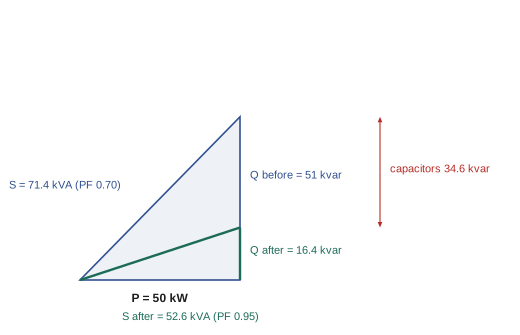
A load draws 50 kW at a power factor of 0.70 lagging. How much capacitive reactive power is needed to raise the power factor to 0.95?
Show solution
- Original angle: \(\cos^{-1} 0.70 = 45.6°\); \(Q_1 = 50 \tan 45.6° = 51.0\) kvar.
- Target angle: \(\cos^{-1} 0.95 = 18.2°\); \(Q_2 = 50 \tan 18.2° = 16.4\) kvar.
- Capacitors needed: \(51.0 - 16.4 = 34.6\) kvar.
- Apparent power falls from \(50/0.70 = 71.4\) kVA to \(50/0.95 = 52.6\) kVA, cutting current by about 26 %.
Answer: About 35 kvar of capacitors.
Three-phase systems
Three-phase calculations are the most common source of avoidable errors. Remember the relationships:
- Wye (star): line voltage = \(\sqrt{3}\) × phase voltage; line current = phase current. A 120/208 V system has 120 V line to neutral and 208 V line to line; 347/600 V and 277/480 V systems follow the same ratio.
- Delta: line voltage = phase voltage; line current = \(\sqrt{3}\) × phase current.
- Power in a balanced three-phase load: \(P = \sqrt{3}\,V_L I_L \cos\theta\), and \(S = \sqrt{3}\,V_L I_L\).
A quick check: a three-phase load draws about 2.8 A per kVA at 208 V, 1.2 A per kVA at 480 V and 0.96 A per kVA at 600 V. If an answer is far from these, look for a missing \(\sqrt{3}\) or a line-to-neutral voltage used by mistake.
Worked problem
A three-phase motor load
A 480 V three-phase motor delivers 30 kW of shaft power with an efficiency of 92 % and a power factor of 0.86. Find the line current.
Show solution
- Input power: 30 / 0.92 = 32.6 kW.
- Line current: \(32{,}600 / (1.732 \times 480 \times 0.86) = 45.6\) A.
- Check: apparent power 32.6 / 0.86 = 37.9 kVA × 1.2 A/kVA ≈ 45 A.
Answer: About 45.6 A.
Transformers
An ideal transformer's voltages are in the ratio of its turns, and currents in the inverse ratio: \(V_p/V_s = N_p/N_s = I_s/I_p\). Its kVA rating is the same on both sides. Real transformers have losses, so efficiency, the output power divided by input power, is typically 95 to 99 %. Percent impedance, marked on the nameplate, determines the available fault current at the secondary: \(I_{\text{fault}} \approx I_{\text{rated}} \times 100 / \%Z\), ignoring the source impedance. A 500 kVA, 208 V transformer with 5 % impedance has a rated secondary current of 1,388 A and an available fault current of about 27,800 A at its terminals, which sets the interrupting rating needed for equipment there.
Voltage drop and conductor resistance
Lesson 4 reviewed the voltage drop formula. Conductor resistance can also be found from the conductor's cross-sectional area and the resistivity of the material, \(R = \rho L / A\), or using the circular mil method, \(R = K L / \text{CM}\), where \(K\) is about 12.9 Ω·cmil/ft for copper and 21.2 for aluminum at operating temperature. Exam questions may ask for the minimum circular mil area for a given voltage drop: \(\text{CM} = 2KIL / V_{\text{drop}}\) for single phase, or \(\sqrt{3}KIL / V_{\text{drop}}\) for three phase, with the result compared with conductor areas in the code tables.
Energy, efficiency and cost
Energy is power multiplied by time, measured in kilowatt-hours: a 1.5 kW heater running 6 hours uses 9 kWh. Efficiency relates output to input power, and losses become heat. One horsepower equals 746 W. Questions may combine these: a motor delivering 10 hp at 90 % efficiency draws \(10 \times 746 / 0.9 = 8.29\) kW from the supply; running 2,000 hours a year at an electricity price of 0.12 per kWh, it costs about 1,990 a year to operate.
Conduit bending calculations
Field calculations also appear on exams. For an offset, the distance between bends is the offset depth multiplied by the cosecant of the bend angle, and the shrinkage of the run is a fraction of the depth:
| Bend angle | Multiplier (distance between bends) | Shrink per unit of offset depth |
|---|---|---|
| 10° | 5.76 | 0.09 |
| 22.5° | 2.61 | 0.20 |
| 30° | 2.00 | 0.25 |
| 45° | 1.41 | 0.41 |
| 60° | 1.15 | 0.58 |
For example, a 6 in offset made with 30° bends needs the bends 2.00 × 6 = 12 in apart and shortens the run by about 0.25 × 6 = 1.5 in.
Checking your answers
Under exam conditions, a few checks catch most errors:
- Units: watts versus volt-amperes, millimeters versus meters, kcmil versus mm².
- Magnitude: is the answer plausible? A dwelling service of 2,000 A or a 15 A motor circuit for 100 hp suggests an error.
- Phase: did you use \(\sqrt{3}\) for three-phase and the correct voltage?
- Factors: were efficiency, power factor, derating and demand factors applied once and only once?
- Rounding: did you round up to a standard size where required, or down where the rule demands, such as motor feeder protection?
Unit conversions to know
Many errors in calculations come from conversions. Keep these at hand: 1 hp = 746 W; 1 kW = 1,000 W; 1 m = 3.281 ft; 1 m² = 10.76 ft²; 1 in = 25.4 mm; 1 in² = 645 mm²; °F = 1.8 × °C + 32; 1 kcmil ≈ 0.507 mm²; and 1 BTU per hour ≈ 0.293 W. Heating questions sometimes give loads in BTU per hour, and motor questions sometimes give kilowatts rather than horsepower; convert before applying code tables, which are indexed by horsepower.
Calculator technique
A non-programmable scientific calculator is a tool to practice with, not just to own. Know how to use the square root, the square, the reciprocal, the memory, and trigonometric functions in degrees rather than radians, which is a common source of nonsense answers in power factor and conduit bending questions. Use brackets for multi-step expressions, such as dividing by the product of √3, voltage and power factor, or calculate the denominator first and store it. Practice with the exact calculator you will take, so that its keys are familiar.
Estimating before calculating
A rough estimate before calculating guards against keying errors. For three-phase currents, use the amperes-per-kVA checks given earlier. For voltage drop, remember that 12 AWG copper drops roughly 1 V for every 20 A·m of current times one-way length in a two-wire circuit, or about 3 V for 15 A over 10 m. For resistive power at a different voltage, remember that a 10 % voltage drop causes about a 19 % power drop. Comparing the calculated answer with the estimate takes seconds and catches errors of a factor of ten.
Practicing calculations
Calculation skill comes from repetition. Build a set of practice problems for each family in this lesson, about ten of each, with answers, and work through them until you can solve each type quickly and accurately. Then mix them at random, so that you practice recognizing which method applies, which is the skill the exam actually tests. Time yourself: most single-step calculations should take under a minute, and multi-step problems such as motor circuits or load calculations under five.
Common mistakes
MistakeUsing single-phase formulas for three-phase loads.
InsteadInclude √3 and line-to-line voltage.
MistakeConfusing kW and kVA.
InsteadDivide kW by power factor to get kVA.
MistakeForgetting efficiency when finding motor input current.
InsteadInput power = output power / efficiency.
MistakeAssuming power scales linearly with voltage.
InsteadFor resistive loads, power scales with voltage squared.
MistakeMixing metric and imperial units.
InsteadConvert all values to one system first.
Summary and key terms
- Ohm's law and P = VI = I²R = V²/R underpin all calculations.
- Series currents are equal; parallel voltages are equal.
- Impedance combines resistance and reactance; power factor is cos θ.
- S² = P² + Q²; capacitors reduce reactive power and current.
- Three-phase power uses √3 × V_L × I_L × PF.
- Transformer currents scale inversely with voltage; %Z sets fault current.
- Check units, magnitude, phase, factors and rounding.
- Impedance
- Total opposition to AC current.
- Reactance
- Opposition from inductance or capacitance.
- Power factor
- Ratio of true to apparent power.
- True power
- Power doing useful work, in watts.
- Reactive power
- Power exchanged with fields, in vars.
- Apparent power
- Product of voltage and current, in VA.
- Line voltage
- Voltage between two lines.
- Phase voltage
- Voltage across one winding or load phase.
- Percent impedance
- Transformer impedance as a percentage of rated voltage.
- Efficiency
- Output power divided by input power.
Practice problems
Work each problem on paper first, then reveal the answer to check.
Current of a 2,000 W, 240 V heater?
Show answer
8.33 A.
Power of a 1,500 W, 120 V heater on 108 V?
Show answer
1,500 × (108/120)² = 1,215 W.
Equivalent of 10 Ω and 15 Ω in parallel?
Show answer
6 Ω.
Inductive reactance of 0.1 H at 60 Hz?
Show answer
37.7 Ω.
kVA for 80 kW at 0.8 power factor?
Show answer
100 kVA.
Reactive power for 80 kW at 0.8 power factor?
Show answer
60 kvar.
Line current for 45 kVA at 208 V three phase?
Show answer
125 A.
Line voltage of a 347 V wye phase?
Show answer
601 V (600 V nominal).
Fault current of a 300 kVA, 480 V transformer at 4 % Z?
Show answer
361 × 25 ≈ 9,020 A.
Input power of a 5 hp motor at 88 % efficiency?
Show answer
5 × 746 / 0.88 ≈ 4.24 kW.
Lesson quiz · 5 questions
Score 60% or more to complete this lesson.
Create a free account to save your progress, take quizzes and earn a certificate.