
ELEC-430 · Lesson 5 of 12 · 24 min
Load calculations for dwellings and other buildings
Load calculations determine the size of services and feeders. They appear on every electrical exam, often as several questions built on one scenario, and they reward a careful, step-by-step method more than any other topic. The principle is that not every load in a building runs at full power at the same time, so codes allow demand factors that reduce the connected load to a realistic calculated load, while setting minimums to ensure adequate capacity. This lesson reviews the purpose and structure of load calculations, the single-dwelling method in detail with a full worked example, apartment and multi-unit buildings, non-dwelling occupancies, motors and air conditioning within calculations, and how the calculated load becomes a service or feeder size.
Connected load, demand and calculated load
The connected load is the sum of the ratings of everything connected. The demand is the maximum load actually drawn over a period, which is lower because loads cycle on and off and are rarely all at maximum together. The ratio of maximum demand to connected load is the demand factor. Codes provide demand factors based on decades of experience for common loads such as general lighting and receptacles, ranges, water heaters, space heating and dryers. The calculated load, after applying the code's method, sets the minimum ampacity of service or feeder conductors and the rating of the service equipment.
The single-dwelling calculation
For a single dwelling, Article 220 (Article 120 in the 2026 NEC) provides a standard method and an optional method. The standard method in Part III adds: general lighting and general-use receptacles at 3 VA per square foot (33 VA/m²) of floor area, measured from the outside dimensions and excluding open porches, garages and unfinished spaces not adaptable for future use; at least two small-appliance branch circuits at 1,500 VA each; a laundry circuit at 1,500 VA. These three are combined and reduced by the demand factors of Table 220.42: the first 3,000 VA at 100 %, the next 117,000 VA at 35 % and the remainder at 25 %. To this are added: fastened-in-place appliances other than ranges, dryers and space heating at 100 %, or 75 % if there are four or more (220.53); clothes dryers at 5,000 VA or the nameplate rating if larger (220.54); cooking appliances using Table 220.55, which allows 8 kW for one range rated not over 12 kW (Column C); and the larger of the heating or air-conditioning load, since they are non-coincident (220.60), with heating at 100 %. Motors add 25 % of the largest motor (220.50 and 430.24). The optional method in 220.82 is simpler and usually gives a smaller result.
Worked problem
A single-dwelling calculation (standard method)
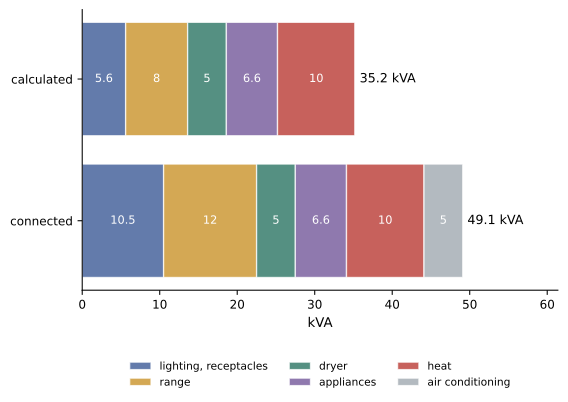
A 2,000 ft² house has a 12 kW range, a 5 kW dryer, a 4.5 kW water heater, a 1.2 kW dishwasher, a 0.9 kW disposal, 10 kW of electric heat and a 5 kVA air conditioner. Find the calculated load and minimum service size at 240 V using the standard method.
Show solution
- General lighting: 3 VA × 2,000 = 6,000 VA; small-appliance circuits 3,000 VA; laundry 1,500 VA; total 10,500 VA.
- Table 220.42 demand: 3,000 + 0.35 × 7,500 = 5,625 VA.
- Range (Table 220.55, Column C): 8,000 VA.
- Dryer: 5,000 VA.
- Fastened-in-place appliances (three, so 100 %): 4,500 + 1,200 + 900 = 6,600 VA.
- Heat versus air conditioning: the larger, 10,000 VA.
- Total: 5,625 + 8,000 + 5,000 + 6,600 + 10,000 = 35,225 VA; current 35,225 / 240 = 146.8 A.
Answer: About 147 A, so a 150 A service. Using the optional method of 220.82 for the same house gives about 26,100 VA (109 A), so a 110 A or larger service would be permitted, with a 100 A minimum service under 230.79(C).
Working method
Load calculations are long, and most errors are arithmetic or omission errors rather than misunderstandings. A reliable method is:
- List every load given in the question before starting, so none is forgotten.
- Write the code reference beside each step, which helps you apply the right demand factor.
- Keep units consistent: watts or volt-amperes, square meters or square feet.
- Apply demand factors only to the loads they cover, and in the order the code specifies.
- Check minimums: minimum calculated loads and minimum service sizes.
- Convert to current using the correct voltage, usually 240 V for single-phase dwellings, and choose the next standard size.
On the exam, write each step on scrap paper rather than relying on the calculator's memory, so that you can check quickly if your answer does not match any option.
Apartments and multi-unit buildings
For multifamily dwellings, the standard method applies the Table 220.42 demand factors to the combined lighting, small-appliance and laundry loads of all units, with Table 220.55 for ranges, Table 220.54 for dryers and 75 % for four or more fastened-in-place appliances. The optional method of 220.84 applies a single demand factor to the total connected load of three or more units, falling from 45 % for three units to 23 % for 62 or more, provided each unit meets the conditions of the rule, such as electric cooking and either electric heat or air conditioning. Because each additional unit adds little to the peak demand, the service for a 50-unit building is far smaller than 50 times one unit's load.
Non-dwelling occupancies
For non-dwelling occupancies, Table 220.12 gives general lighting loads in volt-amperes per square foot by occupancy type, such as offices, schools, stores, warehouses and hospitals, and Table 220.42 gives demand factors for some occupancies. Receptacle loads are calculated at 180 VA per outlet, with 220.44 allowing a demand factor of 50 % for receptacle loads over 10 kVA. Show-window lighting, sign circuits, motors, kitchen equipment (Table 220.56) and continuous loads at 125 % are added. Optional methods exist for schools, restaurants and existing buildings where maximum demand data are available.
Motors and air conditioning in calculations
Motors are included in feeder and service calculations at their full-load currents from the code tables, with the largest motor increased by 25 %, reflecting the conductor sizing rule for motors (Lesson 8). Air-conditioning and heat pump equipment is often rated in minimum circuit ampacity and maximum overcurrent protection on the nameplate, and these values are used directly. Heating and cooling loads that cannot run simultaneously are non-coincident, and only the larger is included, but a heat pump with supplementary electric heat may need both the compressor and the heater counted. Questions frequently test whether candidates recognize non-coincident loads.
Electric vehicle chargers and energy management
Electric vehicle supply equipment has become a major factor in dwelling and commercial calculations, because a single 48 A charger is a continuous load of about 11.5 kW, comparable to all other household loads combined. Codes generally count EV chargers at 100 % of their rating. Load management systems, also called energy management systems, can monitor total demand and reduce or interrupt EV charging or other loads to keep the total within the service capacity, and codes permit the calculated load to be based on the managed maximum when such a system is installed and set appropriately. Exam questions increasingly include EV chargers and load management.
| Load | Typical treatment in a dwelling calculation |
|---|---|
| General lighting and receptacles | Area-based allowance with demand factors |
| Range | Fixed allowance for typical sizes, more for larger ranges |
| Space heating | High demand factor; non-coincident with air conditioning |
| Air conditioning | 100 %; compare with heating |
| Water heater, dryer, other large appliances | Demand factor depends on code and number of appliances |
| EV charger | Usually 100 %, unless managed |
From calculated load to service size
The calculated load in watts or volt-amperes is divided by the system voltage to give the current: for single-phase three-wire services, divide by 240 V; for three-phase services, divide by \(\sqrt{3}\) times the line-to-line voltage. The service conductors must have an ampacity at least equal to this current, with the termination and derating rules of Lesson 3, and the service equipment rating is chosen at or above it from standard sizes, subject to the code's minimum service ratings. For a three-phase building with a calculated load of 180 kW at 208 V, for example, the current is 180,000 / (1.732 × 208) ≈ 500 A.
Checking a load calculation
After completing a load calculation, a few checks catch most errors. Confirm that every load listed in the question appears in your working. Confirm that each demand factor has been applied to the loads it covers and no others. Compare the result with typical values: most single dwellings fall between 100 and 200 A, and a result of 40 A or 600 A for a normal house suggests a mistake. Check that the minimum calculated load and minimum service size have been considered. Finally, check the voltage used to convert watts to amperes and whether the question asks for the calculated load, the conductor ampacity, or the service rating, which may be three different numbers.
Calculations for existing buildings
Adding load to an existing building, such as a heat pump, an EV charger or an addition, raises the question of whether the existing service is adequate. Codes generally allow the existing calculated load to be determined either by recalculating the whole building or, in many cases, by using measured maximum demand data from the utility or from a recording meter over a period such as a year, with the new load added. When measured data are used, codes usually add a margin, and the result must still be within the service rating. Load management systems offer another route, limiting the new load when the building's demand approaches the service capacity.
Other occupancies in exam questions
Exam questions on non-dwelling buildings commonly involve small commercial premises such as stores, offices, restaurants and schools. Typical questions give a floor area, an occupancy type, some special loads such as cooking equipment, signs, air conditioning and motors, and ask for the calculated load or the minimum service. Read the occupancy carefully, because the area-based allowance depends on it, and check whether the question describes loads that are continuous, such as store lighting, which then require the continuous-load treatment. Restaurants and schools have their own demand factors for kitchen equipment and other loads, and questions about them reward finding the right table quickly.
Practicing load calculations
Because load calculations are long and errors are costly, practice with a standard worksheet that lists each step in order. Work several dwelling calculations with different combinations of loads: with and without electric heat, with gas and electric ranges, with and without EV chargers, and with large and small floor areas. Then practice the apartment and commercial methods. Time yourself, aiming to complete a dwelling calculation in about five minutes.
Range and cooking appliance details
Cooking appliance loads often cause confusion. Codes treat a single household range differently from separate cooktops and wall ovens, and give rules for combining them, for treating several units as one range, and for ranges rated above typical sizes. Read the question carefully to see whether the cooking equipment is one range, a cooktop and oven, or several appliances, because each case uses a different step in the calculation, and a distractor will usually be the result of using the wrong one.
Common mistakes
MistakeForgetting minimum calculated loads or service sizes.
InsteadCompare with the code's minimums before choosing a size.
MistakeIncluding both heating and air conditioning.
InsteadInclude only the larger of non-coincident loads.
MistakeApplying demand factors to loads they do not cover.
InsteadApply each factor only to its specified loads.
MistakeUsing the wrong area measurement.
InsteadFollow the code's rules for which areas count.
MistakeDividing a three-phase load by the line-to-line voltage alone.
InsteadDivide by √3 × line-to-line voltage.
Summary and key terms
- Demand factors reduce connected load to a realistic calculated load.
- The standard method uses 3 VA/ft², small-appliance and laundry loads with Table 220.42 demand factors.
- Ranges use Table 220.55; dryers at least 5,000 VA; four or more appliances at 75 %.
- Heating and air conditioning are usually non-coincident.
- Multi-unit buildings apply further demand factors across units.
- EV chargers usually count at 100 % unless load is managed.
- Divide by the correct voltage, using √3 for three phase.
- Connected load
- Sum of ratings of all connected loads.
- Demand
- Maximum load actually drawn.
- Demand factor
- Ratio of maximum demand to connected load.
- Calculated load
- Load determined by the code method.
- Living area
- Floor area used for the general lighting load.
- Non-coincident loads
- Loads that do not operate at the same time.
- Basic load
- Area-based allowance for lighting and receptacles.
- Optional method
- Simplified alternative calculation method.
- Energy management system
- Control that limits total demand.
- Minimum service rating
- Smallest service permitted by the code.
Practice problems
Work each problem on paper first, then reveal the answer to check.
General lighting load for 2,400 ft²?
Show answer
7,200 VA.
Demand for 12,000 VA of lighting, small-appliance and laundry load?
Show answer
3,000 + 0.35 × 9,000 = 6,150 VA.
Range allowance for one 12 kW range (Column C)?
Show answer
8,000 VA.
Five fastened-in-place appliances totaling 10,000 VA?
Show answer
75 % = 7,500 VA.
Minimum dryer load?
Show answer
5,000 VA or nameplate if larger.
Heat 12 kW and air conditioning 6 kW: which is included?
Show answer
The heat, 12 kW (non-coincident).
Current for 30 kW at 240 V single phase?
Show answer
125 A.
Current for 150 kW at 600 V three phase?
Show answer
150,000 / (1.732 × 600) ≈ 144 A.
How is the largest motor treated in a feeder calculation?
Show answer
At 125 % of its full-load current.
How are EV chargers usually counted?
Show answer
At 100 %, unless an energy management system limits them.
Lesson quiz · 5 questions
Score 60% or more to complete this lesson.
Create a free account to save your progress, take quizzes and earn a certificate.