
ECON-101 · Lesson 5 of 12 · 27 min
Efficiency, surplus and market failure
The supply and demand model predicts prices and quantities. But economists also want to evaluate outcomes: is the market result good, and could a different allocation make people better off? This branch of economics is called welfare economics. Its central tools are consumer surplus and producer surplus, which measure the benefits buyers and sellers receive from participating in a market. With these tools we can show why competitive markets, under certain conditions, produce an efficient outcome, and we can measure precisely the losses caused by taxes, price controls, monopoly and pollution in the lessons that follow. We will also see why efficiency is not the only thing that matters, and where markets fail.
Willingness to pay and consumer surplus
Each buyer has a maximum price she is willing to pay for a good, her willingness to pay, which reflects how much she values it. If the market price is below her willingness to pay, she buys and gains the difference. Consumer surplus is the difference between what buyers are willing to pay and what they actually pay, summed over all units bought. Imagine four fans who would pay $200, $150, $120 and $90 for a concert ticket. If tickets sell for $100, the first three buy and receive surpluses of $100, $50 and $20, a total consumer surplus of $170; the fourth fan does not buy.
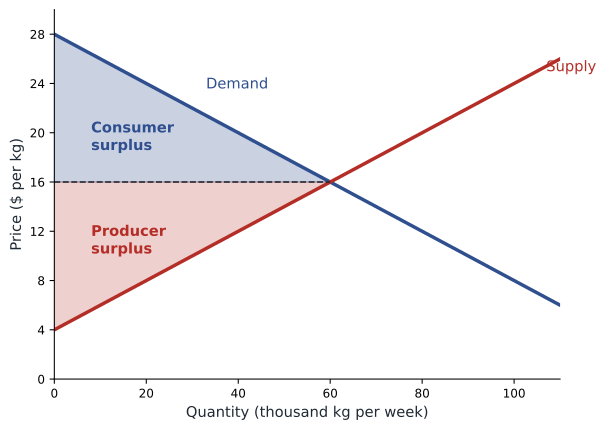
Because the demand curve shows the willingness to pay of the marginal buyer at each quantity, consumer surplus is the area below the demand curve and above the price, up to the quantity bought. When the price falls, consumer surplus rises for two reasons: existing buyers pay less, and new buyers enter the market. When the price rises, consumer surplus falls.
Cost and producer surplus
Each seller has a minimum price at which she is willing to sell, which reflects her cost of production, including the opportunity cost of her time and resources. Producer surplus is the difference between the price sellers receive and their cost, summed over all units sold. Because the supply curve shows the cost of the marginal seller at each quantity, producer surplus is the area above the supply curve and below the price. Producer surplus is closely related to, but not identical to, profit: it ignores fixed costs, which do not affect the decision to sell an extra unit.
Worked problem
Measuring surplus with linear curves
In the coffee bean market of lesson 3, demand is \( Q_d = 140 - 5P \) and supply is \( Q_s = -20 + 5P \), with equilibrium at P = $16 and Q = 60 thousand kg. Calculate consumer surplus, producer surplus and total surplus per week.
Show solution
- The demand curve meets the price axis where \( Q_d = 0 \): P = 140 ÷ 5 = $28.
- The supply curve meets the price axis where \( Q_s = 0 \): P = 20 ÷ 5 = $4.
- Consumer surplus = ½ × 60,000 kg × ($28 − $16) = $360,000.
- Producer surplus = ½ × 60,000 kg × ($16 − $4) = $360,000.
- Total surplus = $720,000 per week.
Answer: Each side gains $360,000 a week from the market. The equal split here reflects the symmetric slopes chosen for the example; in general, the side with the less elastic curve captures more of the surplus.
Market efficiency
An allocation of resources is efficient if it maximizes total surplus: there is no way to rearrange production and consumption to make someone better off without making someone else worse off, a condition called Pareto efficiency after the Italian economist Vilfredo Pareto. The competitive equilibrium has three remarkable properties. First, it allocates the good to the buyers who value it most, those whose willingness to pay exceeds the price. Second, it allocates production to the sellers who can produce at the lowest cost, those whose cost is below the price. Third, it produces the quantity that maximizes total surplus: at any smaller quantity, some buyers value an extra unit more than it costs to produce, so producing it would add surplus; at any larger quantity, the extra units cost more to produce than buyers value them.
This is a modern statement of Adam Smith's famous observation that individuals pursuing their own interest are 'led by an invisible hand' to promote the interest of society. It is one of the most important results in economics, and it underlies the general presumption among economists that markets should be left to work unless there is a specific reason to intervene. But the result depends on conditions that do not always hold, as we will see shortly.
# Total surplus is largest at the competitive quantity (coffee example)
a, b = 140, 5      # demand Qd = a - bP  -> willingness to pay P = (a - Q) / b
c, d = -20, 5      # supply Qs = c + dP  -> marginal cost  P = (Q - c) / d
def wtp(q): return (a - q) / b
def mc(q):  return (q - c) / d
def total_surplus(q, steps=6000):
    # integrate (WTP - MC) from 0 to q with the midpoint rule
    h = q / steps
    return sum((wtp((i + 0.5) * h) - mc((i + 0.5) * h)) * h for i in range(steps))
for q in [40, 50, 60, 70, 80]:
print(f"Q = {q} thousand kg: total surplus = ${total_surplus(q) * 1000:,.0f} per week")Q = 40 thousand kg: total surplus = $640,000 per week Q = 50 thousand kg: total surplus = $700,000 per week Q = 60 thousand kg: total surplus = $720,000 per week Q = 70 thousand kg: total surplus = $700,000 per week Q = 80 thousand kg: total surplus = $640,000 per week
The code confirms that total surplus peaks at the equilibrium quantity of 60 thousand kg. Producing only 40 or 50 thousand kg leaves mutually beneficial trades unmade; producing 70 or 80 thousand kg uses resources worth more than buyers value the extra coffee. The loss of total surplus relative to the efficient level is called deadweight loss, and lesson 6 uses it to measure the cost of taxes and price controls.
Efficiency and equity
Efficiency concerns the size of the economic pie; equity concerns how fairly it is divided. A competitive market may be efficient while leaving some people with very little, because the market distributes goods according to willingness to pay, which depends on income. A wealthy person's willingness to pay for a second home may exceed a poor family's willingness to pay for basic housing. Most people think that fairness matters, and judgments about what is fair are normative, as lesson 1 explained. Different principles lead to different answers: some emphasize equal outcomes, some equal opportunity, some rewards based on contribution, and some the protection of the least well off, as in the philosopher John Rawls's theory of justice.
Economists often argue that it is better to pursue equity through taxes and transfers than by interfering with prices in particular markets. Interventions in prices, such as rent control, tend to reduce the size of the pie and can be poorly targeted, helping some people who are not poor while hurting some who are. Taxes and transfers also have efficiency costs, because taxes discourage work and investment to some degree, so there is a trade-off between efficiency and equity. How much efficiency a society should sacrifice for greater equality is one of the central questions of politics, and economics can inform it but not settle it.
In the United States, the tax and transfer system also reduces measured income inequality, though by less than in most other high-income countries. Programs such as Social Security, Medicaid, the Supplemental Nutrition Assistance Program (SNAP), the Earned Income Tax Credit and the Child Tax Credit transfer income mainly to lower-income and older households, while the federal income tax is progressive. Census Bureau and Congressional Budget Office data show that the Gini coefficient of market income is much higher than that of income after taxes and transfers. ECON-102 examines income distribution and these programs in more detail.
When markets fail
The efficiency of competitive markets rests on several conditions. When one or more fails, the market outcome may not maximize total surplus, a situation called market failure. There are four main sources of market failure, each of which we study later in the course.
| Source of failure | What goes wrong | Example | Lesson |
|---|---|---|---|
| Market power | A seller restricts output to raise price | A monopoly drug patent; a dominant grocery chain in a small town | 10 and 11 |
| Externalities | Costs or benefits fall on people outside the transaction | Pollution from a factory; vaccination protecting others | 12 |
| Public goods | People can benefit without paying, so private markets underprovide | National defense; flood control; basic research | 12 |
| Information problems | One side knows more than the other | Used cars with hidden defects; insurance buyers who know their own risks | 11 and 12 |
Information problems deserve a brief introduction here. George Akerlof's 1970 paper 'The Market for Lemons' showed that when sellers of used cars know more about quality than buyers, buyers will offer only an average price; owners of good cars then withdraw from the market, the average quality falls, and the market can unravel. This is called adverse selection. A related problem is moral hazard: once insured, people may take less care, because they no longer bear the full cost of accidents. Warranties, reputations, inspections, certification, deductibles and mandatory insurance are among the private and public responses. Market failure does not automatically justify government intervention, because governments can fail too, through poor information, political pressure, regulatory capture by the industries they regulate, or unintended consequences. The practical question is always whether a particular intervention is likely to improve on the imperfect market outcome.
Worked problem
Is an intervention worthwhile?
A city estimates that subsidizing home energy audits would raise participation from 2,000 to 5,000 households a year. Each extra audit leads to retrofits that cut emissions, worth an estimated $300 a year in reduced climate and health damage for 10 years beyond the benefits households themselves receive. The subsidy costs $250 per audit for all 5,000 participants, and administration costs $150,000 a year. Ignoring discounting, does the program pass a simple cost-benefit test?
Show solution
- External benefits: 3,000 extra audits × $300 × 10 years = $9 million.
- Subsidy cost: 5,000 × $250 = $1.25 million (paid to all, including the 2,000 who would have audited anyway).
- Administration: $150,000.
- Net benefit: $9 million − $1.4 million = $7.6 million.
Answer: On these illustrative numbers, the program passes comfortably, even though 40 % of the subsidy goes to households that would have acted anyway. A real evaluation would discount future benefits and test how sensitive the result is to the damage estimate.
The limits of surplus analysis
Surplus analysis has limitations that a careful economist acknowledges. It treats a dollar of surplus the same whoever receives it, though a dollar may matter more to a poor person than a rich one. It measures value by willingness to pay, which reflects people's preferences as they are, including preferences that may be poorly informed or that people themselves regret, such as addictions. And it values things that are not traded, such as clean air or cultural heritage, only if we can estimate willingness to pay indirectly. Behavioral economics, which we touch on in lesson 7, has documented systematic departures from the rational choices that surplus analysis assumes. None of this makes the tools useless; it means they should be used with judgment and combined with other considerations.
Common mistakes
MistakeConsumer surplus is the total amount consumers spend.
InsteadIt is the difference between willingness to pay and the price actually paid.
MistakeProducer surplus equals profit.
InsteadProducer surplus ignores fixed costs; it is revenue minus the variable cost of the units sold.
MistakeEfficient means fair.
InsteadEfficiency is about maximizing total surplus; fairness concerns its distribution and involves value judgments.
MistakeAny market failure justifies government action.
InsteadIntervention is justified only if it is likely to improve on the market outcome after allowing for government failure.
MistakeProducing more is always better.
InsteadProducing beyond the competitive quantity creates deadweight loss, because extra units cost more than buyers value them.
Summary and key terms
- Willingness to pay measures value to buyers; cost measures what sellers give up.
- Consumer surplus is the area below demand and above price; producer surplus is the area above supply and below price.
- Total surplus measures the net benefit of a market.
- Competitive equilibrium maximizes total surplus: goods go to those who value them most and production to the lowest-cost sellers.
- Deadweight loss is the fall in total surplus from producing other than the efficient quantity.
- Efficiency and equity are distinct; societies face trade-offs between them.
- Markets fail because of market power, externalities, public goods and information problems.
- Interventions should be judged against government failure as well as market failure.
- Welfare economics
- The study of how the allocation of resources affects economic well-being.
- Willingness to pay
- The maximum amount a buyer will pay for a good.
- Consumer surplus
- Willingness to pay minus the price paid, summed over buyers.
- Producer surplus
- The price received minus the seller's cost, summed over sellers.
- Total surplus
- The sum of consumer and producer surplus.
- Efficiency
- An allocation that maximizes total surplus.
- Pareto efficiency
- A situation in which no one can be made better off without making someone else worse off.
- Deadweight loss
- The fall in total surplus caused by a market distortion.
- Market failure
- A situation in which a market fails to produce an efficient outcome.
- Adverse selection
- A problem in which hidden information leads to the wrong mix of participants in a market.
Practice problems
Work each problem on paper first, then reveal the answer to check.
Four buyers value a good at $50, $40, $30 and $20; the price is $25. Consumer surplus?
Show answer
$25 + $15 + $5 = $45.
Three sellers have costs of $10, $20 and $30; the price is $25. Producer surplus?
Show answer
$15 + $5 = $20.
Demand meets the price axis at $40, supply at $10, equilibrium is $25 and 300 units. Total surplus?
Show answer
½ × 300 × $15 + ½ × 300 × $15 = $4,500.
Why does producing more than the equilibrium quantity reduce total surplus?
Show answer
Extra units cost more to make than buyers value them.
State the three efficiency properties of competitive markets.
Show answer
Goods to highest-value buyers, production by lowest-cost sellers, surplus-maximizing quantity.
Why might an efficient outcome be judged unfair?
Show answer
It allocates by willingness to pay, which depends on income.
Name the four main sources of market failure.
Show answer
Market power, externalities, public goods and information problems.
Explain adverse selection in the used car market.
Show answer
Sellers know quality, buyers do not; good cars are withdrawn and average quality falls.
Give one example of government failure.
Show answer
Regulatory capture, poor information or political pressure leading to costly rules.
Portfolio task: identify a market you use where information problems matter and describe how buyers or sellers deal with them.
Show answer
Answers vary; should mention reputation, warranties, reviews or regulation.
Lesson quiz · 5 questions
Score 60% or more to complete this lesson.
Create a free account to save your progress, take quizzes and earn a certificate.