
ECON-101 · Lesson 11 of 12 · 25 min
Oligopoly, monopolistic competition and competition policy
Most real industries fall between perfect competition and monopoly. A few large firms dominate grocery retailing, wireless telecommunications, airlines, banking and soft drinks; many small firms with slightly different products compete in restaurants, hair salons, clothing and apps. This lesson studies these imperfectly competitive markets. Monopolistic competition describes many firms selling differentiated products with free entry. Oligopoly describes a few interdependent firms, whose behavior we analyze with game theory. The lesson ends with competition policy, the laws and agencies that try to keep markets competitive, and compares the Canadian and US approaches.
Monopolistic competition
A monopolistically competitive market has many sellers, differentiated products and free entry and exit. Each firm's product is slightly different, through location, quality, style, brand or service, so each firm faces a downward-sloping demand curve and has a little market power: a café can raise its price slightly without losing every customer, because some prefer its coffee or its location. But because there are many close substitutes and entry is easy, the demand facing each firm is quite elastic.
In the short run, a monopolistically competitive firm behaves like a small monopolist: it produces where MR = MC and charges the price on its demand curve, possibly earning economic profits. In the long run, those profits attract entry: new cafés open nearby, taking customers and shifting each existing firm's demand curve to the left until economic profits fall to zero. In long-run equilibrium, price equals average total cost, as in perfect competition, but price still exceeds marginal cost, and firms produce at less than the output that minimizes average total cost. Economists call this excess capacity: there are more cafés than would minimize the cost of coffee.
Is this wasteful? Partly, but consumers also value variety. The higher average cost is the price of having many different products and convenient locations to choose from. Firms in monopolistic competition spend heavily on product differentiation and advertising. Advertising can inform consumers about prices, products and new entrants, which promotes competition; it can also create brand loyalty that reduces the elasticity of demand and supports higher prices. The evidence is mixed: studies of eyeglasses and pharmaceuticals found that bans on price advertising led to higher prices, suggesting that advertising often makes markets more competitive.
Oligopoly and interdependence
An oligopoly is a market dominated by a few firms. Its defining feature is interdependence: each firm's best decision depends on what the others do. If one wireless carrier cuts its prices, the others must decide whether to match; if one airline adds a route, its rivals must respond. Oligopolies arise where there are large economies of scale relative to the market, high entry costs, network effects or government restrictions on entry. Industries are often described by their concentration: the share of sales held by the largest firms.
Economists commonly measure concentration with the Herfindahl–Hirschman index (HHI), the sum of the squared market shares of all firms, using shares in percentage points. A monopoly has an HHI of 10,000; a market with many tiny firms has an HHI close to zero. Competition authorities use the HHI to screen mergers.
# Herfindahl-Hirschman index before and after a hypothetical merger (illustrative shares, %)
shares = {"A": 30, "B": 25, "C": 20, "D": 15, "E": 10}
def hhi(s): return sum(v ** 2 for v in s.values())
before = hhi(shares)
merged = dict(shares); merged["C+D"] = merged.pop("C") + merged.pop("D")
after = hhi(merged)
print("HHI before merger:", before)
print("HHI after C and D merge:", after, " change:", after - before)
print("change = 2 x share_C x share_D =", 2 * shares["C"] * shares["D"])
print("highly concentrated (above 1,800)?", after > 1800, "| increase above 100?", after - before > 100)HHI before merger: 2250 HHI after C and D merge: 2850 change: 600 change = 2 x share_C x share_D = 600 highly concentrated (above 1,800)? True | increase above 100? True
The output shows a useful shortcut: the change in HHI from merging two firms equals twice the product of their shares. Here the merger raises the HHI by 600 points to 2,850, well above the thresholds that competition authorities treat as raising serious concern.
Game theory and the prisoner's dilemma
Game theory, developed by John von Neumann, Oskar Morgenstern and John Nash, studies strategic situations in which each player's outcome depends on the choices of others. The most famous game is the prisoner's dilemma. Two suspects are questioned separately. If both stay silent, each gets one year in prison on a minor charge. If one confesses and the other stays silent, the confessor goes free and the other gets ten years. If both confess, each gets five years. Whatever the other suspect does, each is better off confessing: if the other stays silent, confessing means freedom instead of one year; if the other confesses, confessing means five years instead of ten. Confessing is a dominant strategy, and both confess, even though both would be better off staying silent.
Oligopolists face the same dilemma. Consider two firms deciding whether to charge a high price or a low price. If both charge high, each earns a large profit; if one cuts its price, it steals customers and earns even more, while the other suffers; if both cut, each earns a modest profit. The outcome where each firm chooses its best response to the other's choice is a Nash equilibrium. In the classic version, the Nash equilibrium is for both to charge the low price, even though joint profits would be higher if both charged high.
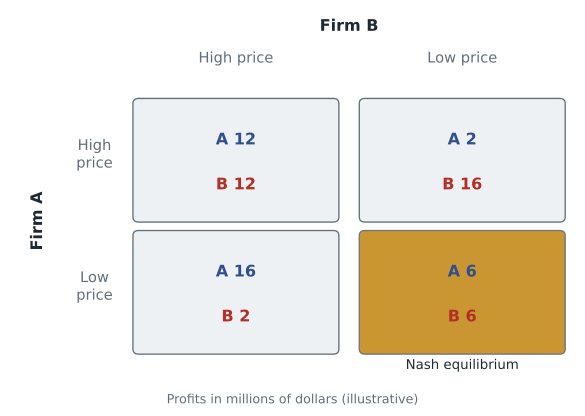
# Find Nash equilibria in a two-firm pricing game by checking best responses
# payoffs[(a_choice, b_choice)] = (profit_A, profit_B) in $ millions (illustrative)
payoffs = {("high", "high"): (12, 12), ("high", "low"): (2, 16),
           ("low", "high"): (16, 2), ("low", "low"): (6, 6)}
choices = ["high", "low"]
for a in choices:
    for b in choices:
        best_a = all(payoffs[(a, b)][0] >= payoffs[(x, b)][0] for x in choices)
        best_b = all(payoffs[(a, b)][1] >= payoffs[(a, y)][1] for y in choices)
        tag = "Nash equilibrium" if best_a and best_b else ""
        print(f"A {a:4} / B {b:4}: profits {payoffs[(a, b)]} {tag}")
print("joint profit if both high:", sum(payoffs[("high", "high")]), "vs both low:", sum(payoffs[("low", "low")]))A high / B high: profits (12, 12) A high / B low : profits (2, 16) A low / B high: profits (16, 2) A low / B low : profits (6, 6) Nash equilibrium joint profit if both high: 24 vs both low: 12
Collusion, cartels and repeated games
Firms in an oligopoly have a strong incentive to escape the dilemma by colluding: agreeing to keep prices high or to divide markets, behaving together like a monopolist. A formal agreement among firms is a cartel. The Organization of the Petroleum Exporting Countries (OPEC) is the best-known international example. Cartels are unstable for the reason the prisoner's dilemma predicts: each member can gain by secretly cheating, selling more at slightly below the agreed price. In most countries, agreements among competitors to fix prices, rig bids or allocate markets are criminal offenses.
Yet collusion can persist, because firms interact repeatedly. In a repeated game, a firm that cheats today can be punished tomorrow, for example by a price war. Strategies such as tit-for-tat, which cooperates at first and then copies the rival's previous move, can sustain cooperation. Tacit collusion, where firms coordinate on high prices without an explicit agreement, for example by following a price leader, is generally legal but hard to distinguish from normal competitive behavior. Competition authorities increasingly worry that pricing algorithms used by many firms may facilitate tacit collusion.
US antitrust history includes many cartels. In the 1990s, Archer Daniels Midland and other firms were convicted of fixing the price of lysine, a feed additive, a case later dramatized in the film The Informant!. More recently, the Department of Justice has prosecuted bid-rigging and wage-fixing conspiracies and pursued cases against algorithmic pricing services alleged to facilitate collusion among landlords. In the broiler chicken industry, producers have paid hundreds of millions of dollars to settle price-fixing class actions.
Other models of oligopoly
Game theory is not the only way to model oligopoly. In the Cournot model, firms choose quantities, and the equilibrium price lies between the monopoly and competitive prices, falling as the number of firms rises. In the Bertrand model, firms selling identical products choose prices, and competition between even two firms can drive the price down to marginal cost. In practice, outcomes depend on whether products are differentiated, whether capacity is limited and how easily firms can monitor each other. A general lesson is that more firms, easier entry and greater transparency for buyers tend to produce lower prices, while transparency among sellers can make collusion easier.
Competition policy
Competition policy, called antitrust policy in the United States, aims to protect competition through three main tools: prohibiting cartels and other agreements that restrain competition, preventing the abuse of dominant positions, and reviewing mergers that could substantially lessen competition. Both countries have strong laws, but their institutions and recent histories differ.
In the United States, the Sherman Act (1890) prohibits agreements in restraint of trade (section 1) and monopolization (section 2); the Clayton Act (1914) addresses mergers and certain practices; and the Federal Trade Commission Act prohibits unfair methods of competition. Enforcement is shared by the Department of Justice's Antitrust Division and the Federal Trade Commission, and private parties can sue for triple damages. The 2023 Merger Guidelines treat a merger that produces a market with an HHI above 1,800 and an increase of more than 100 as presumptively anti-competitive. In a landmark case, a federal court ruled in August 2024 that Google had illegally maintained a monopoly in online search; in September 2025 the court ordered remedies, including limits on exclusive contracts and data sharing with rivals, but declined to order the sale of the Chrome browser. Cases against other large technology platforms continue.
Worked problem
Screening a merger
Four wireless carriers have market shares of 35 %, 30 %, 25 % and 10 %. The second and fourth carriers propose to merge. Calculate the HHI before and after and the change, and say whether the merger would raise concern under a 1,800/100 threshold.
Show solution
- HHI before = 35² + 30² + 25² + 10² = 1,225 + 900 + 625 + 100 = 2,850.
- After the merger the shares are 40, 35 and 25: HHI = 1,600 + 1,225 + 625 = 3,450.
- Change = 3,450 − 2,850 = 600 (= 2 × 30 × 10).
Answer: The post-merger HHI of 3,450 and increase of 600 far exceed the thresholds, so the merger would face close scrutiny. Authorities would also consider entry barriers, efficiencies, whether the smaller carrier had been a disruptive maverick and whether remedies such as selling spectrum or customers could preserve competition.
| Market structure | Number of firms | Product | Entry | Long-run price vs MC | Example |
|---|---|---|---|---|---|
| Perfect competition | Many | Identical | Free | P = MC | Wheat |
| Monopolistic competition | Many | Differentiated | Free | P > MC, zero profit | Restaurants |
| Oligopoly | Few | Identical or differentiated | Restricted | P > MC, profit possible | Wireless carriers |
| Monopoly | One | Unique | Blocked | P > MC, profit possible | Local water utility |
Common mistakes
MistakeMonopolistically competitive firms earn long-run economic profits.
InsteadFree entry drives economic profit to zero, although price still exceeds marginal cost.
MistakeIn a prisoner's dilemma, the players choose the outcome that is best for both.
InsteadEach player's dominant strategy leads to an outcome worse for both than cooperation.
MistakeCartels are stable because members benefit from high prices.
InsteadEach member gains by cheating, which makes cartels unstable without enforcement or repeated interaction.
MistakeA high HHI proves that firms are colluding.
InsteadConcentration makes collusion easier but does not prove it; authorities look for evidence of agreements or harm.
MistakeAll advertising raises prices.
InsteadInformative advertising often increases competition and lowers prices.
Summary and key terms
- Monopolistic competition combines many firms, differentiated products and free entry; long-run profit is zero but P > MC, with excess capacity.
- Oligopoly is defined by interdependence among a few firms.
- The HHI sums squared market shares; a merger raises it by twice the product of the merging firms' shares.
- The prisoner's dilemma shows why individually rational choices can produce outcomes worse for all.
- A Nash equilibrium is a set of strategies where each player's choice is a best response to the others.
- Cartels raise prices but are unstable; repeated interaction can sustain tacit collusion.
- Competition law prohibits cartels, abuse of dominance and anti-competitive mergers.
- Canada strengthened its Competition Act in 2022–2024; US antitrust rests on the Sherman, Clayton and FTC Acts.
- Monopolistic competition
- A market with many firms selling differentiated products and free entry.
- Excess capacity
- Producing less than the output that minimizes average total cost.
- Oligopoly
- A market dominated by a few interdependent firms.
- Herfindahl–Hirschman index
- The sum of squared market shares, a measure of concentration.
- Game theory
- The study of strategic interaction among decision makers.
- Dominant strategy
- A strategy that is best whatever the other players do.
- Nash equilibrium
- An outcome in which each player's strategy is the best response to the others' strategies.
- Cartel
- A group of firms that agree to coordinate prices or output.
- Tacit collusion
- Coordination of behavior without an explicit agreement.
- Competition policy
- Laws and enforcement that protect competition in markets.
Practice problems
Work each problem on paper first, then reveal the answer to check.
Why does a café face a downward-sloping demand curve?
Show answer
Its product is differentiated by location, quality or brand, so it has some market power.
What happens to a monopolistically competitive firm's demand when rivals enter?
Show answer
It shifts left until economic profit is zero.
Market shares are 40, 30, 20 and 10. HHI?
Show answer
1,600 + 900 + 400 + 100 = 3,000.
The firms with 20 % and 10 % merge. Change in HHI?
Show answer
2 × 20 × 10 = 400.
Define a dominant strategy.
Show answer
A strategy that is best whatever the other player does.
In the pricing game, why is low-low the Nash equilibrium?
Show answer
Each firm earns more by pricing low whatever the other does.
Why are cartels unstable?
Show answer
Each member can gain by secretly undercutting the agreed price.
How can repeated interaction sustain cooperation?
Show answer
Cheating can be punished in future rounds, for example with tit-for-tat.
Name the three main tools of competition policy.
Show answer
Prohibiting cartels, preventing abuse of dominance and reviewing mergers.
Portfolio task: choose a concentrated industry in your country, estimate its HHI from published market shares and discuss whether competition is effective.
Show answer
Answers vary; should calculate an HHI and discuss entry and pricing.
Lesson quiz · 5 questions
Score 60% or more to complete this lesson.
Create a free account to save your progress, take quizzes and earn a certificate.