
DCT-340 · Lesson 8 of 12 · 21 min
Communicating with customers and leadership during an incident
In every incident there are two jobs. One is fixing the problem. The other is telling the people who depend on the facility what is happening, so that they can protect their own services, make their own decisions and trust the people running the building. Tenants judge an operator at least as much by how it communicates in an incident as by the incident itself. A short outage handled with prompt, honest, regular updates can strengthen a relationship; a smaller one handled with silence and vague answers can end it. This lesson is about the communication job: who must be told, when, what a good message says and what it must never say.
Who needs to know
The communications lead of Lesson 7, often the shift lead himself in a small incident, works from a notification list in each EOP and in the incident procedure. The list depends on what is affected.
- Affected tenants, through the contacts their contracts name, usually an on-call engineer and a manager. Corvid AI's contract, for example, requires notification of any severity 1 or 2 incident in Hall D within 15 minutes of declaration.
- Tenants who are not affected but could be, if the incident threatens shared systems such as a generator block or a chilled-water plant.
- Stonebridge leadership: the site manager, and for severity 1 the operations director and, depending on the impact, the account managers who look after the tenants commercially.
- Internal teams: security, the network operations team, other shifts and the campus maintenance planner.
- Outside parties when the situation requires: the fire department, the utility, the environmental regulator if a spill reaches drains or soil, the police for a security incident, and insurers.
The notification list is not a place to improvise during the event. The contacts and their order are set in advance, tested in drills and kept current, so that the communications lead makes calls rather than looking up numbers. In the drill of Lesson 6, the missing tenant numbers cost six minutes; after the drill they were added to the EOP.
When to tell them
Timing has two parts: the first notice and the rhythm of updates. Stonebridge's standard, written into its tenant contracts, is a first notice within 15 minutes of declaring a severity 1 or 2 incident and within an hour for severity 3 incidents that affect a tenant. Updates follow on a fixed rhythm, every 30 minutes for severity 1 and every 60 minutes for severity 2, until the incident is resolved, whether or not there is anything new to say. A final notice confirms resolution, and a written report follows.
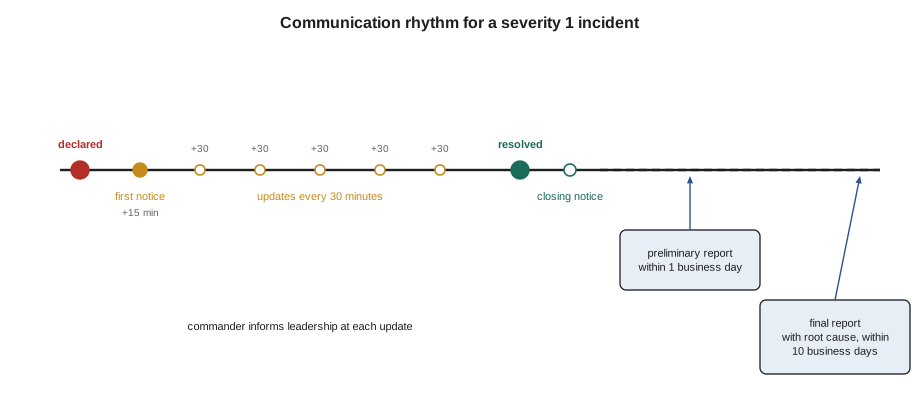
The fixed rhythm matters more than it seems. People waiting for news assume the worst when none comes. An update that says the situation is unchanged, the electrician is twenty minutes away and the next update will be at 15:00 is far better than silence, because it tells the tenant that someone is in control and when to look again. It also protects the incident team: tenants who know when the next update is coming do not keep calling the operations center for news.
Speed of the first notice matters too. Tenants often see problems on their own monitoring before the operator tells them, and the first call they get should not come from their own engineers asking what is happening. Stonebridge's rule is that the first notice goes out when the incident is declared and its effect is roughly known, even if almost nothing is known about the cause. A first notice can be very short.
What a good message says
Every incident message at Stonebridge has the same four parts, in this order.
- What is happening: the facts, in plain language, without guessing at causes.
- What it means for the reader: which services, halls, cabinets or circuits are affected and how.
- What is being done: the actions under way and any action the reader may want to take.
- When the next update will come, and who to contact in the meantime.
The parts are simple, but writing them under pressure is not, so Stonebridge keeps templates for each type of incident. The communications lead fills in the facts and sends it. Templates also protect against the most common mistakes, by leaving out the places where they creep in.
# Fill an incident notification from a template, so every message has the same four parts
template = (
    "INCIDENT {ref} - severity {sev} - update {n}\n"
    "What is happening: {what}\n"
    "Effect on you: {effect}\n"
    "What we are doing: {doing}\n"
    "Next update: {next_update}, or sooner if anything changes. Contact: operations center, {phone}."
)
facts = {
    "ref": "IAD3-2027-0219", "sev": 2, "n": 1,
    "what": "At 14:12 the main breaker of power panel RPP-A2-08 opened. The A-side feed to 14 cabinets in cage A-26 is off.",
    "effect": "All 14 cabinets are running on their B-side feed, which is normal and within capacity. "
              "One single-corded device in A-26-05 has lost power.",
    "doing": "An electrician is on the way to find the cause before the breaker is closed. All planned work on the B side is stopped.",
    "next_update": "15:15",
    "phone": "the number on your access card",
}
msg = template.format(**facts)
print(msg)
missing = [k for k in ("what", "effect", "doing", "next_update") if not facts.get(k)]
print()
print("ready to send" if not missing else f"missing parts: {missing}")INCIDENT IAD3-2027-0219 - severity 2 - update 1 What is happening: At 14:12 the main breaker of power panel RPP-A2-08 opened. The A-side feed to 14 cabinets in cage A-26 is off. Effect on you: All 14 cabinets are running on their B-side feed, which is normal and within capacity. One single-corded device in A-26-05 has lost power. What we are doing: An electrician is on the way to find the cause before the breaker is closed. All planned work on the B side is stopped. Next update: 15:15, or sooner if anything changes. Contact: operations center, the number on your access card. ready to send
This was Dmitri's first notice to Halvorsen Logistics in the breaker incident of Lesson 7, sent at 14:25, ten minutes after declaration. It says nothing about the cause, which was not yet known, and makes no promise about when the A side would return. It gives the customer what they need: their equipment is running on one feed, one device is down, someone is dealing with it, and they will hear again within the hour.
What a message must not say
Some things do not belong in incident messages, however tempting they are.
- Guesses about the cause. Early theories are often wrong, and a wrong cause in writing is hard to take back. Say what is known; the cause comes in the report.
- Blame. Never name an individual, a vendor or a tenant as at fault during an incident, even when it seems obvious. In the breaker incident the damaged cord belonged to the customer's own power strip, but saying so in an update would have been premature, unkind and, as it turned out, not the whole story.
- Promises without a basis. A time for recovery should be given only when the people doing the work can support it, and then as an estimate. Missing a promised time is worse than not giving one.
- Reassurance that is not true. Do not say the load is protected if it is running on a single path; say it is running on the B side, which is normal, and that redundancy is not available until the A side is restored.
- Information about other tenants. A tenant is told about its own equipment and about shared systems, never about another tenant's equipment, names or problems.
- Sensitive security details. A security incident is described in terms of its effect and the response, not how access was gained, which would help the next intruder.
Jargon also gets in the way. The people reading an incident message may be managers, not engineers, and they may be reading it on a phone at 03:00. Static bypass and RPP mean little to them. Words such as running on backup power, cooling capacity is reduced or one of two power feeds is off work for everyone, with the technical detail available to engineers who ask.
One voice
During an incident, only the communications lead and the incident commander speak for Stonebridge to tenants and leadership. Technicians on the floor will often meet tenant staff, and Corvid AI's site engineers in particular spend their days in Hall D. When a tenant asks a technician during an incident what is going on, the right answer is friendly and short: here is what I can see, the shift lead is running this and the updates are coming from the operations center, here is the number. The reason is not secrecy. A technician sees one part of the incident; a remark about what he thinks caused it, or how long it will take, can reach the tenant's management as the operator's official view and contradict what the commander has said.
The same rule applies to social media, the press and anyone outside the company. Stonebridge's policy is that nobody on site comments on an incident outside the company, and any press enquiry is passed to the communications team at head office. Large outages at well-known data centers do get reported, and a careless post by an employee can become the headline.
Talking to leadership
Leadership needs different things from tenants. The site manager and the operations director need to understand the risk, the decisions being made and any decision that needs their authority: approving an emergency purchase, accepting a risk, deciding whether to bring in more people, telling a large tenant's executives. A leadership update is short and structured: the current state, the risk to the load, what has been decided, what needs their decision, and when they will hear next. Anjali's standing request to her shift leads is: tell me early, tell me straight, and tell me what you need.
Worked problem
A first call to the site manager
At 02:52 on a Sunday a severity 1 incident is declared when a chilled-water leak is found under the floor of Hall A, near a floor distribution unit. Dmitri, as commander, calls Anjali at home.
Show solution
- He starts with the state: a leak under the floor in row 4 of Hall A, about a meter from PDU-A2-04, nobody hurt, the area is clear of people.
- Then the risk: if water reaches the unit, the A side of rows 3 to 5 could be lost; the B side is normal.
- Then what has been decided: the section valves for loop A-3 have been closed under the EOP, the other loop is carrying the cooling, the leak is slowing, and the B side has been confirmed normal with work frozen.
- Then what he needs: approval to call out the mechanical contractor for an emergency repair, and a decision on whether to notify all Hall A tenants now or only those in rows 3 to 5.
- Finally, the next call: in 30 minutes, or sooner if water reaches the unit.
Answer: In under two minutes Anjali had the picture, gave both approvals and chose to tell every tenant in the hall, since a loss of the A side could affect the whole row. Lesson 12 follows this incident to its end.
The bridge and the channel
In a large incident, coordination moves to two places: a conference call, called the bridge, which the commander runs and the key people join, and a written channel in the operations team's messaging system where the scribe posts the timeline and decisions. Tenants with large footprints, such as Corvid AI and the cloud provider, may be invited to a separate customer bridge run by the communications lead. Keeping the internal bridge and the customer bridge separate lets the team talk freely about options and uncertainties while the customers receive a clear, agreed picture.
After the incident
Communication does not end with the closing notice. Stonebridge sends affected tenants a preliminary incident report within one business day of a severity 1 or 2 incident, summarizing the timeline, the impact and the immediate actions, and stating that the root cause analysis is under way. A final report follows within ten business days, with the root cause, the contributing factors and the corrective actions, as Lessons 9 and 10 describe. Large tenants often ask for a meeting to go through it. These reports are written carefully and reviewed by the site manager, because they become part of the record of the relationship and sometimes part of a contract discussion about service credits.
# Update schedule for an incident: first notice and regular updates until resolution
from datetime import datetime, timedelta
declared = datetime(2027, 4, 11, 2, 52)
resolved = datetime(2027, 4, 11, 6, 52)
rules = {1: (15, 30), 2: (15, 60), 3: (60, 120)}   # severity: (first notice within, update every) minutes
sev = 1
first, every = rules[sev]
t = declared + timedelta(minutes=first)
times = [("first notice by", t)]
while t + timedelta(minutes=every) < resolved:
    t += timedelta(minutes=every)
    times.append(("update", t))
times.append(("resolution notice", resolved))
for what, when in times:
    print(f"{when:%H:%M}  {what}")
print(f"{len(times)} messages; preliminary report due next business day, final report within 10 business days")03:07 first notice by 03:37 update 04:07 update 04:37 update 05:07 update 05:37 update 06:07 update 06:37 update 06:52 resolution notice 9 messages; preliminary report due next business day, final report within 10 business days
For the Hall A leak, the rhythm means nine messages to tenants between the first notice at 03:07 and the resolution notice. Writing them is a real job, which is why the communications lead in a severity 1 incident is a separate person, not the commander.
Common mistakes
MistakeWaiting until the cause is known before sending the first notice
InsteadSend a short first notice as soon as the incident is declared and its effect is roughly known
MistakeSkipping an update because nothing has changed
InsteadSend every update on schedule; unchanged is news
MistakeGuessing at the cause or naming who is at fault
InsteadState facts and effects; the cause and contributing factors go in the report
MistakeAnswering a tenant's questions on the floor with your own theory
InsteadSay what you can see, explain who is running it and point to the official updates
MistakeUsing jargon in messages for managers
InsteadWrite in plain language and keep the technical detail for engineers who ask
Summary and key terms
- Communicating is half of incident response; tenants judge the operator by it.
- Notification lists are set in advance in each EOP and include tenants, leadership, internal teams and outside parties.
- First notices go out within 15 minutes of a severity 1 or 2 declaration, with updates on a fixed rhythm until resolution.
- Every message says what is happening, the effect on the reader, what is being done and when the next update comes.
- Messages never guess at causes, assign blame, promise without basis, reassure falsely or mention other tenants.
- One voice speaks for the operator; preliminary and final reports follow the incident.
- Communications lead
- The person who sends incident messages to tenants and leadership on schedule.
- First notice
- The first message to affected parties after an incident is declared.
- Update rhythm
- The fixed interval at which incident updates are sent until resolution.
- Bridge
- A conference call used to coordinate a large incident.
- Preliminary incident report
- A short report sent soon after an incident with the timeline, impact and immediate actions.
- Final incident report
- The report with the root cause, contributing factors and corrective actions.
- Notification list
- The prepared list of who to tell about an incident, and in what order.
Practice problems
Work each problem on paper first, then reveal the answer to check.
Name the four parts of every Stonebridge incident message.
Show answer
What is happening, the effect on the reader, what is being done and when the next update comes.
A tenant asks a technician on the floor what caused the outage. How should he answer?
Show answer
Say what he can see, explain the shift lead is running it and point to the official updates and contact number.
Why send an update when nothing has changed?
Show answer
Silence makes people assume the worst; a scheduled update shows the incident is under control.
Give two things that must never go in an incident message.
Show answer
Any two of: guesses about cause, blame, unsupported promises, false reassurance, other tenants' information, sensitive security details.
Lesson quiz · 5 questions
Score 60% or more to complete this lesson.
Create a free account to save your progress, take quizzes and earn a certificate.