
DCT-340 · Lesson 10 of 12 · 20 min
Learning from incidents: corrective actions and lessons learned
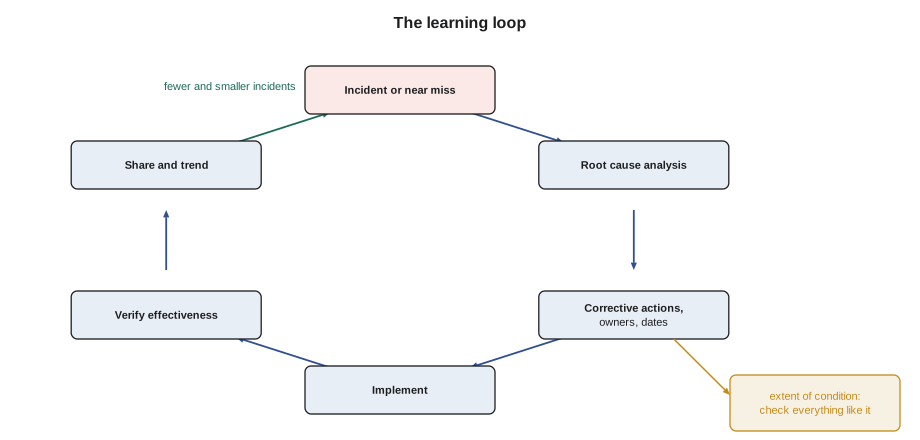
A root cause analysis that ends in a report has done half its job. The other half is making the changes that stop the incident happening again, checking that they worked and making sure the rest of the organization learns from them. Many facilities are good at the first half and weak at the second: the report is written, the actions are agreed, and a year later half of them are still open and the same kind of incident happens on another campus. This lesson is about closing the loop. It follows the corrective actions from the breaker incident of Lessons 7 and 9 and looks at how Stonebridge turns incidents, near misses and drills into lasting improvement.
Correction, corrective action and preventive action
Three words are often confused. A correction fixes the immediate problem: the crushed cord is replaced and the breaker's settings are corrected. A corrective action removes a cause so that the problem does not recur: the procedure is rewritten so that settings are always applied. A preventive action removes the cause of a problem that has not happened yet but could: checking every other trip unit on both campuses for the same mistake before any of them fails. Quality management systems often combine the last two under the name corrective and preventive action, or CAPA. The distinction matters because a list made only of corrections looks like progress and changes nothing.
Strong and weak actions
Not all actions are equally effective. Safety and quality professionals rank them by how much they depend on people remembering to do the right thing. The strongest actions change the design or the equipment so that the error cannot happen or cannot cause harm. Next come engineering controls and automation that catch the error. Then come changes to procedures, checklists and hold points. Weakest are training, warnings and reminders, which rely entirely on memory and attention. Weak actions have their place, but a corrective action list made only of them, such as remind staff to check settings, will not stop a determined recurrence.
| Strength | Kind of action | Example from the breaker incident |
|---|---|---|
| Strongest | Change the design so the error cannot happen or cannot harm | Specify trip units that ship locked to settings loaded from the coordination study |
| Strong | Automate the check or make the error visible | Read every trip unit's settings into the power monitoring system and alarm on any difference from the study |
| Moderate | Change the procedure: steps, checklists, hold points | Add a settings step and a signed hold point to the trip unit MOP template |
| Weak | Training, warnings, reminders | Brief all electricians and technicians on the incident |
In practice, the strongest actions are often expensive or slow, so a good list combines them: a moderate action that can be done this week, a stronger one planned for the next budget, and the briefing that helps people understand why the procedure changed.
Writing a corrective action
Each corrective action at Stonebridge is written so that anyone can tell when it is done. It names one specific change, one owner who is a named role, a due date, and the evidence that will show it is complete. It is linked to the cause it addresses. Remind the team to be careful is not a corrective action. Revise MOP template EL-07 to add a step to load and photograph the coordination settings, with a hold point signed by the shift lead, owner: operations engineer, due 30 April, evidence: revised template issued, is.
For the breaker incident, the RCA team agreed seven actions.
| No. | Action | Kind | Owner | Due |
|---|---|---|---|---|
| 1 | Apply the coordination study settings to the RPP-A2-08 main trip unit and record them | Correction | Electrical contractor | Done during the incident follow-up |
| 2 | Check the settings of every trip unit replaced in the last five years on both campuses | Preventive (extent of condition) | Operations engineer | 4 weeks |
| 3 | Revise the trip unit MOP template to add a settings step and signed hold point | Corrective | Operations engineer | 3 weeks |
| 4 | Add a check of trip unit settings against the study to the annual breaker test program | Corrective | Maintenance planner | Next program review |
| 5 | Read trip unit settings into the power monitoring system and alarm on differences | Corrective (strong) | Controls engineer | Next budget year |
| 6 | Add cord routing clear of doors to the tenant equipment installation checklist | Corrective | Shift leads | 2 weeks |
| 7 | Offer the customer a rack transfer switch for the single-corded storage controller | Contributing factor | Account manager | 2 weeks |
Extent of condition
Action 2 is one of the most important ideas in this lesson. When an incident reveals a weakness in one piece of equipment, the first question after the RCA is: where else does the same weakness exist? This is called the extent of condition. The trip unit on RPP-A2-08 was wrong because of how it was replaced. Every trip unit replaced the same way could be wrong too, and each one is a future incident waiting for its trigger.
Worked problem
Checking everything like it
The operations engineer pulls the work orders for every circuit breaker trip unit replaced on both campuses in the past five years, and the contractor reads the settings of each against the coordination study.
Show solution
- The work order search finds 19 trip units replaced: 11 at IAD-3 and 8 at the other campus.
- Jamal goes with the contractor's engineer on the IAD-3 readings, escorting him in the electrical rooms; each reading is done through the trip unit's front port without opening the panel.
- Sixteen units match the study. Three do not: one more panel in Hall A and two at the other campus, all replaced under the same MOP template, all still at factory defaults.
- The three are corrected within the week under methods of procedure, and the findings are added to the incident's record.
Answer: Three more panels had the same hidden weakness. Without the extent-of-condition check, each would have waited for its own branch fault, and each would have become its own incident.
Verifying effectiveness
An action is closed when it is done; it has worked only when the evidence shows the problem has stopped. Stonebridge separates the two. Each corrective action is closed when its evidence is provided, and the RCA as a whole is reviewed again after a set period, usually six months, to check that the actions have had the intended effect. For the breaker incident, the six-month review checks that the revised MOP has been used for every trip unit job since, that the settings records exist, that the annual test program now includes the check, and that no further mis-set units have been found. If an action has not worked, a new one is raised.
# Corrective action tracker: status, overdue items and effectiveness checks
from datetime import date
today = date(2027, 6, 15)
actions = [  # no, action, due, closed, effectiveness verified
    (1, "apply settings to RPP-A2-08", date(2027, 3, 1), date(2027, 2, 24), True),
    (2, "check all replaced trip units (both campuses)", date(2027, 3, 29), date(2027, 3, 22), True),
    (3, "revise trip unit MOP template", date(2027, 3, 22), date(2027, 3, 19), False),
    (4, "settings check in annual breaker tests", date(2027, 5, 31), None, False),
    (5, "monitor trip unit settings and alarm", date(2028, 3, 31), None, False),
    (6, "cord routing in install checklist", date(2027, 3, 15), date(2027, 3, 11), False),
    (7, "offer transfer switch to customer", date(2027, 3, 15), date(2027, 3, 9), True),
]
open_ = [a for a in actions if a[3] is None]
overdue = [a for a in open_ if a[2] < today]
on_time = sum(1 for a in actions if a[3] is not None and a[3] <= a[2])
print(f"{len(actions)} actions: {len(actions) - len(open_)} closed ({on_time} on time), {len(open_)} open, {len(overdue)} overdue")
for no, what, due, closed, eff in actions:
    state = ("closed " + closed.isoformat()) if closed else ("OVERDUE" if due < today else "open, due " + due.isoformat())
    check = "effective" if eff else ("check due" if closed else "")
print(f" {no}. {what:46} {state:22} {check}")7 actions: 5 closed (5 on time), 2 open, 1 overdue 1. apply settings to RPP-A2-08 closed 2027-02-24 effective 2. check all replaced trip units (both campuses) closed 2027-03-22 effective 3. revise trip unit MOP template closed 2027-03-19 check due 4. settings check in annual breaker tests OVERDUE 5. monitor trip unit settings and alarm open, due 2028-03-31 6. cord routing in install checklist closed 2027-03-11 check due 7. offer transfer switch to customer closed 2027-03-09 effective
Action 4 is overdue: the program review it depended on was postponed, and Morgan has escalated it to Anjali. Action 5 is open but not overdue; it is a budget item for next year. Actions 3 and 6 are closed but their effectiveness has not yet been verified, which will happen at the six-month review. The tracker is reviewed every month at the operations meeting, and overdue actions are reported to the operations director.
Near misses
An incident is expensive to learn from. A near miss, an event that could have caused harm or an outage but did not, teaches the same lessons for free. The CRAH unit almost stopped in Lesson 3's vendor example, the out-of-date placard in Lesson 6's drill and the leftover maintenance mode in Lesson 4 are all near misses. Industry experience, going back to studies of workplace accidents decades ago, is that for every serious incident there are many minor ones and many more near misses with the same causes. A facility that collects and studies its near misses can fix the causes before they produce the serious event.
Stonebridge asks every employee and contractor to report near misses through a short form in the shift log, and reports them in the monthly operations review. The form asks four questions: what happened, what could have happened, why it did not, and what would stop it happening again. Reports are blameless in the same way as RCA: nobody is disciplined for reporting a near miss, even one they caused, unless they deliberately broke a safety rule. Anjali counts the number of near-miss reports as a good sign, not a bad one. A site with no near-miss reports does not have no near misses; it has people who do not report them.
Sharing and trending
Lessons learned on one campus are of little use if the other campus repeats the mistake. Stonebridge shares the summary of every severity 1 and 2 RCA, and of selected near misses, with both campuses and its other sites, in a monthly lessons-learned bulletin and at the quarterly operations meeting. The breaker incident's extent-of-condition check across both campuses was itself a product of this sharing. Some lessons go further: Stonebridge contributes anonymized summaries to an industry incident-sharing group, because the same weaknesses appear across many operators.
Trending looks for patterns across incidents. One incident caused by a maintenance procedure is a problem; five in a year is a pattern that says the procedure-writing process itself needs attention. Morgan and the operations engineer tag every incident and near miss with its causes using the fishbone categories of Lesson 9, and review the counts every quarter. Lesson 1's industry figures, with procedures behind most human-error outages, came from exactly this kind of trending across many organizations.
# Trend incidents and near misses by cause category over four quarters
records = [  # quarter, type, cause category
    ("Q1", "incident", "procedures"), ("Q1", "near miss", "people"), ("Q1", "near miss", "procedures"),
    ("Q2", "incident", "equipment"), ("Q2", "near miss", "procedures"), ("Q2", "near miss", "environment"),
    ("Q2", "near miss", "procedures"), ("Q3", "incident", "procedures"), ("Q3", "near miss", "management"),
    ("Q3", "near miss", "procedures"), ("Q4", "near miss", "equipment"), ("Q4", "near miss", "procedures"),
]
cats = sorted({c for _, _, c in records})
print("category     " + "  ".join(q for q in ("Q1", "Q2", "Q3", "Q4")) + "  total")
for c in cats:
    row = [sum(1 for q, _, cc in records if q == qq and cc == c) for qq in ("Q1", "Q2", "Q3", "Q4")]
    print(f"{c:12} " + "  ".join(f"{n:2}" for n in row) + f"   {sum(row):3}")
inc = sum(1 for _, t, _ in records if t == "incident")
print(f"incidents {inc}, near misses {len(records) - inc}")category Q1 Q2 Q3 Q4 total environment 0 1 0 0 1 equipment 0 1 0 1 2 management 0 0 1 0 1 people 1 0 0 0 1 procedures 2 2 2 1 7 incidents 3, near misses 9
Procedures appear in seven of the twelve records across the year, more than every other category together. The trend leads to a decision that goes beyond any single RCA: a review of how Stonebridge writes and checks its procedure templates, with the operations engineers and the shift leads together, before the next maintenance season.
Learning culture
All of this depends on people being willing to talk about what went wrong. Roz has worked at sites where incidents were quietly fixed and never written up, because writing them up led to blame. Those sites, she says, had the same incidents over and over. At Stonebridge she has seen a technician stand up at the operations meeting and explain how he left a CRAH in maintenance mode, and the result was a change to the return-to-service checklist of Lesson 4 that every crew now uses. The habits of this lesson, blameless reporting, strong actions, checking everything like it, verifying that fixes work and sharing them, are what turn a group of skilled technicians into an organization that gets more reliable every year.
Common mistakes
MistakeTreating a correction as a corrective action
InsteadFix the immediate problem and also remove the cause so it cannot recur
MistakeRelying only on training and reminders
InsteadInclude at least one action that changes design, automates a check or adds a hold point
MistakeFixing the one item that failed
InsteadCheck the extent of condition: everything else that could have the same weakness
MistakeClosing actions without checking they worked
InsteadVerify effectiveness after a set period and raise new actions if needed
MistakeSeeing many near-miss reports as a bad sign
InsteadCount them as a sign people are reporting, and use them to fix causes early
Summary and key terms
- Learning from incidents means carrying out actions, verifying them and sharing them, not only writing reports.
- A correction fixes the problem; a corrective action removes its cause; a preventive action removes a cause before it causes harm.
- Design changes and automated checks are stronger than procedures, which are stronger than training and reminders.
- Each action names one change, an owner, a due date and the evidence of completion.
- Extent of condition checks everything with the same weakness; effectiveness is verified months later.
- Near misses, sharing across sites and trending causes turn individual lessons into lasting improvement.
- Correction
- An action that fixes the immediate problem.
- Corrective action
- An action that removes the cause of a problem so it does not recur.
- Preventive action
- An action that removes the cause of a potential problem before it occurs.
- CAPA
- Corrective and preventive action: the process of finding, carrying out and checking actions after problems.
- Extent of condition
- The search for other equipment or processes with the same weakness as the one that failed.
- Near miss
- An event that could have caused harm or an outage but did not.
- Effectiveness verification
- Checking, after a period, that an action has actually stopped the problem.
Practice problems
Work each problem on paper first, then reveal the answer to check.
Is replacing a crushed cord a correction or a corrective action?
Show answer
A correction; it fixes the immediate problem but not the cause.
Rank these from strongest to weakest: a reminder email, an automated settings alarm, a new hold point.
Show answer
Automated settings alarm, then the hold point, then the reminder email.
What is the extent-of-condition question?
Show answer
Where else does the same weakness exist?
Name the four questions on Stonebridge's near-miss form.
Show answer
What happened, what could have happened, why it did not, and what would stop it happening again.
Lesson quiz · 5 questions
Score 60% or more to complete this lesson.
Create a free account to save your progress, take quizzes and earn a certificate.