
DCT-340 · Lesson 11 of 12 · 19 min
Shift hand-offs, logs and documentation
Twice a day, at 07:00 and 19:00, responsibility for the whole campus passes from one crew to another. For a few minutes, everything the outgoing crew knows about the plant, every open job, every alarm being watched, every valve in an unusual position, every vendor on site, must pass to people who were not there. If something is lost in that moment, the incoming crew begins its shift with a wrong picture of the facility, and nothing in the plant will tell them so until something goes wrong. Investigations of accidents in many industries, from hospitals to chemical plants, find hand-offs among the commonest points where critical information is lost. This lesson is about doing them well, and about the logs and records that make them possible.
Why hand-offs fail
Hand-offs fail in predictable ways. The outgoing crew is tired and wants to go home; the incoming crew is fresh but has no context. Things that seemed obvious to the people who lived through them are not mentioned, because they seem too obvious to say. Items that were fixed during the shift are mentioned, while the temporary arrangements that fixed them, a valve left half open, an alarm inhibited, a unit in manual, are forgotten. Unwritten agreements, such as a tenant's request to call before any work near their cage, vanish. And when the hand-off is a casual chat, what gets said depends on who is talking.
Stonebridge's answer, like that of most well-run facilities, is a structured hand-off: the same items in the same order every time, spoken face to face and written down, at the same place, with the incoming shift lead signing that they have accepted the facility.
The structure of a hand-off
The hand-off happens at the redundancy whiteboard in the operations center, with the outgoing and incoming shift leads and as many technicians from both crews as can attend. It follows four headings, which every crew knows by the word SAFE.
| Heading | What is covered | Examples |
|---|---|---|
| S: Status of the plant | Redundancy of every critical system; anything not in its normal state | UPS-A2 in service; CRAH-A11 out for strainer cleaning, hall at N+2; GEN-D2 in manual for repair |
| A: Activities | Work in progress or planned: vendors on site, permits open, lockouts in place, tenant work | Chiller vendor on site until 21:00; lockout on PUMP-CW2; Corvid installing racks in D-3 |
| F: Faults and alarms | Open incidents, alarms being watched, alarms inhibited, deferred faults | Strainer pressure trend on CRAH-A09; leak detection zone A-4 inhibited during floor work |
| E: Expected events | What the next shift should expect: weather, deliveries, tests, tenant visits, follow-ups due | Freezing rain forecast after 02:00; generator monthly test at 10:00; fuel delivery 08:30 |
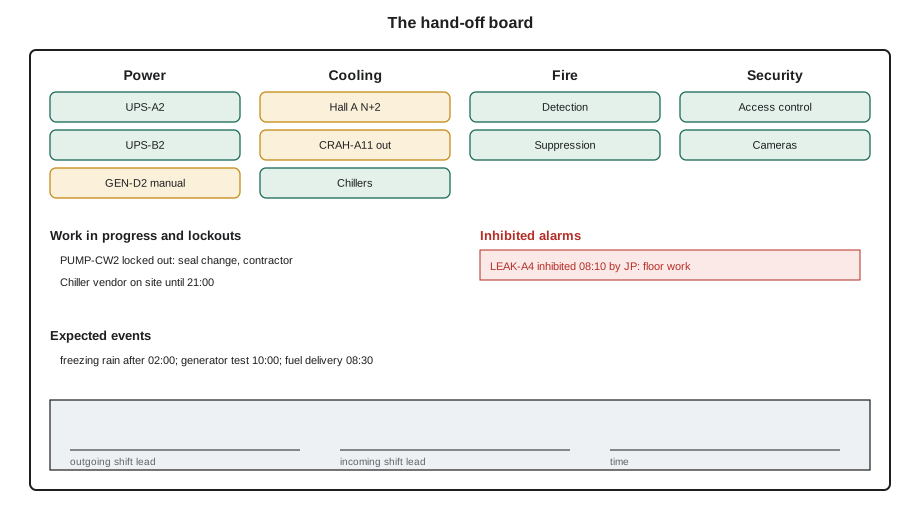
Two parts of the hand-off deserve special attention. The first is anything not in its normal state, because the plant's normal state is what every procedure assumes. A valve left closed, a breaker left open, a unit in manual or maintenance mode, a jumper or bypass fitted to a controller, a door propped open for a delivery: each changes how the plant will behave if something else goes wrong. The second is inhibited alarms. An alarm inhibited for planned work, so that floor tile lifting does not set off the leak detection, is a hole in the facility's protection. Every inhibited alarm is on the board with the time, the reason and the person who inhibited it, and the hand-off confirms whether it is still needed.
Worked problem
The inhibited zone
At the 19:00 hand-off, the outgoing lead mentions that floor work in Hall A finished at 17:30. The incoming lead, Dmitri, reads down the board's inhibit list.
Show solution
- The list shows leak detection zone A-4 inhibited at 08:10 for the floor work, by the outgoing day shift.
- Dmitri asks whether the floor work is finished. It is. He asks why the zone is still inhibited. Nobody knows; it was simply not restored.
- Before signing, he sends Jamal to Hall A to confirm the floor tiles in zone A-4 are back in place and the leak cable is intact and dry, then restores the zone and watches it return to normal on the monitoring screen.
- He records the restoration in the log and the outgoing lead notes it for the day shift's own review.
Answer: The structured hand-off caught a hole in the protection that would otherwise have stayed open all night, under the hall where Lesson 12's leak would later begin.
Face to face, then in writing
A hand-off is spoken and written, and both matter. Speaking allows questions: the incoming lead can ask what the trend on CRAH-A09 looked like, or whether the tenant was happy with the explanation. Writing makes sure nothing depends on memory and leaves a record. At Stonebridge, the outgoing shift lead writes a hand-off summary in the electronic shift log before the hand-off begins, the leads talk through it at the board, the incoming lead adds anything learned in the conversation, and both sign. If the incoming lead is not satisfied with the state of anything, the hand-off waits until it is explained, even if that keeps the outgoing crew late. Dmitri says that the outgoing crew does not leave until the incoming crew owns the building.
Technicians hand off too. A technician in the middle of a job at shift change briefs the technician taking over at the equipment, not in the corridor, showing the state of the work, the step reached in the method of procedure and any lockouts in place. Lockouts are never transferred by word alone: the incoming technician applies their own lock before the outgoing technician removes theirs, following the site's lockout procedure from DCT-120.
The shift log
The shift log is the continuous written record of the facility, entry by entry, through every shift of every day. At Stonebridge it is electronic, linked to the monitoring and ticketing systems, with a printed backup kept in the operations center for times when the systems are not available. Every entry has a time, the author, the equipment tag, and what was seen or done, in plain words. Good entries are factual and specific: 14:12 RPP-A2-08 main breaker found tripped; B side carrying cage A-26; Dmitri informed. Poor entries are vague: power problem in Hall A, sorted.
A few rules keep the log useful.
- Write it as it happens, or as soon as possible. Entries written at the end of the shift from memory are less accurate and miss times.
- Use equipment tags and plain words. Use only abbreviations that everyone on the campus uses.
- Record facts and actions, not opinions about people.
- Never delete or overwrite. Corrections are made by adding a new entry that refers to the old one, so the record of what was believed at the time survives.
- Record readings and times, not only conclusions: the strainer pressure was 7.0 psi, not the strainer looked high.
The log is a legal and contractual record as well as an operational one. Incident reports, tenant disputes about service credits, insurance claims and regulatory inquiries all rely on it. An honest, careful log protects the technicians who write it, because it shows what they knew and did, when.
# Parse a shift log and build the hand-off summary: what is not normal, inhibited alarms and open items
log = [
    "07:12 | RK | CRAH-A11 | out of service for strainer cleaning | NOT_NORMAL",
    "08:10 | JP | LEAK-A4 | leak detection zone inhibited for floor work | INHIBIT",
    "09:30 | DV | GEN-D2 | in manual for starter motor repair, vendor on site | NOT_NORMAL",
    "11:45 | RK | CRAH-A11 | returned to service, strainer cleaned, dP 21 | RESTORED",
    "13:20 | JP | PUMP-CW2 | locked out by mechanical contractor for seal change | LOCKOUT",
    "16:05 | DV | GEN-D2 | repair complete, test start passed, left in manual for second test | NOT_NORMAL",
    "17:30 | JP | LEAK-A4 | floor work complete | INFO",
]
state = {}
for line in log:
    t, who, tag, what, kind = [p.strip() for p in line.split("|")]
    if kind == "RESTORED":
        state.pop(tag, None)
    elif kind != "INFO":
        state[tag] = (t, who, what, kind)
print("Hand-off summary: items not in their normal state")
for tag, (t, who, what, kind) in sorted(state.items(), key=lambda x: x[1][3]):
    print(f"  [{kind:10}] {tag:9} since {t} ({who}): {what}")
inhibits = [tag for tag, v in state.items() if v[3] == "INHIBIT"]
if inhibits:
print("Check before signing: inhibited alarms still in place ->", ", ".join(inhibits))Hand-off summary: items not in their normal state [INHIBIT ] LEAK-A4 since 08:10 (JP): leak detection zone inhibited for floor work [LOCKOUT ] PUMP-CW2 since 13:20 (JP): locked out by mechanical contractor for seal change [NOT_NORMAL] GEN-D2 since 16:05 (DV): repair complete, test start passed, left in manual for second test Check before signing: inhibited alarms still in place -> LEAK-A4
The summary lists three items for the incoming crew: the generator still in manual pending its second test start, the pump under lockout and the leak detection zone still inhibited although the floor work finished at 17:30. It is the example from earlier in the lesson, found here by the log itself. The tags at the end of each entry, which the log's form adds from a short list, are what make this kind of summary possible.
Other records
The shift log is the center of a set of records, each with its own purpose.
| Record | What it holds | Why it matters |
|---|---|---|
| Round sheets | Readings and observations from each round | Trends, as in Lesson 1, and proof that rounds were done |
| Work orders | Every maintenance and repair job, with readings, findings and parts | Maintenance history and program measures, as in Lessons 2 and 3 |
| Permits and the lockout register | Hot work, confined space and energized work permits; every lock applied and removed | Safety: nobody is exposed to energy or hazards they do not know about |
| Inhibit and bypass register | Every alarm inhibited and every protective device bypassed, with reason, time and person | Protection holes are tracked until closed |
| Key and access logs | Keys issued and returned; access to restricted areas | Security and evidence for investigations |
| Visitor and vendor log | Who is on site, why, with whom and until when | Safety in an emergency and security |
| Drawings and documents | Single-line diagrams, valve charts, EOPs, MOPs, procedures | Every procedure depends on them being current |
Drawings and documents deserve a final word, because Lesson 6's out-of-date placard showed what happens when they drift. Every change to the plant, a new valve, a replaced panel, a re-fed circuit, must reach the drawings, the valve charts, the asset register, the monitoring system's labels and the procedures that mention it. At Stonebridge the change management process of DCT-330 includes a documentation step that cannot be closed until the operations engineer confirms all of these are updated. Technicians are often the first to notice when the drawings do not match the floor, and reporting it is part of the job.
Documentation for the next person
Roz has a test for every log entry, hand-off and record: could someone who was not here understand what happened and what to do next? The next person might be the incoming shift lead at 19:00, a vendor arriving tomorrow, the analyst reviewing an incident next month or a new technician reading the history of a unit in two years. Writing for that person takes a little more time on shift and saves a great deal of it later. It is also, as Lesson 12 shows, the thread that holds an incident response together, from the first alarm in the log to the last corrective action in the tracker.
Common mistakes
MistakeHanding off with a casual chat
InsteadUse the same structured headings every time, spoken and written, and sign
MistakeMentioning what was fixed but not the temporary arrangements left in place
InsteadList everything not in its normal state, including valves, manual modes, bypasses and inhibits
MistakeLeaving an alarm inhibited after the work that needed it
InsteadKeep every inhibit on the board and restore it when the work ends, after checking the area
MistakeWriting vague log entries at the end of the shift
InsteadWrite factual, specific entries with times, tags and readings as things happen
MistakeCorrecting the log by deleting entries
InsteadAdd a new entry that refers to the old one, so the original record survives
Summary and key terms
- Hand-offs are where critical information is most easily lost; a structured hand-off prevents it.
- Stonebridge's SAFE hand-off covers status of the plant, activities, faults and alarms, and expected events.
- Anything not in its normal state and every inhibited alarm must be explained before the incoming lead signs.
- Hand-offs are spoken and written; lockouts are transferred lock by lock, never by word alone.
- The shift log is factual, timely, specific and never overwritten; it is also a legal and contractual record.
- Round sheets, work orders, permits, inhibit registers, access logs and current drawings complete the record.
- Hand-off
- The transfer of responsibility for the facility, or a job, from one person or crew to another.
- Shift log
- The continuous written record of observations, actions and events at the facility.
- Inhibited alarm
- An alarm temporarily prevented from sounding, usually for planned work.
- Inhibit register
- The list of alarms inhibited and protective devices bypassed, with reasons and times.
- Normal state
- The usual position or mode of equipment that procedures assume.
- Lockout register
- The record of every lock applied to isolate energy and its removal.
- Round sheet
- The form on which readings and observations from a round are recorded.
Practice problems
Work each problem on paper first, then reveal the answer to check.
What do the letters of Stonebridge's SAFE hand-off stand for?
Show answer
Status of the plant, activities, faults and alarms, and expected events.
Why must inhibited alarms be listed at every hand-off?
Show answer
Each inhibit is a hole in the facility's protection that must be tracked and restored when no longer needed.
A log entry reads: cooling issue fixed. What is wrong with it?
Show answer
It has no time, tag, readings or description of what was found and done.
How is a lockout handed over at shift change?
Show answer
The incoming worker applies their own lock before the outgoing worker removes theirs.
Lesson quiz · 5 questions
Score 60% or more to complete this lesson.
Create a free account to save your progress, take quizzes and earn a certificate.