
DCT-340 · Lesson 7 of 12 · 21 min
Incident response: detect, contain, communicate
Most of the time an alarm is handled by its alarm response procedure and closed within the hour: a filter needs changing, a sensor has drifted, a door was left open. Sometimes an event is bigger. Equipment fails in a way that affects tenants, several things go wrong at once, the cause is not obvious or the situation is getting worse. Then Stonebridge declares an incident and runs it in a structured way. This lesson is about that structure: what an incident is, how it is declared and graded, who does what and how the response moves from the first alarm to a stable, recovered facility. Communication, which is half the work, has Lesson 8 to itself.
What counts as an incident
Stonebridge's definition starts from the one used in IT service management frameworks such as ITIL 4, where an incident is an unplanned interruption to a service or a reduction in its quality, and adds any event that could cause one if nothing is done. For a colocation operator the service is power, cooling, connectivity, security and space for tenants' equipment. So an incident is not only an outage. The loss of redundancy that Lesson 1 described is an incident, even if no tenant notices it, because the next failure could drop the load. A fire alarm in a data hall is an incident even if it turns out to be dust. A security breach of a cage is an incident even if nothing was touched.
Not every alarm is an incident, and not every incident is an emergency. The shift lead decides whether an event becomes an incident, and grades it by its severity. Stonebridge uses four levels.
| Severity | Meaning | Examples | Who leads |
|---|---|---|---|
| 1, critical | Critical load lost, or people in danger, or a whole hall at risk | Loss of power to cabinets; a fire; a major leak near live equipment | Shift lead at once, site manager on call, operations director told |
| 2, major | Redundancy lost on a critical system, or load at imminent risk | A UPS in bypass; one side of a hall lost; several cooling units failed | Shift lead; site manager told within 15 minutes |
| 3, minor | Reduced capacity or a fault with no immediate risk to the load | One CRAH failed of twelve; a failed pump with standby running | Shift lead or a technician the lead assigns |
| 4, low | Little or no risk, but tracked | A sensor fault; a door alarm with no intrusion | Technician on shift |
Severity can change as the incident develops. A chilled-water drip under a CRAH begins as severity 3; if it reaches a floor distribution unit it becomes severity 1. Raising severity early and lowering it later is always better than the reverse, and nobody is criticized at Stonebridge for raising an incident that turns out smaller than feared.
The phases of a response
Every incident moves through the same phases, though in a fast-moving event they overlap.
- Detect: something shows that a problem exists, usually an alarm, sometimes a tenant's call, a technician on a round or a smell.
- Acknowledge and assess: a person takes ownership, confirms the problem is real and gets a first picture of what is affected.
- Declare: the shift lead decides it is an incident, sets its severity and names the incident commander.
- Contain: stop it getting worse and protect people and the load, using the alarm response and emergency procedures of Lesson 6.
- Recover: restore the failed service or redundancy, by repair, replacement or a temporary arrangement.
- Close: confirm everything is back to normal, hand any follow-up to problem management and record the incident fully.
The order of the middle phases matters. Containment comes before cause. A technician's instinct is to find out why something happened, but during the incident the first job is to stop the damage. The question of why is answered later, carefully, in the root cause analysis of Lesson 9, using evidence that the response has been careful to preserve.
Roles
Small incidents need one person. Larger ones fail when everybody does everything, so Stonebridge assigns roles, borrowing the idea from the incident command systems used by fire and emergency services. The roles can be held by different people or combined, depending on the size of the incident.
| Role | Responsibilities |
|---|---|
| Incident commander | Owns the incident: sets priorities, makes decisions, assigns roles, decides when to escalate and when to close. Does not do hands-on work in a large incident. |
| Operations lead | Directs the hands-on work at the equipment, following the EOPs, and reports progress to the commander. |
| Communications lead | Keeps tenants, the site manager and leadership informed on a regular schedule, as Lesson 8 describes. |
| Scribe | Keeps the timeline: every observation, decision, action and message, with the time. |
| Technical specialists | Vendors, electricians, controls engineers and tenant engineers called in for their knowledge. |
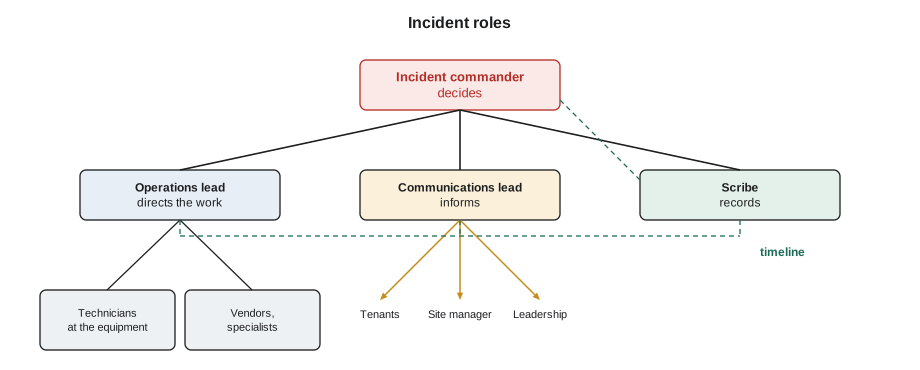
The most important rule about roles is that there is always exactly one incident commander, and everyone knows who it is. Commanders can hand over, for example when the site manager arrives and takes command from the shift lead, but the handover is said aloud and recorded: Anjali has command from 03:40. A second rule is that the commander in a serious incident keeps their hands free. Dmitri likes to say that the moment the commander picks up a tool, nobody is commanding.
A severity 2 incident
Jamal sees the structure work on a weekday afternoon in his third week on the rotation.
Worked problem
A main breaker trips in Hall A
At 14:12 the power monitoring system raises an alarm: the main breaker of remote power panel RPP-A2-08 has tripped. The panel feeds the A side of 14 cabinets of one enterprise customer, Halvorsen Logistics, in cage A-26.
Show solution
- 14:12 The monitoring desk acknowledges the alarm and calls Dmitri, the shift lead. Jamal and Roz go to the cage; Jamal reports the panel's main breaker in the tripped position and no smell, smoke or heat.
- 14:15 The B-side monitoring shows the 14 cabinets now drawing their whole load from RPP-B2-08, at 61 percent of its rating, within limits. One device in cabinet A-26-05, a single-corded storage controller, has lost power. Dmitri declares a severity 2 incident: redundancy lost for 14 cabinets and one device down. He takes command and names Roz as operations lead and the monitoring desk operator as scribe.
- 14:18 Dmitri tells Anjali and calls Halvorsen's on-call engineer, who confirms their storage is running on its partner controller with reduced performance.
- 14:20 Following the ARP for a tripped panel breaker, nobody resets the breaker: a breaker that trips may have tripped on a fault, and closing it onto a fault can cause an arc flash or a second trip. Roz calls the campus electrical contractor's on-call electrician.
- 14:22 Roz confirms the B side's panel, distribution unit and UPS are normal and asks the monitoring desk to alert at 70 percent load on RPP-B2-08. Dmitri stops all planned work in Hall A's B side for the duration.
- 15:05 The electrician arrives, de-energizes and tests the A-side branch circuits of the cage under a lockout, and finds one circuit, to cabinet A-26-11, with a short between line and ground. Inside the cabinet, a rack power strip installed by the customer that morning has a damaged inlet cord, crushed by the cabinet door.
- 15:40 With the faulty strip disconnected and the customer's agreement, the electrician closes the main breaker after confirming insulation resistance on all other circuits. The A side returns to the 13 other cabinets and to the storage controller. Halvorsen's engineer confirms both controllers are back.
- 16:30 After an hour with no further alarms, Dmitri closes the incident and opens a problem record for the root cause: why a single branch fault tripped the panel's main breaker instead of the branch breaker.
Answer: The incident was contained in ten minutes and recovered in under an hour and a half, with no further loss of load. The open question, why the main tripped, is the start of Lesson 9's root cause analysis.
Containment: what not to do
The example shows the most important containment habit: do not restore something until you know why it failed. Resetting a tripped breaker, restarting a failed unit or clearing a latched alarm can work, and when it works nobody remembers the risk. When it does not, it turns a severity 2 into a severity 1. Stonebridge's ARPs for protective devices all start the same way: leave it as it is, confirm the remaining path, call the qualified person.
A second habit is to preserve evidence. Before anything is changed, photographs are taken of the equipment's state, the positions of breakers and valves, the alarm screens and any visible damage. Event logs on UPS systems, breaker trip units and controllers are saved, because some of them overwrite their oldest entries. Failed parts are kept, tagged with the incident number, not thrown away. The root cause analysis depends on all of this.
A third is to protect what is still working. During the breaker incident Dmitri stopped planned work on the B side, because the B side was now the only path for 14 cabinets. Freezing changes on the path that is carrying the load is a standing rule during any severity 1 or 2 incident.
Escalation
Escalation means bringing in more help or more authority. Stonebridge's escalation rules are written into each EOP and into the severity table: severity 1 calls the site manager and the operations director immediately, severity 2 calls the site manager within fifteen minutes, and any incident that is not contained within an hour, or not recovered within four, is escalated one level higher. Technical escalation runs in parallel: the vendors on emergency contracts, with their response times from Lesson 3, the electrical contractor, the controls engineers. A commander who escalates too early wastes some people's evening; one who escalates too late can lose the load. Stonebridge's culture, like most in the industry, prefers the first mistake.
Measuring the response
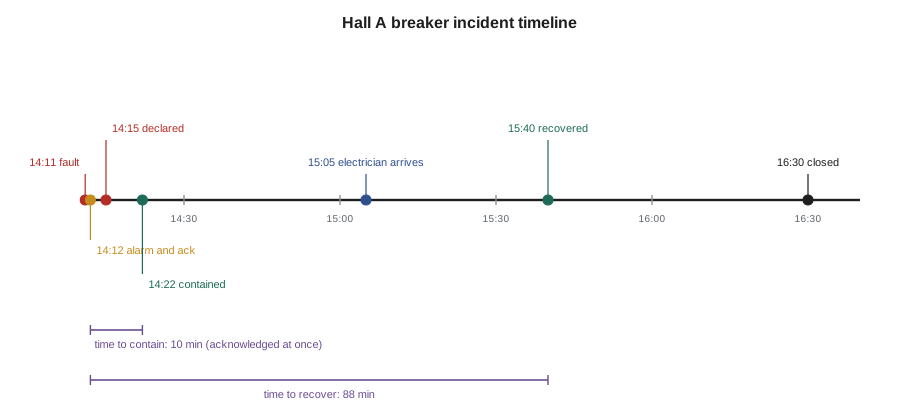
The scribe's timeline makes it possible to measure each incident's response. Four intervals are tracked: time to detect, from the start of the problem to its first detection; time to acknowledge, from detection to a person taking ownership; time to contain, from detection to the problem stopping getting worse; and time to recover, from detection to the service or redundancy being restored. The start of the problem is not always known at once; it is often found later from logs.
# Incident timeline and response metrics from the scribe's log
from datetime import datetime
fmt = "%H:%M"
log = [
    ("14:11", "start", "fault on branch circuit to A-26-11 (from trip unit log)"),
    ("14:12", "detect", "RPP-A2-08 main breaker trip alarm"),
    ("14:12", "ack", "monitoring desk acknowledges, calls shift lead"),
    ("14:15", "declare", "severity 2 declared, Dmitri commands"),
    ("14:22", "contain", "B side confirmed stable, B-side work frozen"),
    ("15:05", "info", "electrician on site"),
    ("15:40", "recover", "A side restored to 13 cabinets and storage controller"),
    ("16:30", "close", "incident closed, problem record opened"),
]
t = {k: datetime.strptime(ts, fmt) for ts, k, _ in log if k != "info"}
mins = lambda a, b: int((t[b] - t[a]).total_seconds() // 60)
for ts, k, what in log:
    print(f"{ts}  {k:8} {what}")
print()
print(f"time to detect      {mins('start', 'detect'):3} min")
print(f"time to acknowledge {mins('detect', 'ack'):3} min")
print(f"time to contain     {mins('detect', 'contain'):3} min")
print(f"time to recover {mins('detect', 'recover'):3} min")14:11 start fault on branch circuit to A-26-11 (from trip unit log) 14:12 detect RPP-A2-08 main breaker trip alarm 14:12 ack monitoring desk acknowledges, calls shift lead 14:15 declare severity 2 declared, Dmitri commands 14:22 contain B side confirmed stable, B-side work frozen 15:05 info electrician on site 15:40 recover A side restored to 13 cabinets and storage controller 16:30 close incident closed, problem record opened time to detect 1 min time to acknowledge 0 min time to contain 10 min time to recover 88 min
Each number points to a different improvement. Time to detect depends on monitoring and rounds; time to acknowledge on staffing and alarm handling; time to contain on procedures and training; time to recover on spares, vendors and the design of the plant. In this incident the longest interval was the electrician's travel time, and the problem review later asked whether a qualified electrician should be on the campus during the day shift. The timing figures are kept for every incident, and their trends are reviewed every quarter.
Closing an incident
An incident is closed when the service and any lost redundancy are restored and stable, when the tenants who were affected agree, and when the record is complete: timeline, actions, communications, evidence collected and what remains to be done. Closing the incident does not close the question of why it happened. That moves to a problem record; in ITIL terms a problem is the cause, or potential cause, of one or more incidents, and the record tracks the investigation, which leads on to the root cause analysis and corrective actions of Lessons 9 and 10. Jamal learns to think of the incident as the fire and the problem as the fire investigation: the first is about speed, the second about care.
Common mistakes
MistakeResetting a tripped protective device to get the load back quickly
InsteadLeave it as found, confirm the remaining path and call a qualified person to find the cause
MistakeHunting for the cause before the incident is contained
InsteadContain first; investigate later with preserved evidence
MistakeLetting two people believe they are in command
InsteadName one incident commander, aloud, and record every handover
MistakeThrowing away the failed part once the repair is done
InsteadTag and keep failed parts and save logs for the root cause analysis
MistakeWaiting to escalate until it is certain the incident is serious
InsteadEscalate early; lowering severity later costs little
Summary and key terms
- An incident is an unplanned interruption or reduction of service, including lost redundancy, or an event that could cause one.
- Stonebridge grades incidents from severity 1 to 4 and raises severity early when in doubt.
- The phases are detect, acknowledge and assess, declare, contain, recover and close; containment comes before cause.
- One incident commander decides; operations, communications and a scribe support, with specialists called in.
- Containment means not restoring before the cause is known, preserving evidence and freezing work on the remaining path.
- Time to detect, acknowledge, contain and recover are measured from the timeline; the cause moves to a problem record.
- Incident
- An unplanned interruption or reduction in the quality of a service, or an event that could cause one.
- Severity
- A grade that describes how serious an incident is and sets who leads and who is told.
- Incident commander
- The one person who owns an incident and makes its decisions.
- Containment
- Actions that stop an incident getting worse and protect people and the load.
- Escalation
- Bringing in more help or more authority to an incident.
- Problem record
- An investigation into the cause of one or more incidents.
- Time to recover
- The interval from detection to the restoration of service or redundancy.
Practice problems
Work each problem on paper first, then reveal the answer to check.
Is the loss of one UPS in a 2N hall an incident if no tenant notices?
Show answer
Yes. Redundancy has been lost, so the next failure could drop the load.
A breaker has tripped and the remaining path is carrying the load. What is the first rule?
Show answer
Do not reset it; confirm the remaining path and call a qualified person to find the cause.
Name the four response intervals Stonebridge tracks.
Show answer
Time to detect, time to acknowledge, time to contain and time to recover.
Why does the commander of a serious incident avoid hands-on work?
Show answer
So someone keeps the whole picture, makes decisions and coordinates everyone else.
Lesson quiz · 5 questions
Score 60% or more to complete this lesson.
Create a free account to save your progress, take quizzes and earn a certificate.