
DCT-340 · Lesson 3 of 12 · 22 min
Building a maintenance program: tasks, intervals and vendors
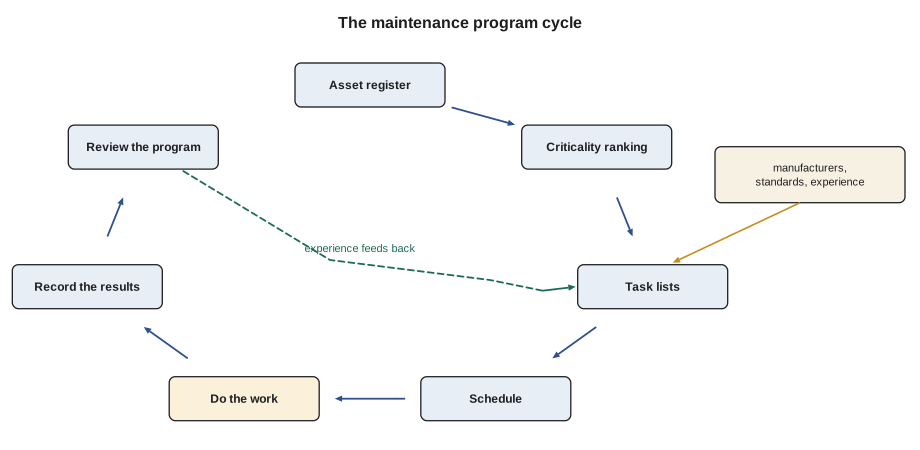
A maintenance program is the written plan that says, for every piece of equipment in the facility, what will be done to it, how often, by whom and how the result will be recorded. Stonebridge's program for the IAD-3 campus fills a few hundred pages and a CMMS database, but Morgan Tremblay explains it to Jamal as a short chain of questions. What do we have? How much does each item matter? What does it need? When? Who does it? Did it get done, and what did we find? This lesson follows that chain, with the standards and manufacturers' requirements that shape the answers and the vendors who do much of the specialist work.
The asset register
Everything starts with knowing what is there. The asset register in the CMMS lists every maintainable item with a unique tag, its location, its make, model and serial number, its installation date, the system it belongs to and what it feeds or serves. The tags match the labels on the equipment and the names on the single-line diagrams and in the monitoring system, so that a work order for UPS-A2 module 3 or CRAH-A11 points to exactly one thing. When equipment is added, replaced or removed, the register must change with it; a register that has drifted from reality produces work orders for equipment that no longer exists and, worse, misses equipment that does.
Jamal's first task for Morgan is a register audit of one electrical room: walk it with a printout and check every item against the list. He finds two differences. A small transfer switch installed last year for a tenant's single-corded equipment is not in the register at all, so it has never been put on a maintenance schedule. And a distribution panel listed in the room was replaced by a new one with a different model number, so its work orders still call up the old manufacturer's procedure. Both are fixed the same day.
Criticality
Not all equipment deserves the same attention. Each asset gets a criticality ranking based on what its failure would do. Stonebridge uses four levels: critical (failure would drop critical load or create a safety hazard, such as main switchgear, UPS systems, generators and fire suppression), essential (failure would remove redundancy, such as one of several CRAH units or pumps), supporting (failure affects comfort or convenience, such as office air conditioning) and minor (failure is cheap and harmless, the run-to-failure list of Lesson 2). Criticality decides the maintenance strategy, the priority of corrective work and how much supervision maintenance needs.
Task lists and where intervals come from
For each type of equipment, the program has a task list: the specific checks, services and tests and their intervals. The intervals come from four sources. The manufacturer's instructions are the starting point, and following them is usually a condition of the warranty. Standards set minimums for many systems. Insurers and the tenants' contracts may add requirements. And the operator's own experience adjusts all of these over time, shortening intervals where problems appear and lengthening them, within the limits of standards and warranties, where equipment proves reliable.
Several standards shape a data center program, and a technician should know their names and what they cover.
| Standard | Covers | Examples of what it sets |
|---|---|---|
| NFPA 70B (US); CSA Z463 (Canada) | Electrical equipment maintenance | A documented electrical maintenance program; intervals that depend on equipment condition; infrared inspections |
| NFPA 110 (US); CSA C282 (Canada) | Emergency and standby generators and transfer switches | Weekly inspections, monthly running under load, annual tests |
| IEEE battery practices (lead-acid and VRLA) | Stationary batteries | Monthly, quarterly and annual checks, ohmic measurements, capacity tests |
| NFPA 25 and 72 (US); CAN/ULC-S536 and the fire code (Canada) | Sprinklers, pre-action systems and fire alarms | Periodic inspection and testing of valves, detectors and alarms |
| NFPA 2001 and the manufacturer | Clean agent suppression | Cylinder weight and pressure checks, room integrity tests |
NFPA 70B deserves a closer look, because its 2023 edition changed its status. Earlier editions were a recommended practice; the 2023 edition became a standard written in mandatory language. It requires an electrical maintenance program with defined elements: a responsible person, an equipment survey, documented procedures, a schedule, records and periodic review. It sets maintenance intervals that depend on an equipment condition assessment. Each item is rated in one of three conditions based on its physical state, how critical it is and how harsh its environment is, and the worst of these sets the interval. Equipment in good condition in a clean, controlled room can be serviced at the longest intervals; equipment in poor condition, critical or in a harsh environment, at much shorter ones. Infrared inspection of electrical equipment is required at least annually, and more often for equipment in the worst condition. The standard is not law by itself, but authorities and insurers can adopt or cite it. In Canada, CSA Z463 plays a similar role.
For generators, NFPA 110 requires, among many other things, a monthly run under load for at least 30 minutes at a load of at least 30 percent of the nameplate rating. Diesel engines that run lightly loaded for long periods suffer from wet stacking, a build-up of unburned fuel and carbon in the exhaust, so a generator that cannot reach the required load in its monthly test must be exercised annually on a load bank. Stonebridge's generators run monthly on the building load during the campus test, as DCT-220 described, and get an annual load bank test as well.
For VRLA batteries, the IEEE practices call for monthly checks of float voltage, charger output and temperature, quarterly checks that add each unit's ohmic value and terminal temperature, and annual checks of connection resistance. A rise in a unit's ohmic value of about 20 percent above its baseline is a common sign of trouble. Periodic capacity tests by discharge are recommended at intervals tied to the battery's expected life, and most manufacturers recommend replacement once capacity falls below about 80 percent of rating. Lesson 5 shows how the ohmic trend is used.
Building the schedule
With task lists and intervals in place, the CMMS generates work orders on schedule. The planner then turns them into a real calendar, which is harder than it sounds. Maintenance on one UPS system cannot happen in the same window as maintenance on its partner. Generator tests must avoid storm forecasts. Chiller work belongs in the cool season in Beauharnois and Ashburn alike, when free cooling carries the load. Vendors are booked weeks ahead. And tenants must be notified of any work that reduces redundancy in their halls, under the notice periods in their contracts. Morgan builds a rolling twelve-month calendar and a detailed four-week plan, and Dmitri's shift leads review the weekly plan against the redundancy whiteboard.
# Generate a year of preventive work orders from an asset list and task intervals
from datetime import date, timedelta
assets = [  # tag, task, interval in days, last done
    ("UPS-A2", "external inspection", 91, date(2026, 12, 2)),
    ("UPS-A2", "full internal inspection (vendor)", 365, date(2026, 5, 14)),
    ("GEN-A1", "load run 30 min", 30, date(2026, 12, 8)),
    ("GEN-A1", "load bank test (vendor)", 365, date(2026, 9, 21)),
    ("BATT-A2", "ohmic and voltage readings", 91, date(2026, 11, 18)),
    ("SWBD-A2", "infrared scan", 182, date(2026, 10, 7)),
    ("CRAH-A11", "filters and belts", 91, date(2026, 12, 9)),
]
start, end = date(2027, 1, 1), date(2027, 12, 31)
orders = []
for tag, task, every, last in assets:
    due = last + timedelta(days=every)
    while due <= end:
        if due >= start:
            orders.append((due, tag, task))
        due += timedelta(days=every)
orders.sort()
print(f"{len(orders)} work orders in 2027")
by_month = {}
for d, tag, task in orders:
    by_month[d.month] = by_month.get(d.month, 0) + 1
print("per month:", " ".join(f"{m}:{n}" for m, n in sorted(by_month.items())))
for d, tag, task in orders[:5]:
print(d.isoformat(), tag, "-", task)28 work orders in 2027 per month: 1:1 2:2 3:3 4:2 5:3 6:3 7:1 8:2 9:4 10:2 11:2 12:3 2027-01-07 GEN-A1 - load run 30 min 2027-02-06 GEN-A1 - load run 30 min 2027-02-17 BATT-A2 - ohmic and voltage readings 2027-03-03 UPS-A2 - external inspection 2027-03-08 GEN-A1 - load run 30 min
Even this small list produces 28 work orders in a year, and the monthly generator runs alone put at least one task in every month. On the real campus the same calculation runs over thousands of tasks, and the planner's work is to spread the peaks so that no week asks for more than the team and the vendors can do safely.
Vendors and contractors
Much of the specialist work is done by vendors: the UPS manufacturer's field engineers, the generator dealer's technicians, the chiller and CRAH service company, the fire protection contractor, the electrical testing company that does infrared scans and breaker tests. Stonebridge's technicians are not trained or authorized to do this work, but they are responsible for how it is done on their site. Vendor management has a few essential parts.
- The contract sets the scope of each visit, the response time for emergency calls (four hours on site for the UPS and generator vendors), the qualifications required and the reports to be delivered.
- Every vendor visit is planned with a method of procedure, reviewed by the shift lead and, for work that reduces redundancy, approved through change management as DCT-330 describes.
- Vendors sign in, attend the site safety induction, are escorted or supervised as their access level requires, and work only on the equipment named in the work order.
- A Stonebridge technician is present for any work on critical equipment, follows the method of procedure, confirms each step and checks the equipment's state before and after.
- Reports, readings and findings go into the CMMS against the asset, and findings become corrective work orders.
The technician who supervises vendor work does not need to know how to do the vendor's job. He needs to know what the equipment is, what it feeds, what state it should be in at each step and what the method of procedure says. Roz has stopped work more than once because a vendor started a step out of order or on the wrong unit. The vendor knows the equipment; the site technician knows the site.
Worked problem
The right unit, the wrong side
A CRAH service technician arrives to replace the belts on CRAH-A11 under a work order. The method of procedure says to confirm that the neighboring units are running, put A11 in maintenance mode at its controller, open its local disconnect and lock it out.
Show solution
- Jamal meets the technician, checks the work order and walks him to the unit, confirming the tag on the nameplate matches.
- At the controller, the technician begins to select maintenance mode on the unit displayed, which is A12, the screen having been left on the neighboring unit.
- Jamal stops him, points to the unit tag on the screen and asks him to select A11.
- They confirm together that A11 has stopped, that A10 and A12 have increased their fan speed to cover, and that the disconnect they lock is the one labeled for A11.
Answer: Checking the unit tag at every step caught a mistake that would have stopped two units side by side.
Records and measuring the program
A maintenance task is not done until it is recorded. The record shows who did the work, when, what was found, the readings taken, any parts used and any follow-up needed. For critical equipment the vendor's report is attached. Records serve three purposes: they prove the work was done, which matters to tenants, insurers and inspectors; they hold the readings that make trends possible; and they let the planner measure the program.
The most watched measure is preventive maintenance compliance: the share of scheduled tasks completed on time, usually within a grace window around the due date. Stonebridge's target is 98 percent for critical equipment and 95 percent overall. The backlog of overdue and corrective work is the second. Morgan reviews both every week.
# Preventive maintenance compliance and backlog for a month (grace window: 7 days after the due date)
from datetime import date
tasks = [  # tag, criticality, due, completed (None = not done)
    ("UPS-B2", "critical", date(2027, 3, 3), date(2027, 3, 3)),
    ("GEN-A2", "critical", date(2027, 3, 8), date(2027, 3, 8)),
    ("GEN-A3", "critical", date(2027, 3, 8), date(2027, 3, 12)),
    ("SWBD-B2", "critical", date(2027, 3, 15), None),
    ("CRAH-A04", "essential", date(2027, 3, 10), date(2027, 3, 22)),
    ("CRAH-A05", "essential", date(2027, 3, 10), date(2027, 3, 11)),
    ("PUMP-CW2", "essential", date(2027, 3, 18), date(2027, 3, 19)),
    ("AHU-OFF1", "supporting", date(2027, 3, 20), None),
]
today = date(2027, 3, 31)
grace = 7
for crit in ("critical", "essential", "supporting"):
    group = [t for t in tasks if t[1] == crit]
    on_time = sum(1 for t in group if t[3] is not None and (t[3] - t[2]).days <= grace)
    print(f"{crit:10} {on_time}/{len(group)} on time ({on_time / len(group) * 100:.0f} %)")
overdue = [(t[0], (today - t[2]).days) for t in tasks if t[3] is None and (today - t[2]).days > grace]
print("overdue:", ", ".join(f"{tag} ({d} days)" for tag, d in overdue))critical 3/4 on time (75 %) essential 2/3 on time (67 %) supporting 0/1 on time (0 %) overdue: SWBD-B2 (16 days), AHU-OFF1 (11 days)
The critical group shows three of four on time because the switchboard SWBD-B2 inspection has not been done; it needed a vendor who canceled. Morgan books the earliest possible date, records the reason and tells Anjali, because missing a critical task is reported to the site manager. One late CRAH filter change, done twelve days after its due date, shows in the essential group; it was done, but late, and Morgan notes that the filter's pressure drop was high when changed, a hint that the interval may be too long. The office air handler filter, a supporting item, is also overdue and is moved into next week's plan.
Reviewing the program
Once a year, and after any significant incident, the program itself is reviewed. The review asks which equipment failed and whether maintenance should have caught it, which tasks found nothing for years and might be extended, which tasks caused problems, what the vendors' reports show, whether new equipment is in the program and whether standards or manufacturers' instructions have changed. The answers feed back into the task lists, closing the cycle at the top of the lesson. The technicians' observations are some of the most valuable input, which is why Morgan asks Jamal, after every round and every vendor visit, the same question: anything that surprised you?
Common mistakes
MistakeLetting the asset register drift from what is installed
InsteadUpdate the register whenever equipment is added, replaced or removed, and audit it on the floor
MistakeSupervising a vendor by watching from a distance
InsteadFollow the method of procedure, confirm the unit at each step and check the state before and after
MistakeScheduling partner systems in the same maintenance window
InsteadKeep partner systems apart so redundancy is never removed twice at once
MistakeRecording that a task was done without its readings
InsteadRecord readings, findings and parts, so trends and follow-up are possible
MistakeTreating the program as fixed once written
InsteadReview it yearly and after incidents, and adjust intervals from experience
Summary and key terms
- A maintenance program answers what we have, how much it matters, what it needs, when, by whom and what was found.
- The asset register must match the floor; criticality decides strategy, priority and supervision.
- Intervals come from manufacturers, standards, insurers and contracts, and the operator's experience.
- NFPA 70B became a standard in 2023, with condition-based intervals and at least annual infrared inspection; CSA Z463 is the Canadian counterpart.
- NFPA 110 requires monthly generator runs of at least 30 minutes at 30 percent load or more, with load bank testing when that is not reached.
- Vendors do specialist work under the site's procedures; compliance and backlog measure the program, which is reviewed yearly.
- Asset register
- The list of every maintainable item, with tag, location, details and what it serves.
- Criticality
- A ranking of how much an asset matters, based on the consequence of its failure.
- Task list
- The specific maintenance tasks and intervals for a type of equipment.
- Equipment condition assessment
- A rating of physical condition, criticality and environment that sets electrical maintenance intervals.
- Wet stacking
- Unburned fuel and carbon building up in a diesel engine run lightly loaded.
- PM compliance
- The share of scheduled preventive tasks completed on time.
- Method of procedure
- A step-by-step written plan for a piece of work, with checks and a way back.
Practice problems
Work each problem on paper first, then reveal the answer to check.
Name four sources that set maintenance intervals.
Show answer
Manufacturers' instructions, standards, insurers and contracts, and the operator's experience.
What does NFPA 110 require of a monthly generator run?
Show answer
At least 30 minutes at a load of at least 30 percent of the nameplate rating.
A vendor starts work on the unit shown on a controller screen, which is not the unit in the work order. What should the site technician do?
Show answer
Stop the work, point out the unit tag and confirm the right unit before continuing.
What is PM compliance, and why does it matter?
Show answer
The share of scheduled tasks completed on time; it shows whether the program is being carried out.
Lesson quiz · 5 questions
Score 60% or more to complete this lesson.
Create a free account to save your progress, take quizzes and earn a certificate.