
DCT-330 · Lesson 10 of 12 · 20 min
Methods of procedure and standard operating procedures
Change management decides whether a piece of work should happen and when. The procedure document decides how. In data centers, the two main kinds are the method of procedure (MOP), a step-by-step script for a specific piece of work on live infrastructure, and the standard operating procedure (SOP), a reusable instruction for a routine task. A third kind, the emergency operating procedure (EOP), tells staff what to do when something has already gone wrong; DCT-340 covers those. This lesson explains what goes into a MOP and an SOP, how they are written, reviewed and used, and why the best technicians follow them even when they know the work by heart.
MOP, SOP and EOP
| Document | Used for | Example | Typical author |
|---|---|---|---|
| Method of procedure (MOP) | A specific planned change or maintenance task on live infrastructure | Replace branch breaker 2-17 on PDU-B2-05 with rack A-31-03 on its A side | Engineer or senior technician, reviewed by peers and the system owner |
| Standard operating procedure (SOP) | A routine task done the same way every time | Daily walking round; adding a visitor; replacing a CRAH filter | Operations team, owned by the shift leads |
| Emergency operating procedure (EOP) | Responding to a failure or emergency | Utility outage with generator failure to start; leak in a hall | Engineers and operations, practiced in drills (DCT-340) |
Many standard changes (lesson 9) are carried out with a standard MOP: a MOP written once for a repeated task, such as installing a tap-off box, and reused with the specific equipment names filled in each time. Normal changes usually need a MOP written or adapted for that change.
What goes into a MOP
Stonebridge's MOP template has the same sections every time, so that anyone can find what they need:
- Header: MOP number and revision, the change ticket, title, site, systems affected, author, reviewers and approvals with dates.
- Scope and purpose: what will be done and why, in two or three sentences.
- Risk summary: the redundancy state during the work, the customers affected, the risk score from the change request, and the specific hazards to people, such as arc flash boundaries or pressurized coolant.
- Prerequisites: everything that must be true before step 1: change approved, customer notices sent, parts and tools on site and checked, people present, redundancy board green except for the planned item, no conflicting work, weather acceptable for outdoor work.
- Roles: who does each step, who reads and checks, who is the point of contact with the desk, and who can stop the work.
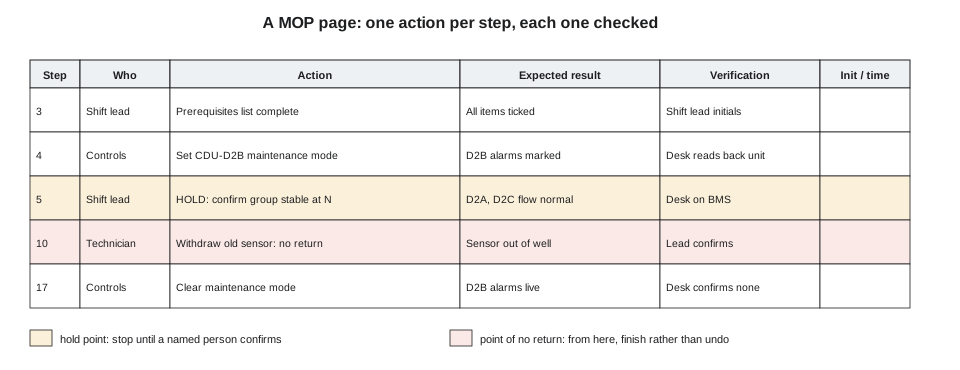
- Procedure steps: numbered, one action each, with the expected result and a verification for each step.
- Hold points: steps where work stops until a named person confirms it may continue.
- Back-out plan: steps to return to the starting state, and the point after which backing out is no longer possible.
- Post-work checks and close-out: confirming normal state, clearing maintenance modes and suppressions, updating DCIM, drawings and labels, notifying customers and closing the change.
The template is long on purpose. A MOP that fits on one page is usually missing its prerequisites or its back-out plan, which are the sections that prevent the worst outcomes.
Writing good steps
Each step should be a single action that one person does, written so that it can only be read one way. It names the exact equipment by its label, says what to do and what should happen, and gives a way to check that it did. Compare:
| Poor step | Good step |
|---|---|
| Turn off the B side. | 12. Electrician opens breaker 2-17 on PDU-B2-05 (label 'A-31-03 B'). Expected: EPMS shows breaker 2-17 open; branch current 0 A. Verify: desk confirms on EPMS and reads A-31-03 A-side current rises to about 22 A. |
| Check everything is OK. | 13. Technician checks A-31-03 front panel: all four devices show power, no amber lights. Customer confirms by phone that all devices are reachable. Record time. |
| Put it back. | 21. Electrician closes breaker 2-17. Expected: B-side current returns to about 11 A, A side falls to about 11 A. Verify: desk confirms on EPMS. |
Every step that changes the state of equipment has a verification by a second source, usually the desk watching the BMS or EPMS. This is the reader-doer practice used in aviation and power plants: one person reads the step aloud, the other does it and reports the result, and the reader confirms against the expected result before moving on. It sounds slow; it takes seconds per step and catches the moment someone reaches for breaker 2-18 instead of 2-17.
Back-out plans and points of no return
Every MOP must say how to undo the work if something goes wrong, and when undoing is no longer possible. For a breaker replacement, the point of no return comes when the old breaker has been removed: from then on, the way back is to finish installing the new one. The MOP states this, and the prerequisites make sure the risky part starts only when everything is ready: the new breaker checked against the drawing, the right tools present and the customer confirmed dual-corded.
The back-out plan also says who decides to back out and on what signs: an unexpected alarm, a reading different from the expected result, a customer report of lost devices, or simply the work running much longer than planned and approaching the end of the change window.
Reviewing and approving a MOP
A MOP is reviewed by at least one person who did not write it, usually an engineer who owns the system and a senior technician who will do or supervise the work. Reviewers check the steps against the drawings (lesson 11), the equipment labels and the actual state of the facility. Stonebridge requires a site walk-down for normal changes: before approval, the people doing the work walk through the steps at the equipment, reading each label and checking each breaker, valve and point named in the MOP. Walk-downs routinely find mistakes: a breaker relabeled since the drawing was made, a valve that is not where the drawing puts it, a step that needs a ladder.
Once approved, the MOP's revision is fixed. If anything has to change on the night, the work stops at a safe point, the change is agreed with the approver by phone, written on the MOP with the time and names, and the MOP is revised formally afterwards. Changing a step on the fly without stopping is how most procedure-related incidents start.
# MOP checker: every step that changes equipment state needs a verification and
# a rollback before the point of no return; hold points need a named approver.
mop = [  # (step, action, changes state?, verification, rollback, hold approver)
    (1, "Confirm prerequisites list complete", False, "shift lead initials", None, None),
    (2, "Set PDU-B2-05 branch 2-17 alarms to maintenance mode (CHG-5512)", True, "desk sees mode on BMS", "clear maintenance mode", None),
    (3, "Customer confirms all devices dual-corded and A side healthy", False, "customer by phone", None, "shift lead"),
    (4, "Open breaker 2-17", True, "EPMS shows open, A-side current about 22 A", "close breaker 2-17", None),
    (5, "Remove old breaker (point of no return)", True, "", None, "shift lead"),
    (6, "Install and torque new breaker", True, "torque recorded", None, None),
    (7, "Close breaker 2-17", True, "EPMS shows closed, both sides about 11 A", None, None),
    (8, "Clear maintenance mode", True, "", None, None),
]
no_return = 5
problems = []
for step, action, changes, verify, rollback, hold in mop:
    if changes and not verify:
        problems.append(f"step {step}: changes equipment but has no verification")
    if changes and step < no_return and not rollback:
        problems.append(f"step {step}: before the point of no return but has no rollback")
    if "point of no return" in action and not hold:
        problems.append(f"step {step}: point of no return needs a hold point")
print("\n".join(problems) if problems else "MOP structure OK")step 5: changes equipment but has no verification step 8: changes equipment but has no verification
The checker finds two gaps: the point-of-no-return step has no verification (what should the electrician confirm after removing the old breaker, for example that the bus stab is undamaged?), and clearing maintenance mode has no verification (the desk should confirm that the alarms are live again). Both were added before approval. The second gap is exactly the kind of omission the capstone shows going wrong.
Using a MOP on the night
On the night, the MOP is printed or on a tablet, and the person leading the work keeps the controlled copy. Each step is read, done, verified and initialed with the time. Nobody skips ahead, even for steps that seem trivial. The desk keeps its own copy and follows along, because it does many of the verifications and because it needs to know what state the facility is in at each moment. If the radio goes quiet for longer than the step should take, the desk calls.
Two habits matter most. The first is stopping when reality does not match the MOP: a label different from the step, a reading different from the expected result, an alarm the MOP did not predict. Stopping costs minutes; carrying on with a wrong picture can cost the load. Anyone in the team may call a stop, including the most junior technician, and nobody is criticized for a stop that turns out to be unnecessary. The second habit is completing the close-out with the same care as the work: the facility is not back to normal until maintenance modes are cleared, suppressions removed, alarms live, records updated and the desk has confirmed the redundancy board.
Standard operating procedures
SOPs cover the routine work that keeps the facility running: walking rounds, shift handovers, visitor escorts, receiving deliveries, generator weekly checks, filter changes, battery visual inspections. They are shorter than MOPs and do not need individual approval each time they are used, but they are still controlled documents with owners, revision numbers and review dates. Stonebridge reviews every SOP at least once a year, and after any incident where it was involved.
SOPs make work consistent between people and shifts, and they are how new staff learn. Jamal's first weeks on the desk were largely spent working through the desk SOPs with Dmitri: alarm response, shift log, handover, ticket handling, on-call paging and the flood procedure.
Document control
Procedures are only useful if everyone uses the current version. Stonebridge keeps all MOPs, SOPs and EOPs in a document management system where each has a number, a revision, an owner and an approval record; superseded revisions are withdrawn and marked, and printed copies are dated and marked 'valid for this change only' or 'check revision before use'. A technician who finds a procedure that is wrong or out of date raises a ticket to its owner, rather than correcting their own copy. A procedure fixed quietly in one person's folder is still wrong for everyone else.
Worked problem
Stopping on a label mismatch
During the walk-down for a tap-off box installation on busway BW-D1-04, step 9 of the standard MOP says 'confirm tap-off slot 14 is labeled for rack D-3-12'. Jamal finds slot 14 labeled D-3-11 and slot 15 labeled D-3-12. What happens?
Show solution
- Jamal stops and reports the mismatch to Roz and the desk; he does not decide which label is right.
- Roz checks DCIM: it shows D-3-12 on slot 15. The drawing used to write the MOP shows slot 14, from an older revision.
- The walk-down is the right place to find this. The MOP is corrected to slot 15, re-reviewed by the engineer, and its revision increased before approval.
- A ticket goes to the document owner to update the busway drawing, and DCIM is confirmed as matching the floor.
Answer: Had the mismatch been found on the night, the work would have stopped there. Found at the walk-down, it cost twenty minutes and a revision.
Common mistakes
MistakeWriting 'turn off the B side' as a step.
InsteadName the exact equipment, the action, the expected result and the verification.
MistakeSkipping steps you know well.
InsteadRead, do, verify and initial every step; familiarity is when mistakes happen.
MistakeChanging a step on the night and carrying on.
InsteadStop at a safe point, agree the change with the approver, write it on the MOP.
MistakeTreating close-out as paperwork.
InsteadClear maintenance modes, confirm alarms live, update records and check the board.
MistakeCorrecting your own copy of a wrong SOP.
InsteadRaise a ticket to the owner so the controlled version is fixed for everyone.
Summary and key terms
- MOPs script specific work on live infrastructure; SOPs cover routine tasks; EOPs cover emergencies (DCT-340).
- A MOP has a header, scope, risk summary, prerequisites, roles, numbered steps with expected results and verifications, hold points, a back-out plan and close-out.
- Steps are single actions on named equipment; state-changing steps are verified by a second source, as in reader-doer practice.
- MOPs are peer reviewed and walked down at the equipment before approval; on the night, any mismatch is a reason to stop.
- SOPs make routine work consistent and are controlled, owned and reviewed documents.
- Document control ensures everyone uses the current revision; errors are fixed by the owner, not on private copies.
- MOP
- Method of procedure: a step-by-step script for specific work on live infrastructure.
- SOP
- Standard operating procedure: a controlled instruction for a routine task.
- Hold point
- A step where work stops until a named person confirms it may continue.
- Point of no return
- The step after which the work can no longer simply be undone.
- Reader-doer
- A practice where one person reads each step and checks the result while another performs it.
- Walk-down
- Walking through a procedure at the equipment before approval to check every label and step.
- Document control
- Managing procedure revisions so that only the current, approved version is used.
Practice problems
Work each problem on paper first, then reveal the answer to check.
Name three sections of a MOP that prevent the worst outcomes.
Show answer
Prerequisites, verifications and the back-out plan (also hold points).
During a MOP, a breaker label does not match the step. What do you do?
Show answer
Stop, report, and wait for the approver to agree a corrected step.
Why does the desk keep its own copy of the MOP?
Show answer
It does many verifications and must know the facility's state at each step.
What is the difference between a standard MOP and a MOP for a normal change?
Show answer
A standard MOP is pre-approved for a repeated task; a normal change usually needs a MOP written or adapted and approved for it.
Lesson quiz · 5 questions
Score 60% or more to complete this lesson.
Create a free account to save your progress, take quizzes and earn a certificate.