
DCE-470 · Lesson 8 of 12 · 25 min
Supply chain and long-lead equipment
A data center is built from equipment as much as from concrete and steel: transformers, switchgear, generators, UPS systems, batteries, busway, chillers, cooling distribution units and controls, much of it manufactured to order in factories around the world. When demand for this equipment surges, as it did in the mid-2020s with data center growth, grid expansion, renewable energy and electrification all competing for the same factories, lead times stretch to years and the supply chain becomes the project's critical path. This lesson covers the equipment market and lead times, procurement strategies for long-lead items, calculating order dates, expediting and quality assurance, logistics for heavy equipment, trade and tariffs, prefabrication and modular construction, and supply chain risk management.
The equipment market
Several categories of electrical and mechanical equipment have experienced severe supply constraints. Large power transformers are custom-engineered, built by a limited number of factories, and depend on specialized materials such as grain-oriented electrical steel; utilities replacing aging assets and connecting renewable generation compete with data centers for the same production slots. Medium-voltage switchgear, generators, and large UPS systems have also seen long lead times, as have some components within them, such as circuit breakers, controls and semiconductors. Lead times change with market conditions, but in the mid-2020s, two to four years for large transformers and one to two years for generators and switchgear were commonly reported. Prices rose substantially during the same period.
Manufacturers respond by expanding factories, but new capacity takes years to build and staff. In the meantime, buyers with long-term volume commitments, standard designs and early orders receive priority. For project teams, this means equipment procurement must begin very early, often before the site is secured or the design is complete, and that procurement strategy is as important as design.
Procurement strategies for long-lead equipment
Owners and contractors use several strategies to secure equipment:
- Early ordering: placing orders during concept design using standard specifications, accepting some risk that design changes will require modifications.
- Slot reservations: paying deposits to reserve production slots at a factory before the detailed specification is final, with the specification confirmed later.
- Framework and volume agreements: multi-year agreements for a pipeline of projects, giving manufacturers confidence to invest in capacity in exchange for priority, pricing and dedicated engineering support.
- Standardization: using the same equipment ratings and configurations across projects, so units can be redirected from one project to another if one is delayed.
- Dual sourcing: qualifying two or more suppliers for critical items to reduce dependence on one factory, at the cost of more engineering and interface work.
- Inventory and pooling: holding strategic spares or a pool of units for a program, or buying from secondary markets, with careful verification of condition and warranty.
- Design flexibility: designing so that equipment of different ratings or manufacturers can be substituted, for example by standardizing pad dimensions and connection arrangements.
Each strategy commits money earlier and creates risk if the project is canceled or changed, so owners weigh the cost of early commitment against the cost of delay (Lesson 1).
Calculating order dates
Working backward from the date each item is required on site, the latest order date is the required-on-site date minus the manufacturing lead time, minus time for submittals, approvals, shipping and receiving inspection. Because quoted lead times are uncertain and often optimistic, planners use a conservative percentile rather than the quoted figure.
import numpy as np
# Latest order dates for long-lead equipment, given required-on-site weeks and uncertain lead times
rng = np.random.default_rng(8)
items = [  # name, week needed on site, quoted lead time (weeks), spread (lognormal sigma)
    ("Main power transformers", 112, 100, 0.15),
    ("Medium-voltage switchgear", 90, 52, 0.20),
    ("Generators", 92, 60, 0.15),
    ("UPS modules", 96, 30, 0.20),
    ("Chillers", 88, 40, 0.25),
]
print("item                      quoted  P90 lead  order by week   status")
for name, need, lead, sig in items:
    sample = lead * rng.lognormal(0.0, sig, 100_000)
    p90 = np.percentile(sample, 90)
    order_by = need - p90
    status = "late even if ordered today" if order_by < 0 else f"order within {order_by:.0f} weeks"
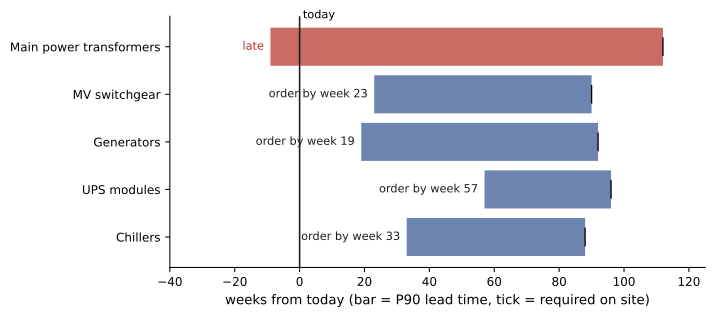
print(f"{name:25s} {lead:5d} {p90:7.0f} {order_by:12.0f} {status}")item quoted P90 lead order by week status Main power transformers 100 121 -9 late even if ordered today Medium-voltage switchgear 52 67 23 order within 23 weeks Generators 60 73 19 order within 19 weeks UPS modules 30 39 57 order within 57 weeks Chillers 40 55 33 order within 33 weeks
Using P90 lead times, the main transformers are already late: even ordered today, there is only about a 75 % chance they will arrive by week 112 when installation must start, short of the 90 % confidence the team requires. The switchgear and generators must be ordered within about five months, while the UPS and chillers can wait a year or more. The project team's choices for the transformers are to secure an existing production slot or a unit from a framework pool, redesign the schedule so transformers are needed later (for example energizing in phases), arrange temporary power, or accept and communicate the schedule risk. Calculations like this, repeated as quotes and the schedule change, should drive procurement decisions in the first months of a project.
Expediting and quality assurance
Ordering early is not enough; orders must be followed through. Expediting means monitoring the supplier's progress against milestones (engineering drawings, material procurement, core and coil manufacture, testing, shipping) and intervening when it slips. Large owners station expediters and inspectors at key factories. Quality assurance includes reviewing shop drawings and design documents, inspecting during manufacture, and attending factory acceptance testing (FAT) and factory witness tests (DCE-450), where equipment is tested against the specification before shipping. Problems found at the factory are far cheaper to fix than problems found on site. Purchase orders should specify the test procedures, witness rights, documentation (test reports, manuals, certificates), and the consequences of failed tests.
Counterfeit and non-genuine components, particularly circuit breakers and electronic parts sold through unofficial channels during shortages, are a real risk. Buying through authorized distributors, verifying certification marks, and checking serial numbers with manufacturers reduce it.
Logistics for heavy equipment
Large transformers can weigh well over 100 metric tons when shipped, generators and switchgear line-ups tens of metric tons, and prefabricated power modules may be the size of shipping containers or larger. Moving them requires planning:
- Route surveys: road widths, bridge load ratings, overhead clearances and turning radii; some routes need temporary reinforcement or removal of obstacles.
- Permits and escorts for oversize and overweight loads, which vary by province or state and may restrict travel times.
- Rail, barge or heavy-haul trucking, and port handling for imported equipment.
- Site access and laydown: heavy-haul roads, crane pads, and the sequence of setting equipment before buildings are closed in.
- Rigging plans and lift studies for cranes.
- Storage and protection: equipment that arrives before it can be installed must be stored in clean, dry, secure conditions, with heaters energized and manufacturer storage requirements met, or warranties may be voided.
Delivery terms (Incoterms such as FCA, DAP or DDP) define where risk and responsibility pass from seller to buyer; insurance must cover the equipment throughout transit.
Trade, tariffs and domestic content
Much data center equipment and many of its components are imported, so trade policy affects cost and schedule. Tariffs, quotas and export controls can change prices suddenly, and tariff policies between Canada and the United States, and with other trading partners, changed frequently in 2025 and 2026. Contracts should state who bears the risk of new or increased tariffs, often through change-in-law clauses or price adjustment provisions, and procurement teams should know the country of origin of major components.
For United States projects, trade with Canada and Mexico is governed by the USMCA, with rules of origin determining duty-free treatment, while tariffs imposed under trade laws in 2025 affected steel, aluminum and many other imports. Projects receiving federal funding may be subject to Buy American requirements, including the Build America, Buy America Act provisions for infrastructure, which set domestic content rules for iron, steel, manufactured products and construction materials.
Prefabrication and modular construction
Prefabrication moves work from the site to factories: electrical rooms built as skids or enclosures with switchgear, UPS and distribution pre-installed and tested; prefabricated generator enclosures; cooling plant modules; busway and cable tray assemblies; and even complete data hall modules. Benefits include shorter site schedules (factory and site work proceed in parallel), better quality and testing in controlled conditions, less dependence on scarce site labor, and safer work. Costs include transport, design constraints from shipping dimensions, earlier design freeze, and dependence on the integrator's factory capacity, which can itself become a bottleneck. Prefabrication works best with standardized, repeated designs, which is why hyperscale programs use it extensively.
Supply chain risk management
Supply chain risks belong in the project risk register (Lesson 5) with specific responses: early warning indicators from suppliers, alternative sources, contractual remedies, and schedule buffers for the most critical items. Mapping the supply chain beyond the first tier, to identify components such as electrical steel, semiconductors or castings that many suppliers depend on, reveals hidden single points of failure. Communication with suppliers matters as much as contracts: sharing forecasts, design standards and schedules helps suppliers plan, and suppliers who see an owner as a reliable long-term customer prioritize its orders.
Worked problem
Responding to a late transformer
Three months before scheduled delivery, the transformer manufacturer advises that delivery will slip by 20 weeks because of a shortage of core steel. Transformer installation and energization are on the critical path. What options should the project team evaluate?
Show solution
- Verify: request the revised production schedule, the root cause and recovery options from the manufacturer; check contractual remedies such as liquidated damages and termination rights.
- Alternatives: check framework pools or other projects in the program for a compatible unit that could be redirected; check secondary market availability.
- Phasing: can part of the facility be energized from the first transformer or from existing utility capacity, delivering partial capacity on time?
- Temporary power: evaluate temporary transformers or mobile substations, or temporary generation for commissioning, with permitting and fuel implications.
- Communication: inform tenants, lenders and the contractor; adjust the schedule and assess claims (owner-furnished equipment delay is usually compensable to the contractor).
Answer: Combine recovery actions from the supplier with alternatives that reduce dependence on the late unit: redirect a pooled unit, phase energization, or use temporary power. The best response depends on cost, permitting and risk, but evaluating options quickly, within days, preserves the most choices.
Warranties and spare parts strategy
Supply constraints affect operations as well as construction. If a transformer, switchgear section or generator fails after handover, a replacement may take as long to obtain as the original did. Owners therefore negotiate warranty terms (typically one to two years from energization, sometimes extended for major equipment), response times for service, and access to critical spare parts as part of the original purchase. Programs often hold strategic spares, such as a spare transformer shared among several sites, circuit breakers and controller boards, so that a failure does not leave a facility running without redundancy for months. The cost of such spares is small relative to the risk of extended operation without redundancy.
Common mistakes
MistakeWaiting for complete design before ordering transformers.
InsteadOrder or reserve slots early with standard specifications.
MistakeUsing quoted lead times as certain.
InsteadPlan with conservative percentiles and track supplier milestones.
MistakeSkipping factory testing to save time.
InsteadWitness factory acceptance tests to catch problems before shipping.
MistakeIgnoring transport routes until delivery.
InsteadSurvey routes, permits and site access early.
MistakeLeaving tariff risk unallocated.
InsteadAddress tariffs with change-in-law or price adjustment clauses.
Summary and key terms
- Transformers, switchgear and generators have had lead times of one to four years.
- Strategies include early orders, slot reservations, frameworks, standardization, dual sourcing and pooling.
- Latest order dates come from required-on-site dates minus conservative lead times.
- Expediting and factory acceptance testing keep orders on track and catch defects early.
- Heavy equipment needs route surveys, permits, rigging plans and proper storage.
- Tariffs and domestic content rules affect cost and must be allocated in contracts.
- Prefabrication shortens site schedules but needs standard designs and factory capacity.
- Lead time
- Time from order to delivery.
- Slot reservation
- A deposit reserving manufacturing capacity before specification is final.
- Expediting
- Monitoring and pushing supplier progress against milestones.
- Factory acceptance test
- Testing equipment at the factory against the specification.
- Required-on-site date
- The date equipment must arrive to support the schedule.
- Incoterms
- Standard terms defining where delivery risk passes.
- Rules of origin
- Criteria determining a product's origin for trade purposes.
- Change-in-law clause
- A clause adjusting the contract for new laws such as tariffs.
- Prefabrication
- Building assemblies off site for installation.
- Dual sourcing
- Qualifying two suppliers for the same item.
Practice problems
Work each problem on paper first, then reveal the answer to check.
Why have transformer lead times been so long?
Show answer
Custom manufacturing, limited factories, scarce materials and competing demand from utilities, renewables and data centers.
What does a slot reservation secure?
Show answer
Manufacturing capacity before the specification is final.
How is the latest order date calculated?
Show answer
Required-on-site date minus lead time and allowances for approvals and shipping.
From the output, which item is already late?
Show answer
The main power transformers.
From the output, when must generators be ordered?
Show answer
Within about 19 weeks.
Why use P90 rather than quoted lead times?
Show answer
Quoted lead times are uncertain and often optimistic.
What is the purpose of factory acceptance testing?
Show answer
To find and fix defects before equipment ships.
Name three logistics items for a 150-metric ton transformer.
Show answer
Route survey, oversize permits, heavy-haul transport, crane and rigging plan, site access.
How can contracts handle tariff changes?
Show answer
Change-in-law or price adjustment clauses.
Name two benefits of prefabricated electrical rooms.
Show answer
Shorter site schedule, better quality, less site labor, safer work.
Lesson quiz · 5 questions
Score 60% or more to complete this lesson.
Create a free account to save your progress, take quizzes and earn a certificate.