
DCE-470 · Lesson 4 of 12 · 25 min
Procurement and tendering
Procurement is the process of selecting the designers, contractors and suppliers who will deliver the project and agreeing the terms on which they will do so. Good procurement attracts capable, motivated firms, produces prices that reflect real costs and fair risk allocation, and stands up to legal challenge. Poor procurement attracts firms that plan to profit from changes, produces disputes about what was promised, and in public projects can be overturned by bid protests. This lesson covers procurement strategy and packaging, prequalification, requests for proposals and invitations to tender, evaluation methods including best value, the legal framework of tendering, procurement of designers and equipment, and the ethics of procurement.
Procurement strategy and packaging
Before inviting anyone, the owner decides how the work will be divided into packages and in what order they will be procured. Options range from a single package (one design-builder or general contractor for everything) to many packages (separate contracts for site work, foundations, structure, electrical, mechanical, commissioning, and owner-purchased equipment). Packaging decisions consider:
- Schedule: early packages for site work, long-lead equipment and utility work let the project start before the full design is complete.
- Market capacity: dividing a very large project into packages sized to the capacity of available contractors increases competition; conversely, scarce specialist trades may need to be secured early.
- Interfaces: every package boundary is an interface that someone must coordinate; too many packages shift coordination risk to the owner.
- Owner capability: managing many direct contracts requires an experienced owner team or a construction manager.
Data center owners commonly pre-purchase long-lead equipment (transformers, switchgear, generators, UPS and chillers) and later assign the purchase orders to the selected contractor, who then becomes responsible for receiving, installing and commissioning the equipment.
Prequalification
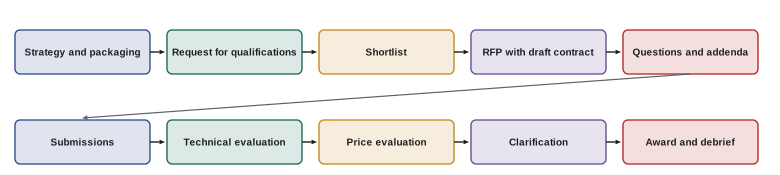
Prequalification narrows the field to firms capable of performing the work, so that the owner evaluates detailed proposals only from serious candidates and bidders are not discouraged by having to compete against unqualified firms. A request for qualifications (RFQ) or prequalification questionnaire asks for:
- Relevant experience: completed data center or mission-critical projects of similar size, with references.
- Key personnel: project manager, superintendent, commissioning lead and their experience.
- Financial capacity: revenue, backlog, bonding capacity and financial statements.
- Safety record: incident rates, experience modification rate or provincial equivalent, and safety program.
- Quality and commissioning processes, and capacity to perform the work in the project's timeframe.
Typically three to six firms are shortlisted for a major package. More than that wastes the industry's bidding effort; fewer reduces competition.
Requests for proposals and invitations to tender
The procurement documents tell bidders what is required and how they will be evaluated. An invitation to tender (ITT) or invitation to bid usually seeks prices on a complete design and awards to the lowest compliant bid. A request for proposals (RFP) seeks proposals that may include technical approach, schedule, team and price, evaluated against stated criteria. Good documents include the scope, the draft contract with all proposed amendments, the evaluation criteria and their weights, the schedule for questions and submissions, rules for communication (usually through a single contact, with answers shared with all bidders as addenda), requirements for bid security, and the owner's rights to reject bids or negotiate. Ambiguity in procurement documents produces inflated prices, qualified bids and disputes.
Evaluation methods
Owners choose among several evaluation methods:
- Lowest compliant price: simple and transparent, appropriate when the scope is fully defined and bidders are prequalified, as in design-bid-build.
- Best value: technical and price scores are combined with stated weights, often after a minimum technical threshold (two-envelope evaluation, where price envelopes are opened only for technically qualified proposals).
- Qualifications-based selection (QBS): the most qualified firm is chosen first, then the fee is negotiated; standard for engineering and architectural services, and the basis of progressive design-build and CM selection.
- Fixed price, best proposal: price is fixed by the owner and firms compete on what they will deliver for it.
The evaluation method should be stated in advance and followed exactly, both for fairness and, for public owners especially, to withstand challenge.
# Two-envelope best-value evaluation of four proposals for a design-build contract
bids = {   # technical score out of 100, price in million dollars
    "Bidder A": (82, 96.0),
    "Bidder B": (74, 88.5),
    "Bidder C": (91, 104.0),
    "Bidder D": (58, 79.0),
}
pass_mark, w_tech, w_price = 65, 0.6, 0.4
qualified = {k: v for k, v in bids.items() if v[0] >= pass_mark}
low = min(p for _, p in qualified.values())
print("disqualified on technical score:", [k for k in bids if k not in qualified])
results = []
for name, (tech, price) in qualified.items():
    price_score = 100 * low / price
    results.append((w_tech * tech + w_price * price_score, name, tech, price, price_score))
for total, name, tech, price, ps in sorted(results, reverse=True):
    print(f"{name}: technical {tech}, price {price:5.1f} M (price score {ps:5.1f}), total {total:5.1f}")
# How far would Bidder B have to cut its price to win? Price scores change because B sets the low price.
def winner(prices):
    lo = min(prices.values())
    tot = {k: w_tech * qualified[k][0] + w_price * 100 * lo / prices[k] for k in prices}
    return max(tot, key=tot.get), tot
prices = {k: v[1] for k, v in qualified.items()}
for cut in range(0, 41):
    prices["Bidder B"] = 88.5 - cut * 0.5
    win, tot = winner(prices)
    if win == "Bidder B":
        b_price = prices["Bidder B"]
        print(f"Bidder B wins only at {b_price:.1f} M or below")
breakdisqualified on technical score: ['Bidder D'] Bidder C: technical 91, price 104.0 M (price score 85.1), total 88.6 Bidder A: technical 82, price 96.0 M (price score 92.2), total 86.1 Bidder B: technical 74, price 88.5 M (price score 100.0), total 84.4 Bidder B wins only at 77.0 M or below
Bidder D, the cheapest, fails the technical threshold and is excluded before its price is considered. Among the others, Bidder C wins despite the highest price because its technical score is much stronger, and Bidder B, the lowest qualified price, would have to cut its price to 77 million dollars, about 13 % lower, to win. The weights decide the outcome: a 40 % price weight with this price-scoring formula rewards quality strongly. Owners should test their evaluation formulas with plausible scenarios before issuing the RFP, to make sure they reward what the owner actually values.
The legal framework of tendering
In the United States, public procurement is governed by statute: the Federal Acquisition Regulation (FAR) for federal projects and state and local procurement codes elsewhere, which typically require competitive sealed bidding or competitive proposals, public bid openings for sealed bids, and bid protest procedures (for federal contracts, through the agency, the Government Accountability Office or the Court of Federal Claims). Federal procurement of architectural and engineering services follows qualifications-based selection under the Brooks Act. Private owners have much more freedom: an invitation to bid is generally not an offer, and the owner may negotiate or reject bids unless its documents promise otherwise. Subcontractor bids relied on by a general contractor may be enforceable under promissory estoppel, following Drennan v. Star Paving (California, 1958), which discourages subcontractors from withdrawing bids after the general contractor has used them.
In both countries, bid shopping, where a contractor uses one subcontractor's price to pressure others after award, is widely regarded as unethical and damages trust; some owners require contractors to name subcontractors in their bids to discourage it.
Procuring designers
Designers are usually selected on qualifications, then a fee is negotiated, because the quality of design affects the whole project cost and price competition among designers tends to reduce the effort and care invested in design. Fees may be lump sum per phase, a percentage of construction cost, or hourly with a ceiling. The design contract should define the scope of services (including site visits, shop drawing review, commissioning support and record drawings), the deliverables at each phase, the standard of care, professional liability insurance, ownership and licensing of design documents, and coordination obligations with the owner's other consultants. For data centers, the owner often also engages an owner's engineer to review designs and contractor submissions independently.
Procuring equipment
Major equipment is procured on technical specifications with performance requirements, tested to stated standards, often with factory witness testing (DCE-450). Evaluation considers price, delivery date, efficiency and lifecycle cost, local service capability, warranty, compliance with standards and certifications, and the manufacturer's track record. Equipment contracts specify delivery terms (Incoterms for imports), payment milestones (often with significant deposits for long-lead items), liquidated damages for late delivery, storage and protection, documentation and spare parts. Where equipment will later be assigned to a contractor, the assignment terms must be agreed with the supplier at the outset. Large owners negotiate framework agreements that reserve manufacturing slots in advance (Lesson 8).
Clarification and negotiation
After evaluation, owners usually clarify proposals and may negotiate with the preferred bidder, if the documents allow it. Clarification confirms what is included, resolves qualifications and exclusions in the bid, and aligns assumptions, for example about site conditions or owner-furnished items. Owners should avoid using clarification to change the basis of competition, or negotiating prices downward with the winning bidder using information from others, which is unfair and, for public owners, may breach procurement rules. The principles of negotiation in Lesson 9 apply: be clear about interests, prepare alternatives, and focus on terms that create value for both sides, such as schedule incentives or risk-sharing arrangements.
Ethics in procurement
Procurement concentrates large sums and discretion, so it attracts ethical risks: conflicts of interest, gifts and hospitality, leaks of confidential pricing, bid rigging and collusion among bidders, and corruption. Safeguards include conflict-of-interest declarations by evaluators, separation of evaluation and approval roles, documented evaluations, confidentiality rules, single points of contact, and audit trails. Bid rigging is a criminal offense in both Canada and the United States, and bribery of foreign officials is prohibited by the Corruption of Foreign Public Officials Act in Canada and the Foreign Corrupt Practices Act in the United States, which matter for owners and contractors working internationally. Professional engineers also have codes of ethics requiring fairness and integrity in procurement.
Worked problem
Responding to a qualified bid
The lowest bid on an electrical package excludes "all work associated with utility metering" and assumes 8-hour work days, while the tender requires metering work and allows 10-hour days. The second-lowest bid is fully compliant and 2 % higher. What should the owner consider?
Show solution
- Check the tender documents: do they permit the owner to accept bids with qualifications, waive minor irregularities, or seek clarification?
- Assess materiality: excluding a scope item changes the price basis; if the qualification could affect ranking, accepting it may be unfair to other bidders.
- For a public owner, accepting a materially non-responsive bid may be grounds for a bid protest; a private owner has more latitude but should treat bidders consistently.
- Estimate the cost of the excluded work: if adding it makes the low bid higher than the second, the decision is clear.
Answer: Treat material qualifications as non-compliance unless the documents clearly allow otherwise. The safest course is usually to award to the lowest compliant bid, or to clarify with all bidders on equal terms if the documents permit. Writing clear scope and compliance rules in the first place avoids the dilemma.
Common mistakes
MistakeIssuing RFPs without stating evaluation criteria and weights.
InsteadPublish criteria and weights and follow them exactly.
MistakeInviting too many bidders to a complex package.
InsteadPrequalify and shortlist three to six capable firms.
MistakeSelecting designers mainly on lowest fee.
InsteadUse qualifications-based selection, then negotiate the fee.
MistakeAccepting materially qualified bids to save money.
InsteadTreat material qualifications as non-compliance or clarify with all bidders fairly.
MistakeShopping subcontractor bids after award.
InsteadRespect bids received; consider naming subcontractors at bid time.
Summary and key terms
- Procurement strategy decides packaging, sequence and pre-purchase of long-lead equipment.
- Prequalification shortlists capable firms on experience, people, finances, safety and capacity.
- ITTs seek prices on complete designs; RFPs evaluate approach, team, schedule and price.
- Evaluation methods include lowest price, best value, QBS and fixed price best proposal.
- US public procurement follows FAR and state codes with protests; private owners have more freedom.
- Designers are selected on qualifications; equipment on performance, delivery and lifecycle cost.
- Ethics safeguards prevent conflicts, collusion and corruption.
- Packaging
- Dividing project work into separately procured contracts.
- Prequalification
- Screening firms for capability before inviting proposals.
- RFQ
- Request for qualifications.
- RFP
- Request for proposals.
- ITT
- Invitation to tender, seeking prices on a defined scope.
- Two-envelope evaluation
- Technical evaluation before price envelopes are opened.
- QBS
- Qualifications-based selection followed by fee negotiation.
- Bid security
- A bond or deposit guaranteeing that a bidder will sign if awarded.
- Bid shopping
- Using one subcontractor's price to pressure others after award.
- Addendum
- A formal change or clarification to procurement documents issued to all bidders.
Practice problems
Work each problem on paper first, then reveal the answer to check.
Why do data center owners pre-purchase long-lead equipment?
Show answer
To secure delivery dates before the contractor is selected.
Name four items assessed in prequalification.
Show answer
Experience, key personnel, financial capacity, safety record, capacity.
How many firms are typically shortlisted?
Show answer
Three to six.
What is a two-envelope evaluation?
Show answer
Technical proposals are scored first; prices are opened only for those passing.
From the output, which bidder wins and why?
Show answer
Bidder C, because its high technical score outweighs its higher price.
From the output, what price would Bidder B need to win?
Show answer
77.0 million dollars or less.
What procedure lets an unsuccessful federal bidder challenge an award?
Show answer
A bid protest to the agency, GAO or Court of Federal Claims.
Why are designers usually selected on qualifications?
Show answer
Design quality affects total project cost far more than the design fee.
What should equipment contracts specify about late delivery?
Show answer
Liquidated damages and delivery terms.
Name two safeguards against procurement corruption.
Show answer
Conflict declarations, separation of roles, documented evaluations, confidentiality, audit trails.
Lesson quiz · 5 questions
Score 60% or more to complete this lesson.
Create a free account to save your progress, take quizzes and earn a certificate.