
DCE-470 · Lesson 1 of 12 · 24 min
Data center projects and the project life cycle
Data centers are among the most demanding construction projects in the built environment. A single campus can cost billions of dollars, involve hundreds of contractors and suppliers, depend on utility connections that take years to secure, and carry a market value that is lost for every month it is late. Engineering excellence is necessary but not sufficient: a technically perfect design that cannot be procured, permitted, built and energized on time fails its owner. This course is about delivering data center projects: choosing how a project is organized and contracted, procuring designers, contractors and equipment, managing schedule, cost, risk and supply chains, and negotiating with the contractors, utilities, municipalities and communities whose agreement every project needs. This first lesson sets the scene: the characteristics of data center projects, the project life cycle and its decision gates, the stakeholders, and why time is the dominant variable.
The course builds on the engineering courses in this program and on ENGG-401 (engineering management). Lessons 2 to 4 cover delivery models, contracts and procurement. Lessons 5 to 8 cover risk, scheduling, cost and the supply chain. Lessons 9 to 11 cover negotiation in general and with utilities, municipalities and communities in particular, and Lesson 12 covers claims, disputes, closeout and a capstone project.
What makes data center projects different
Data center projects share the characteristics of other complex buildings, such as hospitals and laboratories, but several features set them apart:
- Mechanical and electrical intensity: the mechanical, electrical and plumbing (MEP) systems account for most of the cost, often 60 % to 70 % of construction cost, compared with 30 % to 40 % for an office building. Equipment such as transformers, switchgear, generators, UPS systems and chillers dominates the budget and the schedule.
- Power: the facility depends on a utility connection of tens to hundreds of megawatts, which may require new substations and transmission lines and years of planning. Power availability has become the main constraint on where and when data centers can be built.
- Speed to market: owners, especially hyperscale cloud and AI companies and colocation providers with signed tenants, value each month of earlier completion highly, because capacity generates revenue as soon as it is live.
- Repetition and standardization: large operators build the same design many times, so programs of projects rather than single buildings are the norm, with framework agreements, standard designs and prefabricated modules.
- Phasing: campuses are built in phases, often with later phases constructed next to live, operating data halls where outages are unacceptable.
- Commissioning: rigorous, multi-level commissioning (DCE-450) must be completed before the facility can carry critical load, and is often squeezed by delays earlier in the schedule.
- Rapid technology change: rack densities and cooling technologies, particularly for AI workloads with liquid cooling, may change during design or construction, driving design changes.
Scale and cost
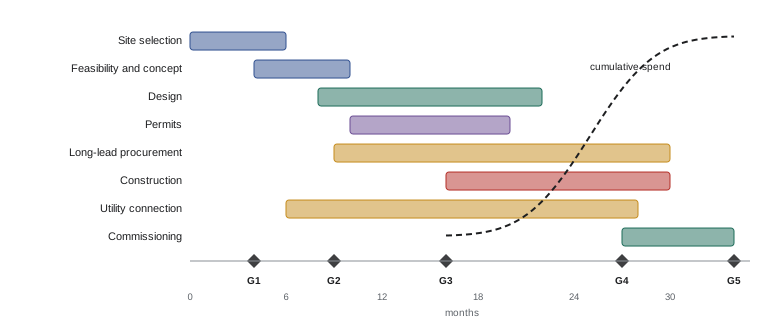
Costs vary widely with location, resilience level, density and scope, but a common rule of thumb in North America in the mid-2020s has been roughly 8 to 15 million dollars of construction cost per megawatt of critical IT load for the shell, core and MEP infrastructure, with high-density AI facilities and campuses requiring new substations at the upper end or beyond. A 40 MW facility therefore represents several hundred million dollars before IT equipment, which itself may cost several times more. Spending follows an S-curve: slow during design and early works, rapid during building and MEP installation, and tapering during commissioning.
import numpy as np
# Capital spend over a 30-month build of a 40 MW facility, as an S-curve, and the cost of a 3-month delay
months = np.arange(1, 31)
capex_total = 40 * 11.0e6                    # dollars, assuming 11 million dollars per MW
weights = np.exp(-0.5 * ((months - 17) / 6.5) ** 2)
monthly = capex_total * weights / weights.sum()
cumulative = np.cumsum(monthly)
for m in (6, 12, 18, 24, 30):
    print(f"month {m:2d}: spent {cumulative[m - 1] / 1e6:6.1f} M ({cumulative[m - 1] / capex_total:5.1%})")
# Revenue the facility would earn once live, and the value of finishing three months later
revenue_per_mw_month = 150_000              # dollars of lease revenue per MW per month
lost = 3 * 40 * revenue_per_mw_month
interest = 0.07 / 12 * capex_total * 3      # carrying cost of capital during the delay
print(f"three-month delay: lost revenue {lost / 1e6:.1f} M, extra financing {interest / 1e6:.1f} M, "
f"total {(lost + interest) / 1e6:.1f} M = {(lost + interest) / capex_total:.1%} of capex")month 6: spent 21.4 M ( 4.9%) month 12: spent 107.6 M (24.5%) month 18: spent 264.2 M (60.0%) month 24: spent 392.5 M (89.2%) month 30: spent 440.0 M (100.0%) three-month delay: lost revenue 18.0 M, extra financing 7.7 M, total 25.7 M = 5.8% of capex
Only about a quarter of the money is spent in the first twelve months, while the decisions that fix most of the cost and schedule are made in that period. And the cost of delay is large: three months of lost lease revenue and financing cost amount to about 26 million dollars, nearly 6 % of the capital cost in this example. This is why owners will pay premiums for faster delivery, why early procurement of long-lead equipment is routine, and why the contracts studied in this course devote so much attention to time.
The project life cycle
Most organizations divide a project into phases separated by decision gates, at which the sponsor reviews progress, risk and the business case and decides whether to continue. A typical data center project life cycle is:
- Strategy and site selection: defining the business need (capacity, location, timing, tenant requirements), screening sites for power, fiber, land, water, hazards and incentives, and securing land options.
- Feasibility and concept: confirming power availability with the utility, early environmental and planning studies, concept design, a Class 4 or 5 cost estimate (Lesson 7), and choosing the delivery model (Lesson 2).
- Design: schematic design, design development and construction documents (or a design-builder's design), with permits and approvals running in parallel.
- Procurement: selecting contractors and ordering long-lead equipment, often before design is complete.
- Construction: site work, building, MEP installation and utility connection.
- Commissioning and handover: testing at every level, integrated systems testing, training, documentation and turnover to operations (DCE-450).
- Operation and closeout: final payments, warranty period, lessons learned, and planning the next phase.
In fast-track projects, these phases overlap heavily: procurement of transformers begins during concept design, site work during design development, and construction of early phases during design of later ones. Overlap saves time but increases the risk of changes and rework, which is why delivery models and contracts that handle evolving designs matter.
Stakeholders
A data center project involves many parties with different interests:
- The owner (developer, hyperscaler, colocation provider or enterprise), and within it the real estate, engineering, operations, finance and legal teams, who may not agree on priorities.
- Tenants or end users, whose requirements (capacity, density, resilience, timing) drive the design, and whose contracts may impose penalties for late delivery.
- Lenders and investors, who require cost and schedule certainty and may appoint independent engineers to monitor the project.
- Designers: architects, electrical, mechanical, structural, civil and fire protection engineers, and specialist consultants.
- Contractors: general contractors, construction managers or design-builders, and electrical, mechanical and other trade contractors.
- Equipment manufacturers and suppliers, whose delivery dates often control the schedule.
- The electric utility and transmission operator, who control the most critical input.
- Municipalities and other authorities having jurisdiction, who control land use, building permits and inspections.
- Communities, neighbors and Indigenous nations, whose support or opposition can determine whether a project proceeds.
Managing these relationships, through contracts, communication and negotiation, is as much a part of project delivery as managing the work itself.
The iron triangle and its limits
Projects are traditionally judged on scope (including quality), time and cost, the iron triangle: improving one usually costs another. For data centers, the triangle is unbalanced: time often dominates, and owners willingly spend more to deliver sooner. But speed is not free: compressing schedules increases the risk of errors, safety incidents and rework, and some activities, such as utility upgrades and transformer manufacturing, cannot be compressed by spending more. Experienced project leaders identify early which constraints are truly fixed and focus effort there. Modern project management adds further measures of success: safety (zero serious injuries), quality and reliability in operation, sustainability (DCE-460), and the relationships preserved for the next project.
Project governance
Governance defines who decides what. A typical owner organization has a project sponsor accountable for the business case, a project director or manager responsible for delivery, a steering committee that approves gate decisions and major changes, and defined authority limits for approving change orders and spending. Clear governance prevents two common failures: decisions that wait for weeks because no one is authorized to make them, and uncontrolled changes made directly between designers, contractors and operations staff without considering cost and schedule. Documents that formalize governance include a project charter, a responsibility assignment matrix (RACI), a change control procedure, and a reporting cycle with standard dashboards for schedule, cost, risk and safety.
Worked problem
Setting authority limits
A 440 million dollar project has an approved contingency of 25 million dollars. Propose authority limits for approving changes.
Show solution
- Project manager: individual changes up to 250,000 dollars, within the contingency, reported monthly.
- Project director: individual changes up to 2 million dollars, or cumulative changes up to 10 million dollars.
- Steering committee: changes above 2 million dollars, any change affecting the completion date or tenant commitments, and any use of contingency beyond 10 million dollars.
- Executive or board: any increase in the total approved budget.
Answer: Graduated authority limits let routine changes proceed quickly while escalating significant cost, schedule and scope decisions to people who can weigh them against the business case. Limits should be written into the project charter and the contracts' change procedures.
Lessons from troubled projects
Reviews of large projects consistently find the same root causes of overruns: optimistic early estimates and schedules, incomplete scope at the time of contract, late design changes, inadequate risk allocation, poor coordination between trades, late equipment, and adversarial relationships that turn problems into disputes. Data center projects add their own: underestimating the time for utility connections and permits, ordering equipment too late, and allowing changes in density or cooling technology late in design. Most of these causes are determined before construction starts, by the choices covered in Lessons 2 to 8. The course returns to them repeatedly.
Common mistakes
MistakeTreating delivery as an afterthought to engineering.
InsteadChoose delivery model, contracts and procurement strategy early.
MistakeAssuming spending more can always buy time.
InsteadIdentify fixed constraints such as utility work and transformer lead times early.
MistakeLeaving authority for changes undefined.
InsteadSet graduated authority limits in the project charter.
MistakeFocusing only on contractors.
InsteadManage utilities, municipalities, communities and lenders as key stakeholders.
MistakeStarting construction with incomplete scope and optimistic estimates.
InsteadUse gate reviews, realistic estimates and contingency.
Summary and key terms
- Data center projects are MEP-intensive, power-dependent, fast-track and often repeated as programs.
- Costs of roughly 8 to 15 million dollars per MW mean large capital at risk.
- Spending follows an S-curve; early decisions fix most cost and schedule.
- Delay is expensive: lost revenue and financing costs accumulate monthly.
- The life cycle runs from strategy to closeout with decision gates; fast-track overlaps phases.
- Many stakeholders, especially utilities and municipalities, shape outcomes.
- Governance defines decisions, authority limits and change control.
- Project life cycle
- The sequence of phases from concept to closeout.
- Decision gate
- A review point where continuation of a project is approved.
- Fast-track
- Overlapping design, procurement and construction to save time.
- S-curve
- The shape of cumulative spending or progress over time.
- Iron triangle
- The trade-off between scope, time and cost.
- Project sponsor
- The person accountable for the business case.
- Steering committee
- A group that approves major project decisions.
- RACI
- A matrix of who is responsible, accountable, consulted and informed.
- Authority limit
- The maximum value a role may approve.
- Long-lead equipment
- Equipment whose manufacturing time drives the schedule.
Practice problems
Work each problem on paper first, then reveal the answer to check.
Why are MEP systems more important in data centers than in offices?
Show answer
They account for most of the cost and schedule, often 60 % to 70 % of construction cost.
Estimate the construction cost of a 25 MW facility at 11 million dollars per MW.
Show answer
About 275 million dollars.
From the output, what share of capex is spent by month 12?
Show answer
About 24.5 %.
From the output, what does a three-month delay cost?
Show answer
About 25.7 million dollars, 5.8 % of capex.
What happens at a decision gate?
Show answer
The sponsor reviews progress, risk and the business case and decides whether to continue.
What is the main risk of fast-tracking?
Show answer
Changes and rework as design evolves during procurement and construction.
Name four external stakeholders of a data center project.
Show answer
Utility, municipality, community, lenders, tenants, suppliers.
Why can the iron triangle mislead data center teams?
Show answer
Time dominates and some constraints cannot be bought down with money.
What does a RACI matrix define?
Show answer
Who is responsible, accountable, consulted and informed for each task.
Name three common root causes of project overruns.
Show answer
Optimistic estimates, incomplete scope, late changes, poor risk allocation, late equipment.
Lesson quiz · 5 questions
Score 60% or more to complete this lesson.
Create a free account to save your progress, take quizzes and earn a certificate.