
DCE-470 · Lesson 2 of 12 · 25 min
Project delivery models
A project delivery model defines how the owner organizes design and construction: who is contracted to whom, when the builder becomes involved, who carries the risk of design errors and cost overruns, and how the price is determined. The choice of model is one of the most consequential early decisions on a project, because it shapes the schedule, the owner's control over design, the allocation of risk, and the relationships among the parties for years. This lesson describes the main models used for data centers (design-bid-build, construction management, design-build in its stipulated and progressive forms, integrated project delivery, and engineering, procurement and construction management), explains how to choose among them, and considers program-level approaches used by owners who build many facilities.
Design-bid-build
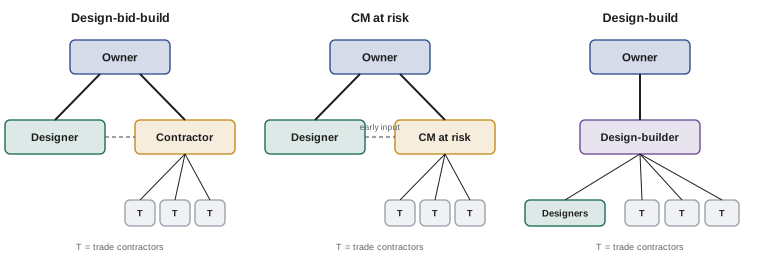
In design-bid-build (DBB), the traditional model, the owner hires designers to prepare complete construction documents, then invites contractors to bid on the finished design, and awards a contract, usually to the lowest compliant bidder, for a stipulated (lump sum) price. The owner holds two separate contracts, one with the design team and one with the contractor, and stands between them.
- Advantages: the owner controls the design in detail; competitive bidding on a complete design gives a firm price and apparent fairness, which is why public owners often require it; roles are familiar and well tested in law.
- Disadvantages: it is slow, because construction cannot start until design is complete and bidding has finished; the contractor has no input into constructability, cost or equipment choices during design; and the owner carries the risk of errors and omissions in the design, which turn into change orders and disputes between designer and contractor. Low-bid selection can attract contractors who plan to recover margin through changes.
For data centers, pure DBB is uncommon except for smaller enterprise or public-sector projects, because it is too slow and because long-lead equipment must be ordered before the contractor is selected.
Construction management
Construction management brings a builder into the project during design. The construction manager (CM) advises on cost, constructability, scheduling and procurement while the design develops, then manages construction. There are two main forms:
- CM as agent (CM for services, or CM advisor): the CM is a consultant to the owner, paid a fee, and does not hold the trade contracts or take cost risk; the owner contracts directly with the trade contractors.
- CM at risk (CMAR, or CM for services and construction): the CM becomes the constructor, holds the trade contracts, and commits to deliver the project for a guaranteed maximum price (GMP), usually established when design is sufficiently advanced. Costs above the GMP are borne by the CM (except for owner-directed changes); savings below it are returned to the owner or shared.
CM at risk is widely used for data centers because it allows early contractor involvement, early trade packages (for example, site work and foundations awarded while the building design is finished), and a price commitment, while the owner keeps a separate contract with the designer and retains control of design. The difficulty lies in setting the GMP: set too early, it carries large contingencies; set late, much of the benefit of price certainty is lost.
Design-build
In design-build (DB), the owner contracts with one entity, the design-builder, which is responsible for both design and construction. The design-builder is typically a contractor with designers as subconsultants, or a joint venture. The owner provides a statement of requirements (the owner's project requirements or bridging documents), and the design-builder develops the design and builds it.
- Advantages: single-point responsibility: if the design does not work, the design-builder cannot blame the designer, because it is the designer. Design and construction overlap naturally, saving time; the builder's knowledge improves constructability and cost from the start; and change orders arising from design errors largely disappear.
- Disadvantages: the owner gives up detailed control of design, so requirements must be specified carefully in performance terms; price competition is based on incomplete designs, so bidders add contingency or propose lower-quality solutions; and checking that the design meets requirements needs strong owner technical staff or an owner's engineer.
In stipulated-price design-build, the price is fixed at contract award on the basis of the owner's requirements and a preliminary design. In progressive design-build (PDB), the design-builder is selected mainly on qualifications and fees, then develops the design in collaboration with the owner, with the price agreed (often as a GMP) at a later stage when design is sufficiently advanced; if the parties cannot agree, the owner can take the design and procure construction elsewhere. Progressive design-build has become popular for complex and fast-moving projects, including data centers, because it combines early collaboration with an off-ramp.
Integrated project delivery
Integrated project delivery (IPD) goes further in collaboration. The owner, designer and constructor (and sometimes key trade contractors) sign a single multi-party agreement. They jointly develop the design and plan, share risk and reward, typically by putting their profit at risk against agreed targets for cost and schedule and sharing savings, and usually waive claims against each other except in cases such as wilful misconduct. Decisions are made by a joint management team. IPD aims to align everyone's interests with the project's overall outcome rather than with their individual contracts. It requires sophisticated, trusting parties and strong leadership, and is used most where complexity and uncertainty are high, for example in hospitals and some technology facilities. Lean construction methods, such as target value design and pull planning, are commonly associated with IPD.
In the United States, AIA documents such as C191 (multi-party agreement) and ConsensusDocs 300 (tri-party collaborative agreement) provide standard IPD forms.
EPCM and owner-managed delivery
Some large owners, especially those building many facilities, use engineering, procurement and construction management (EPCM): a firm is engaged to engineer the project, procure equipment and materials on the owner's behalf, and manage the construction contractors, while the owner holds the supply and construction contracts and their risk. Similar is engineering, procurement and construction (EPC), a turnkey model common in power and industrial projects, where one contractor delivers a complete facility for a fixed price and schedule. Some hyperscale operators run their own owner's engineering and procurement teams, buy major equipment directly through global framework agreements, and engage general contractors on cost-reimbursable or GMP terms for installation. Owner-furnished equipment gives control over long-lead items and volume pricing, but makes the owner responsible for delivering equipment on time and coordinating its interfaces.
Choosing a delivery model
No model is best for every project. The choice depends on the owner's priorities, capabilities and constraints:
- Speed: design-build and progressive design-build are fastest; CM at risk allows early packages; DBB is slowest.
- Price certainty and its timing: DBB and stipulated design-build give a firm price at award; CMAR and PDB give a GMP later.
- Owner control of design: highest in DBB and CMAR, lowest in stipulated design-build.
- Risk transfer: design-build transfers design risk; DBB leaves design risk with the owner.
- Owner capability: DBB and EPCM need strong owner management; design-build needs strong requirements and review capability; IPD needs collaborative culture.
- Legal and policy constraints: public owners may be required to use particular procurement methods.
- Market conditions: in a busy market, qualified contractors may decline risky lump-sum bids, favoring collaborative models.
A structured way to choose is a weighted scoring matrix: list the criteria, weight them according to the owner's priorities, score each model against each criterion for the specific project, and compare totals. The scores are judgments, but the process forces explicit discussion of priorities and trade-offs.
# Weighted scoring of delivery models for a 40 MW data center with a tight schedule
criteria = {"speed to market": 0.30, "price certainty": 0.20, "owner control of design": 0.15,
            "risk transfer": 0.15, "innovation and early contractor input": 0.10, "owner staff effort": 0.10}
scores = {   # 1 = poor, 5 = excellent, for this project
    "Design-bid-build":       [1, 4, 5, 3, 1, 2],
    "CM at risk":             [4, 3, 4, 3, 4, 3],
    "Design-build":           [5, 4, 2, 5, 4, 4],
    "Progressive design-build": [5, 3, 3, 4, 5, 3],
    "IPD":                    [4, 2, 4, 2, 5, 2],
}
weights = list(criteria.values())
ranked = sorted(((sum(w * s for w, s in zip(weights, sc)), name) for name, sc in scores.items()), reverse=True)
for total, name in ranked:
    print(f"{name:26s} {total:.2f}")
# Sensitivity: what if price certainty matters most?
criteria2 = [0.15, 0.40, 0.15, 0.15, 0.05, 0.10]
print("with price certainty weighted 0.40:")
for total, name in sorted(((sum(w * s for w, s in zip(criteria2, sc)), n) for n, sc in scores.items()), reverse=True)[:3]:
print(f" {name:24s} {total:.2f}")Design-build 4.15 Progressive design-build 3.95 CM at risk 3.55 IPD 3.20 Design-bid-build 2.60 with price certainty weighted 0.40: Design-build 4.00 Progressive design-build 3.55 CM at risk 3.35
With speed weighted most heavily, design-build scores highest, followed by progressive design-build and CM at risk; design-bid-build ranks last. Raising the weight on price certainty does not change the leader here, but narrows the gap and moves CM at risk closer. Sensitivity checks like this show whether the choice is robust or depends on a narrow set of assumptions. In practice, many data center owners choose design-build or CM at risk for a first facility and then shift to programmatic models with standard designs as they repeat.
Programs and framework agreements
Owners building many data centers treat them as a program: a portfolio of similar projects delivered with standard designs, standard specifications, pre-negotiated framework agreements with contractors and suppliers, and continuous improvement from project to project. Framework agreements commit volumes or preferred status in exchange for reserved capacity, pricing formulas, and dedicated teams, which is particularly valuable when equipment and skilled labor are scarce. Programs also make prefabrication and modular construction worthwhile: power skids, electrical rooms, cooling modules and even complete data halls are built in factories and shipped to sites, reducing site labor and schedule (Lesson 8). The trade-off is reduced flexibility: standard designs must be adapted to local codes, climates and utility arrangements, and commitments to particular suppliers may become liabilities if technology changes.
Worked problem
Choosing a model for a first enterprise data center
A regional bank plans its first 4 MW data center on land it owns. It has a small facilities team, wants high control over design to meet regulatory resilience requirements, needs completion in 30 months, and its procurement policy requires competitive selection. Recommend a delivery model.
Show solution
- Speed: 30 months for 4 MW is achievable without extreme fast-tracking.
- Control: high control of design favors separate designer contract (DBB or CMAR) over design-build.
- Capability: a small team will benefit from a CM who advises on cost and schedule during design.
- Procurement: competitive selection of the CM on qualifications and fees satisfies policy.
- Long-lead equipment: the CM can pre-purchase generators and switchgear early on the bank's behalf.
Answer: CM at risk, with an independent design team and an owner's engineer experienced in data centers. The GMP is set at about 60 % to 90 % design completion, with early packages for site work and long-lead equipment. If the bank had stronger performance requirements and less need to control details, progressive design-build would also be reasonable.
Common mistakes
MistakeDefaulting to design-bid-build because it is familiar.
InsteadAssess speed, control, risk and capability for each project.
MistakeChoosing design-build without clear performance requirements.
InsteadWrite detailed owner's project requirements and provide review capability.
MistakeSetting a GMP before design is mature enough.
InsteadTime the GMP so contingencies are reasonable, using early packages if needed.
MistakeAdopting IPD without collaborative culture.
InsteadUse IPD only with experienced, trusting parties and strong leadership.
MistakeIgnoring the owner's role with owner-furnished equipment.
InsteadPlan delivery, storage, interfaces and responsibility for owner-supplied items.
Summary and key terms
- Delivery models define contracts, timing of builder involvement, risk and pricing.
- Design-bid-build gives control and firm prices on complete designs but is slow.
- CM at risk brings the builder in early and commits to a GMP.
- Design-build gives single-point responsibility and speed; progressive DB adds collaboration and an off-ramp.
- IPD shares risk and reward among owner, designer and builder in one agreement.
- EPCM and owner-managed procurement give large owners control over equipment and programs.
- Choose with weighted criteria, sensitivity checks and attention to owner capability.
- Design-bid-build
- Design completed before contractors bid a stipulated price.
- CM at risk
- A construction manager who holds trade contracts and commits to a GMP.
- CM as agent
- A construction manager acting as the owner's consultant without cost risk.
- GMP
- Guaranteed maximum price.
- Design-build
- One contract for both design and construction.
- Progressive design-build
- Design-build with collaborative design development and later pricing.
- IPD
- Integrated project delivery with a multi-party agreement and shared risk.
- EPCM
- Engineering, procurement and construction management on the owner's behalf.
- Owner's project requirements
- The owner's documented performance requirements.
- Framework agreement
- A pre-negotiated agreement covering multiple future projects.
Practice problems
Work each problem on paper first, then reveal the answer to check.
Why is design-bid-build slow?
Show answer
Construction waits for complete design and bidding.
Who carries design error risk in DBB?
Show answer
The owner, through its designer.
What is the difference between CM as agent and CM at risk?
Show answer
CM at risk holds trade contracts and commits to a GMP; CM as agent is a consultant without cost risk.
What is the main advantage of design-build?
Show answer
Single-point responsibility for design and construction, and speed.
What off-ramp does progressive design-build provide?
Show answer
If price cannot be agreed, the owner can take the design and procure construction elsewhere.
What do IPD parties usually put at risk?
Show answer
Their profit, against shared cost and schedule targets.
From the output, which model scores highest with speed weighted at 0.30?
Show answer
Design-build, at 4.15.
Why perform a sensitivity check on the scoring?
Show answer
To see whether the choice depends on uncertain weights.
What does a framework agreement offer in a tight market?
Show answer
Reserved capacity, pricing formulas and dedicated teams.
Name a risk of owner-furnished equipment.
Show answer
The owner becomes responsible for timely delivery and interface coordination.
Lesson quiz · 5 questions
Score 60% or more to complete this lesson.
Create a free account to save your progress, take quizzes and earn a certificate.