
DCE-470 · Lesson 5 of 12 · 25 min
Risk allocation, contingency, insurance and bonds
Every project is a bet on an uncertain future: ground conditions, equipment deliveries, utility schedules, labor availability, prices and the owner's own requirements may all turn out differently from the plan. Risk management is the discipline of identifying these uncertainties, understanding their likely effects, deciding how to respond, and allocating them sensibly among the parties. Contracts allocate risk; insurance and surety bonds transfer some of it to third parties; contingency budgets and float absorb what remains. This lesson covers the risk management process, quantitative analysis with Monte Carlo simulation, principles of risk allocation, the major risks of data center projects, insurance, bonds and other security, and delay risk.
The risk management process
Standards such as ISO 31000 and the PMI practice guides describe a cycle of identifying, analyzing, responding to and monitoring risks:
- Identify: workshops with the project team, designers, contractors and operators, checklists from past projects, and assumptions reviews produce a risk register listing each risk with its cause, event and consequence.
- Analyze: each risk is assessed for probability and impact on cost, schedule, safety and reputation, first qualitatively on a probability-impact matrix and then, for significant risks, quantitatively with ranges.
- Respond: for each risk, choose a strategy: avoid (change the plan to eliminate it), transfer (by contract, insurance or bonds), mitigate (reduce probability or impact), or accept (carry it with contingency). Positive risks, or opportunities, can be exploited or enhanced.
- Monitor: review the register regularly, assign owners to each risk, track triggers and update analyses as the project progresses.
A risk register is only useful if it changes decisions. Registers that are filled in once and filed away are a common failure; the best projects review the top risks at every progress meeting and link responses to actions with owners and dates.
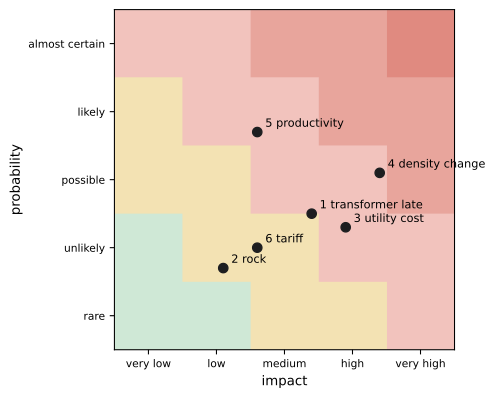
Quantitative risk analysis and contingency
The qualitative matrix ranks risks, but setting a contingency budget requires numbers. Monte Carlo simulation models each risk with a probability of occurring and a range of impacts, typically a three-point estimate (low, most likely, high), then simulates thousands of possible project outcomes. The result is a distribution of total cost (or completion date), from which the owner chooses a confidence level: a P50 estimate is equally likely to be exceeded or not; a P80 estimate is exceeded only 20 % of the time.
import numpy as np
# Monte Carlo of a project risk register to set contingency
rng = np.random.default_rng(5)
n = 200_000
base = 440.0                                   # million dollars, base estimate
risks = [  # name, probability, low, most likely, high impact (million dollars)
    ("transformer delivery late", 0.35, 2, 6, 15),
    ("rock found in excavation", 0.20, 1, 3, 8),
    ("utility connection cost increase", 0.30, 3, 8, 20),
    ("design change for higher rack density", 0.40, 4, 10, 25),
    ("labor productivity below plan", 0.50, 2, 5, 12),
    ("tariff on imported switchgear", 0.25, 2, 5, 10),
]
total = np.full(n, base)
for name, p, lo, ml, hi in risks:
    occurs = rng.random(n) < p
    total += occurs * rng.triangular(lo, ml, hi, n)
expected = sum(p * (lo + ml + hi) / 3 for _, p, lo, ml, hi in risks)
p50, p80, p90 = np.percentile(total, [50, 80, 90])
print(f"expected risk cost {expected:.1f} M")
print(f"P50 {p50:.1f} M, P80 {p80:.1f} M, P90 {p90:.1f} M")
print(f"contingency for P80 confidence: {p80 - base:.1f} M ({(p80 - base) / base:.1%} of base)")expected risk cost 16.4 M P50 455.4 M, P80 465.5 M, P90 470.9 M contingency for P80 confidence: 25.5 M (5.8% of base)
The expected value of the risks is about 16 million dollars, but the P80 cost is about 465 million, so a contingency of about 25 million dollars, roughly 6 % of the base, gives 80 % confidence of staying within budget. Public agencies and lenders commonly require P80 or P90 budgets for major projects. The simulation also shows which risks contribute most to the spread, guiding mitigation: here, design changes for higher rack density contribute most, followed by labor productivity and utility connection costs; the owner can influence the first and last through early design decisions and negotiation with the utility. Separate contingencies are often held for known-unknowns within the design (design contingency, carried by the designer or contractor) and for risks to the owner's scope (owner's contingency, controlled by the steering committee).
Principles of risk allocation
Contracts allocate risk, and the allocation determines price, behavior and the likelihood of disputes. Widely accepted principles are:
- Allocate each risk to the party best able to control it: the contractor controls means and methods, productivity and the quality of its work; the owner controls its requirements, decisions, site information and owner-furnished equipment.
- Where no one controls a risk, allocate it to the party best able to bear it or insure it, or share it.
- Make the allocation clear: ambiguous allocation produces disputes, because each party assumes the other carries the risk.
- Remember the price of transfer: a contractor asked to carry an uncontrollable risk adds a premium sized for the bad case, and the owner pays it even if the risk never occurs; if the premium is inadequate, the contractor may fail, and the owner suffers anyway.
A classic example is the differing site conditions clause: if subsurface conditions differ materially from those indicated in the contract documents or normally encountered, the contractor is entitled to an adjustment. This allows bidders to price the conditions described in a geotechnical report rather than adding large contingencies for unknown ground, and the owner pays only if bad conditions actually occur.
Major risks on data center projects
- Utility power: delays to connection or substation work, changes to cost allocation, and capacity limits. Largely outside the contractor's control; usually an owner risk managed through early utility engagement (Lesson 10).
- Long-lead equipment: late or defective deliveries of transformers, switchgear and generators. Mitigated by early orders, framework agreements, factory inspections and contractual liquidated damages (Lesson 8).
- Design changes driven by technology: changes to rack density, liquid cooling or power architecture during design or construction. Owner risk, managed by freezing design decisions at defined points and designing flexibility for future change.
- Site conditions: rock, contamination, groundwater and archaeology. Managed by investigation and differing site conditions clauses.
- Labor: shortages of electricians, pipefitters and commissioning specialists, especially where several large projects compete in one region, reducing productivity and increasing cost.
- Price escalation and tariffs: rising prices for copper, steel and equipment, and trade tariffs on imported components. Managed by early purchase, price adjustment clauses tied to published indices, and supply diversification.
- Permitting and community opposition: delays to approvals and conditions imposed (Lesson 11).
- Commissioning failures: defects found late in integrated testing that delay readiness for service.
Insurance
Insurance transfers the financial consequences of defined accidental losses to insurers. Construction projects typically carry:
- Builder's risk (course of construction) insurance: covers physical loss or damage to the works under construction, materials and often equipment in transit and storage, from causes such as fire, flood, theft and accidental damage. Usually arranged by the owner or contractor for the benefit of all parties. Delay in start-up (or soft costs) coverage can be added to cover the owner's lost revenue and extra financing costs when insured damage delays completion.
- Commercial general liability (CGL): covers bodily injury and property damage to third parties arising from the work.
- Professional liability (errors and omissions): covers designers for negligent design.
- Automobile, equipment, and workers' compensation coverage as required by law and contract.
- Wrap-up programs: owner-controlled or contractor-controlled insurance programs (OCIP or CCIP) cover all contractors on a large project under one policy, reducing gaps and duplication.
Insurance does not cover poor workmanship itself, normal delays, cost overruns or contractual penalties, and policies have deductibles, exclusions and limits that must be compared with the contract's requirements. Contracts specify required coverages and limits, and certificates must be checked before work starts.
Bonds and other security
A surety bond is a three-party guarantee: the surety guarantees to the owner (the obligee) that the contractor (the principal) will perform its obligations, and the contractor must repay the surety for any losses. Unlike insurance, bonds are underwritten on the expectation that the surety will not suffer a loss, because it assesses the contractor's capacity and has recourse against it.
- Bid bond: guarantees that the bidder will enter into the contract and provide the required bonds if its bid is accepted; commonly 10 % of the bid price.
- Performance bond: guarantees completion of the contract; if the contractor defaults, the surety may finance it, arrange completion by another contractor, or pay the owner up to the bond amount.
- Payment bond (labor and material payment bond): guarantees payment of subcontractors and suppliers, protecting them and, indirectly, the owner from liens.
In the United States, performance and payment bonds are commonly provided at 100 % of the contract price, and the Miller Act requires them on federal construction contracts above 150,000 dollars; state "Little Miller Acts" impose similar requirements on public projects.
Other forms of security include letters of credit from banks, parent company guarantees, cash holdbacks, and subcontractor default insurance, which some large general contractors purchase instead of requiring bonds from each subcontractor.
Delay risk
Delays are among the most contested risks. Contracts typically classify delays as excusable or non-excusable, and excusable delays as compensable or non-compensable:
- Non-excusable: caused by the contractor; no extension of time, and liquidated damages may apply.
- Excusable but non-compensable: caused by neither party, such as unusually severe weather or force majeure events; extension of time but no extra payment.
- Excusable and compensable: caused by the owner, such as late design information, late owner-furnished equipment or changes; extension of time and payment for the extra costs.
Concurrent delay, where owner and contractor delays overlap, is treated differently in different jurisdictions and contracts, often giving an extension of time without compensation. Proving delay requires a reliable schedule (Lesson 6) updated throughout the project, so that the effect of each event on the critical path can be demonstrated through methods such as time impact analysis.
Worked problem
Allocating transformer delivery risk
An owner pre-purchased main transformers with a quoted delivery of 100 weeks and plans to assign the purchase order to the design-builder. The design-builder asks who carries the risk if the transformers arrive late. How should the contract allocate it?
Show solution
- Control: the owner selected the supplier and set the delivery date; the design-builder cannot influence manufacturing.
- Allocation: the contract should treat late delivery of assigned owner-procured equipment as an excusable delay, with an extension of time, and as compensable for the design-builder's extra costs if the owner does not pass the risk to the supplier.
- Transfer upstream: the owner's supply contract should include liquidated damages for late delivery and progress reporting, factory inspection rights, and expediting.
- Mitigation: the design-builder plans the work so transformer installation is not needed until as late as possible, and the owner considers temporary power or partial energization options.
Answer: The owner retains transformer delivery risk toward the design-builder, transfers part of it to the supplier through liquidated damages, and both parties mitigate through schedule planning. Asking the design-builder to accept the risk would add a large premium for something it cannot control.
Common mistakes
MistakeFilling in a risk register once and filing it.
InsteadReview top risks at every progress meeting with owners and actions.
MistakeSetting contingency as a round percentage without analysis.
InsteadUse quantitative analysis to choose a contingency for a stated confidence.
MistakeTransferring uncontrollable risks to contractors by default.
InsteadAllocate risk to the party best able to control, bear or insure it.
MistakeAssuming insurance covers cost overruns and delays.
InsteadCheck coverage, exclusions and add delay in start-up cover where needed.
MistakeConfusing bonds with insurance.
InsteadBonds guarantee performance with recourse to the contractor; insurance pays defined losses.
Summary and key terms
- Risk management identifies, analyses, responds to and monitors risks in a living register.
- Monte Carlo simulation sets contingency for a chosen confidence level such as P80.
- Allocate risks to the party best able to control, bear or insure them, clearly.
- Data center risks include utility power, long-lead equipment, technology-driven changes, site, labor, prices and permits.
- Builder's risk, CGL, professional liability and wrap-ups transfer accidental losses.
- Bid, performance and payment bonds provide surety guarantees, commonly at 100 % in the United States.
- Delays are excusable or not, compensable or not; proving them needs an updated schedule.
- Risk register
- A list of risks with causes, consequences, ratings, owners and responses.
- Probability-impact matrix
- A grid ranking risks by likelihood and consequence.
- Monte Carlo simulation
- Repeated random sampling to estimate outcome distributions.
- P80
- A value exceeded in only 20 % of simulated outcomes.
- Contingency
- A budget reserved for risks.
- Differing site conditions
- A clause adjusting the contract when ground conditions differ materially.
- Builder's risk insurance
- Insurance against physical damage to works under construction.
- Surety bond
- A guarantee by a surety of a contractor's obligations.
- Performance bond
- A bond guaranteeing completion of the contract.
- Concurrent delay
- Overlapping delays caused by both owner and contractor.
Practice problems
Work each problem on paper first, then reveal the answer to check.
Name the four risk response strategies for threats.
Show answer
Avoid, transfer, mitigate, accept.
What does P80 mean?
Show answer
A value exceeded in only 20 % of outcomes.
From the output, what contingency gives 80 % confidence?
Show answer
About 25.5 million dollars, 5.8 % of the base.
Why is the expected risk cost lower than the P80 contingency?
Show answer
Contingency must cover adverse combinations, not just the average.
Why include a differing site conditions clause?
Show answer
So bidders price the reported conditions and the owner pays only if worse conditions occur.
Who should usually carry utility connection delay risk?
Show answer
The owner, who manages the utility relationship.
What does delay in start-up insurance cover?
Show answer
Lost revenue and extra financing costs when insured damage delays completion.
How does a surety bond differ from insurance?
Show answer
The surety expects no loss and has recourse against the contractor.
What typical amount is a bid bond?
Show answer
10 % of the bid price.
What compensation does an excusable, non-compensable delay give?
Show answer
An extension of time but no extra payment.
Lesson quiz · 5 questions
Score 60% or more to complete this lesson.
Create a free account to save your progress, take quizzes and earn a certificate.