
DCE-460 · Lesson 9 of 12 · 24 min
Heat reuse and community energy
Almost every kilowatt-hour that enters a data center leaves it as heat. A 20 MW facility rejects enough heat, continuously, to warm thousands of homes, yet most data centers simply dump it into the air through cooling towers and dry coolers. Reusing that heat in district heating networks, buildings, greenhouses or industry can displace fossil fuels and turn a data center into part of a community's energy system. Heat reuse is well established in the Nordic countries and is now required by law in parts of Europe, but it faces real obstacles: the heat is low in temperature, it is often far from users, and its supply and demand do not always match. This lesson covers the quantity and quality of data center heat, heat pumps, district heating, other uses, the business and contractual models, regulation, and how to design for heat reuse.
How much heat, at what temperature
The quantity of heat is simple: essentially all the electrical energy consumed by the IT equipment and most of the facility's overhead ends up as heat. The problem is its quality, meaning its temperature. Air-cooled data halls return air at perhaps 30 to 40 °C, and chilled water returns at around 20 to 30 °C, too cool to heat most buildings directly. Liquid cooling produces much warmer heat: direct-to-chip systems can return coolant at 45 to 60 °C or more, close to the temperatures used by modern low-temperature district heating networks (around 50 to 70 °C) and well suited to heat pumps. The trend toward liquid cooling for AI hardware therefore makes heat reuse much more attractive.
Heat pumps
To raise low-grade heat to useful temperatures, heat pumps are used. A heat pump uses electricity to move heat from a cooler source (the data center's return water) to a warmer sink (the district heating supply). Its coefficient of performance, the heat delivered per unit of electricity, depends on the temperature lift, as for chillers (Lesson 4):
where η, typically around 0.4 to 0.6, captures the difference between real heat pumps and the ideal Carnot cycle, and temperatures are in kelvins. The delivered heat is the source heat plus the electricity used by the compressor.
# Heat reuse: upgrading server waste heat with heat pumps for district heating
heat_MW = 10.0                 # waste heat available from the facility
target_C = 70.0                # district heating supply temperature
eta = 0.5                      # heat pump achieves about half of the Carnot COP

for source_name, source_C in [("air-cooled hall, 30 C return air", 30.0), ("liquid cooling, 45 C coolant", 45.0),
                              ("liquid cooling, 60 C coolant", 60.0)]:
    t_hot, t_cold = target_C + 273.15 + 3, source_C + 273.15 - 3     # 3 K heat exchanger approaches
    cop = eta * t_hot / (t_hot - t_cold)
    # Heat delivered = source heat + compressor electricity; electricity = delivered / COP
    delivered = heat_MW * cop / (cop - 1)
    elec = delivered / cop
    homes = delivered * 8760 * 0.5 / 15        # 50 % annual utilization, 15 MWh of heat per home per year
print(f"{source_name:<34} COP {cop:4.1f}: delivers {delivered:5.1f} MW using {elec:4.1f} MW of electricity, ~{homes:,.0f} homes")air-cooled hall, 30 C return air COP 3.8: delivers 13.6 MW using 3.6 MW of electricity, ~3,977 homes liquid cooling, 45 C coolant COP 5.6: delivers 12.2 MW using 2.2 MW of electricity, ~3,557 homes liquid cooling, 60 C coolant COP 10.8: delivers 11.0 MW using 1.0 MW of electricity, ~3,217 homes
From 30 °C air-cooled return, the heat pump achieves a COP of about 3.8, delivering 13.6 MW of heat while using 3.6 MW of electricity. From 60 °C liquid cooling return, the COP is above 10, and only about 1 MW of electricity is needed. Warmer source heat means far less electricity per unit of useful heat, which is why liquid-cooled facilities are the best candidates for reuse. In every case, the delivered heat can supply thousands of homes, and the heat pumps also take over some of the data center's cooling duty, reducing its own cooling energy when the network takes heat.
District heating
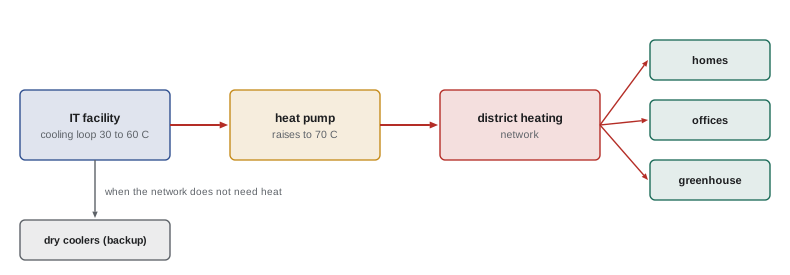
District heating networks distribute hot water through insulated pipes to many buildings from central sources. They are common in Scandinavia, Central and Eastern Europe, and some North American city centers and campuses, and they are the most natural outlet for data center heat, because they can absorb large, steady quantities. Several well-known examples exist: data centers in Stockholm feed the city's network under a program that pays for recovered heat; large facilities in Finland and Denmark supply municipal networks, including a major project in the Helsinki region; and modern "fifth-generation" networks operate at low temperatures, sometimes near ambient, letting each building use its own heat pump and exchange heat with others. Where no network exists, building one is costly and slow, so heat reuse is easiest when a data center is sited near an existing network or a new development planned with one.
Other uses of data center heat
Where district heating is unavailable, other users may be nearby:
- Buildings on the same campus or next door: offices, residential buildings, swimming pools and schools.
- Greenhouses and vertical farms, which need steady warmth year-round in cool climates.
- Aquaculture (fish farming), which benefits from warm water.
- Industrial processes needing low-temperature heat, such as drying of timber, food and biomass.
- Snow melting and de-icing of pavements in cold climates.
Each use has a different temperature requirement, scale and seasonal profile, and many projects combine several users.
Matching supply and demand
Data center heat is steady year-round, while heating demand peaks in winter and falls to domestic hot water levels in summer. As a result, a data center can typically supply only part of its heat to a heating network over a year, unless the network has other year-round loads or seasonal storage. The data center must also be able to reject all its heat itself whenever the network does not need it, because cooling cannot depend on a third party. Heat reuse systems therefore sit alongside, not instead of, normal heat rejection, and the energy reuse factor (ERF, Lesson 2) is usually well below 1.
Worked problem
Estimating reusable heat
A 15 MW (IT) liquid-cooled data center returns coolant at 50 °C. A nearby district heating network needs up to 12 MW in winter, 6 MW in spring and autumn, and 2 MW in summer, each for about a quarter of the year. Ignoring heat pump electricity, about what share of the data center's heat can the network use, and what would the ERF be at PUE 1.15?
Show solution
- Data center heat available: about 15 MW all year (the IT load, plus overheads, but take 15 MW for simplicity).
- Network use: winter 12 MW, spring 6 MW, summer 2 MW, autumn 6 MW, each a quarter of the year: average (12 + 6 + 2 + 6) / 4 = 6.5 MW.
- Share of heat reused: 6.5 / 15 ≈ 43 %.
- Facility energy: 15 × 1.15 = 17.25 MW average; ERF ≈ 6.5 / 17.25 ≈ 0.38.
Answer: About 43 % of the heat can be reused, giving an ERF near 0.38. Adding a year-round user such as a greenhouse or domestic hot water storage would raise it. This illustrates why heat reuse plans need hourly or monthly demand data, not just annual totals.
Business models and contracts
Heat reuse involves at least two parties, the data center and the heat user or network operator, with different priorities. Typical arrangements include the network operator owning and operating the heat pumps and buying heat at a price linked to its alternative fuel costs, or the data center selling heat at the fence. Contracts must address heat quantity and temperature commitments (usually "as available" from the data center's side), liability if heat delivery stops, metering, pricing, the cost of connection, responsibility for the heat pumps, and what happens when the data center changes its cooling technology or load. Public support, such as grants for connections or carbon pricing that raises the value of displaced fossil heat, often makes projects viable.
Regulation and planning
European regulation is pushing heat reuse. The recast EU Energy Efficiency Directive requires large new data centers to assess and, where feasible, use their waste heat, and some member states go further: Germany's Energy Efficiency Act requires new data centers to reuse a rising share of their waste heat over the coming years. Several cities make heat reuse a condition of planning approval.
In the United States, there is no federal requirement for data center heat reuse, and district heating is less common than in Europe, mostly found in older city centers, university campuses and military bases. A few projects use data center heat for campus buildings, greenhouses or nearby developments, and some states and cities are studying requirements or incentives as data center growth draws attention to wasted heat.
Designing for heat reuse
Heat reuse is far easier when planned from the start. Designers can choose sites near existing or planned heat networks or users; select cooling systems with warm return temperatures (liquid cooling, warm-water chilled systems); provide space, pipework connections and heat exchangers for future heat export; meter heat flows; and engage early with municipalities and network operators. Even where no user exists today, a "heat-ready" design with connection points and space for heat pumps keeps the option open for the facility's decades-long life.
Measuring and verifying reused heat
Heat delivered to a network should be metered with calibrated heat meters, which combine flow rate and the temperature difference between supply and return to calculate energy. Metered heat supports billing, the ERF calculation (Lesson 2), and any regulatory or certification claims. Where heat pumps are involved, their electricity use must be metered too, so that the net benefit can be calculated: the fossil heat displaced, minus the emissions from the heat pump's electricity. On a clean grid, the net benefit is large; on a carbon-intensive grid, it depends on the heat pump's COP and on what fuel the network would otherwise burn.
Even where full heat reuse is impractical, smaller steps help: heating the facility's own offices and generator rooms with recovered heat, and preheating domestic hot water, use heat that would otherwise be wasted.
Common mistakes
MistakeAssuming low-temperature air-side heat is directly usable.
InsteadPlan for heat pumps or warmer liquid cooling return temperatures.
MistakeCounting annual heat output as reusable heat.
InsteadMatch supply to seasonal and hourly demand.
MistakeMaking cooling depend on the heat user.
InsteadKeep full heat rejection capacity on site.
MistakeLeaving contracts vague about availability and liability.
InsteadDefine quantities, temperatures, metering, pricing and failure responsibilities.
MistakeIgnoring heat reuse until after construction.
InsteadDesign heat-ready connections and choose sites near users.
Summary and key terms
- Almost all data center energy becomes heat; its low temperature limits direct reuse.
- Liquid cooling provides warmer heat, close to modern district heating temperatures.
- Heat pumps upgrade heat; warmer sources give higher COP and less electricity.
- District heating is the main outlet; greenhouses, buildings and industry are alternatives.
- Seasonal demand limits reusable share; facilities must keep their own heat rejection.
- Contracts and public support determine viability; European rules increasingly require reuse.
- Heat-ready design and siting near users keep the option open.
- Heat reuse
- Using waste heat for a useful purpose outside the data center.
- Low-grade heat
- Heat at relatively low temperature, hard to use directly.
- Heat pump
- A machine using electricity to move heat to a higher temperature.
- District heating
- A network distributing heat from central sources to buildings.
- Fifth-generation network
- A low-temperature network where buildings use their own heat pumps.
- Supply temperature
- The temperature of water delivered by a heating network.
- ERF
- Energy reuse factor: share of energy reused outside the facility.
- Heat-ready design
- Design with provisions for future heat export.
- Seasonal storage
- Storing heat from summer for use in winter.
- Displaced fuel
- The fuel no longer burned because recovered heat is used.
Practice problems
Work each problem on paper first, then reveal the answer to check.
Why is air-side data center heat hard to reuse directly?
Show answer
Its temperature, about 30 to 40 °C, is too low for most heating.
What return temperatures can direct-to-chip liquid cooling provide?
Show answer
About 45 to 60 °C or more.
Estimate the heating COP with η = 0.5, T_hot = 343 K and T_cold = 313 K.
Show answer
0.5 × 343 / 30 ≈ 5.7.
From the output, how much electricity does the heat pump need with 60 °C coolant?
Show answer
About 1.0 MW to deliver 11 MW of heat.
Why does delivered heat exceed source heat?
Show answer
The compressor's electricity is added as heat.
Name three non-district-heating uses of data center heat.
Show answer
Greenhouses, nearby buildings, aquaculture, industrial drying, snow melting.
Why must a data center keep its own heat rejection?
Show answer
Cooling cannot depend on the heat user's demand or availability.
In the example, what share of heat is reused?
Show answer
About 43 %.
Name three items a heat reuse contract should cover.
Show answer
Quantities and temperatures, liability, metering, pricing, connection costs, equipment responsibility.
What does a heat-ready design include?
Show answer
Connection points, space for heat pumps and exchangers, warm return temperatures, metering.
Lesson quiz · 5 questions
Score 60% or more to complete this lesson.
Create a free account to save your progress, take quizzes and earn a certificate.